
Now You're Talking: Soap Box
Bert Striegler
THE GREATEST PROBLEM that we face in the AMA today is attracting youth into model building. They are the next generation of modelers. If we do not somehow attract youngsters to the thrill and excitement of model aviation, there may not be a "next generation." Ample evidence of this problem is all around us.
At the 1994 AMA Nationals at Lubbock, Texas, the facilities were excellent and the city of Lubbock went all out to make things pleasant and the contest was run efficiently, but the turnout just gets lower every year. I was struck by the age of the contestants. There were very few youngsters in attendance, and this has been the trend for many years.
Whatever happened to the Juniors? Is it that aviation is no longer exciting to them? Would they rather just watch TV? Are they somehow different than we were back in the good old days? Are they too lazy to build things for themselves? A recent experiment here in the little town of Brady, Texas, was a real eye-opener for me, and I hope it will be for you.
Finding the juniors
We found the Juniors! They were right here all along, right under our noses. The best part is that they look and act a lot like we did at that age. The big difference is that we were constantly exposed to model aviation from a lot of different directions. Model airplane building was part of growing up, and kids were encouraged to participate. Manufacturers and magazines catered to the youthful model builder, and a bewildering array of inexpensive kits was available. We even had comic books about model building.
Kids today have the interest, but are exposed to the hobby in a very different way. Model building is presented as a very sophisticated, highly technical hobby that costs a fortune to pursue. Manufacturers and publishers cater to the top end of the hobby, and you can't blame them for that. To be honest, much of what we read about now is also beyond my grasp, and I have been an active model builder for more than 55 years. In our little town, there is no model shop and there is no way a youngster can buy a model magazine to even see what it is all about. The nearest model shop is 75 miles away, but even in the cities, most kids have never been into a model shop. Kids just do not represent the mainstream of the market anymore.
Tom Bishop asked me if I would do a short program on model airplanes for the monthly meeting of his Cub Scout Pack #424. I told him that I would be glad to do this. He suggested that 20 or so would be appropriate. It lasted a lot longer — in fact, nearly three months.
I prepared a talk about the scope and history of model aviation and took enough models to illustrate the types of flying that can be accomplished — for example, an RC trainer, a control-line model, a glider, an advanced RC fun-flyer, free flight, and a large selection of model engines past and present. Most important, I took an example, the AMA Cub (Delta Dart), and invited the kids to handle the model, try the controls and ask questions. They wanted to. I believe they asked a lot of questions and even flew the Cub around the room just to show what they liked. The interest was obvious, and it was equally obvious that it could be carried another step forward.
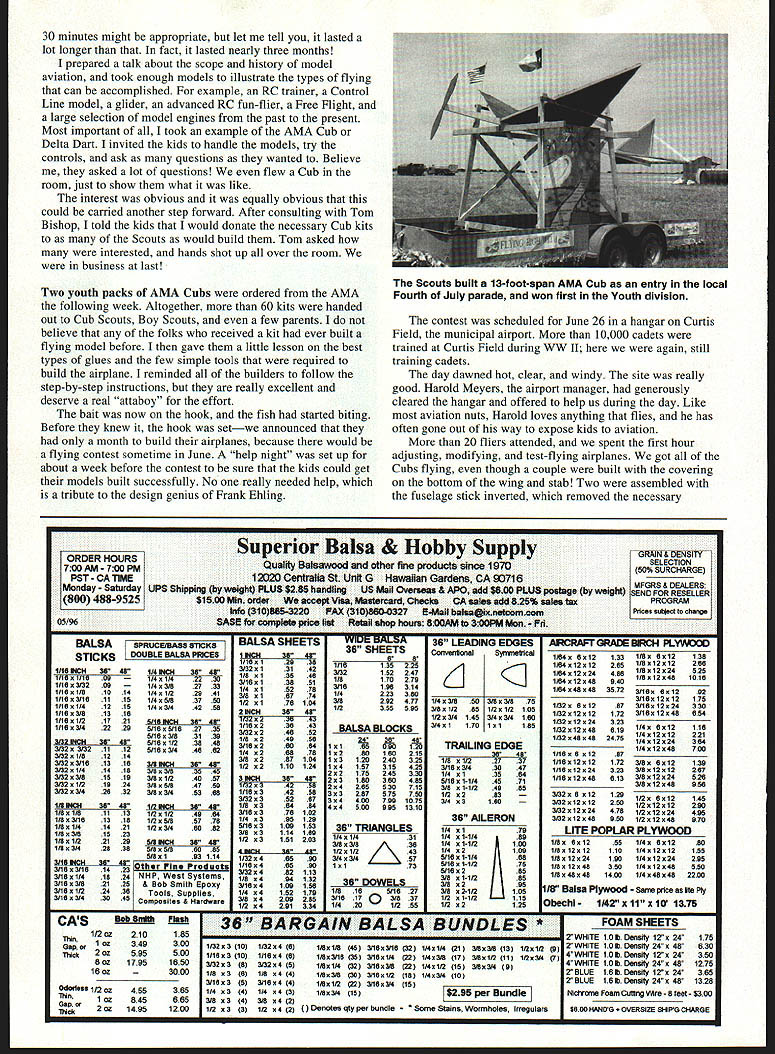
After consulting, Tom Bishop told me that if I would donate the necessary Cub kits the Scouts would build them. Tom asked who was interested and hands shot up all over the room. Business was under way. Two youth packs ordered AMA Cubs the following week. Altogether, 60 kits were handed out to Cub Scouts, Boy Scouts and a few parents. Hardly anyone who received a kit had ever built and flown a model before. I gave a little lesson on the best types of glues and a few simple tools required to build the airplane, and reminded the builders to follow the step-by-step instructions. The work was really excellent and deserved a real attaboy. The bait had taken — now the fish started biting.
Building and the parade
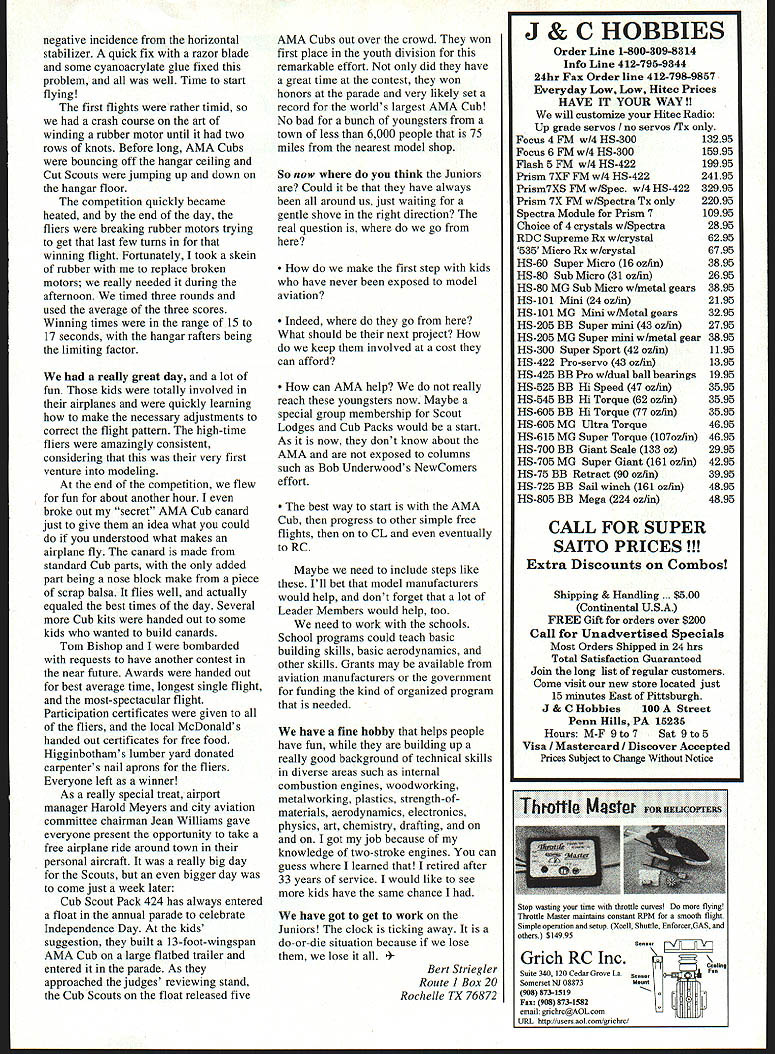
Before we knew it the hook was set. We announced a month to build the airplanes because we would have a flying contest sometime in June. To help, one night we set up about a week before the contest to make sure the kids could get their models built successfully. We really didn't need much help, which is a tribute to the design genius of Frank Ebling. The Scouts built a 13-foot-span AMA Cub entry in the local Fourth of July parade and won first in the youth division.
The contest at Curtis Field
The contest was scheduled June 26 in the hangar at Curtis Field municipal airport. Ten thousand cadets trained at Curtis Field during WWII, and it is again still training cadets today. The day dawned hot, clear and windy but the site was really good. Harold Meyers, airport manager, generously cleared the hangar and offered to help us during the day. Like any aviation nut, Harold loves anything that flies and has often gone out of his way to expose kids to aviation.
Twenty fliers attended and spent the first hour adjusting, modifying and test-flying airplanes. We got the Cubs flying, though a couple were built with the covering on the bottom of the wing and stabilizer. Two had the fuselage stick assembled inverted, which removed the necessary negative incidence from the horizontal stabilizer. A quick fix with a razor blade and some cyanoacrylate glue fixed this problem, and all was well. Time to start flying!
The first flights were rather timid, so we had a crash course on the art of winding a rubber motor until it had two rows of knots. Before long, AMA Cubs were bouncing off the hangar ceiling and Cub Scouts were jumping up and down on the hangar floor.
The competition quickly became heated, and by the end of the day the fliers were breaking rubber motors trying to get that last few turns in for a winning flight. Fortunately, I took a skein of rubber with me to replace broken motors; we really needed it during the afternoon. We timed three rounds and used the average of the three scores. Winning times were in the range of 15 to 17 seconds, with the hangar rafters being the limiting factor.
We had a really great day, and a lot of fun. Those kids were totally involved in their airplanes and were quickly learning how to make the necessary adjustments to correct the flight pattern. The high-time fliers were amazingly consistent, considering that this was their very first venture into modeling.
At the end of the competition, we flew for fun for about another hour. I even broke out my "secret" AMA Cub canard just to give them an idea what you could do if you understood what makes an airplane fly. The canard is made from standard Cub parts, with the only added part being a nose block made from a piece of scrap balsa. It flies well, and actually equaled the best times of the day. Several more Cubs were handed out to some kids who wanted to build canards.
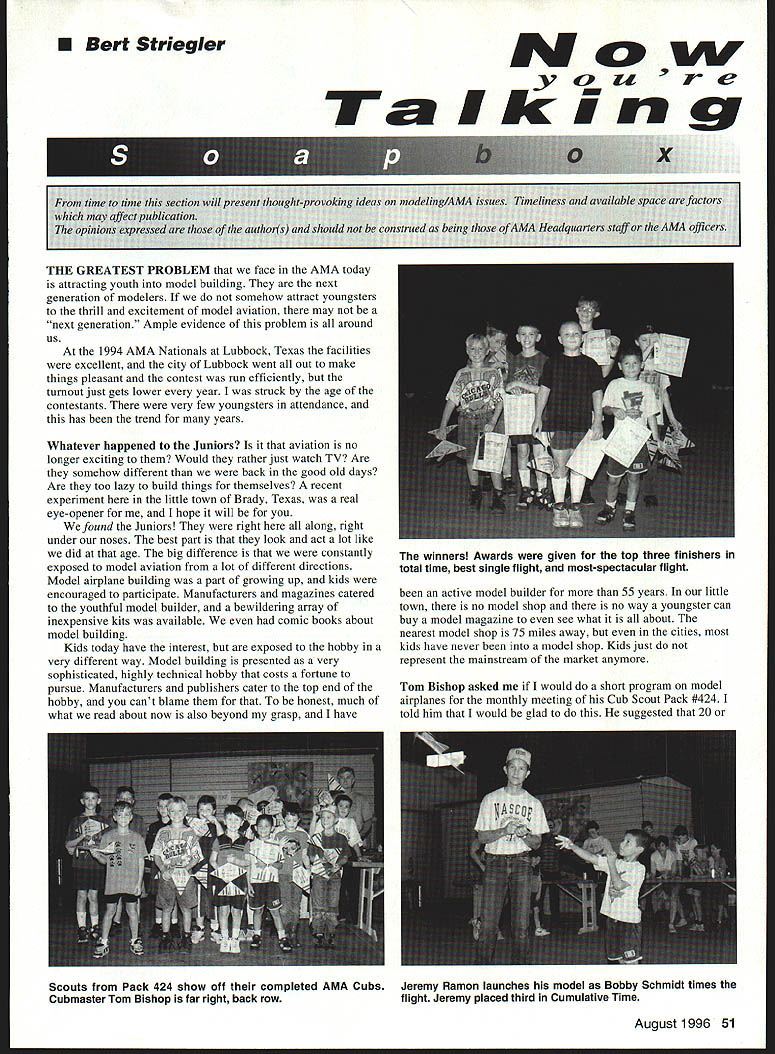
Tom Bishop and I were bombarded with requests to have another contest in the near future. Awards were handed out for best average time, longest single flight, and the most-spectacular flight. Participation certificates were given to all of the fliers, and the local McDonald's handed out certificates for free food. Higginbotham's lumber yard donated carpenter's nail aprons for the fliers. Everyone left as a winner!
As a really special treat, airport manager Harold Meyers and city aviation committee chairman Jean Williams gave everyone present the opportunity to take a free airplane ride around town in their personal aircraft. It was a really big day for the Scouts, but an even bigger day was to come just a week later.
Cub Scout Pack 424 has always entered a float in the annual parade to celebrate Independence Day. At the kids' suggestion, they built a 13-foot-wingspan AMA Cub on a large flatbed trailer and entered it in the parade. As they approached the judges' reviewing stand, the Cub Scouts on the float released five AMA Cubs out over the crowd. They won first place in the youth division for this remarkable effort. Not only did they have a great time at the contest, they won honors at the parade and very likely set a record for the world's largest AMA Cub! Not bad for a bunch of youngsters from a town of less than 6,000 people that is 75 miles from the nearest model shop.
Where do we go from here?
So now where do you think the Juniors are? Could it be that they have always been all around us, just waiting for a gentle shove in the right direction? The real question is, where do we go from here?
- How do we make the first step with kids who have never been exposed to model aviation?
- Where do they go from here? What should be their next project? How do we keep them involved at a cost they can afford?
- How can AMA help? We do not really reach these youngsters now. Maybe a special group membership for Scout lodges and Cub Packs would be a start. As it is now, they don't know about the AMA and are not exposed to columns such as Bob Underwood's NewComers effort.
The best way to start is with the AMA Cub, then progress to other simple free flights, then on to control line and even eventually to radio control. I'll bet that model manufacturers would help, and don't forget that a lot of Leader Members would help, too.
We need to work with the schools. School programs could teach basic building skills, basic aerodynamics, and other skills. Grants may be available from aviation manufacturers or the government for funding the kind of organized program that is needed.
We have a fine hobby that helps people have fun while they are building up a very good background of technical skills in diverse areas such as internal combustion engines, woodworking, metalworking, plastics, strength-of-materials, aerodynamics, electronics, physics, art, chemistry, drafting, and on and on. I got my job because of my knowledge of two-stroke engines. You can guess where I learned that! I retired after 33 years of service. I would like to see more kids have the same chance I had.
We have got to get to work on the Juniors! The clock is ticking away. It is a do-or-die situation because if we lose them, we lose it all.
Bert Striegler Route 1 Box 20 Rochelle, TX 76872
Transcribed from original scans by AI. Minor OCR errors may remain.

