
Nuremberg '85
Overview
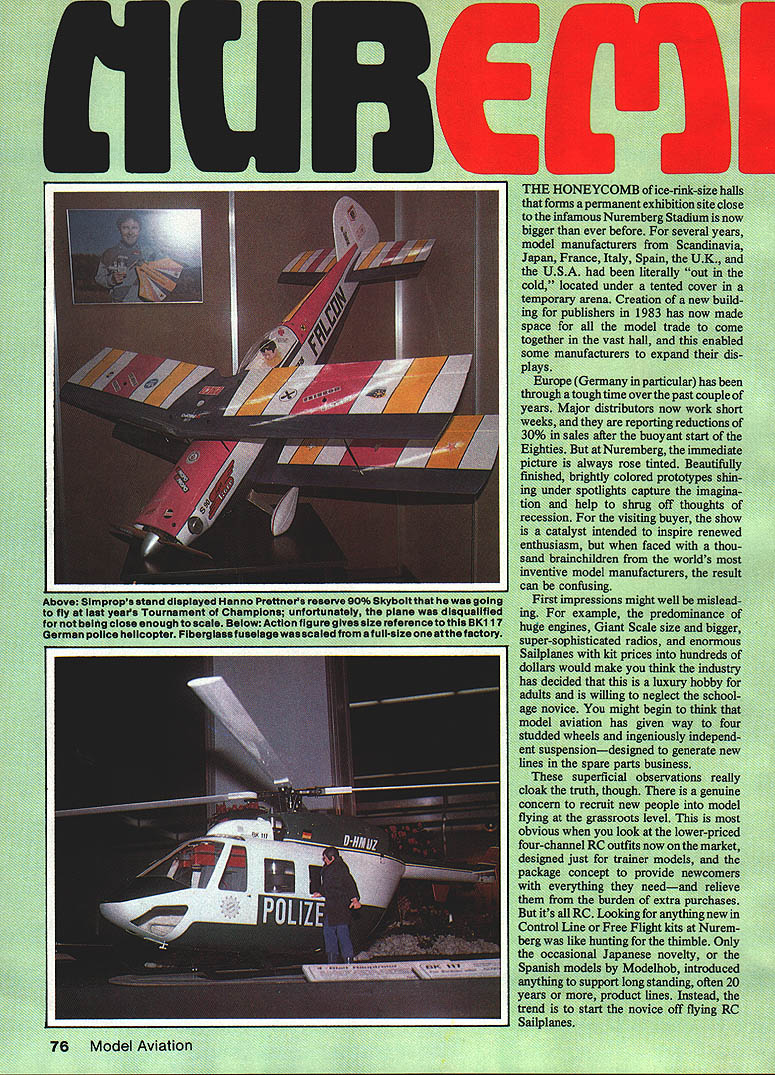
The honeycomb of ice-rink-size halls that forms a permanent exhibition site close to the infamous Nuremberg Stadium is now bigger than ever. For several years model manufacturers from Scandinavia, Japan, France, Italy, Spain, the U.K., and the U.S.A. had been literally "out in the cold," located under a tented cover in a temporary arena. Creation of a new building for publishers in 1983 has now made space for all the model trade to come together in the vast hall, enabling some manufacturers to expand their displays.
Europe (Germany in particular) has been through a tough time over the past couple of years. Major distributors now work shorter weeks and report reductions of 30% in sales after the buoyant start of the Eighties. But at Nuremberg the immediate picture is always rose-tinted. Beautifully finished, brightly colored prototypes shining under spotlights capture the imagination and help to shrug off thoughts of recession. For the visiting buyer, the show is a catalyst intended to inspire renewed enthusiasm, but when faced with a thousand brainchildren from the world's most inventive model manufacturers, the result can be confusing.
Trends
First impressions might be misleading. The predominance of huge engines, Giant Scale models and larger, super-sophisticated radios, and enormous sailplanes with kit prices into the hundreds of dollars might suggest the industry has decided this is a luxury hobby for adults and is willing to neglect the school-age novice. You might begin to think model aviation has given way to four studded wheels and ingeniously independent suspension—designed to generate new lines in the spare parts business.
Those superficial observations mask the truth. There is a genuine concern to recruit new people into model flying at the grassroots level. This is most obvious in the lower-priced four-channel RC outfits now on the market, designed for trainer models, and in package concepts that provide newcomers with everything they need—relieving them of the burden of extra purchases. But it's all RC: looking for anything new in Control Line or Free Flight kits at Nuremberg was like hunting for the thimble. Only the occasional Japanese novelty, or Spanish models by Modelhob, introduced anything to support long-standing product lines. Instead, the trend is to start novices off flying RC sailplanes.
Highlights by Manufacturer
#### Aeronaut
- Reputation for well-engineered kits; Aerofly continues to be a highly recommended Electro-Soarer.
- New: a four-meter SHK V-tail Scale Sailplane (about 13 ft. 1.5 in.), priced around $150 — an enviable soarer.
#### Bauer Modelle
- Many German glider kits in this span; their Variant program is an ingenious interchangeable system with seven designs.
- Features: interchangeable fuselage, wing, and tail components; swappable RC panel and canopy.
- Wings vary in span and airfoil from Wortmann FX-60-100 (speed) to MVA 164 (duration).
- Construction: ARF with ready-made units.
- Novelty: Variant Kranich, a twin-boom type with an electric power option.
- Also notable for ducted-fan He 162 and Douglas A-4 models that always look fresh.
#### Eismann
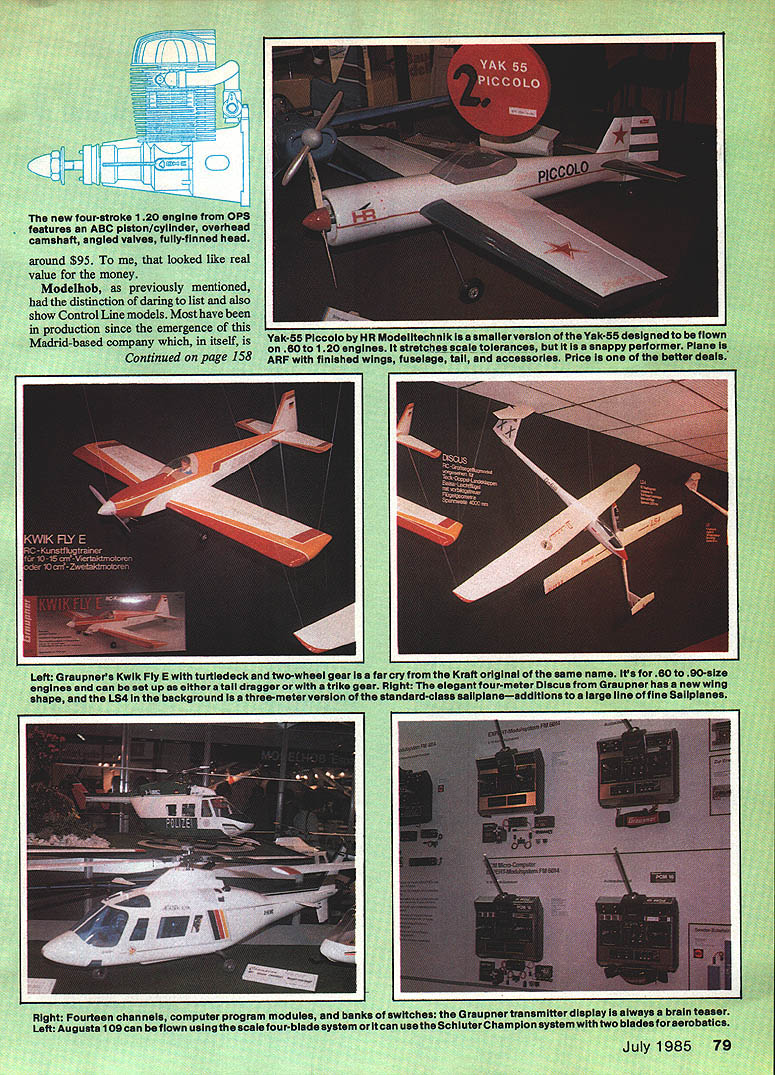
- Known for clean, purposeful ARF gliders.
- 1985 innovation: new T-tail and fuller fuselage for the Playboy and Pioneer models (previously had a thin-boom "tadpole" look).
- Both kits convertible to electric with 8–12 cells.
- High-mounted wing with Eppler 387 airfoil; optional clipped-span wing with NACA 0011 for aerobatics.
#### Graupner
- Bold program aimed at novices.
- Introduced three HL gliders and a 4 ft. 3 in. Fun Fly training glider that borrows details from the earlier Amigo.
- LS4 and LS6 duo use the same fuselage design.
- Introduced the Discus, a four-meter model with multi-taper wing shape in the Schempp-Hirth style.
- Kwik Fly: a stock four-channel sport design, more akin to the Bar-Fly.
- Other kits: Scale ultralight (Chinook by Birdman of Edmonton, for .40 engines) and Hughes 500E using Helimax mechanics.
- Electronics: added the FM 4014 by JR (up to 14 channels) to their module-system RC units; D4 set offers servo reversing and single-side servo throw, in 27, 35, and 40 MHz.
#### HR Modelltechnik
- Horst Rabel's kit company that pairs with Bauer.
- New: 7 ft. 3 in. Yak-55 for .30–.32 engines (contest-winning), available ready-made.
- Newer: 5 ft. Piccolo for 1.20 FS engines, with finished wings, fuselage, tail surfaces, and accessories — good value at around $95.
#### Modelhob
- Madrid-based company notable for listing and showing Control Line models.
- Range includes FAI Combat, an RC Tucano for .40s, Club 20 pylon racers, and F3B contest sailplanes.
- Highlights: stretched Northrop F5 for CL stunt, and the Lancero (8 ft. 6 in. RC sailplane) for tow launching; Lancero has the wing plan printed on the inside surface sheeting.
#### Engine Manufacturers / OPS
- Four-stroke performance improving and FAI recognition of up to 20 cc (1.2 cu. in.) in FAI aerobatics influencing design.
- OPS introduced an overhead camshaft, angled-valve ABC engine with a fully-finned head — appears like a low-ported two-stroke but promises 6,500–12,000 rpm.
#### Prazise Modellbau
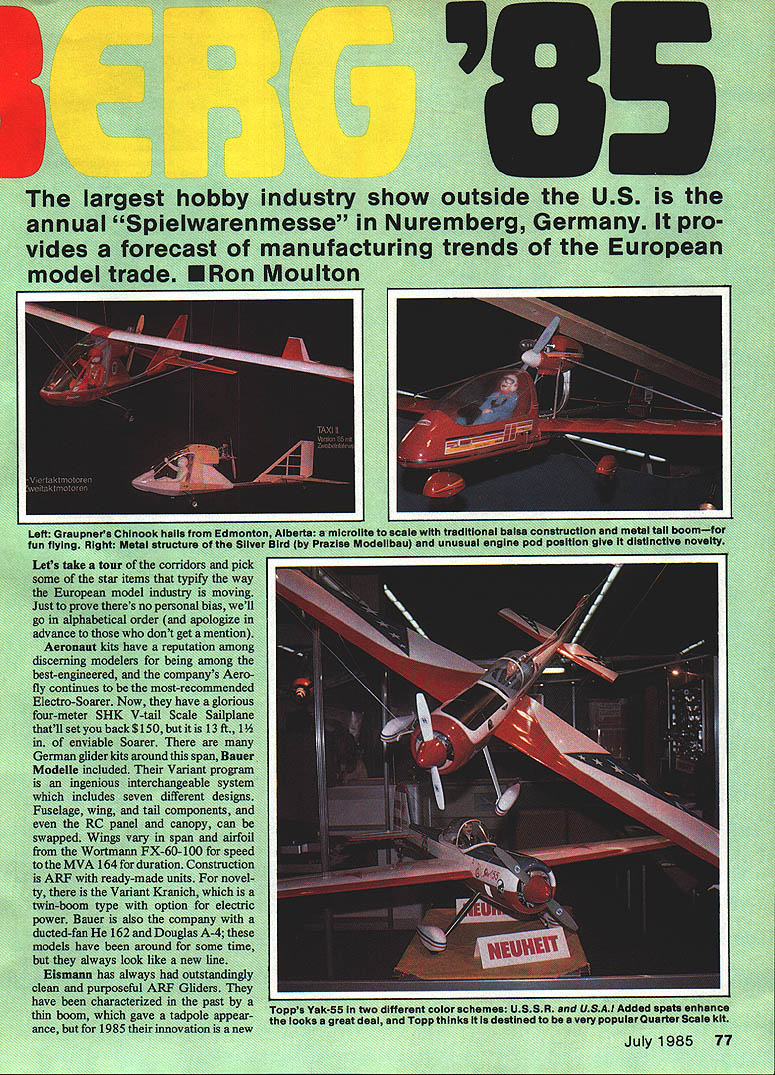
- Known for fancy metalwork and mixed-construction microlights.
- Weekend Flyer microlight for .60s; new Grasmucker for .19–.40 engines.
- Introduced Silver Bird: high-mounted, mid-engine (.60–.90), pod-and-boom fuselage with "Ganzmetall-Bauweise" (all-metal construction).
- Company bets on aluminum construction as an acceptable alternative to traditional wood kits.
#### Robbe
- Expanding in the U.S. with packaged Robby marketing: introductory kit, motor, and RC packages for boats, cars, and a new sailplane.
- New sailplane: RC Start, 7 ft. 9 in. span, molded fuselage in Plas and wing panels in Siros; recommended power: Enya .09 on a pylon tank mount.
- Starter pack includes charger for RC battery and is priced competitively versus buying items separately.
- New trainers: Windy (7 ft. motor glider) available with .09 two-stroke, .21 four-stroke, or Le Mans 360 electric motors with gearbox.
- Robbe also offers Starmax and Le Mans ranges.
#### Rodelmodellbau
- New 9 ft. 4 in. sailplane that converts to electric, marketed under the name Okay.
- New 7 ft. 6 in. tail-dragging cabin sportster called the Mule; can be piggybacked with the Okay for air-launching.
- Mule: tough construction with pre-formed ply sides and veneered Eppler 205 wings with Dornier swept tips; recommended engine ~1.2 cu. in.
#### Simprop / Technicall
- Simplified RC: Star 8 four-channel FM ultra-narrow-band set for 35 or 40 MHz.
- Suits package deals with the Technicall-produced SE10 trainer kit.
- Technicall offering a summer contest with a cup and $5,500 prize (plus other awards) for SE10/Star 8 combos — purchase price $145.
- Simprop revealed the first SuperTiger four-stroke powerplant: a big 1.82 S2000-304T, resembling the 2000 two-stroke (and new 3000).
- Also added a .90 WSM two-stroke to their range. ("La più vasta gamma di motori," as the claim.)
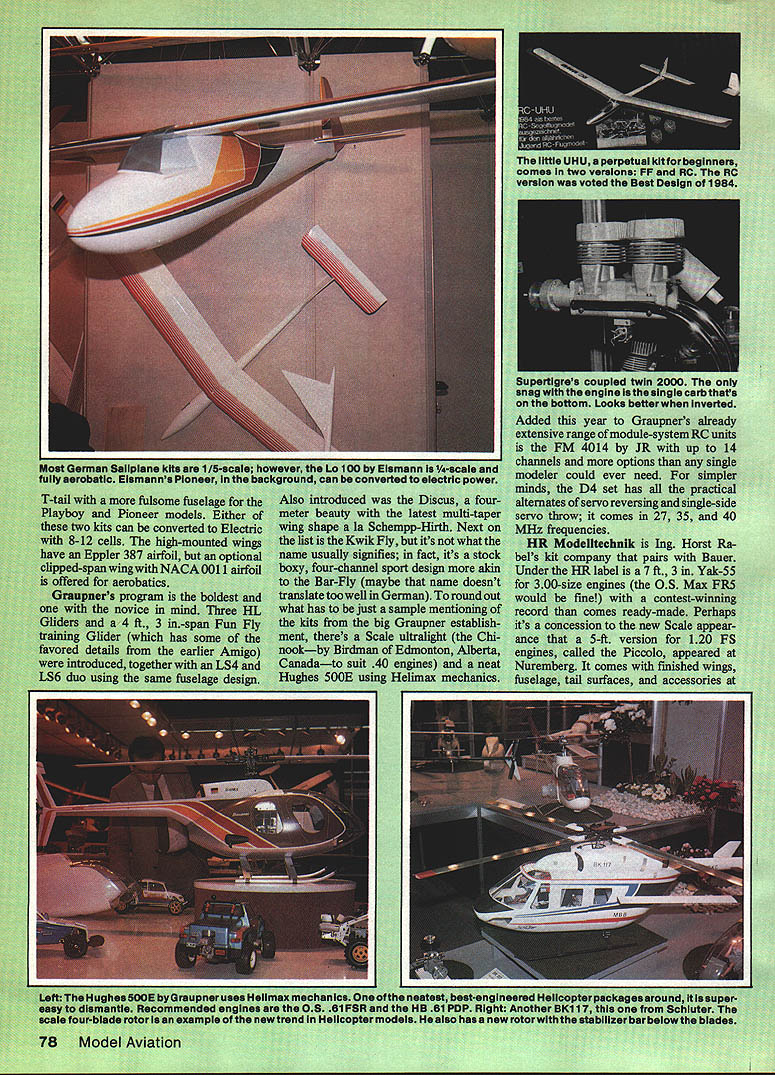
#### Topp / Topps
- Known for eye-catching, pre-molded big models.
- 1985 highlights: Wolfgang Matt’s Joker (available with fixed gear or retracts) and a stubby Yak 55 in scale finish (with spats), including a novelty stars-and-stripes version.
- Kit price quoted around $200 ex Ischhorn.
#### Wilk Modelle (Wilf Klingner)
- Added classic 1/5-scale sailplanes: Orlice (11 ft. 6 in. span) and the Standard Libelle (10 ft. 2 in.), bringing a trio of classic 1/5-scale sailplanes to the range.
- Wilf Klingner produced a Grob G109B model to the same scale and a G-111 Observer version with additional detailing.
- Full-size Grob motor-glider has a glide ratio of 1:28; the model (11 ft. 5 in.) suits a .40 two-stroke or preferably a .60 four-stroke.
#### Dieter Schluter (Helicopters)
- Since the World Championships at Doylestown and the Toledo RC expositions, Schluter has steadily promoted helicopters.
- Expanded list of designs and mechanics; for 1985 introduced a rotor with stabilizer bar below the blades and a multi-blade spider for three, four, or five blades.
- New models include the Long Ranger III, the BK117, and a non-scale Champion aerobatic helicopter.
- Schluter's expansion is notable; his stand was a strong contender for an accolade for effort.
Summary
Nuremberg defies the pessimism surrounding general world trade. The hobby sections (railroading was the biggest) reflect imagination and the ability to continuously advance manufacturing and marketing standards. The only danger is apathy at the customer level. On the 1985 showing, model aviation appears to be on its way up again, and the powerful dollar will possibly bring more of these European items into the U.S.
Transcribed from original scans by AI. Minor OCR errors may remain.

