
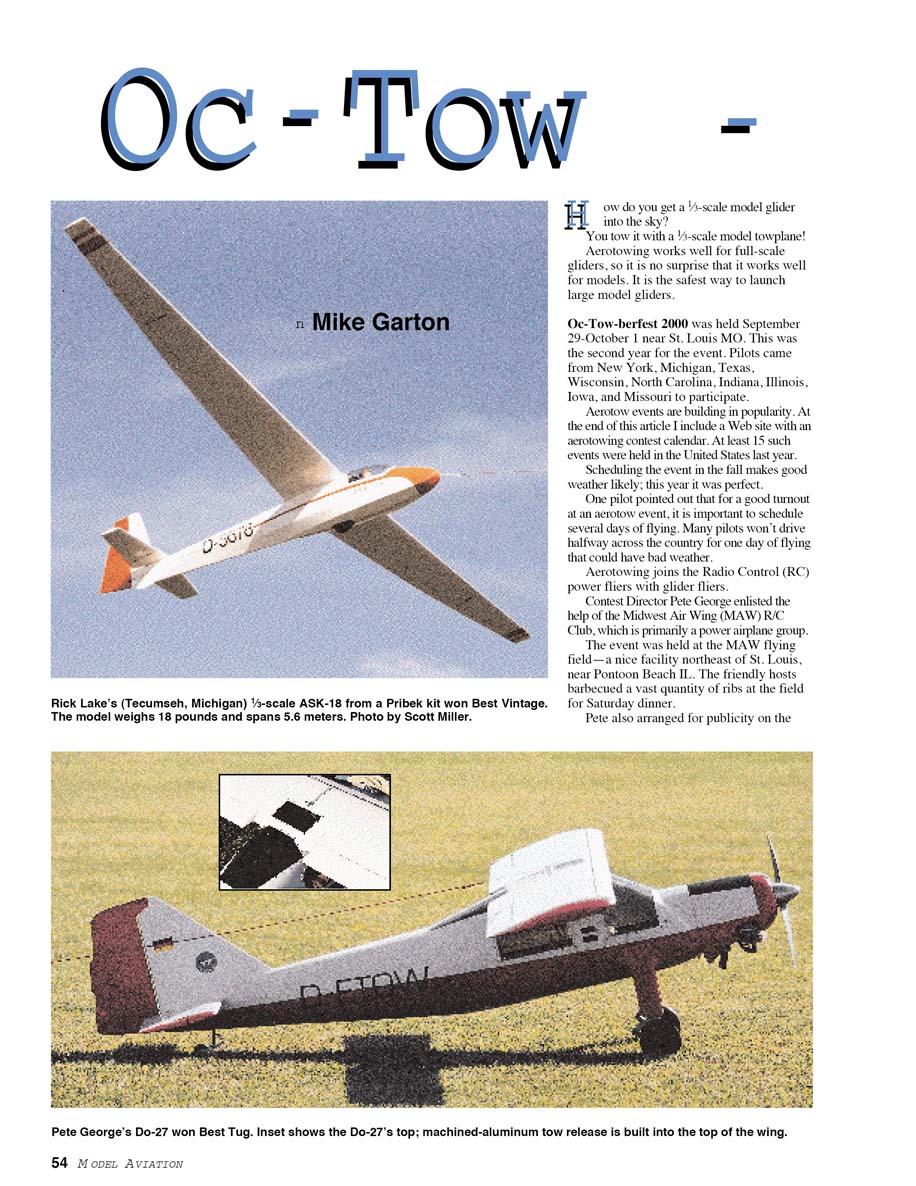
Oc-Tow-berfest
by Mike Garton
Event overview
How do you get a 1/3-scale model glider into the sky? You tow it with a 1/3-scale model towplane. Aerotowing works well for full-scale gliders, so it is no surprise that it works well for models. It is the safest way to launch large model gliders.
Oc-Tow-berfest 2000 was held September 29–October 1 near St. Louis, MO. This was the second year for the event. Pilots came from across the United States to participate.
Participants and weather
Pilots attended from:
- New York
- Michigan
- Texas
- Wisconsin
- North Carolina
- Indiana
- Illinois
- Iowa
- Missouri
Scheduling the event in the fall makes good weather likely; this year it was perfect. One pilot pointed out that for a good turnout at an aerotow event, it is important to schedule several days of flying. Many pilots won’t drive halfway across the country for one day of flying that could have bad weather.
Aerotowing joins radio-control (RC) power fliers with glider fliers. Contest Director Pete George enlisted the help of the Midwest Air Wing (MAW) R/C Club, a power-airplane group. The event was held at the MAW flying field—a nice facility northeast of St. Louis, near Pontoon Beach, IL. The friendly hosts barbecued a vast quantity of ribs at the field for Saturday dinner. Pete also arranged television-news publicity. The event ran very smoothly.
The contest was basically a fun-fly. Pilots flew as often as they wanted by grabbing the frequency pin and putting their airplanes in line for a tow. This is a low-key, low-stress format. Pilots’ Choice awards were given; no scale documentation was required. The three categories were Best Vintage, Best Modern, and Best Tug.
The German connection
Full-scale and model glider flying is very popular in Germany. The number of model manufacturers and pilots is disproportionately large for the country’s population. High-quality large-scale glider kits are common there. Not only can you buy a model of your favorite full-scale airplane, you can probably find it in several sizes.
Most large-scale gliders flown in the U.S. have been imported from Germany, and the typical level of prefabrication is very high—these kits are almost ready-to-fly (ARF). White gel–coated fiberglass fuselages are the norm. The relatively inexpensive kits have foam-core wings presheeted with obechi veneer.
Fiberglass hollow molded wings are becoming common on high-end models. These wings are laid up in female molds. Unlike fiberglass fuselages, the wing skins are a sandwich of fiberglass, high-density foam or balsa, and fiberglass. A carbon-spar structure is used in addition to the fiberglass sandwich skins—this is the same construction method used with modern full-scale gliders.
Awards and notable aircraft
There was no cutoff year for Vintage. Glass-slipper style gliders were considered Modern; fabric-covered open structures were Vintage. ASK-18s fit into Vintage because the full-scale gliders use a fabric-covered fuselage.
Best Vintage
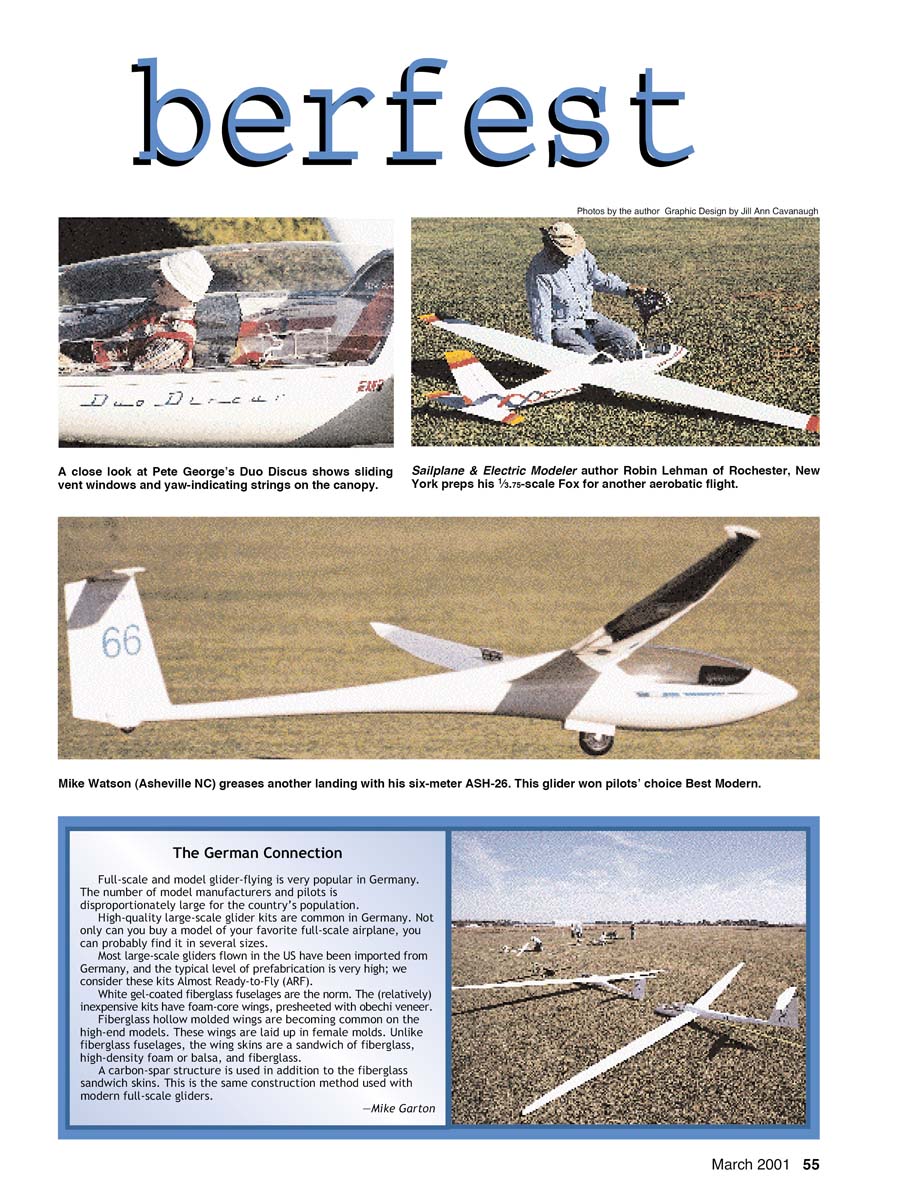
Rick Lake (Tecumseh, MI) won Best Vintage. His ASK-18 kit was manufactured by Pribek. The 1/3-scale model had an 18½-foot span and weighed 20 pounds.
Best Modern
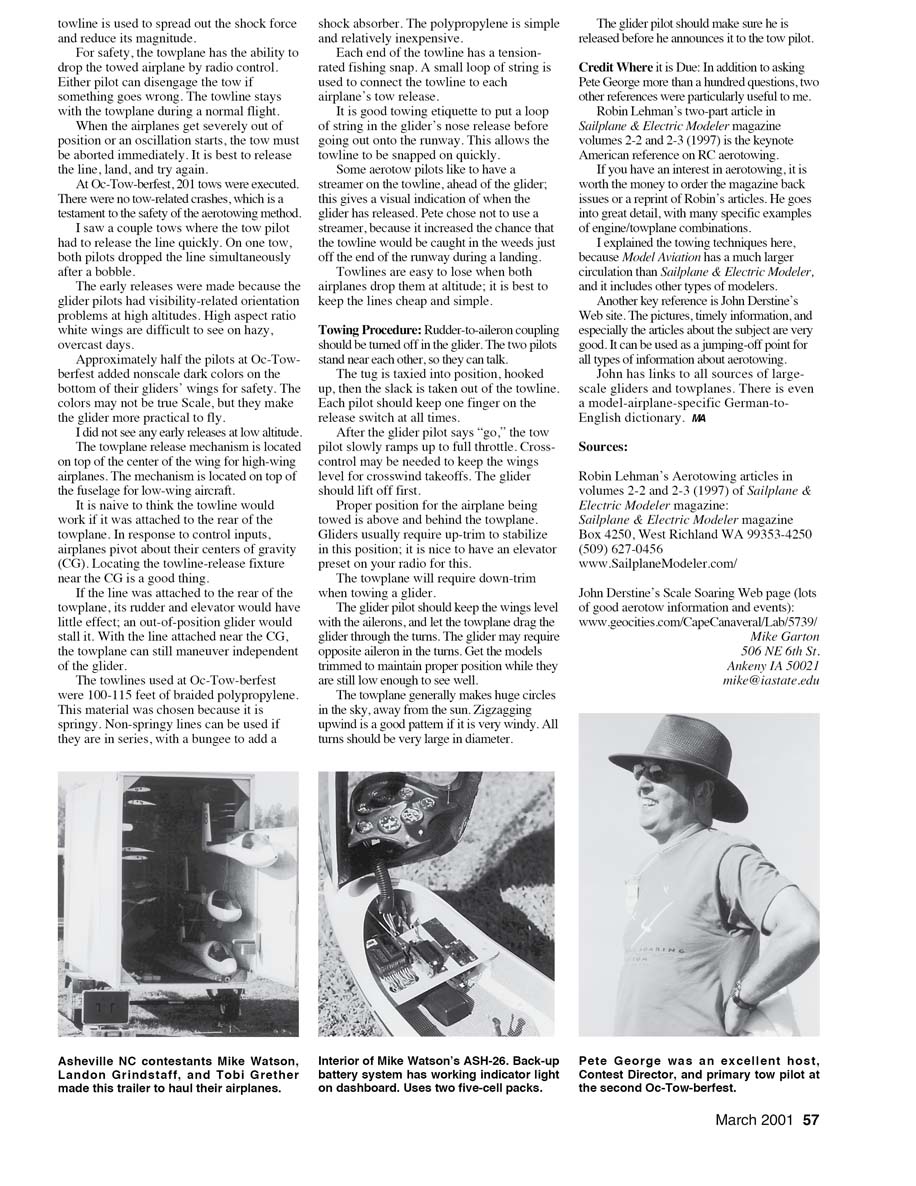
Mike Watson (Asheville, NC) won Best Modern with his ASH-26, all-molded by Schuller. The model had a six-meter span (1/3 scale). Mike reported that it took 40–50 hours to install the radio and detail the cockpit. He used two five-cell battery packs and a battery-backup system; the five-cell pack gives servos more speed and power and corrects for average voltage drop over long runs to the wing. Aileron servo leads in an airplane this size should be eight to ten feet long.
Best Tug
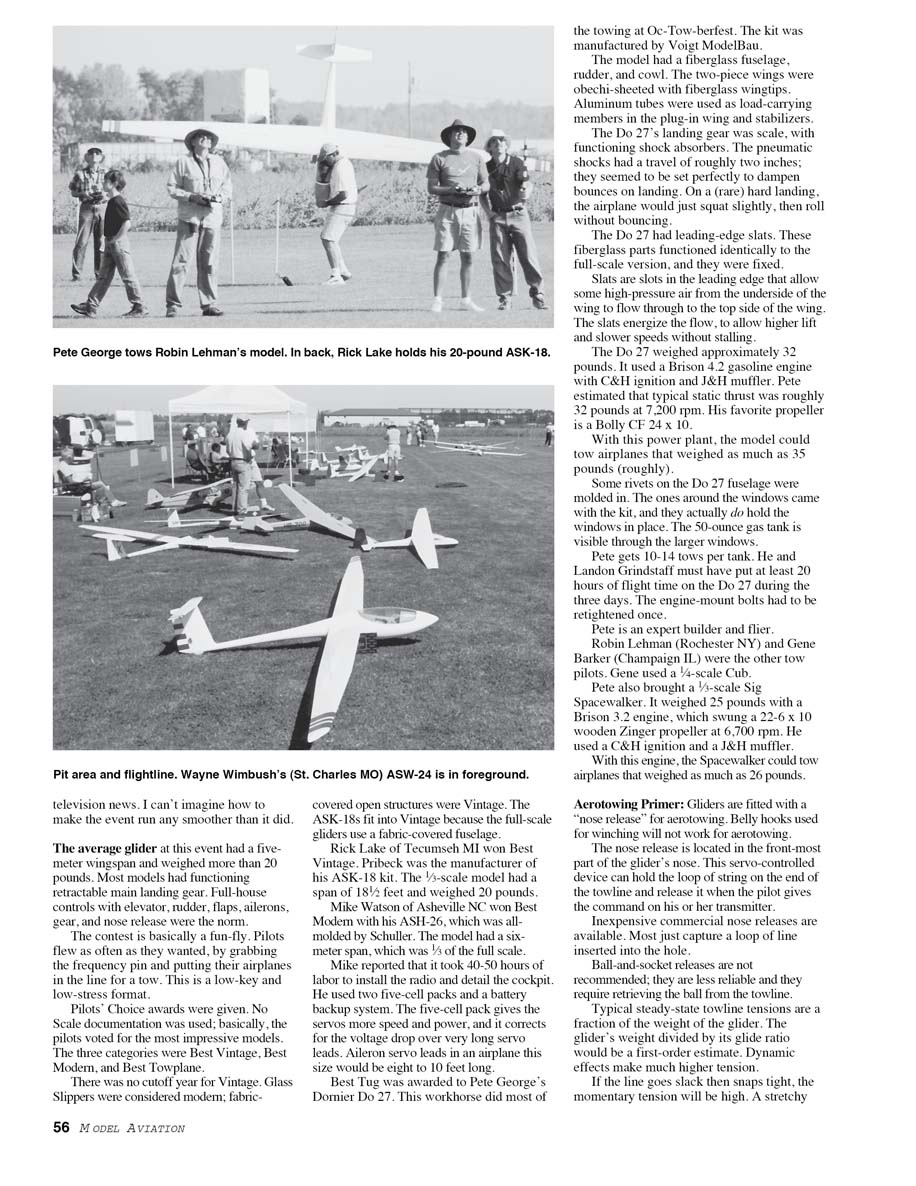
Best Tug was awarded to Pete George’s Dornier Do 27. This workhorse performed most of the towing at Oc-Tow-berfest. The kit was manufactured by Voigt ModelBau.
Notable features of Pete’s Do 27:
- Fiberglass fuselage, rudder, and cowl
- Two-piece obechi-sheeted wings with fiberglass wingtips
- Aluminum tubes used as load-carrying members in the plug-in wing and stabilizers
- Scale landing gear with functioning pneumatic shock absorbers (about two inches of travel), which dampened bounces on landing
- Fixed leading-edge slats that function like the full-scale version
The Do 27 weighed approximately 32 pounds and used a Brison 4.2 gasoline engine with C&H ignition and a J&H muffler. Pete estimated static thrust at roughly 32 pounds at 7,200 rpm. His favorite propeller is a Bolly CF 24 x 10. With this powerplant, the model could tow airplanes up to roughly 35 pounds.
Some rivets around the windows were molded in and actually hold the windows in place. The 50-ounce gas tank is visible through the larger windows. Pete gets 10–14 tows per tank. He and Landon Grindstaff logged at least 20 hours on the Do 27 over the three days; the engine-mount bolts needed retightening once. Pete is an expert builder and flier.
Other tow pilots were Robin Lehman (Rochester, NY) and Gene Barker (Champaign, IL); Gene used a 1/4-scale Cub. Pete also brought a 1/3-scale Sig Spacewalker that weighed 25 pounds with a Brison 3.2 engine, swinging a 22.5 x 10 wooden Zinger propeller at 6,700 rpm (C&H ignition, J&H muffler). With that engine, the Spacewalker could tow up to about 26 pounds.
Aerotowing primer
Nose releases
Gliders are fitted with a "nose release" for aerotowing. Belly hooks used for winching will not work for aerotowing. The nose release is located in the front-most part of the glider’s nose. This servo-controlled device holds the loop of string on the end of the towline and releases it on command from the glider pilot’s transmitter.
- Inexpensive commercial nose releases are available; most capture a loop of line through a hole.
- Ball-and-socket releases are not recommended; they are less reliable and require retrieving the ball from the towline.
Towline and hardware
Typical steady-state towline tensions are a fraction of the glider’s weight; a first-order estimate is the glider’s weight divided by its glide ratio. Dynamic effects can produce much higher tensions. If the line goes slack then snaps tight, momentary tension will be high. A stretchy shock cord will absorb some of the shock, but the release mechanism must be robust.
Recommendations from Oc-Tow-berfest:
- Use a strong towline—400-lb-test Spectra line was used by some.
- Use swivels at both ends to avoid twisting.
- Consider a short section of heavier cable or reinforced line near the glider release to prevent chafing or breakage.
- The towlines at Oc-Tow-berfest were 100–115 feet of braided polypropylene. This material was chosen because it is springy. Non-springy lines can be used if placed in series with a bungee to add shock absorption.
- Each end of the towline should have a tension-rated fishing snap. Use a small loop of string to connect the towline to each airplane's tow release.
- It is good towing etiquette to put a loop of string in the glider's nose release before going out onto the runway so the towline can be snapped on quickly.
- Some pilots add a streamer on the towline ahead of the glider to indicate release; Pete chose not to use a streamer because it can catch in weeds during landing.
Towlines are easy to lose when both airplanes drop them at altitude; keep the lines cheap and simple.
Towplane release location and mechanics
The towplane release mechanism is located:
- On top of the center of the wing for high-wing airplanes.
- On top of the fuselage for low-wing aircraft.
Locate the towline-release fixture near the towplane’s center of gravity (CG). Airplanes pivot about their CG in response to control inputs; placing the release near the CG allows the towplane to maneuver independently of the glider. If the line were attached to the rear of the towplane, the rudder and elevator would have little effect and an out-of-position glider could stall the tug.
Towing procedure and trim
- Turn off rudder-to-aileron coupling in the glider.
- The two pilots stand near each other so they can talk.
- Taxi the tug into position, hook up, and take out the slack in the towline.
- Each pilot should keep one finger on the release switch at all times.
- After the glider pilot says "go," the tow pilot slowly ramps up to full throttle. Cross-control may be needed for crosswind takeoffs; the glider should lift off first.
- Proper position for the glider is above and behind the towplane. Gliders usually require up-trim to stabilize in this position; it is useful to have an elevator preset on your radio for towing.
- The towplane will require down-trim when towing a glider.
- The glider pilot should keep the wings level with ailerons and let the towplane drag the glider through turns. The glider may require opposite aileron in turns.
- Get the models trimmed to maintain proper position while they are still low enough to see well.
- The towplane generally makes very large circles, away from the sun. Zigzagging upwind is a good pattern if it is very windy. All turns should be very large in diameter.
- The glider pilot should be sure he is released before announcing it to the tow pilot.
Safety and etiquette
- For safety, the towplane must be able to drop the towed airplane by radio control. Either pilot can disengage the tow if something goes wrong. The towline stays with the towplane during a normal flight.
- When airplanes get severely out of position or an oscillation starts, abort the tow immediately: release the line, land, and try again.
- At Oc-Tow-berfest, 201 tows were executed with no tow-related crashes—a testament to the safety of aerotowing with proper equipment and procedures.
- I observed a couple of early releases; on one tow both pilots dropped the line simultaneously after a bobble. Early releases in those cases were due to visibility-related orientation problems at high altitude. High-aspect-ratio white wings are difficult to see on hazy, overcast days.
- Approximately half the pilots at Oc-Tow-berfest added nonscale dark colors to the bottoms of their gliders' wings for visibility. These colors may not be true scale, but they make the glider more practical to fly.
- I did not observe any early releases at low altitude.
Credit where it is due
In addition to asking Pete George more than a hundred questions, two references were particularly useful:
- Robin Lehman’s two-part article in Sailplane & Electric Modeler magazine, volumes 2-2 and 2-3 (1997), is the keynote American reference on RC aerotowing. If you have an interest in aerotowing, it is worth ordering the back issues or a reprint of Robin's articles; he goes into great detail with many specific engine/towplane examples.
- John Derstine’s web site has very good pictures, timely information, and articles about the subject. It is a good jumping-off point for aerotow information and includes links to sources of large-scale gliders and towplanes, plus a model-airplane–specific German-to-English dictionary.
I explained towing techniques here because Model Aviation has a much larger circulation than Sailplane & Electric Modeler and includes other types of modelers.
Sources
- Robin Lehman’s aerotowing articles in Sailplane & Electric Modeler magazine, volumes 2-2 and 2-3 (1997)
- Sailplane & Electric Modeler magazine
- Box 4250, West Richland, WA 99353-4250
- (509) 627-0456
- www.SailplaneModeler.com
- John Derstine’s Scale Soaring web page (lots of good aerotow information and events):
- www.geocities.com/CapeCanaveral/Lab/5739/
Contact: Mike Garton 506 NE 6th St. Ankeny, IA 50021 mike@iastate.edu
Transcribed from original scans by AI. Minor OCR errors may remain.

