
OLD-TIMERS
Mike Keville 6218 E. Evergreen St., Mesa, AZ 85205 E-mail: jkeville@extremezone.com
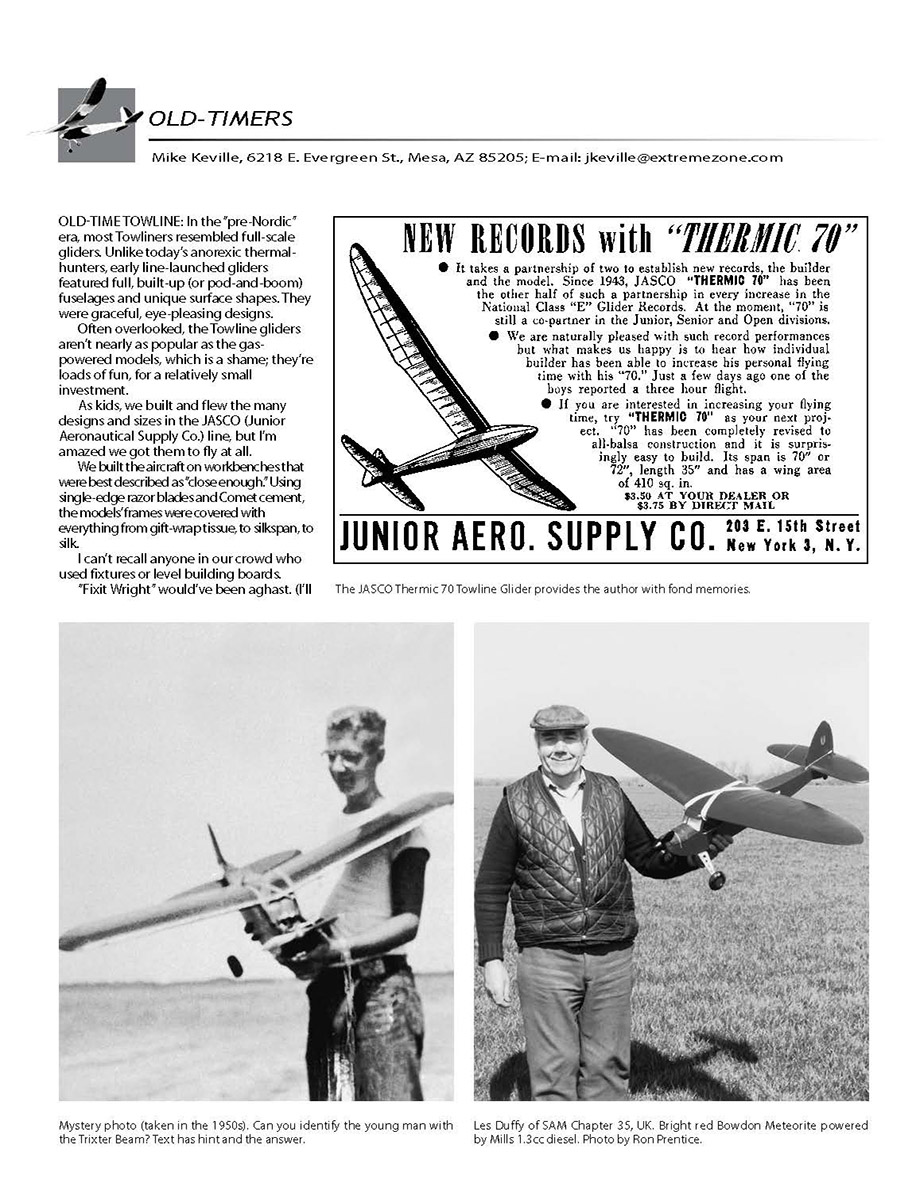
OLD-TIME TOWLINE: In the "pre-Nordic" era, most towliners resembled full-scale gliders. Unlike today's anorexic thermal-hunters, early line-launched gliders featured full, built-up (or pod-and-boom) fuselages and unique surface shapes. They were graceful, eye-pleasing designs.
Often overlooked, the towline gliders aren't nearly as popular as the gas-powered models, which is a shame; they're loads of fun for a relatively small investment.
As kids, we built and flew the many designs and sizes in the JASCO (Junior Aeronautical Supply Co.) line, but I'm amazed we got them to fly at all. We built the aircraft on workbenches that were best described as "close enough." Using single-edge razor blades and Comet cement, the models' frames were covered with everything from gift-wrap tissue to silkspan to silk.
I can't recall anyone in our crowd who used fixtures or level building boards. "Fixit Wright" would've been aghast. (I'll discuss that subject another time.) Then came the payoff: that first tentative toss. We adjusted nose weight, incidence, rudder tab, etc., and fiddled with one or all of those factors. Eventually the toss resulted in a long, flat, floating glide, and ended with the model gently kissing the ground. Finally, there was the delight of hooking up a towline. The towlines were approximately 200 to 400 feet long. There were no adjustable towhooks; separate hooks were standard—usually one at the center of gravity, one further back for calm air, and one forward for windy weather. Sometimes the hooks were placed on the side of the fuselage, to counter the effect of a fixed rudder tab.
Okay, I confess: this topic is the result of a daydream involving a mid-1950s summer evening, a Midwestern hayfield, and a certain Thermic 70. I probably should've left well enough alone, considering most people prefer powered models. I like gliders, though. I always have and I always will, despite my current obsessive involvement with antique control-line (CL) models.
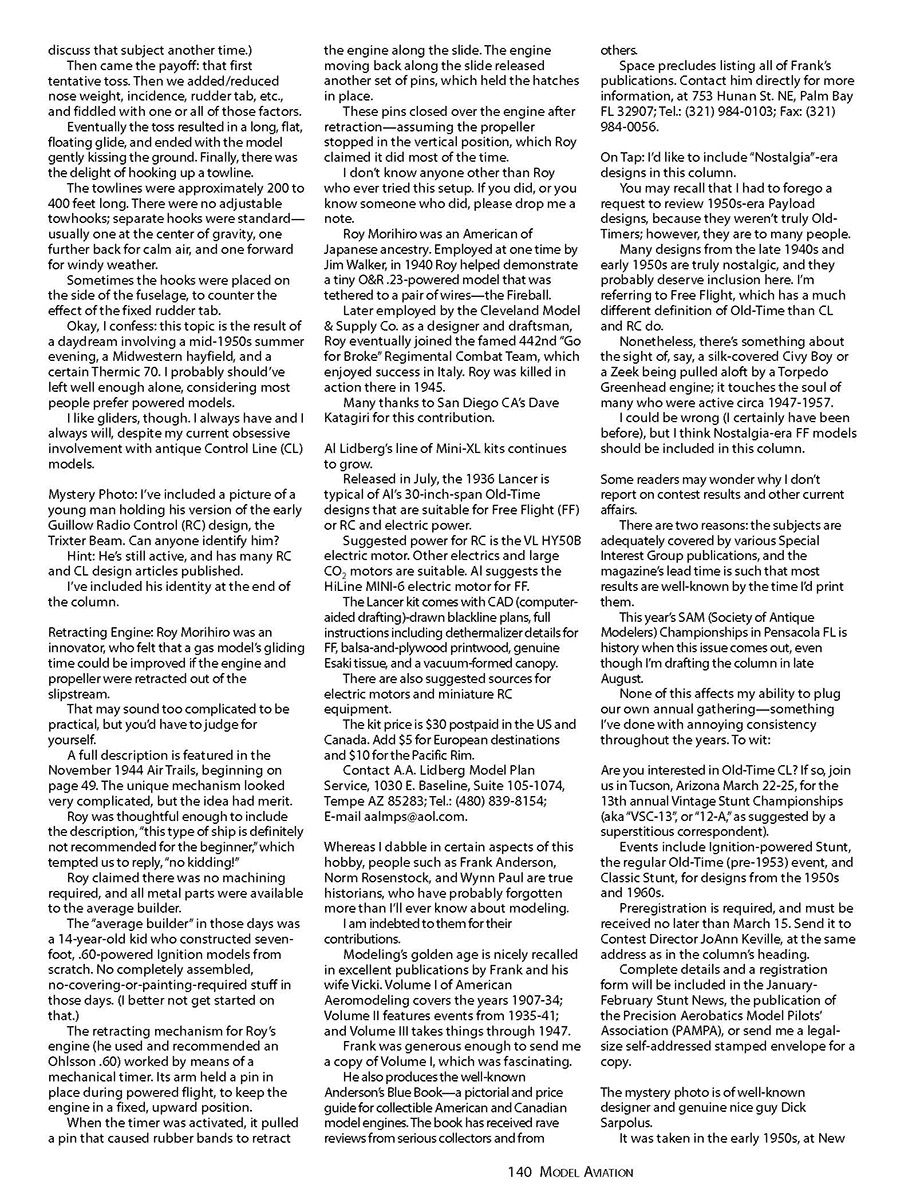
Mystery Photo
I've included a picture of a young man holding his version of the early Guillow radio-control (RC) design, the Trixter Beam. Can anyone identify him? Hint: He's still active, and has many RC and CL design articles published. I've included his identity at the end of the column.
Retracting engine
Roy Morihiro was an innovator who felt that a gas model's gliding time could be improved if the engine and propeller were retracted out of the slipstream. That may sound too complicated to be practical, but you'd have to judge for yourself. A full description is featured in the November 1944 Air Trails, beginning on page 49. The unique mechanism looked very complicated, but the idea had merit. Roy was thoughtful enough to include the description, "this type of ship is definitely not recommended for the beginner," which tempted us to reply, "no kidding!"
Roy claimed there was no machining required and that all metal parts were available to the average builder. The "average builder" in those days was a 14-year-old kid who constructed seven-foot, .60-powered ignition models from scratch. No completely assembled, no-covering-or-painting-required stuff in those days.
The retracting mechanism for Roy's engine (he used and recommended an Ohlsson .60) worked by means of a mechanical timer. Its arm held a pin in place during powered flight to keep the engine in a fixed, upward position. When the timer was activated, it pulled a pin that released rubber bands to retract the engine along the slide. The engine moving back along the slide released another set of pins, which held the hatches in place. These pins closed over the engine after retraction—assuming the propeller stopped in the vertical position, which Roy claimed it did most of the time.
I don't know anyone other than Roy who ever tried this setup. If you did, or you know someone who did, please drop me a note.
Roy Morihiro was an American of Japanese ancestry. Employed at one time by Jim Walker, in 1940 Roy helped demonstrate a tiny O&R .23-powered model that was tethered to a pair of wires—the Fireball. Later employed by the Cleveland Model & Supply Co. as a designer and draftsman, Roy eventually joined the famed 442nd "Go For Broke" Regimental Combat Team, which saw action in Italy. Roy was killed in action there in 1945.
Many thanks to Dave Katagiri of San Diego, CA, for this contribution.
Al Lidberg Mini-XL kits
Al Lidberg's line of Mini-XL kits continues to grow. Released in July, the 1936 Lancer is typical of Al's 30-inch-span old-time designs that are suitable for free flight (FF) or RC and electric power.
Suggested power for RC is the VLH Y50B electric motor. Other electric motors or large CO2 motors are suitable. Al suggests the HiLine MINI-6 electric motor for FF.
The Lancer kit includes:
- CAD (computer-aided drawing)-drawn blackline plans
- Full instructions, including dethermalizer details for FF
- Balsa-and-plywood printwood
- Genuine Esaki tissue
- A vacuum-formed canopy
There are also suggested sources for electric motors and miniature RC equipment.
Kit price: $30 postpaid in the U.S. and Canada. Add $5 for European destinations and $10 for the Pacific Rim.
Contact:
- A.A. Lidberg Model Plan Service, 1030 E. Baseline, Suite 105-1074, Tempe AZ 85283
- Tel.: (480) 839-8154
- E-mail: aalmdps@aol.com
Frank Anderson and historical publications
Whereas I dabble in certain aspects of the hobby, people such as Frank Anderson, Norm Rosenstock, and Wynn Paul are true historians who have probably forgotten more than I'll ever know about modeling. I am indebted to them for their contributions.
Modeling's golden age is nicely recalled in excellent publications by Frank and his wife Vicki. Volume I of American Aeromodelling covers the years 1907–34; Volume II features events from 1935–41; and Volume III takes things through 1947. Frank also produces the well-known Anderson's Blue Book—a pictorial and price guide for collectible American and Canadian model engines. The book has received rave reviews from serious collectors and others.
Space precludes listing all of Frank's publications. Contact him directly for more information:
- 753 Hunan St. NE, Palm Bay FL 32907
- Tel.: (321) 984-0103
- Fax: (321) 984-0056
On Tap
I'd like to include "nostalgia"-era designs in this column. You may recall that I had to forego a request to review 1950s-era payload designs because they weren't truly old-timers; however, they are to many people.
Many designs from the late 1940s and early 1950s are truly nostalgic and probably deserve inclusion here. I'm referring to free flight, which has a much different definition of "old-time" than CL and RC do. Nonetheless, there's something about the sight of, say, a silk-covered City Boy or a Zeek being pulled aloft by a Torpedo Greenhead engine; it touches the soul of many who were active circa 1947–1957.
I could be wrong (I certainly have been before), but I think nostalgia-era FF models should be included in this column.
Some readers may wonder why I don't report on contest results and other current affairs. There are two reasons: the subjects are adequately covered by various Special Interest Group publications, and the magazine's lead time is such that most results are well-known by the time I'd print them. This year's SAM (Society of Antique Modelers) Championships in Pensacola, FL, is history when this issue comes out, even though I'm drafting the column in late August.
None of this affects my ability to plug our own annual gathering—something I've done with annoying consistency throughout the years. To wit:
Vintage Stunt Championships (VSC-13)
Are you interested in old-time C/L? If so, join us in Tucson, Arizona, March 22–25, for the 13th annual Vintage Stunt Championships (aka "VSC-13," or "12-A," as suggested by a superstitious correspondent).
Events include:
- Ignition-powered Stunt
- Regular Old-Time (pre-1953) event
- Classic Stunt (designs from the 1950s and 1960s)
Pre-registration is required and must be received no later than March 15. Send it to Contest Director JoAnn Keville at the same address as in the column's heading. Complete details and a registration form will be included in the January–February Stunt News, the publication of the Precision Aerobatics Model Pilots' Association (PAMPA), or send me a legal-size self-addressed stamped envelope for a copy.
The mystery photo is of well-known designer and genuine nice guy Dick Sarpolaus. It was taken in the early 1950s.
Transcribed from original scans by AI. Minor OCR errors may remain.

