
OLD-TIMERS
Author / Contact
Mike Keville 6218 E. Evergreen St., Mesa AZ 85205 E-mail: jkeville@extremezone.com
EXPANDED COVERAGE
"Old-Timer" is a relative term. To Free Flighters, it means models designed no later than 1942; the year is 1952 in Control Line Stunt.
In a previous column, I mentioned the intent to seek editorial approval to include Nostalgia-era designs here. That request was granted.
This will probably cause grumbling in certain quarters, but the reasoning is sound. When I was approached about writing this column, it was with the understanding that it would encompass not only Free Flight (FF), but Control Line (CL) and Radio Control (RC). As most are aware, the last two categories began significantly later than the first, so they have different guidelines for what constitutes "Old-Time."
Moreover, the majority of AMA members have been in the hobby a relatively short time compared to those of us who have been involved since the 1940s and earlier. A previous request asking me to feature the 1950s Payload designs is a case in point.
That modeler recalled those designs from his childhood as among the earliest flying models he'd seen. To him, they are surely "Old-Time" in every sense of the term. I can understand how others might feel the same about a deBolt Live Wire Cruiser or a Veco Smoothie.
With that in mind, I'm going to expand this column to include models and activities through the mid-1950s. (Pause here for gnashing of teeth among selected readers.) Feel free to send your opinions on this decision. Contact me directly or via "Letters to the Editor." If the change in format meets overwhelming disapproval, I'll change it. After all, this is your magazine. By the same token, let me hear if you do approve. Then go dig out the photos of those old Zeeks, Civy Boys, Veco Chiefs, Rudder Bugs, etc., and send them to me, along with anything else of a vintage nature.
Photos and contributors
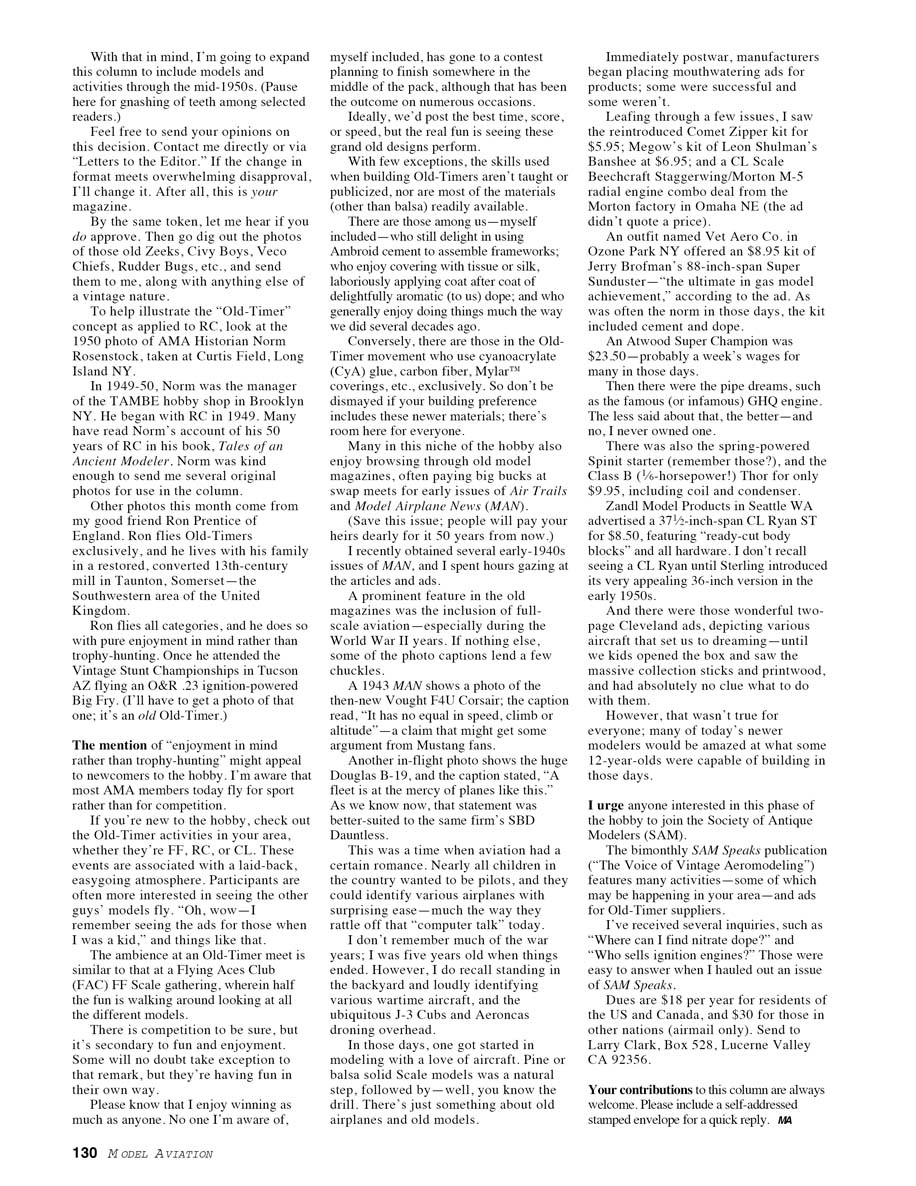
To help illustrate the "Old-Timer" concept as applied to RC, look at the 1950 photo of AMA Historian Norm Rosenstock, taken at Curtiss Field, Long Island, NY. In 1949–50, Norm was the manager of the TAMBE hobby shop in Brooklyn, NY. He began with RC in 1949. Many have read Norm's account of his 50 years of RC in his book, Tales of an Ancient Modeler. Norm was kind enough to send me several original photos for use in the column.
Other photos this month come from my good friend Ron Prentice of England. Ron flies Old-Timers exclusively, and he lives with his family in a restored, converted 13th-century mill in Taunton, Somerset — the southwestern area of the United Kingdom. Ron flies all categories, and he does so with pure enjoyment in mind rather than trophy-hunting. Once he attended the Vintage Stunt Championships in Tucson, AZ, flying an O&R .23 ignition-powered Big Fry. (I'll have to get a photo of that one; it's an old Old-Timer.)
Enjoyment, competition, and building methods
The mention of "enjoyment in mind rather than trophy-hunting" might appeal to newcomers to the hobby. I'm aware that most AMA members today fly for sport rather than for competition. If you're new to the hobby, check out the Old-Timer activities in your area, whether they're FF, RC, or CL. These events are associated with a laid-back, easygoing atmosphere. Participants are often more interested in seeing the other guys' models fly. "Oh, wow — I remember seeing the ads for those when I was a kid," and things like that. The ambience at an Old-Timer meet is similar to that at a Flying Aces Club (FAC) FF Scale gathering, wherein half the fun is walking around looking at all the different models. There is competition, to be sure, but it's secondary to fun and enjoyment. Some will no doubt take exception to that remark, but they're having fun in their own way. Please know that I enjoy winning as much as anyone. No one I'm aware of, myself included, has gone to a contest planning to finish somewhere in the middle of the pack, although that has been the outcome on numerous occasions.
Ideally, we'd post the best time, score, or speed, but the real fun is seeing these grand old designs perform.
With few exceptions, the skills used when building Old-Timers aren't taught or publicized, nor are most of the materials (other than balsa) readily available.
There are those among us—myself included—who still delight in using Ambroid cement to assemble frameworks; who enjoy covering with tissue or silk, laboriously applying coat after coat of delightfully aromatic dope; and who generally enjoy doing things much the way we did several decades ago.
Conversely, there are those in the Old-Timer movement who use cyanoacrylate (CYA) glue, carbon fiber, Mylar coverings, etc., exclusively. So don't be dismayed if your building preference includes these newer materials; there's room here for everyone.
Many in this niche of the hobby also enjoy browsing through old model magazines, often paying big bucks at swap meets for early issues of Air Trails and Model Airplane News (MAN).
(Save this issue; people will pay your heirs dearly for it 50 years from now.)
Magazines, ads, and nostalgia
I recently obtained several early-1940s issues of MAN, and I spent hours poring over the articles and ads.
A prominent feature in the old magazines was the inclusion of full-scale aviation—especially during the World War II years. If nothing else, some of the photo captions lend a few chuckles.
- A 1943 MAN shows a photo of the then-new Vought F4U Corsair; the caption read, "It has no equal in speed, climb or altitude"—a claim that might get some argument from Mustang fans.
- Another in-flight photo shows the huge Douglas B-19, and the caption stated, "A fleet is at the mercy of planes like this." As we know now, that statement was better suited to the same firm's SBD Dauntless.
This was a time when aviation had a certain romance. Nearly all children in the country wanted to be pilots, and they could identify various airplanes with surprising ease—much the way they rattle off that "computer talk" today.
I don't remember much of the war years; I was five years old when things ended. However, I do recall standing in the backyard and loudly identifying various wartime aircraft, and the ubiquitous J-3 Cubs and Aeroncas droning overhead.
In those days, one got started in modeling with a kit or a balsa solid-scale model was a natural step, followed by—well, you know the drill. There's just something about old airplanes and old models.
Immediately postwar, manufacturers began placing mouthwatering ads for products; some were successful and some weren't.
Leafing through a few issues, I saw:
- Comet Zipper kit reintroduced for $5.95
- Megow's kit of Leon Shulman's Banshee at $6.95
- A CL Scale Beechcraft Staggerwing/Morton M-5 radial engine combo deal from the Morton factory in Omaha, NE (ad didn't quote a price)
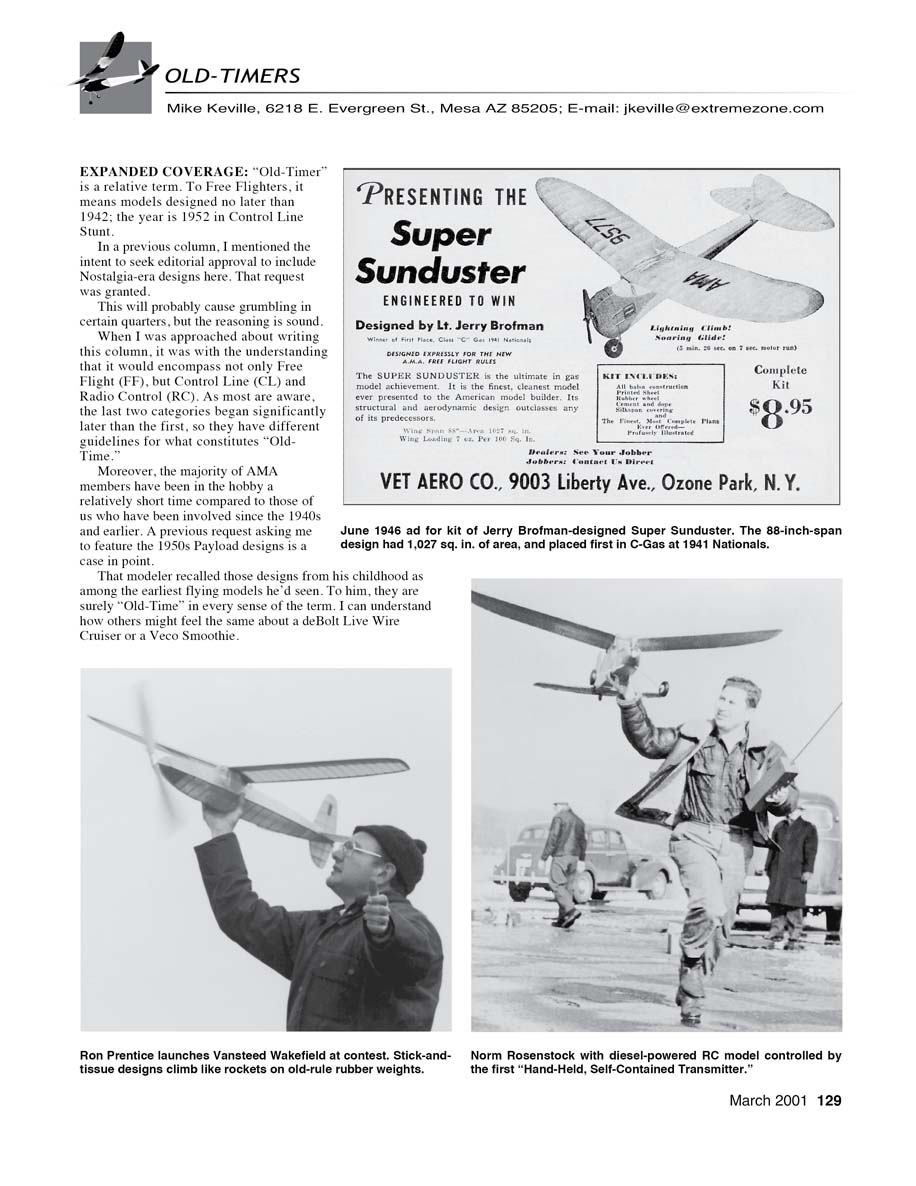
- Vet Aero Co. in Ozone Park, NY offering an $8.95 kit of Jerry Brofman's 88-inch-span Super Sunduster — "the ultimate in gas model achievement" (kit included cement and dope)
- Atwood Super Champion for $23.50 — probably a week's wages for many in those days
- The famous (or infamous) GHQ engine — the less said about that, the better (I never owned one)
- The spring-powered Spirit starter and the Class B (1/6-horsepower) Thor for $9.95, including coil and condenser
- Zandl Model Products in Seattle, WA advertised a 37½-inch-span CL Ryan ST for $8.50, featuring "ready-cut body blocks" and all hardware
- Wonderful two-page Cleveland ads depicting various aircraft that set us dreaming — until we kids opened the box and saw the massive collection of sticks and primwood, and had absolutely no clue what to do with them
However, that wasn't true for everyone; many of today's newer modelers would be amazed at what some 12-year-olds were capable of building in those days.
Join SAM (Society of Antique Modelers)
I urge anyone interested in this phase of the hobby to join the Society of Antique Modelers (SAM). The bimonthly SAM Speaks publication ("The Voice of Vintage Aeromodelling") features many activities—some of which may be happening in your area—and ads for Old-Timer suppliers.
I've received several inquiries, such as "Where can I find nitro or rope?" and "Who sells ignition engines?" Those were easy to answer when I hauled out an issue of SAM Speaks.
Dues and contact:
- Dues: $18 per year (U.S. and Canada), $30 per year (other nations — airmail only)
- Send to: Larry Clark, Box 528, Lucerne Valley, CA 92356
Contributions
Your contributions to this column are always welcome. Please include a self-addressed stamped envelope for a quick reply.
— Mike Keville
Transcribed from original scans by AI. Minor OCR errors may remain.

