
OLD-TIMERS
Mike Keville 6218 E. Evergreen St., Mesa AZ 85205 E-mail: jkeville@extremezone.com
READER RESPONSE to the Thermic glider feature a couple of issues ago was pleasantly surprising. I have received several requests for plan sources.
In this column I’ll feature something along the same line (no pun intended) for Control Line (CL) fans.
Old-Time Stunt (OTS)
Old-Time Stunt (OTS) is a concept introduced in 1970 by John Miske Jr. of the Garden State Circle Burners club. Using the 1951–52 AMA CL Stunt pattern as a guide, some changes were made to simplify scoring. Appearance points were eliminated, but bonus points were awarded for the use of non-flapped designs and spark-ignition engines.
The winner of that inaugural 1970 OTS contest—foregoing the “no-flap” bonus by flying a Veco Mustang—was Model Aviation’s (MA) Aeromodeling Editor and AMA Hall of Fame member Bob Hunt, the 1978 Fédération Aéronautique Internationale (FAI) CL Precision Aerobatics (F2B) World Champion.
The event is thriving today, notwithstanding an apparent need for clarification of maneuver descriptions.
Plans for these grand old designs are available from several sources, as are a number of high-quality kits. Space precludes listing all the sources; if you’d like the names and addresses, E-mail me or send a legal-size self-addressed stamped envelope (SASE) and I’ll point you in the right direction.
Classic (Nostalgia) Stunt
Classic (initially called Nostalgia) Stunt is a companion event to OTS for post-1952 designs, such as the Smoothie, the Thunderbird, the Ares, the Nobler, the Shark 45, and others. Old-Time designs are also eligible to compete in this event. Classic Stunt is flown using the current AMA Precision Aerobatics pattern. At many contests, the number of Classic entries exceeds the number of OTS entries.
Many of today’s top-ranking CL Stunt pilots fly in these events—primarily for fun and relaxation, though never without that competitive spirit. One thing that never fails to amaze me is the number of people who are willing to travel thousands of miles to fly designs that were obsolete 30–50 years ago. At the annual Vintage Stunt Championships (VSC) in Tucson, AZ, entrants to date have come from England, Japan, Australia, Germany, Holland, and Switzerland.
Vintage Stunt Championships (VSC) and notable designers
We at the VSC have also been privileged to witness flights by several legendary designers: George Aldrich (Nobler), Bob Palmer (Thunderbird), Lew McFarland (Shark 45), Bob Gialdini (Sting Ray), Ed Southwick (Skylark), and Bill Werwage (Ares), who is still a world-class competitor.
I’ll be glad to supply names and sources for plans, kits, and other information about the Classic Stunt event. An E-mail or SASE will do the trick.
There is also VSC participation by an increasing number of Radio Control (RC) and Free Flight (FF) fliers who cut their modeling teeth on these designs. Jim Persson, who is active in the Society of Antique Modelers (SAM) as a competitor and organizer, entered last year’s VSC. Jim flew a Super Cyclone–powered Akrobat (a Bill Skipper design) in the Ignition Stunt event and won the prestigious Spirit of ’46 award, presented to the model that best represented construction methods and materials of the era.
Other vintage events: Combat, Carrier, Team Racing
Although most Old-Time CL activity currently centers on Stunt, there is increasing interest in 1950s-era designs among those who fly Combat, Carrier, and especially Team Racing.
Several of the latter are making a serious attempt to revive the old AMA Class B Team Race event using .21- or .25-displacement engines. B-T/R, as it’s known, features rules that require the use of models that resemble full-scale aircraft, with appearance points being part of the game.
Dave Domizi, the 1954 Nationals Carrier winner, paved the way for smaller, simpler models in that event with a lightweight 28-inch-span Guardian. (Simpler, that is, until the advent of line-sliders and other gadgets.) We’re hearing of growing interest in Old-Time (read, "classic and hook-only") Carrier.
Thanks to Mr. Domizi, you can see the original Guardian on display at the AMA museum.
Testors CL kits: Freshman, Sophomore, Junior, Senior
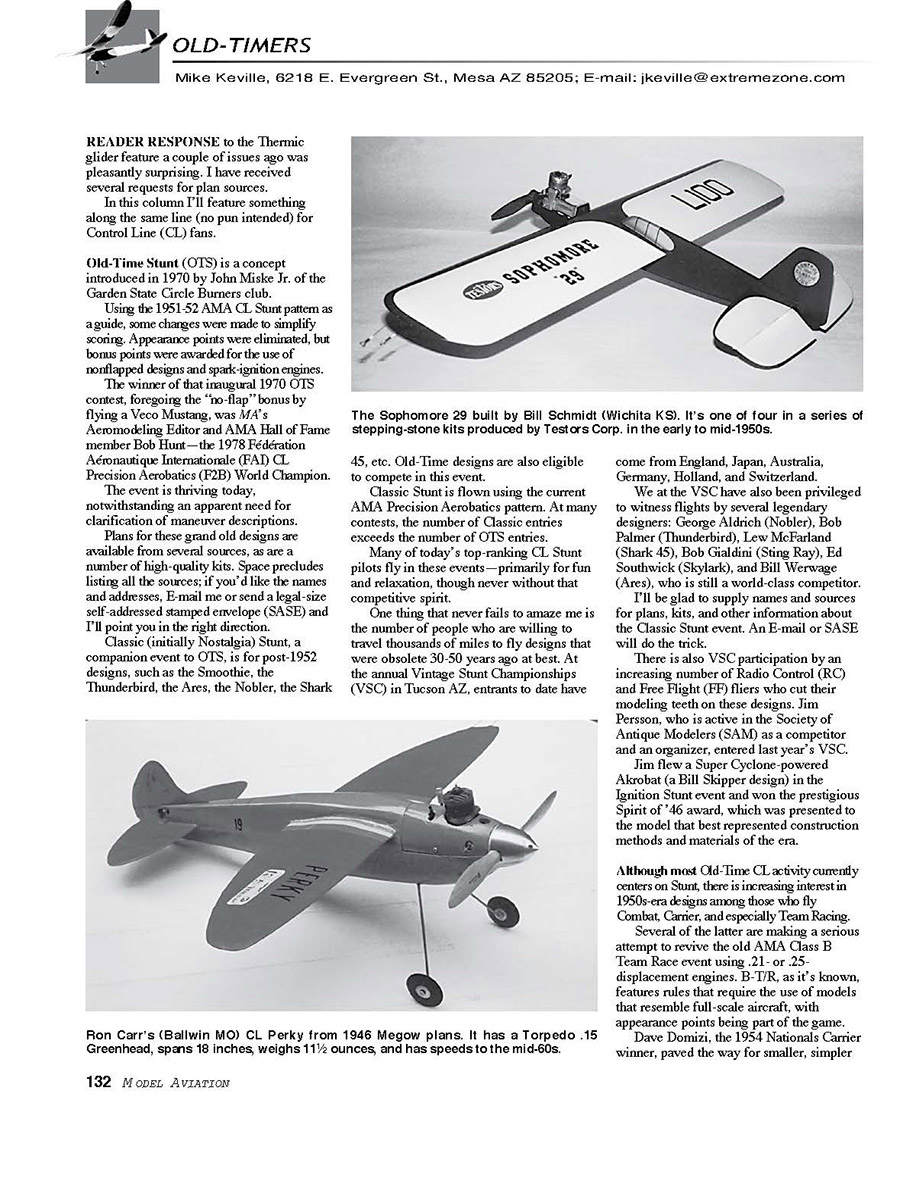
In the early to mid-1950s the Testors Corporation produced four CL kits, each available in three sizes: .09, .19, and .29, with an obvious preference for McCoy Stunt engines. Ranging from a basic trainer to a (supposedly) full-Stunt competition model, these aircraft were the Freshman, the Sophomore, the Junior, and the Senior.
The models weren't produced for very long, nor were they all that popular at the time. However, now that CL nostalgia is in full swing, we're seeing an increasing number of the airplanes at Old-Time meets.
Bill Schmidt, known for his series of delightful rubber-powered Free Flight Soledad designs, remembers the old Testors CL models well. He wrote, "I flew the .06 and .10 kits from 1949 to 1957. I was a kid then, and boy, was life simple!"
Bill sent photos of two models he'd built recently. His Sophomore 29, an all-balsa design, is powered by a 1950s silver-case McCoy Stunt .29. Although you can't see them in the photo, Bill's replica is equipped with the original wooden wheels. The Sophomore sports a dope finish of Diana Cream with Maroon trim, using the original hardware and landing-gear design.
Bill's rendition of the Senior 29, which uses a built-up symmetrical airfoil wing and planked fuselage, is powered by a K&B glow Torpedo .29. Among others who have built and flown the Senior 29 are AMA Hall of Fame member Art Adams and Nationals CL Stunt director Warren Talbot.
If you want plans for the model, contact Bill Schmidt at: 4647 Krueger St., Wichita KS 67220.
The Junior and other examples
The Junior is arguably the most attractive of the series; I've only seen one fly recently—the white-and-red beauty built by Roy DeCampa of Vancouver, WA. Roy builds odd designs for sheer enjoyment rather than for trophy hunting, although his models have won numerous appearance awards. Using an original silver-case McCoy, Roy's clockwork-looking Junior was built solely to exhibit a piece of modeling history.
Megow Perky — Ron Carr
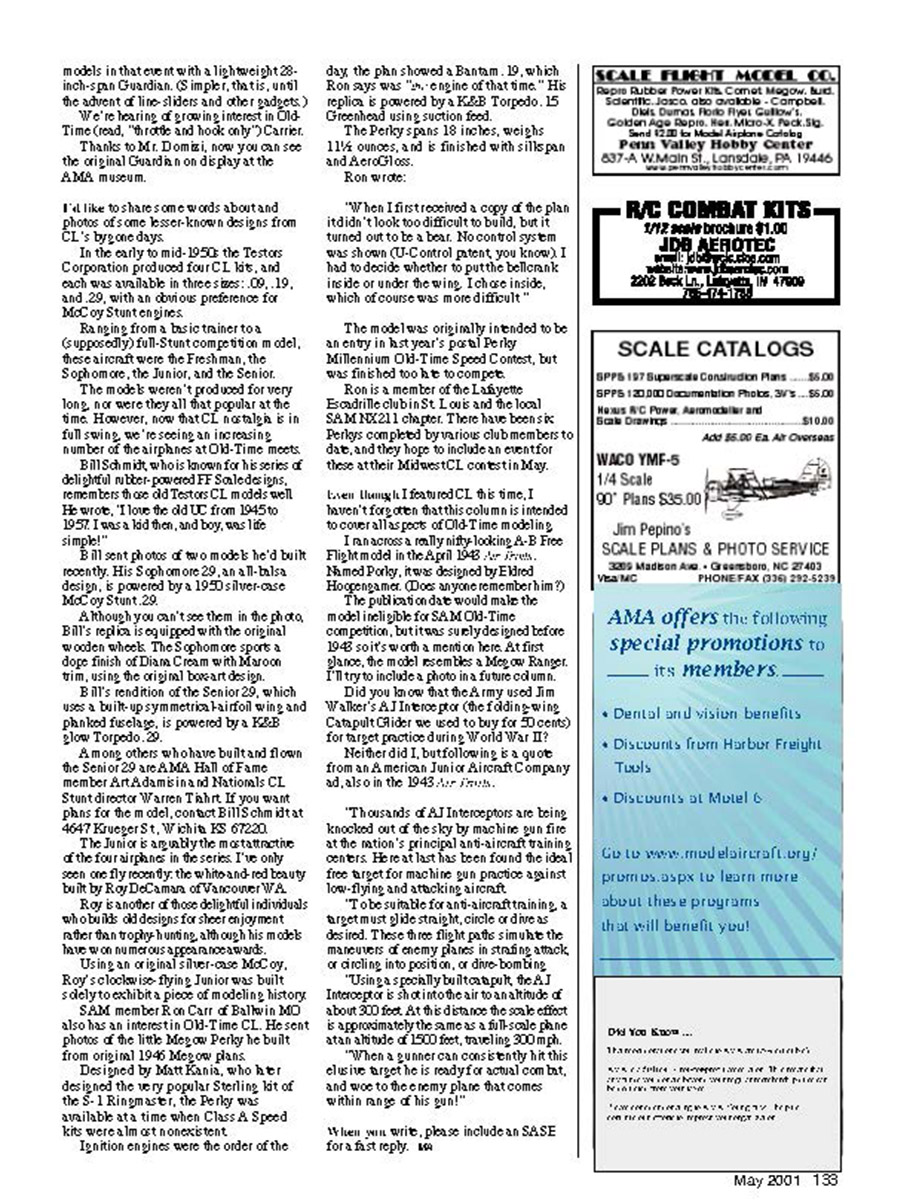
SAM member Ron Carr of Ballwin, MO sent photos of the little Megow Perky he built from original 1946 Megow plans. Designed by Matt Kania (who later designed the popular Sterling kit of the S-1 Ringmaster), the Perky was available at a time when Class B Speed kits were almost nonexistent.
Ignition engines were the order of the day; the plan showed a Bantam .19, which Ron says was "an engine of that time." His replica is powered by a K&B Torpedo .15 Greenhead using suction feed.
The Perky spans 18 inches, weighs 4½ ounces, and is finished with silkspan and AeroGloss.
Ron wrote: "When I first received a copy of the plan it didn't look too difficult to build, but it turned out to be a bear. No control system was shown (U-Control, not that you know), I had to decide whether to put the bellcrank inside or under the wing. I chose inside, which of course was more difficult."
The model was originally intended to be an entry in last year's Petit Perky Millennium Old-Time Speed Contest, but it was finished too late to compete.
Ron is a member of the Lafayette Escadrille Club in St. Louis and the local SAM #211 chapter. There have been six Perkys completed by various club members to date, and they hope to include an event for these at their Midwest contest in May.
Closing
Even though I featured CL this time, I haven't forgotten that this column is intended to cover all aspects of Old-Time modeling. In a future column I'll include more on Classic Stunt, Team Racing, Carrier, Combat, and Free Flight, and I'll supply names and sources for plans, kits, and other information about these events. An E-mail or SASE will do the trick.
When you write, please include an SASE for a fast reply.
Transcribed from original scans by AI. Minor OCR errors may remain.

