
OLD-TIMERS
Mike Keville, 6218 E. Evergreen St., Mesa, AZ 85205; E-mail: jkeville@extremezone.com
I wonder how many readers spotted the following item in Newsweek, dated October 28, 2002. A gentleman named Dana Wall, reminiscing about his father's craftsmanship with musical instruments, included this anecdote:
"When I was 13, I said I wanted an 'Olson [sic] 60' gasoline engine for my balsa-wood model airplanes. Dad said he could build it for me. He borrowed my friend's motor, took measurements, made wooden parts, cast them in aluminum and turned the pieces on his lathe until they fit. He purchased only a spark plug, the gas tank and a rubber fuel line."
SAM Chapter 40 and Old-Time Modeling
One of several club newsletters I receive is from Society of Antique Modelers (SAM) Chapter 40 in Michigan, edited by Joe Roose. Among the members is Joe Dallaire, who is one of the better-known names among Old-Time (OT) modelers. The club flies a lot of 1/2A Texaco—an event for scaled-down versions of the large, graceful Free Flight (FF) designs of the late 1930s. The club also promotes a limited-engine-run event: the increasingly popular "Foxacoy" for OT Class C FF models powered only by Fox .35 Stunt or McCoy .35 Red Head engines. If you live in that area and would like to hook up with SAM 40, contact Joe Dallaire, 6263 Charlesworth, Dearborn Heights, MI 48127. Dues are $10 per year.
Although most OT activity centers on FF and Radio Control (or Radio Assist) events, much interest is being seen in Control Line (CL). The majority of OT/CL focus has been on Stunt designs, but I've noted an increase in Speed, Class B Team Racing, and "retro" Carrier (i.e., throttle and hook only; no line-sliders and no "prop-hanging"). If your tastes run to CL, you might want to be in Tucson, Arizona, March 20–23 for the 15th annual Vintage Stunt Championships (VSC). It's 100% OT CL Stunt with three separate events:
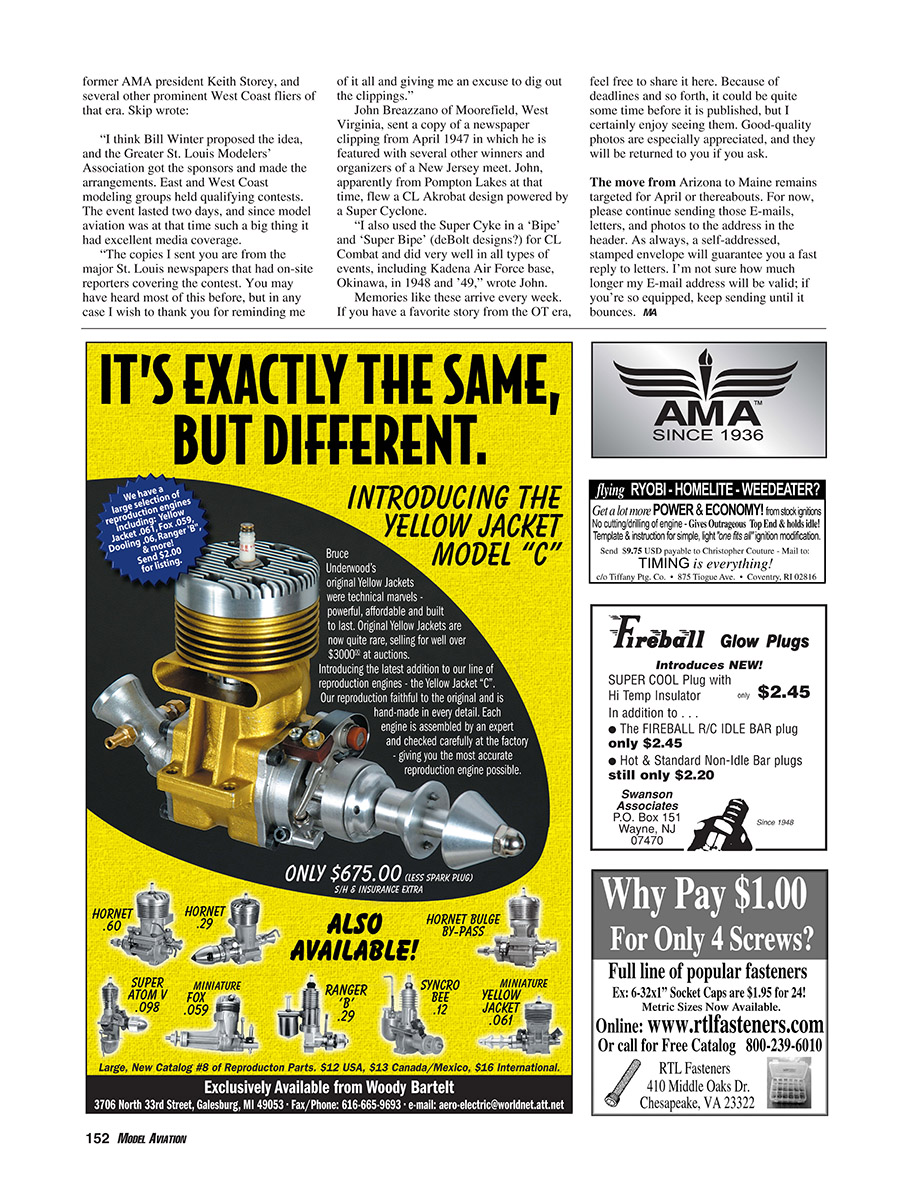
- Old-Time: For models designed prior to 1953. Internal modifications are permitted for strength and safety, but all exterior measurements must be as originally designed. Flight pattern is based on the 1951–1952 AMA rules and is far less difficult to perform well than the current one. Bonus points are awarded for designs with no wing flaps and for using spark-ignition engines.
- Classic: For models designed prior to 1970 and flown according to the current AMA CL Precision Aerobatics pattern. This event features such nostalgic designs as the Nobler, the Thunderbird, the Shark 45, and those beautiful I-beam wing designs such as the Ares and the Cobra from the 1950s and 1960s. Many-time F2B team member David Fitzgerald flew a Ringmaster to ninth place (out of 80-plus entries) at last year's gathering.
- Ignition-only Old-Time: In it you will see everything from Jim Walker Fireballs to Super Cyclone-powered Zilches and Floyd Carter's magnificent Wildman 60.
Although many prizes are awarded, the VSC is a four-day celebration of "the way things used to be" (or perhaps ought to be), where the focus is on fun and exhibition rather than trophy-hunting. You will meet such notables in the hobby as Bill Werwage, Charles Mackey, Larry Scarinzi, "Wild Bill" Netzeband, and many others whose names are well known from past and present, including MA's aeromodeling editor, Bob Hunt. Because of the large number of participants, pre-entry is required by March 10. For full details contact Jim Hoffman, 2658 W. Montgomery Dr., Chandler, AZ 85224; Tel.: (480) 897-0630; E-mail: Windswept4@aol.com.
Nostalgia Meets
Spacers, Ramrods, Texans, Zeeks, and other 1950s FF designs filled the air at the 2002 San Valleros Nostalgia Annual at Taft, California. Mike Thompson won Sweepstakes, followed closely by Bob DeShields. There is not enough space here to list all the entrants, although it looks like fixed-surface FF with plain-bearing engines is gaining popularity. Many thanks to Terry Thorkildson for the report.
It might seem unbelievable to anyone who began modeling in recent years, but there was a time when radio didn't "control" the majority of the hobby. Before World War II, FF was king. From 1946 to sometime near 1970, CL was a dominant force. Youngsters built and flew everything, in all categories. There was no "Junior problem" (unless you consider that some of the youngsters often outflew everyone else). It was a wonderful, magical time—an era when one didn't need a second mortgage to be competitive and "competition" was not a dirty word.
I receive many letters from those who fondly recall their early years in modeling. Some include copies of photos or newspaper clippings. Copy quality ranges from excellent (in some cases) to barely legible. Although some are occasionally submitted for print here, most are unable to be reproduced on these pages.
Memories from the 1930s and 1940s
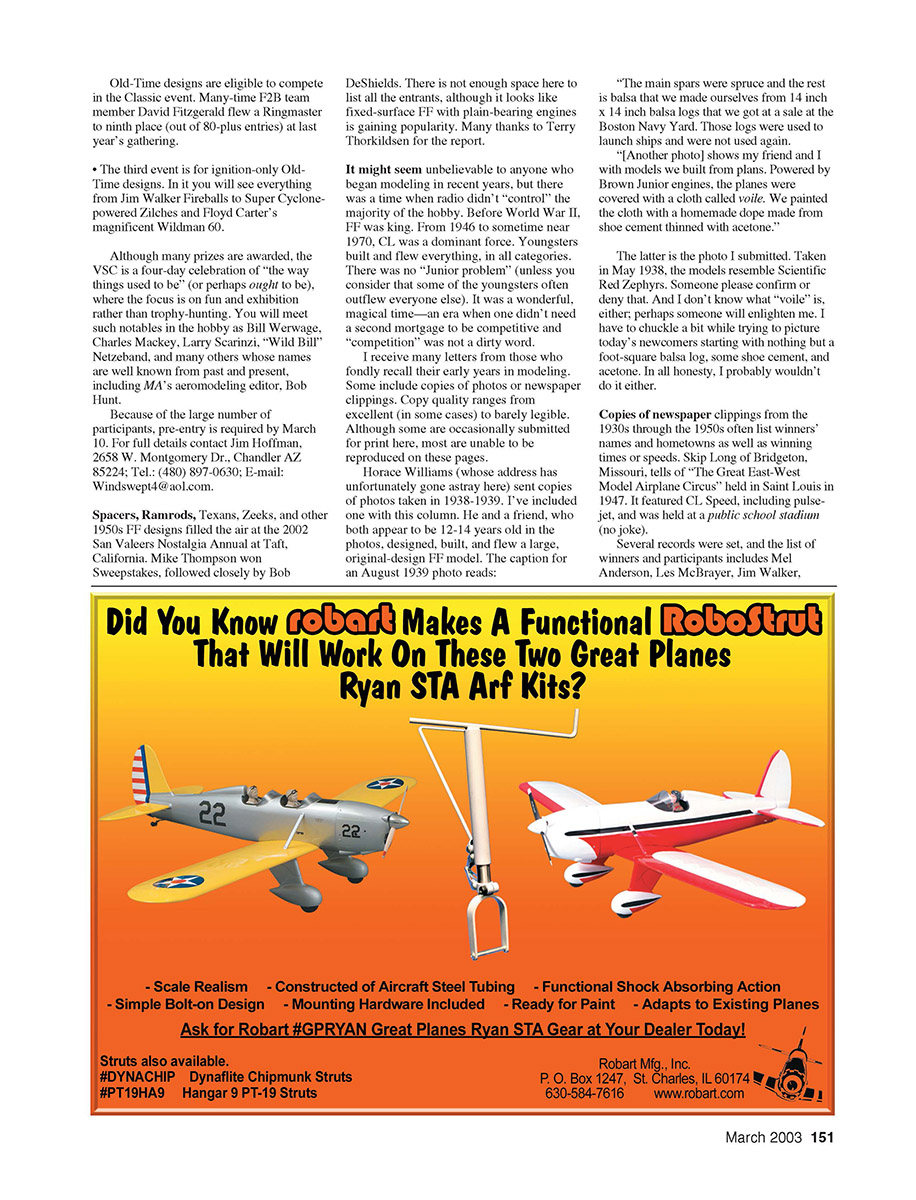
Horace Williams (whose address has unfortunately gone astray here) sent copies of photos taken in 1938–1939. He included one with this column. He and a friend, who both appear to be 12–14 years old in the photos, designed, built, and flew a large, original-design FF model. The caption for an August 1939 photo reads:
"The main spars were spruce and the rest is balsa that we made ourselves from 14 inch x 14 inch balsa logs that we got at a sale at the Boston Navy Yard. Those logs were used to launch ships and were not used again.
"Another photo shows my friend and I with models we built from plans. Powered by Brown Junior engines, the planes were covered with a cloth called voile. We painted the cloth with a homemade dope made from shoe cement thinned with acetone."
The latter is the photo I submitted. Taken in May 1938, the models resemble Scientific Red Zephyrs. Someone please confirm or deny that. And I don't know what "voile" is, either; perhaps someone will enlighten me. I have to chuckle a bit while trying to picture today's newcomers starting with nothing but a foot-square balsa log, some shoe cement, and acetone. In all honesty, I probably wouldn't do it either.
Copies of newspaper clippings from the 1930s through the 1950s often list winners' names and hometowns as well as winning times or speeds. Skip Long of Bridgeton, Missouri, tells of "The Great East-West Model Airplane Circus" held in Saint Louis in 1947. It featured CL Speed, including pulse-jet, and was held at a public school stadium (no joke).
Several records were set, and the list of winners and participants includes Mel Anderson, Les McBrayer, Jim Walker, former AMA president Keith Storey, and several other prominent West Coast fliers of that era. Skip wrote:
"I think Bill Winter proposed the idea, and the Greater St. Louis Modelers' Association got the sponsors and made the arrangements. East and West Coast modeling groups held qualifying contests. The event lasted two days, and since model aviation was at that time such a big thing it had excellent media coverage.
"The copies I sent you are from the major St. Louis newspapers that had on-site reporters covering the contest. You may have heard most of this before, but in any case I wish to thank you for reminding me of it all and giving me an excuse to dig out the clippings."
John Breazzano of Moorefield, West Virginia, sent a copy of a newspaper clipping from April 1947 in which he is featured with several other winners and organizers of a New Jersey meet. John, apparently from Pompton Lakes at that time, flew a CL Akrobat design powered by a Super Cyclone.
"I also used the Super Cyke in a 'Bipe' and 'Super Bipe' (deBolt designs?) for CL Combat and did very well in all types of events, including Kadena Air Force Base, Okinawa, in 1948 and '49," wrote John.
Memories like these arrive every week. If you have a favorite story from the OT era, feel free to share it here. Because of deadlines and so forth, it could be quite some time before it is published, but I certainly enjoy seeing them. Good-quality photos are especially appreciated, and they will be returned to you if you ask.
The move from Arizona to Maine remains targeted for April or thereabouts. For now, please continue sending those e-mails, letters, and photos to the address in the header. As always, a self-addressed, stamped envelope will guarantee you a fast reply to letters. I'm not sure how much longer my e-mail address will be valid; if you're so equipped, keep sending until it bounces.
MA
Transcribed from original scans by AI. Minor OCR errors may remain.

