
OLD-TIMERS
Mike Keville 31 Franklin Pkwy., Brunswick ME 04011 E-mail: mjkeville@gwi.net
THE BRAND NAME
Ambroid needs no introduction to longtime modelers. It was, and remains, the adhesive of choice for many. Thanks to the efforts of former Ambroid president Art Laneau, the company also produced a line of kits which included the Ares, Stuka, and Whipsaw CL models and the Jetstream A/1 Towline Glider.
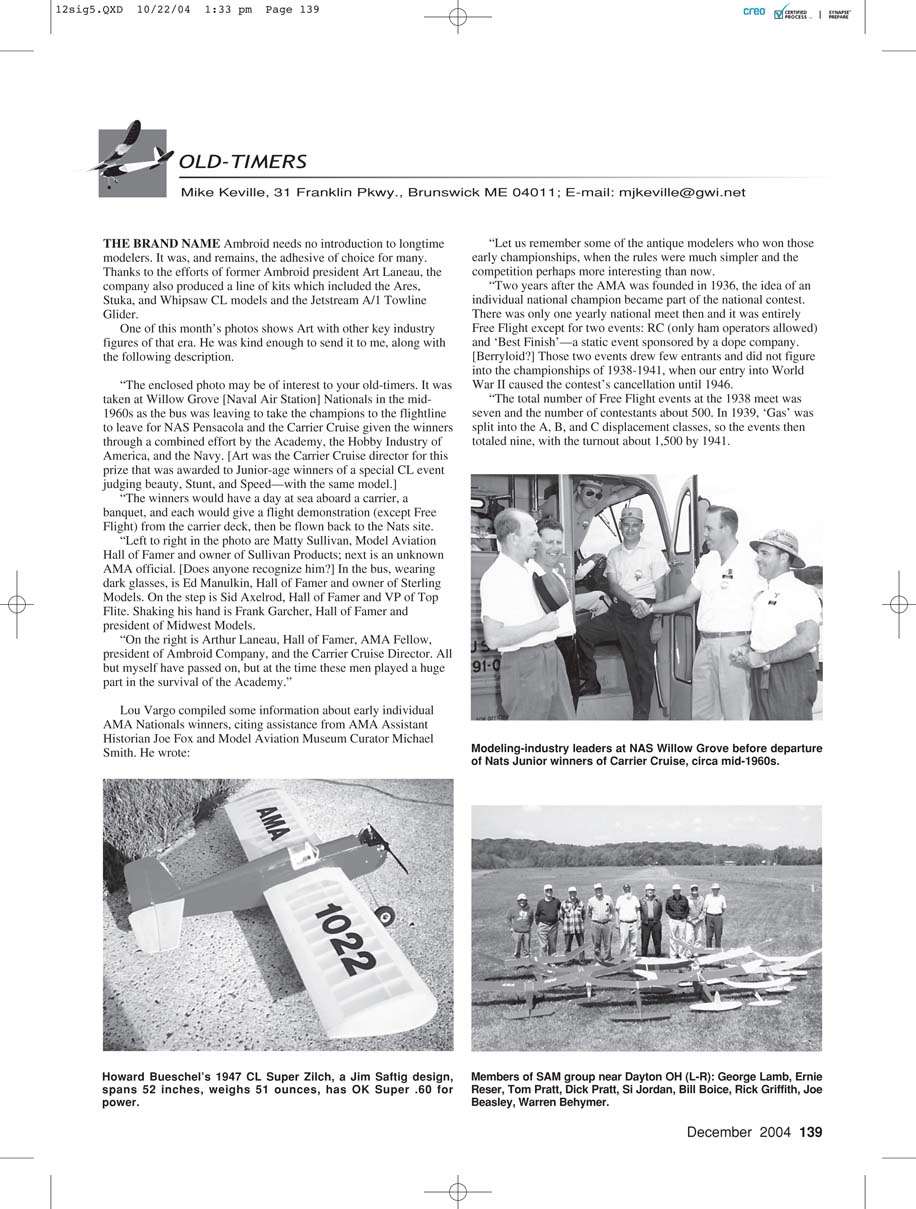
One of this month's photos shows Art with other key industry figures of that era. He was kind enough to send it to me, along with the following description.
Art Laneau wrote that the enclosed photo was taken at Willow Grove (Naval Air Station) Nationals in the mid-1960s as the bus was leaving to take the champions to the flightline to leave for NAS Pensacola and the Carrier Cruise given the winners through a combined effort by the Academy, the Hobby Industry of America, and the Navy. Art was the Carrier Cruise director for this prize that was awarded to junior-age winners of a special CL event judging beauty, stunt, and speed—with the same model.
The winners would have a day at sea aboard a carrier, a banquet, and each would give a flight demonstration (except Free Flight) from the carrier deck, then be flown back to the Nats site.
Left to right in the photo are Matty Sullivan, Model Aviation Hall of Famer and owner of Sullivan Products; next is an unknown AMA official (does anyone recognize him?). In the bus, wearing dark glasses, is Ed Manulkin, Hall of Famer and owner of Sterling Models. On the step is Sid Axelrod, Hall of Famer and VP of Top Flite. Shaking his hand is Frank Garcher, Hall of Famer and president of Midwest Models.
On the right is Arthur Laneau, Hall of Famer, AMA Fellow, president of Ambroid Company, and the Carrier Cruise Director. All but Art have since passed on, but at the time these men played a huge part in the survival of the Academy.
EARLY AMA NATIONALS
Lou Vargo compiled some information about early individual AMA Nationals winners, citing assistance from AMA Assistant Historian Joe Fox and Model Aviation Museum Curator Michael Smith. He wrote:
Let us remember some of the antique modelers who won those early championships, when the rules were much simpler and the competition perhaps more interesting than now.
Two years after the AMA was founded in 1936, the idea of an individual national champion became part of the national contest. There was only one yearly national meet then and it was entirely Free Flight except for two events: RC (only ham operators allowed) and "Best Finish"—a static event sponsored by a dope company (Berryloid?). Those two events drew few entrants and did not figure into the championships of 1938–1941, when our entry into World War II caused the contest's cancellation until 1946.
The total number of Free Flight events at the 1938 meet was seven and the number of contestants was about 500. In 1939, "Gas" was split into the A, B, and C displacement classes, so the events then totaled nine, with the turnout about 1,500 by 1941.
We don't have an exact breakdown by age classification for these contests, but we do know that junior participation was proportionately much greater than today, while the senior group (16–20 years of age) was also relatively larger and contained many of the best builders and fliers of the time. Open (21 years and older) tended to have fewer entrants but some of the best-known modelers of the time (Goldberg, Korda, et al.) — old old-timers whose contest records went back before the AMA were in this category.
The first individual championship competition took place at the 1938 Nationals in Detroit. A contestant did not have to sign up for this; he could compete in as many events as possible with his score being based on where he placed in his age division in each event. There was some hand-wringing over that, but fortunately the winner, Milton Huguelet of the Chicago Aeronauts, so outclassed all others that this contention was short-lived. He placed first in Indoor Cabin, second in Indoor Stick, third in Outdoor Stick, and fifth in Outdoor Cabin.
The next year, 1939, saw the championship go to Henry Thomas (not to be confused with H.A. Thomas of low-wing gas model fame)—and from a sweep to almost a default. I say that not to diminish Thomas’s win; the championships always depended much on luck and how others did. Thomas did place in both Outdoor Rubber and Gas, which did much to quiet those who were saying that only a hotshot indoor builder could win. There is no AMA biography for this champion.
When the Nationals moved to Chicago in 1940, turnout topped 1,000 for the first time, and it was also the first time that the national championship point standings were published. George Sass, a junior from Detroit, squeaked into first place with 200 points. Four others had 175 points, including former champ Huguelet and future champ Henry Struck. It was quite a competition. Sass amassed his points in the rubber events only. His winning margin would have been greater if I had not beaten him in Mulvihill. For those who think this may have been a phony "Junior" win for Sass, note that he flew against 52 others in Outdoor Stick and 48 others in Outdoor Cabin. I do not know where George is now.
Fortune caught up with the quiet man from Connecticut at the ’41 Nats. The story goes that Struck did not unpack any of his models from the 1940 Nats until just before the 1941 meet. Good show, Henry! For the first time, Flying Scale was in the winner’s point count. It was close: Struck 175, Beaumont and Stanwick 150 each.
It is regrettable that the AMA biography file contains only Struck’s of these early winners. Surely one of you present-day Aeronauts could put together a page on Huguelet. About Thomas and Sass I have no ideas except to seek information from readers. In twenty years there will be no one around who knew these guys. Let's get their accomplishments preserved with some short biographies.
If you can contribute, contact Louis G. Vargo:
- Address: 19292 Echo Pass Rd., Trabuco Canyon CA 92679
- Tel.: (949) 858-8084
- E-mail: louisgvargo@aol.com
DAYTON OLD-TIMERS
Warren Behymer (Wilmington OH) wrote:
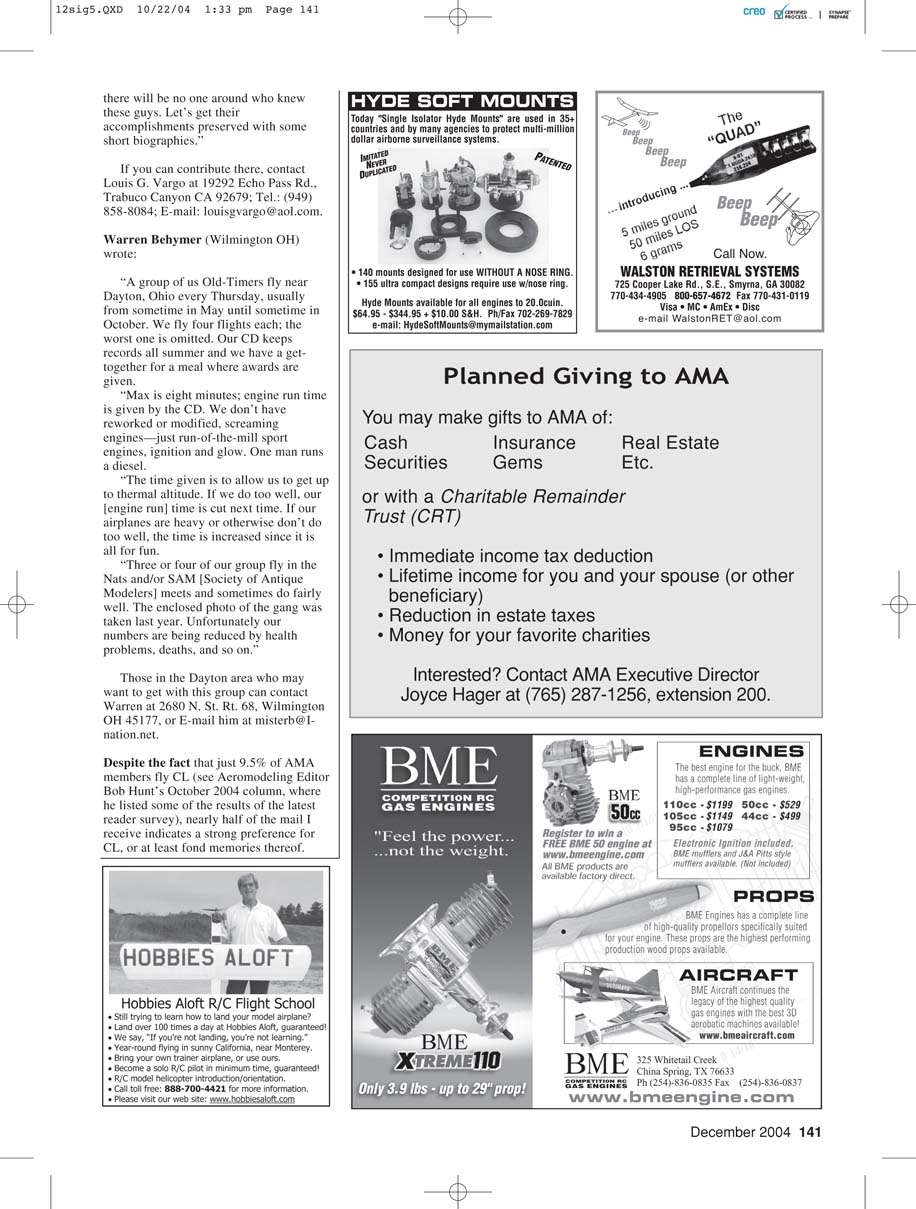
A group of us old-timers fly near Dayton, Ohio every Thursday, usually from sometime in May until sometime in October. We fly four flights each; the worst one is omitted. Our CD keeps records all summer and we have a get-together for a meal where awards are given.
Max is eight minutes; engine run time is given by the CD. We don't have reworked or modified, screaming engines—just run-of-the-mill sport engines, ignition and glow. One man runs a diesel.
The time given is to allow us to get up to thermal altitude. If we do too well, our engine run time is cut next time. If our airplanes are heavy or otherwise don't do too well, the time is increased since it is all for fun.
Three or four of our group fly in the Nats and/or SAM (Society of Antique Modelers) meets and sometimes do fairly well. The enclosed photo of the gang was taken last year. Unfortunately our numbers are being reduced by health problems, deaths, and so on.
Those in the Dayton area who may want to get with this group can contact Warren:
- Address: 2680 N. St. Rt. 68, Wilmington OH 45177
- E-mail: misterb@i-nation.net
CL FLIERS — HOWARD BUESCHEL
Despite the fact that just 9.5% of AMA members fly CL (see Aeromodeling Editor Bob Hunt's October 2004 column, where he listed some results of the latest reader survey), nearly half of the mail I receive indicates a strong preference for CL, or at least fond memories thereof.
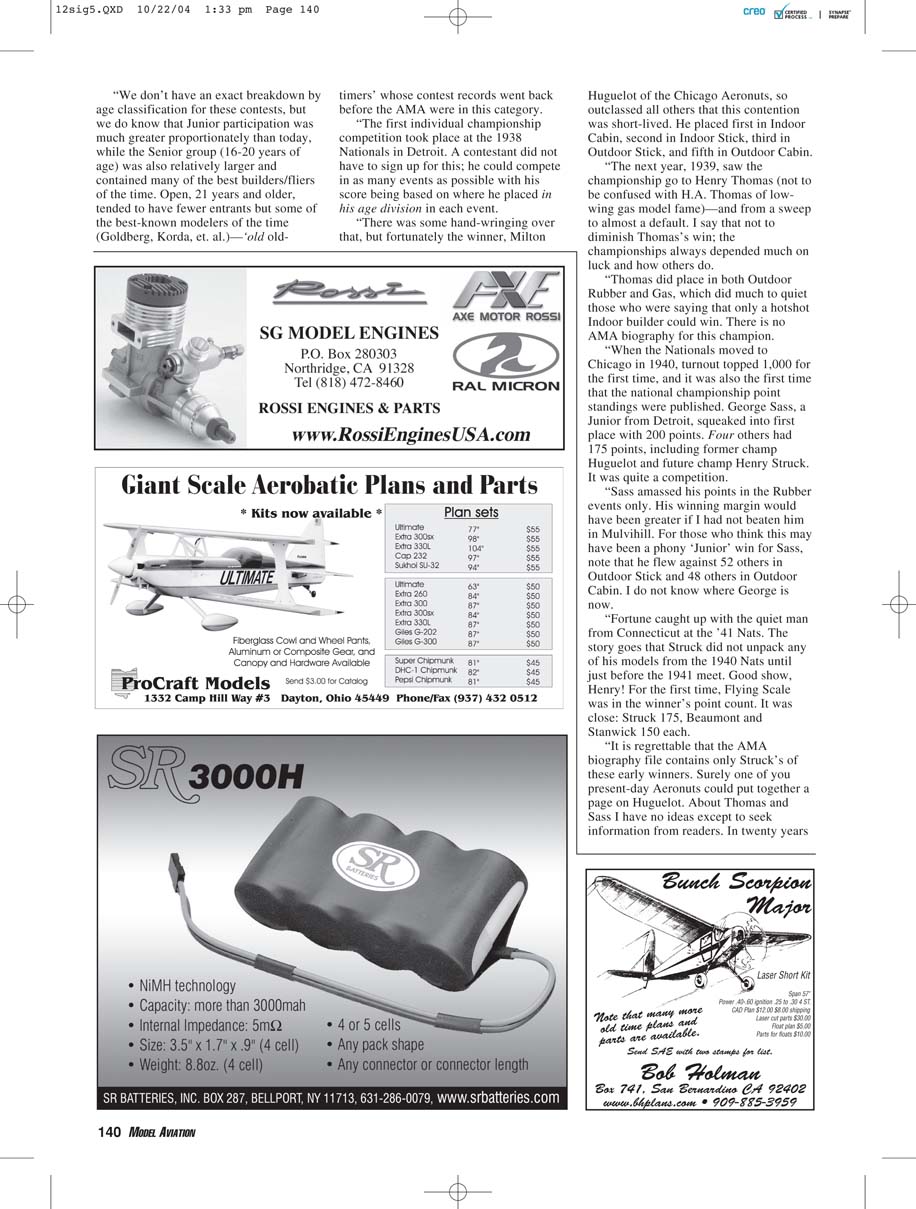
Howard Bueschel (Trenton NJ) is an old-time CL flier with an amazing collection of early engines and pioneering Stunt models. A retired educator, he remains extremely active in the hobby—especially at engine swap meets.
He flies with a Jim Walker U-Reely handle, saying: “Yes, I can still do those—and hope at 90 years I will still be doing the whirling dance in the copycat style of Jim Walker. I saw him twice and he was some inspiration for all who watched him.”
Recalling his introduction to the hobby, Howard wrote:
My first gas model was a Tethered Trainer built from Air Trails plans and powered by an Ohlsson .23. My mother gave me an OK Super .60 for my eighth grade graduation, but I didn't want to chance damaging it in a first gas model, so I cut grass and bought my first Q&R .23 for $16.50 at Craftsman Model Shop in Plainfield, New Jersey.
I had only magazines and the plans to go by, since I didn't know of any clubs or individual gas model fliers. So with thin stick and bottled glue—must have been Ambroid, for it was amber colored—I was off and running.
Flying it was easy. Earl Cayton (the model's designer) was simply a master at design and building. It has remained my favorite gas model and I hope this year to reproduce that first one and have the joy of flying it as I did the original in the summer of 1945.
Thanks to all for your continued support and letters. When writing, please remember to enclose an SASE if you would like a reply.
MA
Transcribed from original scans by AI. Minor OCR errors may remain.

