
Olde Birds Over Pennsylvania
By Dick Miller
On June 28–29, 1997, the Second Chance Squadron, SAM (Society of Antique Modelers) 100 of Lancaster, PA, held what some contestants called the best-run, friendliest, most-fun affair they had ever attended—Olde Birds Over Pennsylvania. The meet was held near Reinholds, PA, at the newly improved Cocalico Propbusters' field. The weather was perfect, the field was in great shape, and the organization was top-drawer. The event honored Maxwell Bassett and Bill Brown.
Background Maxwell Bassett and Bill Brown changed modeling history in 1932 by winning a contest with a gasoline-powered airplane later named Miss Philadelphia. Maxwell designed the victorious model and Bill designed and built its engine. Their win effectively negated competition between rubber- and gasoline-powered model aircraft. For more detail see Dave Ritchie’s three-part article beginning in the September 1983 Model Aviation.
Concept and Rules The concept of Olde Birds Over Pennsylvania, originated by John Delagrange, president of SAM 100, was to commemorate the original event and to honor Maxwell and Bill by centering the contest on a single design—Miss Philly. John simplified SAM rules to eliminate weight and other restrictions; only fuel or battery requirements were necessary to present contestants with a level playing field.
Events and Categories
- Giant Scale — anything with a wingspan greater than 84 inches
- Brown Jr.
- Spark Ignition
- Diesel
- .05 Electric
- Mini Electric — wingspan limited to a maximum (plans could be scaled to meet category requirements)
Because Maxwell periodically changed Miss Philly’s design to meet flying conditions, plans for various versions were available and could be scaled up or down. Participants could find Miss Philly plans with big or small rudders, polyhedral or dihedral wings, and cabin or cabane wing mountings.
Organization and Facilities John Delagrange served as Contest Director (CD), emceed the Saturday night banquet, designed the Olde Birds Over Pennsylvania logo, made road signs, prepared time sheets, and designed unique personal trophy plaques. Winners were photographed holding their airplane while Maxwell congratulated them; each winner’s plaque included that photo.
SAM 100 acquired use of the Cocalico Propbusters' field and the two clubs worked together to provide outstanding services. The renovated field measured approximately 200 feet wide by 600 feet long and could accommodate additional parking. Landowner Vernon Leininger set aside about 25 feet on both sides of the 1,000-foot lane leading to the field so grass could be planted instead of the usual corn crop.
Services and safety provisions included:
- Timers and food service provided by the Propbusters
- Airplane retrieval teams and golf carts to aid spectators with long walks
- An ambulance attendant on site and a Propbusters member trained in CPR and First Aid
- Several cell phones available (the nearest ambulance was about three miles away)
- Two cots in the clubhouse for those needing rest
- Signs posted from the Pennsylvania Turnpike exit at Denver, PA, to the intersections of routes 501 and 897 at Schaefferstown (about 19 miles)
- Contest maps, rules, and a booklet containing Dave Ritchie’s 1983 articles distributed to contestants
- Four-color contest-logo T-shirts produced by assistant CD Paul Arnett
Participants and Notable Entries Contestants represented 15 states from New Jersey to California. Some traveled for days by car (Jim Adams and Sal Taibi were notable examples). Several local contestants and spectators brought Brooklyn Dodgers and Powerhouses for Sal to sign.
Notable entries and incidents:
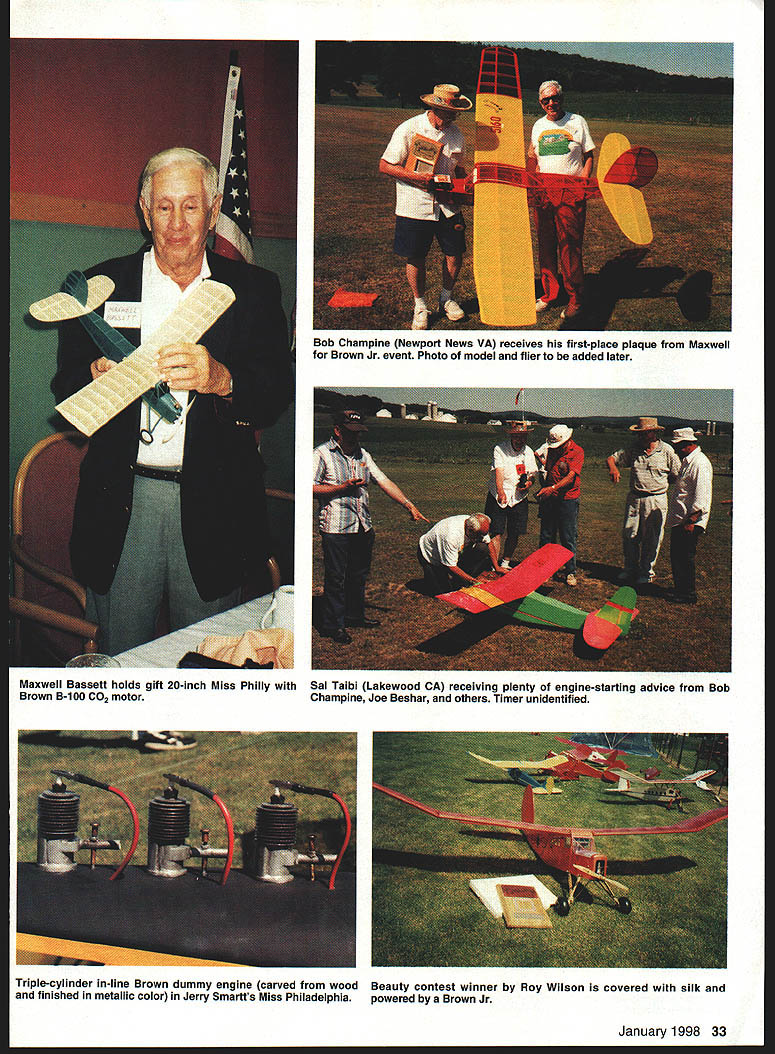
- Bob Kennedy didn’t quite finish his Miss Philly in time for the event.
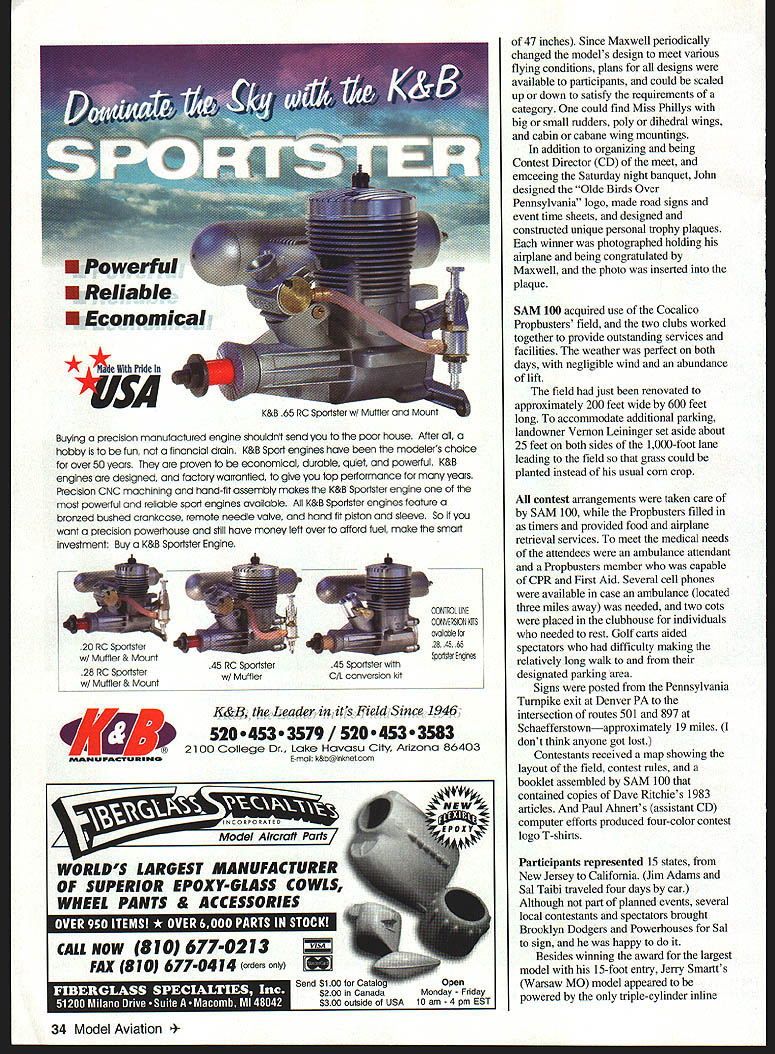
- Jerry Smartt (Warsaw, MO) entered a 15-foot model and won the award for the largest model. His airplane appeared to be powered by the only triple-cylinder in-line Brown Jr. ever made. On closer inspection, the three cylinder assemblies—complete with spark plugs, fuel tanks, needle valves, and venturis—were dummy chambers carved from wood and finished to look metallic. The actual powerplant was six electric motors connected to a planetary gearing arrangement driving a common propeller shaft with a 22 x 10 propeller. Two receivers were used: one for motor control and a second (in the removable tailplane) containing its own battery and servos to eliminate electrical and mechanical connections to the fuselage. Jerry’s initial flight produced a short that opened the series of motors and destroyed his ESC.
- Bob Champine (Newport News, VA) received a first-place plaque.
Mechanical and Electrical Troubles Many models failed to get airborne because of mechanical or electrical problems; most were unable to fly for hardware reasons. All electric entries flew except one (the author’s).
Model Retrieval and Junior Member Recognition Models that missed the normal landing area sometimes needed rescuing from surrounding cornstalks. Seven-year-old Seth Shultz (a Propbusters junior member) and his father Bob retrieved several models. Danny Shields was so impressed that he presented Seth with the 12-book Junior Birdmen Library.
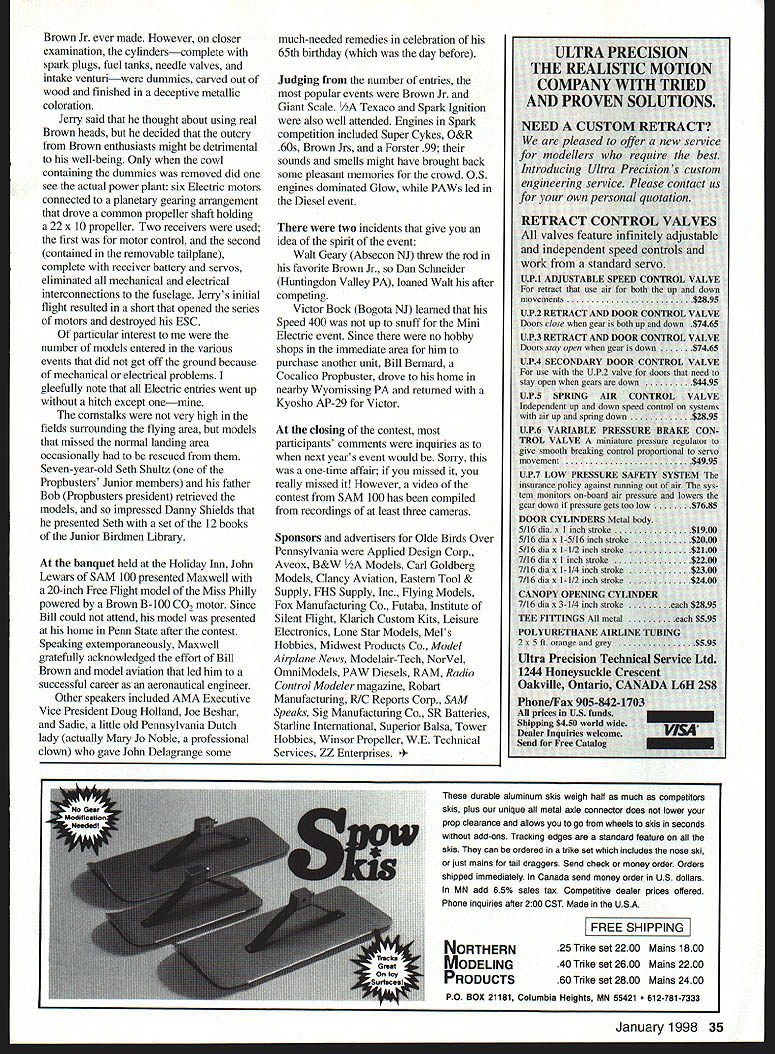
Banquet and Honors At the banquet held at the Holiday Inn, John Lewars of SAM 100 presented Maxwell with a 20-inch free-flight model of Miss Philly powered by a Brown B-100 CO2 motor. Bill Brown, who had suffered a stroke a few weeks before the contest, could not attend; his model was presented at his home in Penn State after the contest. Maxwell spoke extemporaneously and gratefully acknowledged Bill Brown’s contributions and how model aviation led him to a career as an aeronautical engineer.
Other speakers included AMA Executive Vice President Doug Holland, Joe Beshar, and “Sadie,” a little old Pennsylvania Dutch lady (actually Mary Jo Noble, a professional clown), who gave John Delagrange some much-needed remedies in celebration of his 65th birthday.
Spirit of Cooperation — Two Examples
- Walt Geary (Absecon, NJ) threw the rod in his favorite Brown Jr.; Dan Schneider (Huntingdon Valley, PA) loaned Walt his engine after Dan had already competed.
- Victor Bock (Bogota, NJ) found his Speed 400 inadequate for the Mini Electric event. Bill Bernard, a Cocalico Propbuster, drove to his home in nearby Wyomissing, PA, and returned with a Kyosho AP-29 for Victor.
Popular Events and Equipment Judging from entries, the most popular events were Brown Jr. and Giant Scale. 1/2A Texaco and Spark Ignition were also well attended. Engines heard in the Spark competition included Super Cyke, O&R .60s, Brown Jr.’s, and a Forster .99—sounds and smells that brought back pleasant memories for many. O.S. engines dominated Glow, while PAW engines led the Diesel event.
Closing At contest close, most participants wanted to know when next year’s event would be. This was a one-time affair; for those who missed it, SAM 100 compiled a video of the contest from recordings of at least three cameras.
Sponsors and Advertisers
- Applied Design Corp.
- Avexx
- B&W/A Models
- Carl Goldberg Models
- Clancy Aviation
- Eastern Tool & Supply
- FHS Supply, Inc.
- Flying Models
- Fox Manufacturing Co.
- Futura
- Institute of Silent Flight
- Klarich Custom Kits
- Leisure Electronics
- Lone Star Models
- Mel’s Hobbies
- Midwest Products Co.
- Model Airplane News
- Modelair‑Tech
- NorVel
- Omni Models
- P.A.W. Diesels
- RAM
- Radio Control Modeler magazine
- Robart Manufacturing
- R/C Reports Corp.
- SAM Speaks
- Sig Manufacturing Co.
- SR Batteries
- Starline International
- Superior Balsa
- Tower Hobbies
- Winsor Propeller
- W.E. Technical Services
- ZZ Enterprises
Transcribed from original scans by AI. Minor OCR errors may remain.

