
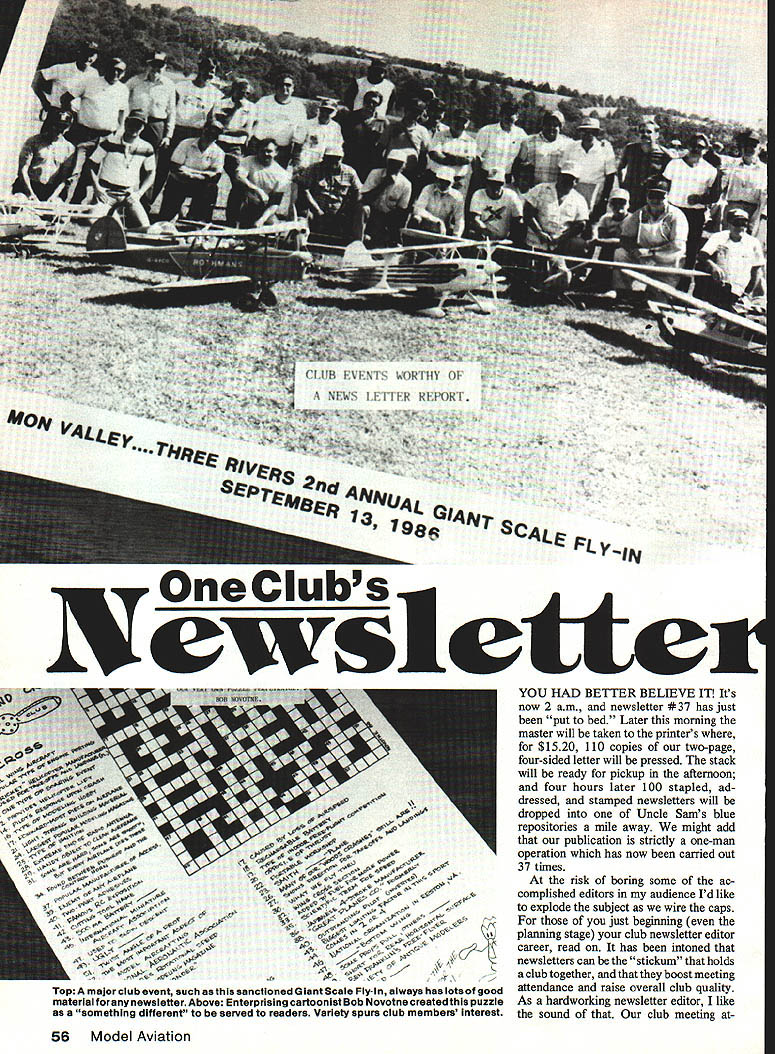
One Club's Newsletter
YOU HAD BETTER BELIEVE IT! It's now 2 a.m., and newsletter #37 has just been "put to bed." Later this morning the master will be taken to the printer where, for $15.20, 110 copies of our two-page, four-sided letter will be pressed. The stack will be ready for pickup in the afternoon; and four hours later 100 stapled, addressed, and stamped newsletters will be dropped into one of Uncle Sam's blue repositories a mile away. Our publication is strictly a one‑man operation which has now been carried out 37 times.
Why a Newsletter Matters
It has been said that newsletters can be the "stickum" that holds a club together — they can boost meeting attendance and raise overall club quality. Our club meeting attendance has risen about 60% above what it had been. The reality, though, is that other factors besides the newsletter have contributed. Still, members seem to appreciate seeing it each month: no one's canceled a subscription, and the club did vote to provide necessary operating funds from its treasury.
The Editor's Workload
The hard part for any newsletter editor — especially of a new publication — is that virtually every aspect of getting the product into members' hands will fall on you. The Post Office will deliver (and will eat up three‑quarters of the operating budget), and print shops will print it. But those are the easy things.
What you should be prepared for is an almost total lack of usable comments or input — even from club officers. Lots of people will say they liked it (or at least hope they will), but you can practically forget receiving material to fill your pages. You're most likely going to have to come up with most of the copy yourself.
Eventually you'll develop a little birdbrain — yes, birdbrain — that's always watching letter stuffings and club happenings. Many clubs don't have a newsletter simply because no member feels they're wordy enough to put one together. Take a close look: what a newsletter very obviously is: a letter.
Content Sources and Filling Pages
Our newsletter is mostly text. In the first place, I enjoy writing; in the second, we feel we cannot yet afford photographs. Maybe someday. After running the newsletter for years, stocks of articles build up and it's easy to round out allotted pages. Newer newsletters must struggle to build such a file and to inform membership about current events. When that happens, you have to take off the editor's hat and become your own ace reporter.
Being unemployed for a time gave me the luxury of more in‑depth reading than was possible during my stint as breadwinner. I could pick up worthwhile articles that at first glance seemed too dry, boil them down, and liven them up for our newsletter — topics like RC frequencies or sound‑level disclosures.
Features and Regular Columns
We include light, engaging features to keep readers coming back:
- Good‑natured banter between factions (for example, four‑cycle engine enthusiasts vs. practical flyers). It’s done in fun and prompts readers to think.
- "Konsumer's Korner" — we blow the whistle on excessive advertising claims and point out, for instance, that a "combination kit" rarely suits both novice and expert pilots. To preserve editorial independence, we opted to operate on a small budget rather than accept outside advertising that might limit our critiques.
- "Trading Post" — members can advertise items to buy or sell free of charge. Response has been lukewarm, but you might find it popular in your club; if an idea doesn't take off, replace it with something else that better gauges reader interest.
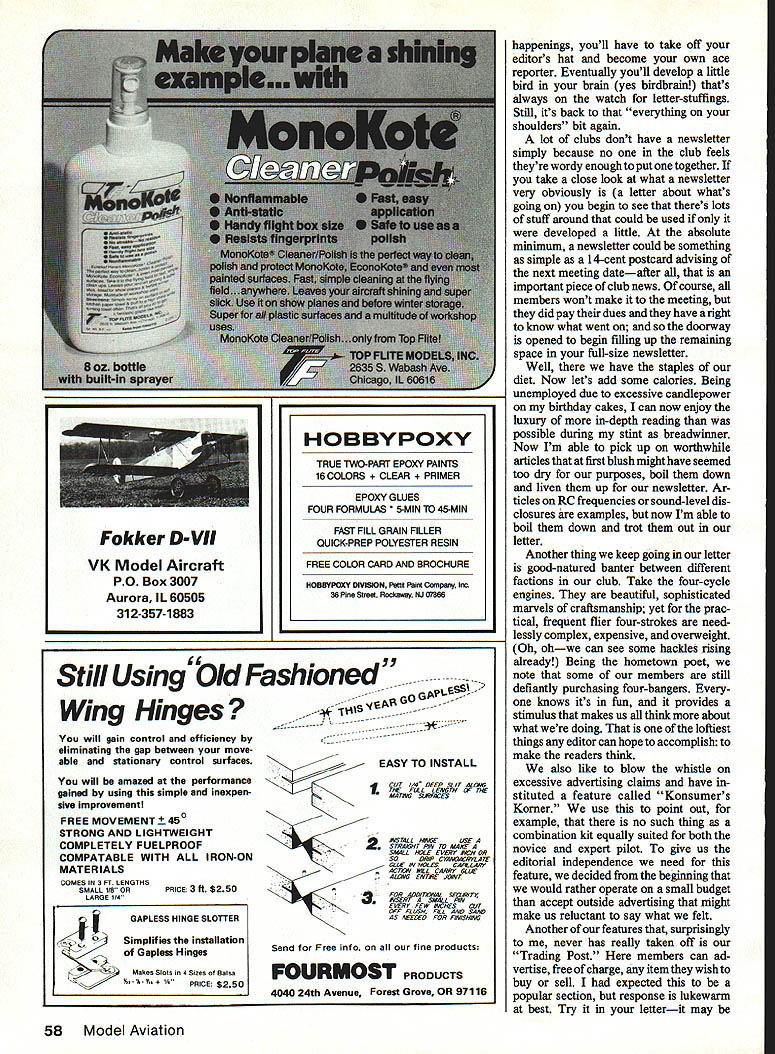
- Member cartoons — many clubs have at least one member with drawing talent. Our cartoons visually enhance the letter.
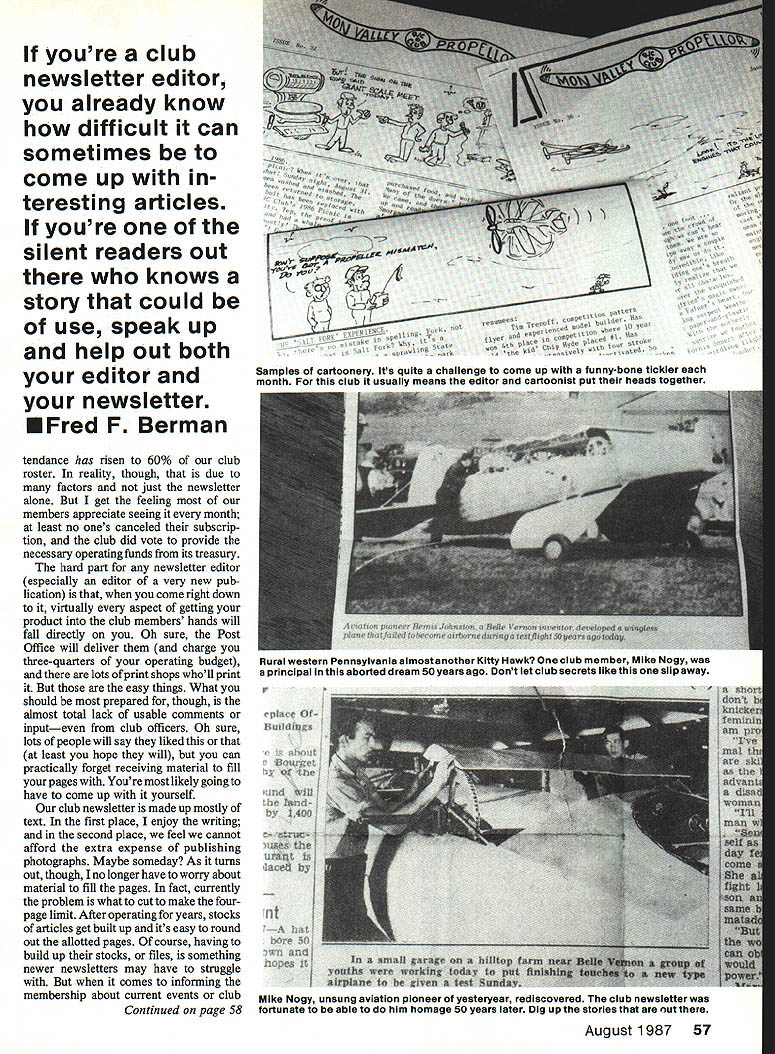
- Member polls and a home‑brewed crossword puzzle.
The newsletter is also an ideal platform for the editor to speak tactfully about pertinent club topics, suggest better or safer rules other clubs have enacted, and act as a second club conscience.
Personalizing the Letter
A Dale Carnegie principle I use: the sound of a person's own name is the sweetest note. I cram articles and reports with members' names and the names of their families. I avoid embarrassing anyone and always report on sick or ailing members when I find out about them.
Accentuating the personal is popular with readers and can be a goldmine of news copy. People are in this hobby because of their link with aviation, and there's likely someone in your club with an unusual background in modeling or full‑scale aviation. You just have to put on your reporter's hat and dig them out.
A Local Aviation Story: The Wingless Airplane
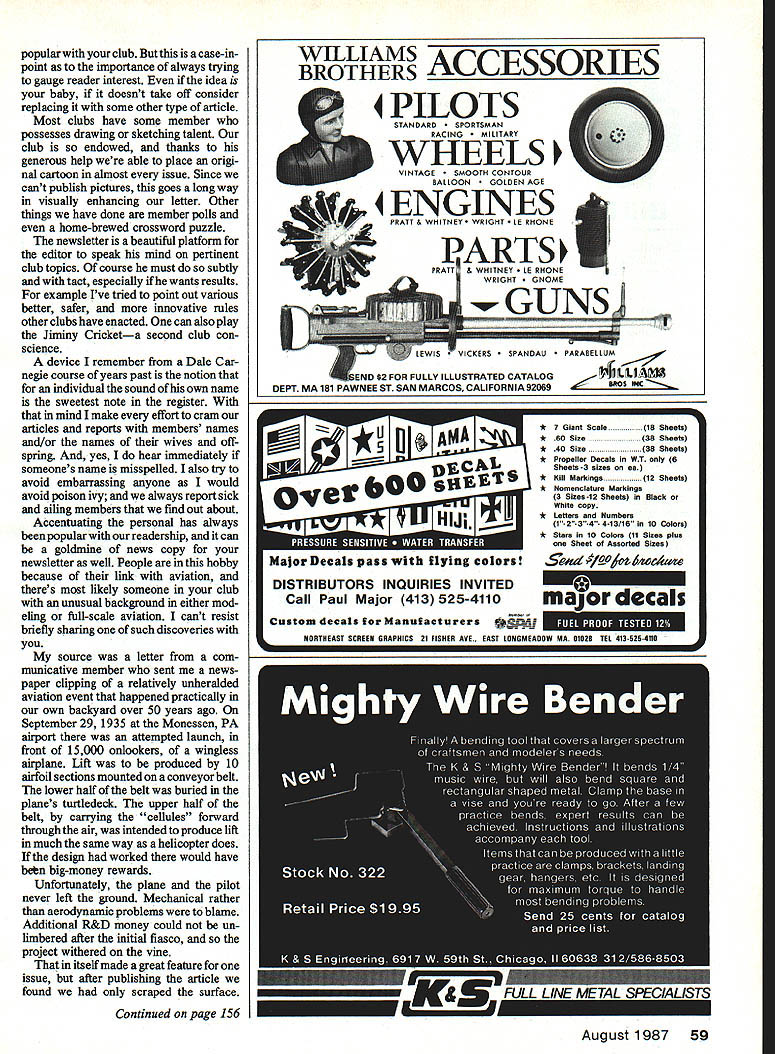
A great example: a member sent a newspaper clipping about an attempted launch, on September 29, 1935 at the Monessen, PA airport, of a wingless airplane intended to produce lift with 10 airfoil sections mounted on a conveyor belt. The design failed to fly due to mechanical problems, and additional R&D money was not forthcoming.
After publishing that item, Michael T. Nogy, our elder statesman member, came forward with pictures and clippings. He had built the plane for its inventor and had a fascinating, tragic story. He confirmed that, in principle, it should have flown; in practice, mechanical problems and restrictions on repairs doomed the project. That follow‑up made a richly detailed sequel and illustrated how many captivating stories sit in your membership if you look for them.
Being an Active Club Member
One of the editor's best assets is being active and aware of other members' activities both on and off the field. This inside information makes your letter more interesting to the group — wives, too, seem to read our little gazette, perhaps to see what we're up to.
Production Mechanics and Shortcuts
The routine mechanics of getting out a newsletter are straightforward: staple pounding, address label taping, and stamp wetting. Typical mailing prep runs about four hours. A few shortcuts we've used:
- Put members' names and addresses into blocks on an 8½ × 11 piece of paper, photocopy it, and cut up for mailing labels.
- Tape labels quickly to already‑stapled newsletters.
- Use a sponge to wet stamps instead of doing it all by mouth.
Types of Newsletters
Newsletters can be broken down into two basic categories:
- Abbreviated report‑type letter:
- Conveys news and dates.
- Lists meeting dates, raffle prizes, flea markets.
- Reports happenings at the previous meeting and names of attendees who stood out (raffle winners, show‑and‑tell exhibitors, snack donors).
- Announces national and local events, mall shows, special programs, and modeling spectaculars like Striking Back.
- Expanded newsletter:
- Includes editorials, critiques, and plans for scratch‑built models.
- Adds safety articles, building techniques, consumer critiques, and unusual experiences.
- Condenses major topics such as frequency allocations, new narrow‑band radios, combating noise, and strategies for holding onto a flying field.
There really is no limit to what you can include in an expanded letter — crank out whatever you can sustain and what your readers value.
Final Thoughts
At times newsletter editors may seem "full of it" — perhaps from the baloney or the urge to write — but the goal is simple: produce a quality product that readers can enjoy and learn from. If your club doesn't have a newsletter and any of this strikes home, think about doing it yourself. It won't be easy, and often you'll work alone, but I can guarantee that your work will do much to make your club a better club.
Transcribed from original scans by AI. Minor OCR errors may remain.

