

One, Two, Three, Kick
L. F. Randolph
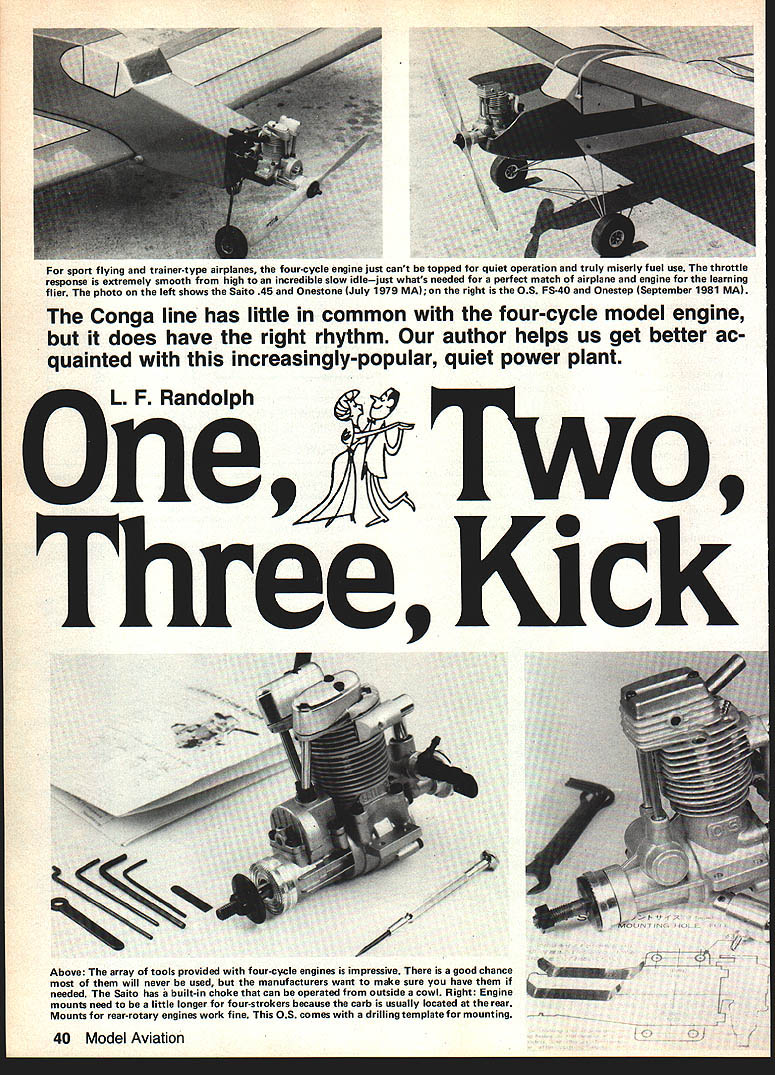
The conga line has little in common with the four-cycle model engine, but it does have the right rhythm. Our author helps us get better acquainted with this increasingly popular, quiet power plant.
One, Two, Three, Kick
RC flying is done by hearing as well as by seeing. Before the flight starts, tuning the engine is done by sound. In the air the sound of the throttle being retarded or the engine going lean or lugging is heard before any visual indication is given, and controls are moved to compensate. At the same time we fool ourselves with sound. When we hear a recording of a model airplane engine, we are surprised at the high, thin noise that comes out—and usually blame the effect on a poor recording.
Actually, the equipment is correct. Our brain translates those pops into a roar when the airplane is flying. Unfortunately, those not in the hobby-sport do not have such a translator. To them, our engines sound like the recording.
The dependence on sound is the reason that first flights with a four-cycle-engine-powered airplane are a surprise, for the engine just doesn't sound as though it is running fast enough to fly the airplane. Even after a ground run that is twice as long as necessary and the airplane is flying well, the feeling still persists. It takes quite a few flights with round loops and good vertical figures to realize that the power is there and that the sound is really more realistic than before.
Sound, therefore, is of real importance to us fliers as well as to the public. In the case of the public, the term is noise rather than sound. The four-cycle engine in RC aircraft may well be the answer that pleases both, with a bonus of more flying time from a gallon of rather expensive fuel.
The two-cycle engine that we have long used in our airplanes is a very remarkable and powerful machine that has been brought near perfection, yet it still sends nearly as much fuel out the exhaust stack as it actually burns in the cylinder. The operation of a two-cycle engine is such that the exhaust port is opened by the descending piston while the vaporized fuel is still burning, so part of the burning takes place outside of the cylinder. Like the report of a pistol when the bullet has left the barrel, noise is generated. A short time later the intake port is opened by the piston on its way down, and a fresh charge of fuel is pushed into the cylinder by the compression of the fuel‑air mixture in the crankcase. Some of this fresh charge also goes out the still‑open exhaust port.
When the burning of the fuel‑air mixture occurs in the cylinder head of a four-cycle engine, the burned gases cannot escape from the cylinder until the piston is at the bottom of its stroke and the exhaust valve opens. Actually, the piston pushes the burned gases out the exhaust as it returns to the top of the cylinder. The piston then pulls a new charge of fuel and air into the combustion chamber as it descends in the cylinder the second time. It then compresses the new charge as it ascends for another power stroke when the fuel‑air mixture is ignited as the piston once more reaches the top of the cylinder.
This up‑down, up‑down movement of the piston for every time the plug fires is the reason for the term four‑stroke cycle (usually shortened to four‑cycle or four‑stroke). It is also the reason that most of the fuel that goes into the engine is burned as power—and because the "explosion" of the burning fuel is contained, and occurs only once for every two revolutions of the propeller, the operation is quiet in comparison with a two‑cycle engine.
In a two‑cycle engine the piston itself is the valve that opens and closes the intake and exhaust ports. In the four‑cycle, this must be done in a different manner. The intake and exhaust valves are located in the head rather than in the sleeve, and they are activated in the proper order by cams which are geared to the crankshaft. One make of four‑cycle engine uses rotary‑type valves which are operated by a belt, but most systems use pushrods.
In both systems, timing is critical, and disassembly is not recommended. The pushrods work through rocker arms which open and close the valves as required by the position of the piston. A few drops of oil on these rocker arms after a flying session is a very good idea. The fuel requirement for a four‑cycle is the same as for a two‑cycle; experts to the contrary, do not skimp on oil.
There is one thing that should be done after the initial break‑in and running period that is different from two‑cycle operation: adjustment of the rocker arms. After a period of time the pushrods tend to wear and become slightly shorter. On each rocker arm there is a screw adjustment which compensates for this wear. The adjustment is well covered in the manuals that come with the engines, along with the proper tools and gauges to make the task. The procedure is simple, and after adjustment the clearances can be checked with the gauges periodically to assure the engine is performing at its peak.
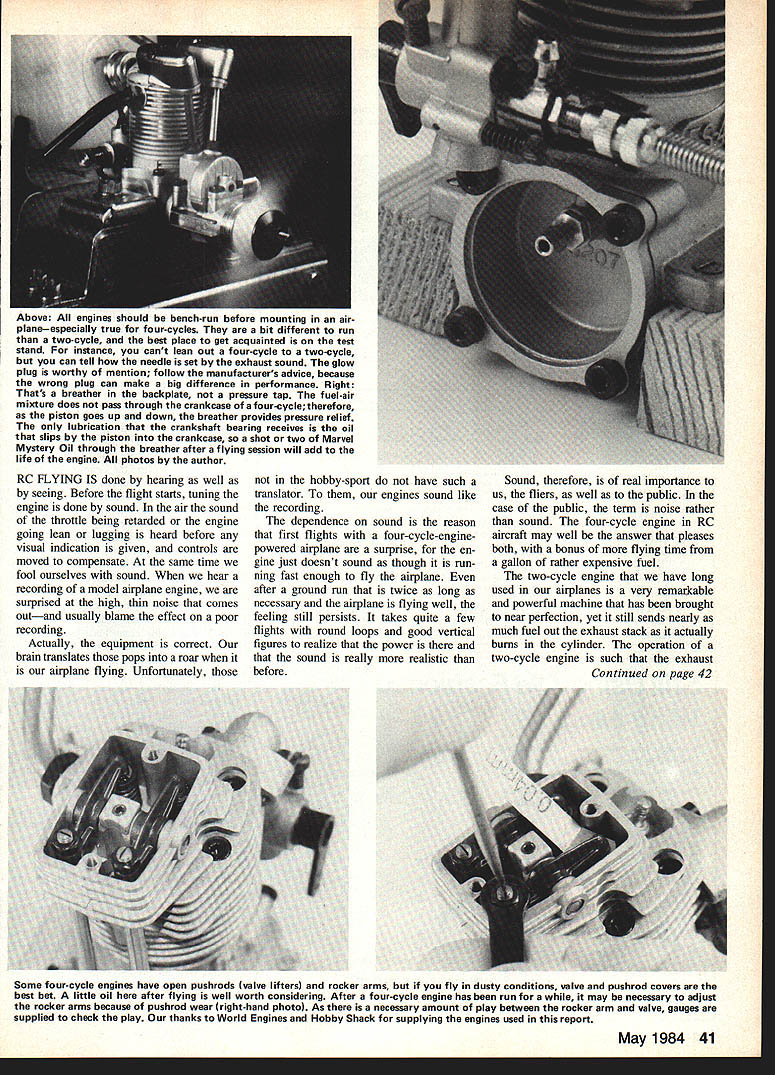
Some four‑cycle engines have open pushrods, valve lifters and rocker arms; if used in dusty conditions, valve pushrod covers are recommended. A little oil after flying is well worth considering. After a four‑cycle engine has run it may be necessary to adjust rocker arms because of pushrod wear. The necessary amount of play between rocker arm and valve is checked with the gauges supplied.
Four-Cycle
Four-cycle engines have crankcase breathers. As the piston goes up and down in the cylinder, air must come in and go out of the crankcase. A breather is provided to allow for this action (it is not a pressure tap). In a tightly cowled engine installation, the breather should be vented to the outside. A squirt of oil into the breather after a flying session gives the shaft bearings good lubrication.
The ability to turn larger, more efficient propellers at a reasonable speed tends to offset the somewhat less power developed by the four-cycle as compared to the faster‑revving two‑stroke. For example, a .40 four‑cycle easily turns a 12x6 prop at 8,500 to 9,000 rpm. This ability should especially appeal to those who fly scale airplanes with large radial cowlings.
In summary, as the state of the art now stands, the four‑cycle engine produces about 75% as much power as the same size two‑cycle, but it produces only one‑fourth as much noise, and that noise is a rumble rather than a whine.
Recommended additional reading:
- Small Gas Engines, Paul Weisser, Harper & Row.
- All About Small Gas Engines, Jud Purvis, Goodheart‑Willcox.
- Diesel & High Compression Gas Engine Fundamentals, Edgar J. Kates, American Technical Society.
- The Internal Combustion Engine and How It Works, David Urquhart, Henry Z. Walck, Inc.
Transcribed from original scans by AI. Minor OCR errors may remain.

