
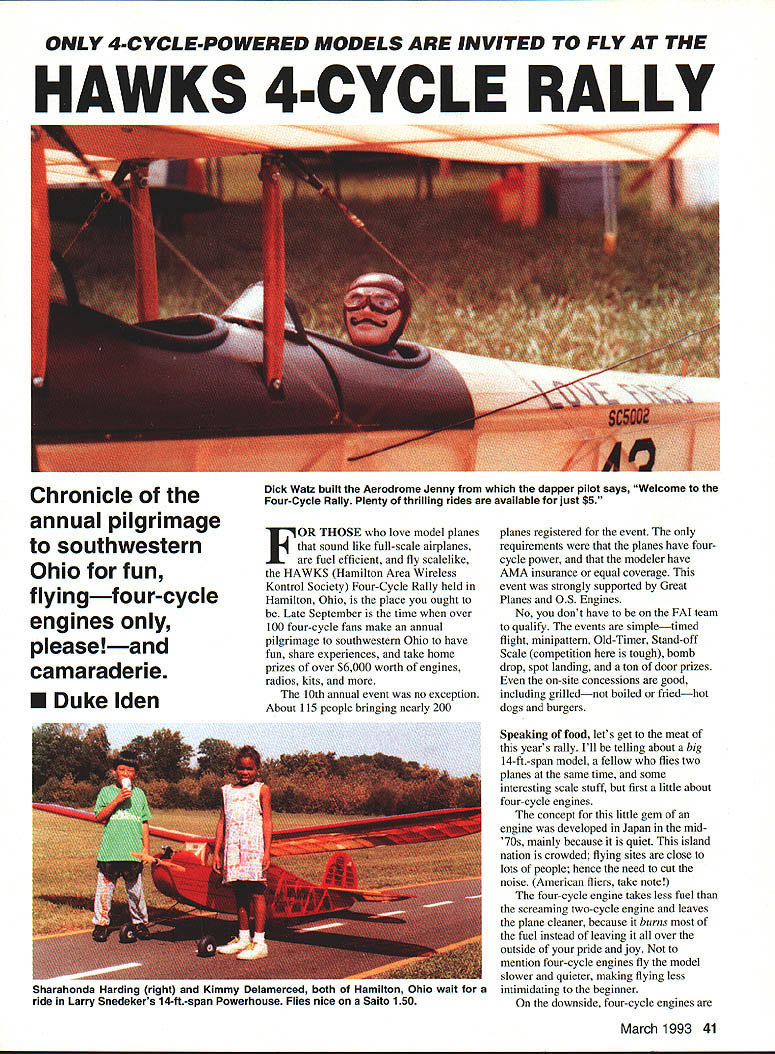
ONLY 4-CYCLE-POWERED MODELS ARE INVITED TO FLY AT THE HAWKS 4-CYCLE RALLY
Duke Iden
For those who love model planes that sound like full-scale airplanes, are fuel efficient, and fly scale-like, the HAWKS (Hamilton Area Wireless Kontrol Society) Four-Cycle Rally in Hamilton, Ohio, is the place to be. Late September is when over 100 four-cycle fans make an annual pilgrimage to southwestern Ohio to have fun, share experiences, and take home prizes worth more than $6,000 in engines, radios, kits, and more.
The 10th annual event was no exception. About 115 people bringing nearly 200 planes registered for the rally. The only requirements were that the planes have four-cycle power and that the modeler have AMA insurance or equal coverage. The event was strongly supported by Great Planes and O.S. Engines.
Events were simple and fun:
- Timed flight
- Minipattern
- Old-Timer
- Stand-off Scale (competition here is tough)
- Bomb drop
- Spot landing
- Tons of door prizes
Even the on-site concessions were good, including grilled — not boiled or fried — hot dogs and burgers.
Four-cycle engines: advantages and trade-offs
The four-cycle engine concept was refined in Japan in the mid-1970s mainly because it is quiet. With flying sites close to populated areas, noise reduction became important.
Advantages:
- Quieter operation, sounding more like full-scale airplanes
- Better fuel efficiency; they burn more of the fuel rather than leaving residue on the model
- Slower, more scale-like flying that is less intimidating for beginners
- Higher torque allows swinging larger props and pulling bigger planes
Trade-offs:
- More expensive initially than two-cycle engines (but fuel savings can recoup cost over time)
- Require more frequent break-in and more frequent oiling because bearings can rust
- Valve adjustments are needed periodically
- Lower power-to-weight ratio compared to two-strokes
THE BIG, THE STRANGE, AND THE BEAUTIFUL
The big
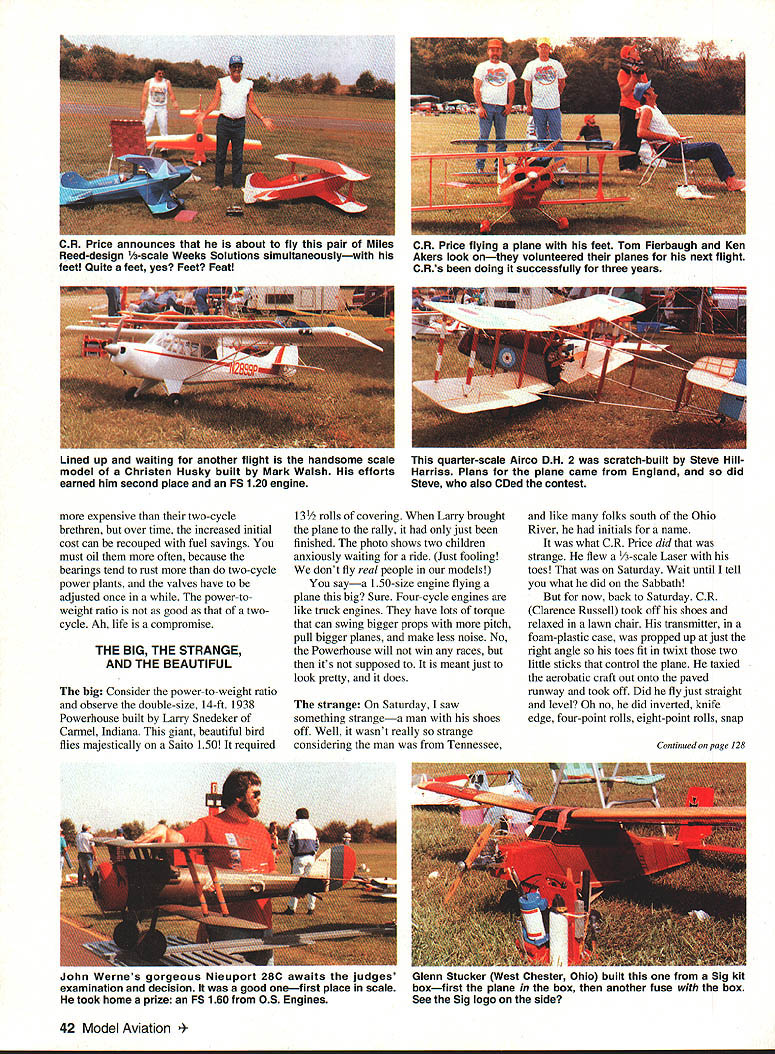
Consider power-to-weight ratio and observe the double-size, 14-foot 1938 Powerhouse built by Larry Snedeker of Carmel, Indiana. This giant, beautiful bird flies majestically on a Saito 1.50 and required 13½ rolls of covering. When Larry brought the plane to the rally, it had only just been finished. (Just fooling! We don't fly real people in our models!)
You might ask—a .50-size engine flying a plane this big? Sure. Four-cycle engines are like truck engines: lots of torque that can swing bigger props with more pitch, pull larger airframes, and make less noise. The Powerhouse isn't meant to win races; it's meant to look pretty, and it does.
The strange
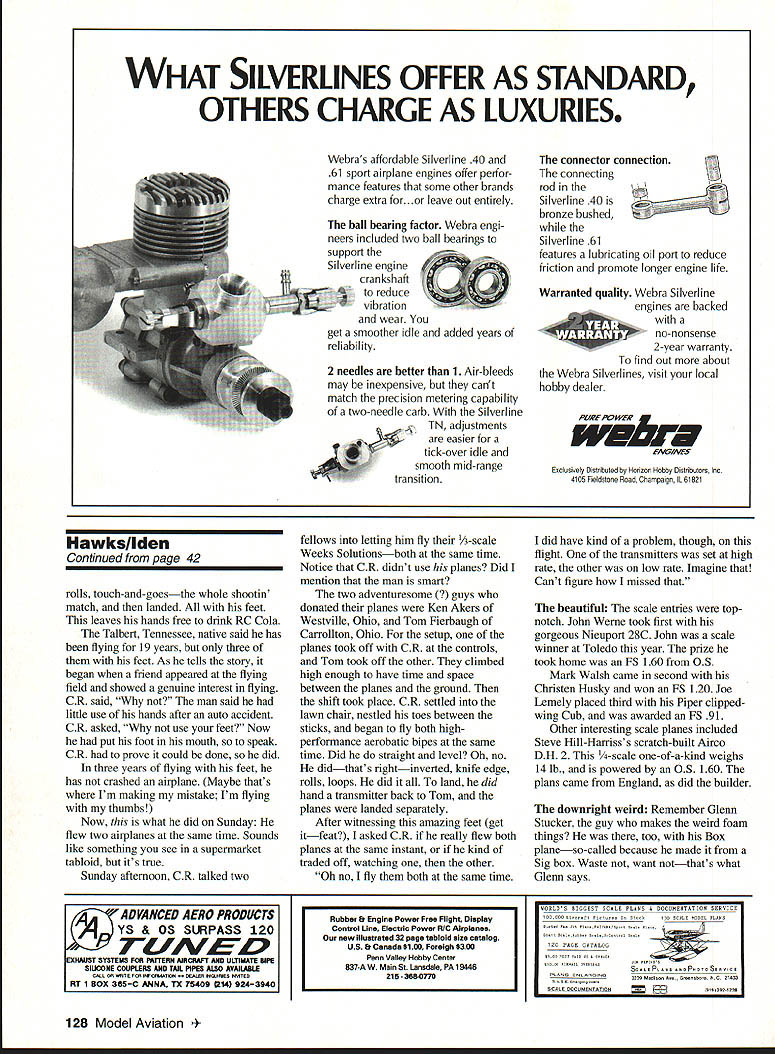
On Saturday I saw something unusual: a man flying with his shoes off. Not that uncommon for someone from Tennessee, perhaps, but what C.R. (Clarence Russell) Price did was remarkable. He flew a 1/3-scale Laser using his toes.
C.R. relaxed in a lawn chair with his transmitter in a foam-plastic case propped at just the right angle so his toes fit between the sticks that control the plane. The Laser taxied out onto the paved runway and took off. Did it fly straight and level? No — inverted, knife-edge, four-point rolls, eight-point rolls, snap rolls, touch-and-goes — the whole shootin' match — and then landed. All with his feet. This leaves his hands free to drink RC Cola.
The Tennessee native said he has been flying for 19 years, but only three of them with his feet. His interest began when a friend with limited use of his hands wanted to learn to fly. C.R. figured, why not use your feet? He had to prove it could be done, and he did. In three years of flying with his feet, he has not crashed an airplane.
On Sunday he outdid himself: he flew two airplanes at the same time. C.R. talked two fellows into letting him fly their 1/3-scale Weeks Solutions simultaneously. One plane took off with C.R. at the controls while Tom took off the other. They climbed high enough, then C.R. settled into the lawn chair, nestled his toes between the sticks, and flew both high-performance aerobatic ships at once — inverted, knife-edge, rolls, loops — and then handed a transmitter back to Tom to land them separately.
When asked if he really flew both at the same instant, C.R. said, "Oh no, I fly them both at the same time." He did note one problem on that flight: one transmitter was set at high rate and the other on low rate. "Imagine that! Can't figure how I missed that."
The beautiful
Scale entries were top-notch. First place in Scale went to John Werne for his gorgeous Nieuport 28C; his prize was an FS .160 from O.S. Engines. Mark Walsh took second with a Christen Husky and won an FS .120. Joe Lemely placed third with his Piper clipped-wing Cub and was awarded an FS .91.
Other notable scale planes included Steve Hill's scratch-built Airco DH.2 (plans and builder from England). This quarter-scale one-of-a-kind weighs 14 lb. and is powered by an O.S. .160.
The downright weird
Glenn Stucker, known for his unusual foam creations, was there with a "box plane" so called because it was built from a large box. Waste not, want not — that’s Glenn's philosophy.
Closing
Those were some highlights from the 10th annual HAWKS Four-Cycle Rally (11 if you count the very first informal meeting). If this sounds interesting, head to southwestern Ohio next year and enjoy the sights and quiet sounds of a four-cycle rally. You might even go home with an engine.
Transcribed from original scans by AI. Minor OCR errors may remain.

