

For Openers
Welcome Aboard! In two words, we already have some explaining to do.
What's happening? Let's begin with that title, "For Openers." It marks the beginning point of the issue, and under it we will talk about between-the-lines things relating to the models we publish, their designers, more or less related events—a hint of mystery there—and appropriate things the publisher does not construe as cruelty to the reader.
Who is "we?" "We" represents the staff. This is not an editorial, so keep your cool. Whenever we think of editors and editorials we are reminded of the book, "The View from Pompey's Head." Pompey was a place but the words, somehow, seem to apply. If "we" come on low key, it is because the Model Aviation readers are among the most sophisticated in model airplane publishing. If we didn't think so, John Preston's article (pg. 53), "You and Your Scale Model," might have been titled "Here Come de Judge." But now it is time to say something.
This month we welcome Mike Gretz, our new CL Scale columnist who picks up the handle from the busy Mike Stott. Gretz needs no introduction. You see his designs in the ads and hobby shops. He was a member of the 1974 and 1976 CL Scale World Championship Teams, had the highest U.S. placing in both years. He took first in Open AMA CL Scale at the 1975 and 1976 Nats—winning the Sterling Award in the latter.
In his introductory number, he states very well some of the deep concern to all columnists. They need input from the readers, info on new models, useful hints, pictures of new ships—literally everything and anything. The Wischers, Schoonard, Van Putte, Pruss, and all the other columnists, lay it on the line every month. Fantastic stuff, as you know. But what a brain drain!
It is well to sit back and enjoy, but for how long do you think a guy can talk about his own models and techniques? Please do write the columnist of your choice—his address is at the end of his copy. This is not a routine reminder to get out and vote. Others benefit from your efforts, as you will from them. We want you to have the best. It's all for one, and one for all.
And welcome, too, Don Jehlik, who, last month kicked off his column "Engine Techniques." We know you will be impressed by his understandable, in-depth approach to a subject in which he has few peers.
Don is known as the mechanics half of the Stockton-Jehlik FAI TR Team. They dominated U.S. Team Racing for over a decade. During the span from 1963 to 1970 they held the world's best times, were European Champions once, 1967-1969, second 1965-67, and consecutive World Champions from 1966 to 1970, a feat never duplicated in international competition. Don's other model activities include a long history of power modeling. From CL and FF power models in 1946, a PAA load record in 1952, CL Speed records in 1955 to World FAI Records co-held in CL 10cc Speed with Bob Lauderdale and RC Speed with Bob Scott. He was one of the early engine specialists who showed CL Aerobatics fliers the value of specially prepared engines—notably Bob Gieseke. Don recently moved to Nevada where he works for the Navy at the world's largest ammunition depot. He is continuing work with engines, designing and testing new concepts. The years Don has spent in competitive power modeling will bring readers a wealth of information about model power systems.
Big models have always flown better than small ones. Brad Powers' lead article explains why. Reynolds Number also has much to do with it. If you'll forgive our amateurish definition, that has "something" to do with the viscosity of the air and the number of air molecules that pass over the wing, determined by the airspeed. As spans and chords grow larger, things get smooth. Groovy. Having published "Thinking Big?" in August 1977, we are impressed by the people who wax ecstatic over the majestic flight appearance, and the docility of the planes because of the gentle response times required. We would like to hear from readers about their big ones—and please send pictures so we can enjoy.
We suppose that none of us ever look at a new issue of any magazine without second-guessing the editor's choice of model designs. Why is this or that published, while some other type of model is conspicuous by its absence? While only a few have written us so far about this touchy question, MA has learned the hard way that nothing is what it seems. A magazine audience may expect Pattern and Pylon models, for example, but with scores of winning kits, such as the remarkable Phoenix 7, Dirty Birdy, Cosmic Winds and Minnows, who builds from scratch?
On the other hand, "off beat" sport jobs often ring the bell. Bill Evans' "Simitair" (Dec. '76 MA) flying wing was one sleeper. Not only was the demand for plans sky-high—higher than anything we've seen since the Smog Hog (ask Gramps), but now is growing by word of mouth—more than 3000 sets of foam wings were sold by the supplier. And when MA publishes, with crossed fingers, something that few people will build—like the "Big Boy" Unlimited Rubber job (May 1977 MA)—demand often is beyond expectation. An old-timer RC may bang the bell. Or a half-size Korda Wakefield. All this reflects MA's sense of duty toward all interests.
While we go as far as we can to please the sport and RC modeler, we know that the racing fraternity sops up a Kilsdonk Goodyear, or free flighters some Jumbo Rubber job. And, incidentally, the growth of serious Rubber Scale—Peanut, Walnut, Jumbo, and other sizes matching no classification—is a phenomena. Phenomena? Maybe it's a natural.
So MA is "different"—as it is supposed to be—because its policy of promoting
For Openers
all forms of modeling, steers it away from mere popular appeal. Great RC jobs like Nellitz's Chipmunk and Sauger's Fairchild may always lead the way, but expect to see an occasional Speed job, Indoor model, Rubber job, or other supposedly low-appeal types. Although being popular is not a top priority, we hope you like us. We do want your respect.
Aerodynamics and design articles are the bane of any staff's existence. People are forever charging editors with neglect for not doing more about the black art of aerodynamics. But, alas, the venturesome author, and his editor, get picked apart when the formulae hit the printed page. Now we are determined that only a virtual Willie Messerschmitt will talk about the science of flight—as it applies to models. That's the rub—as it applies to models. When a modeler writes about design, engineers sometimes swoon hysterically. And vice versa. So, rubbing our rabbit's foot and manning the barricades, we've decided to let Brad Powers have his say in "About the Size of It" (see pg. 8).
planes launching into overcasts and times were very low. But wouldn't you know it, the only recognizable bubble came through as skies tried to clear, and Jeff Mrlik with his famous Astro-Jeff, and Warren Tiahrt with SD-100, got the highest times of the day and won their respective classes. Jeff was just over the 28-minute mark (for three flights), with a 1933 out of a possible 2100 point score, while Tiahrt scored 1576. Second placers were nearly 250 points behind in both classes, and it was a day when "big sailplanes flew better."
Though most clubs aren't in favor of cash prizes for contest awards, it's worth mentioning L.O.F.T.'s approach to their annual Cash Bash. Twenty percent of the entry fees goes to the winner, while ten percent is awarded each to second, third, and fourth place. The remaining 50 percent goes to the club. The more contestants, the bigger the take. Conversely, if attendance is low, so is the prize money, but then the club hasn't stuck out its financial neck for a table full of trophies and hardware. The system has worked for four years now and Jeff Mrlik, who not only won Unlimited class on Saturday, took two firsts on Sunday and went back to Detroit $62 ahead.
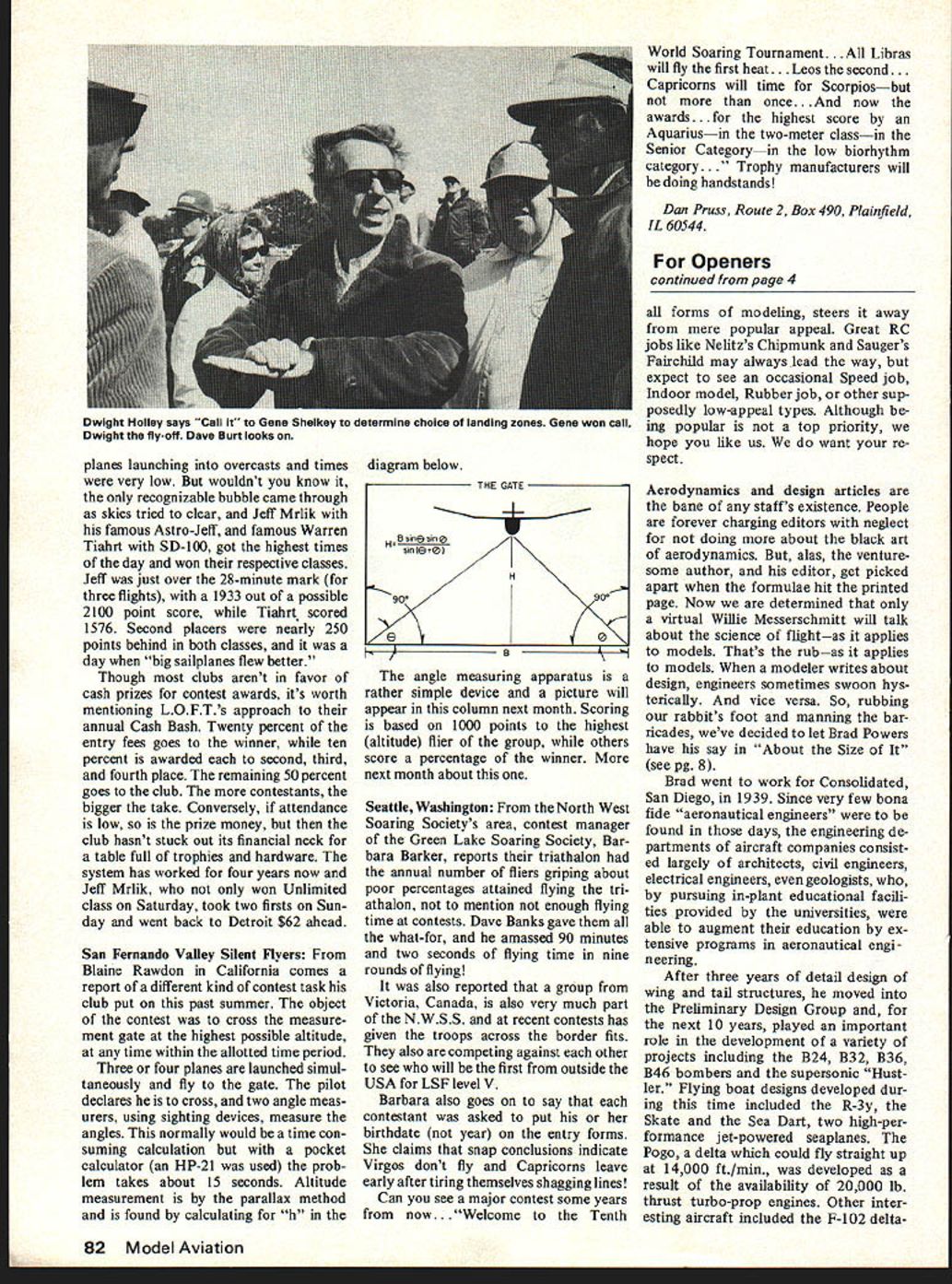
San Fernando Valley Silent Flyers: From Blaine Rawdon in California comes a report of a different kind of contest task his club put on this past summer. The object of the contest was to cross the measurement gate at the highest possible altitude, at any time within the allotted time period.
Three or four planes are launched simultaneously and fly to the gate. The pilot declares his to cross, and two angle measurers, using sighting devices, measure the angles. This normally would be a time-consuming calculation but with a pocket calculator (an HP-21 was used) the problem takes about 15 seconds. Altitude measurement is by the parallax method and is found by calculating for "h" in the diagram below.
The angle measuring apparatus is a rather simple device and a picture will appear in this column next month. Scoring is based on 1000 points to the highest (altitude) flier of the group, while others score a percentage of the winner. More next month about this one.
Seattle, Washington: From the North West Soaring Society's area, contest manager of the Green Lake Soaring Society, Barbara Barker, reports their triathlon had the annual number of fliers griping about poor percentages attained flying the triathlon, not to mention not enough flying time at contests. Dave Banks gave them all the what-for, and he amassed 90 minutes and two seconds of flying time in nine rounds of flying!
It was also reported that a group from Victoria, Canada, is also very much part of the N.W.S.S.S. and at recent contests has given the troops across the border fits. They also are competing against each other to see who will be the first from outside the USA for LSF level V.
Barbara also goes on to say that each contestant was asked to put his or her birthdate (not year) on the entry forms. She claims that snap conclusions indicate Virgos don't fly and Capricorns leave early after tiring themselves shagging lines!
Can you see a major contest some years from now... "Welcome to the Tenth World Soaring Tournament... All Libras will fly the first heat... Leos the second... Capricorns will time for Scorpios—but not more than once... And now the awards... for the highest score by an Aquarius—in the two-meter class—in the Senior Category—in the low biorhythm category..." Trophy manufacturers will be doing handstands!
Brad went to work for Consolidated, San Diego, in 1939. Since very few bona fide "aeronautical engineers" were to be found in those days, the engineering departments of aircraft companies consisted largely of architects, civil engineers, electrical engineers, even geologists, who, by pursuing in-plant educational facilities provided by the universities, were able to augment their education by extensive programs in aeronautical engineering.
After three years of detail design of wing and tail structures, he moved into the Preliminary Design Group and, for the next 10 years, played an important role in the development of a variety of aircraft including the B-24, B-32, B-36, B-46 bombers and the supersonic "Hustler." Flying boat designs developed during this time included the R-3y, the Skate and the Sea Dart, two high-performance jet-powered seaplanes. The Pogo, a delta which could fly straight up at 14,000 ft./min., was developed as a test for availability of 20,000 lb. class thrust turbo-prop engines. Other interesting aircraft included the F-102 delta-
For Openers
wing fighter, and later the F-106. After the war, Convair developed the model 110 Commercial Transport, followed by the 240, 440, and 880. Development had been going on on the Atlas missile under the direction of a wonderful man, Karl Bossart. In 1952, five years before Sputnik, it was speculated that if the payload—the warhead—were replaced with fuel, a speed of 17,500 mph—orbital speed—could be attained. It might even serve as a booster for a moon vehicle....
Other members of the design team included Don Hall, the designer of the Spirit of St. Louis; Etienne Dormoy, one of the early French designers; and Anthony Fokker—the namesake of his uncle, the great Dutch designer of German WW I aircraft.
In 1952 Mr. Powers' talents as an architectural illustrator were in demand. Accordingly, he reluctantly took a year's leave of absence in 1952, and is still on it. After 25 years of architectural work, he still keeps his interest in aeronautics and he and his grandson are now both "avid" model builders—where Brad began.
Whether this month's "For Openers" has come to a close too soon for us, or too late for you, the reader, we should clue you for next month. Less weight and more payload. That's a promise.
Transcribed from original scans by AI. Minor OCR errors may remain.

