
For Openers
Editors get all the glory. If blessed with excellent writers, as is the case with Model Aviation, an editor can't help but look good. There are other people who keep his spelling and language within bounds, who ride shotgun on what everybody says—you never hear of them. Even typesetters can bring an editor up short. One editor who "cut" a Bill Barnes novel decided to "kill" one of several murders in the gory tale. Then came the proofs, with the printer's queries in green ink in the margins: "Where did this body come from?" Ye editor had eliminated one murder all right, but he had five crimes and six bodies.
The Art Editor
On every masthead you find the art editor. He rates more than a mere "film credit." An art editor is always tolerant of the editor as a necessary nuisance but, like an editor, fancies that it is his "graphics" that determine the box office. There is a germ of truth in this. We are the first to admit that things have been looking up ever since our resident graphics doctor came aboard. You'll find him on the contents page—beneath the editor, of course.
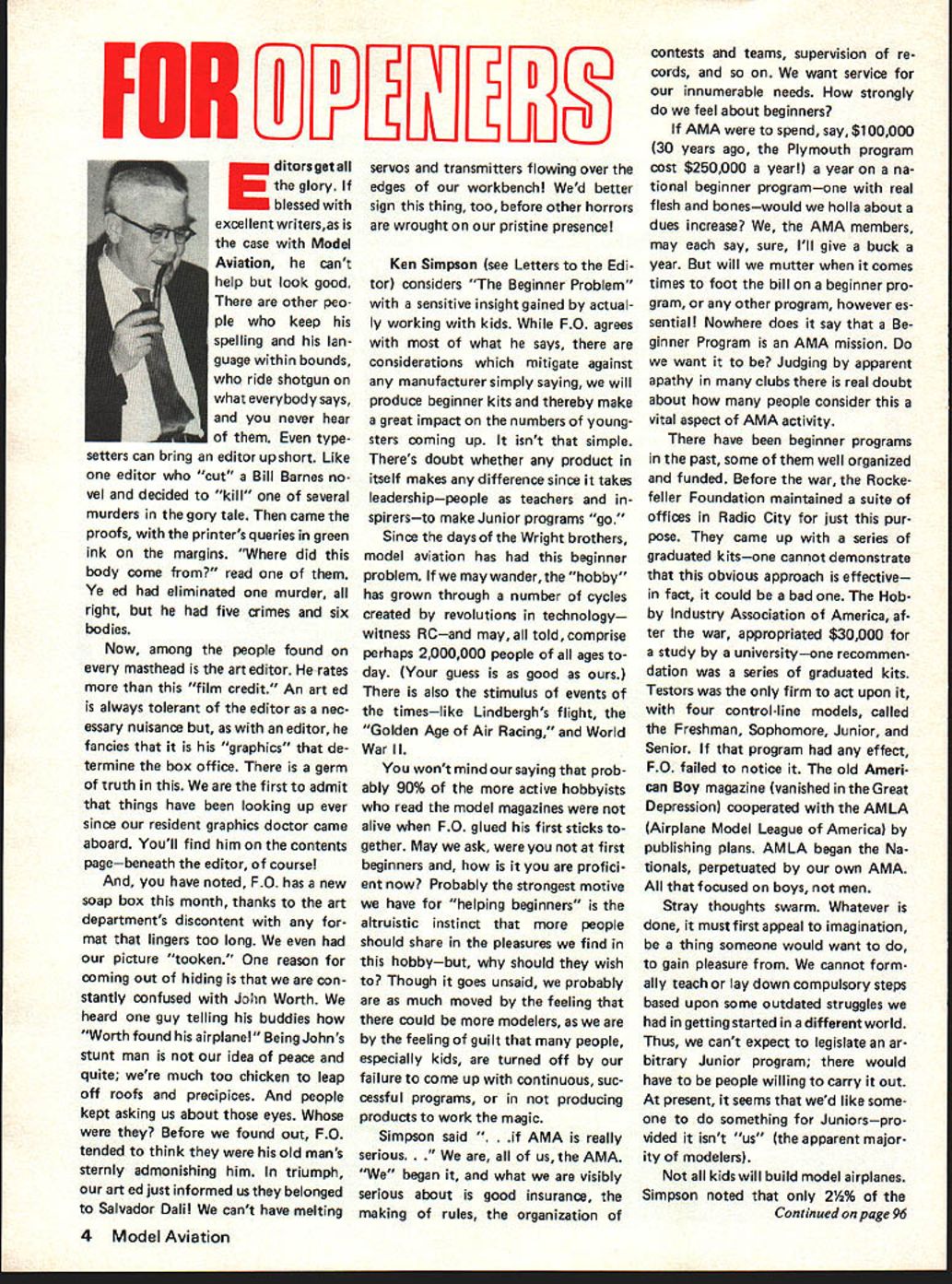
You may have noticed that F.O. has a new soapbox this month, thanks to the art department's discontent with any format that lingers too long. We even had our picture "tooken." One reason for coming out of hiding is that we are constantly confused with John Worth. We heard one guy telling his buddies how "Worth found his airplane!" Being John's stunt man is not our idea of peace and quiet; we're much too chicken to leap off roofs and precipices. And people kept asking us about those eyes. Whose were they? At first F.O. tended to think they were his old man's stern admonishing look. In triumph, our art editor informed us they belonged to Salvador Dalí! We can't have melting servos and transmitters flowing over the edges of our workbench. We'd better sign this thing, too, before other horrors are wrought on our pristine presence!
The Beginner Problem
Ken Simpson (see Letters to the Editor) considers "The Beginner Problem" with sensitive insight gained by actually working with kids. While F.O. agrees with most of what he says, there are considerations that mitigate against any manufacturer simply saying, "We will produce beginner kits" and thereby make a great impact on the number of youngsters coming up. It isn't that simple. There's doubt whether any product in itself makes a difference, since it takes leadership—people as teachers and inspirers—to make junior programs "go."
Since the days of the Wright brothers, model aviation has had this beginner problem. The hobby has grown through a number of cycles created by revolutions in technology—witness R/C—and may, all told, comprise perhaps 2,000,000 people of all ages today (your guess is as good as ours). There is also the stimulus of events of the times—like Lindbergh's flight, the "Golden Age of Air Racing," and World War II.
You won't mind our saying that probably 90% of the more active hobbyists who read the model magazines were not alive when F.O. glued his first sticks together. May we ask: were you not at first beginners, and how is it you are proficient now? Probably the strongest motive we have for "helping beginners" is the altruistic instinct that more people should share in the pleasures we find in this hobby—but why should they wish to? Though it goes unsaid, we are probably as much moved by the feeling that there could be more modelers as we are by a feeling of guilt that many people, especially kids, are turned off by our failure to come up with continuous, successful programs, or in not producing products that work the magic.
Simpson said "...if AMA is really serious..." We all are the AMA. "We" began it, and what we are visibly serious about is:
- good insurance,
- the making of rules,
- the organization of contests and teams,
- supervision of records,
- and so on.
We want service for our innumerable needs. But how strongly do we feel about beginners? If AMA were to spend, say, $100,000 a year on a national beginner program—one with real flesh and bones—would we holler about a dues increase? Thirty years ago the Plymouth program cost $250,000 a year! As AMA members we may each say, "Sure, I'll give a buck a year." But will we mutter when it comes time to foot the bill on a beginner program, or any other essential program? Nowhere does it say that a Beginner Program is an AMA mission. Do we want it to be? Judging by apparent apathy in many clubs, there is real doubt about how many people consider this a vital aspect of AMA activity.
Past Beginner Programs
There have been beginner programs in the past, some well organized and funded. Before the war, the Rockefeller Foundation maintained a suite of offices in Radio City for this purpose. They came up with a series of graduated kits—one cannot demonstrate that this obvious approach is effective; in fact, it could be a bad one. The Hobby Industry Association of America (HIAA), after the war, appropriated $30,000 for a university study—one recommendation was a series of graduated kits. Testors was the only firm to act upon it, with four control-line models called the Freshman, Sophomore, Junior, and Senior. If that program had any effect, F.O. failed to notice it.
The old American Boy magazine (vanished in the Great Depression) cooperated with the Airplane Model League of America (AMLA) by publishing plans. AMLA began the Nationals, which were later perpetuated by our own AMA. All that focused on boys, not men.
Simpson noted that only 2½% of the 4-H youngsters available to him were interested in his program. He felt badly about it. Well, that percentage of some millions of kids would still be a mighty impressive number.
Reality and Audience
Looking at the current situation realistically, we'd have to say that most beginners are not kids. All the magazines are more concerned with another beginner—the adult who wants to get into radio, or perhaps into some other advanced form of modeling. (Parents magazine once tried a comic-book-style True Aviation—it flopped.) Alas, there is no advertising support for youth stuff, and no magazine can live today without advertising. The Junior Modeler, with 20,000 readers, was, at best, a break-even thing. No publisher in our field is so noble-minded that he would support a magazine that never shows profit. Hence, Junior Modeler became Sport Modeler.
It would be nice if the HIAA put $100,000 annually into junior promotion. No one else, including AMA, has as much to gain. But is money alone so important?
How to Promote Juniors
Any promotion, to be successful, must first gain the kid's attention. How do you do that? Where? Even when magazines wore white hats, before the modeling world became so commercial, kids did not read them. The world's finest ideas and projects could have been in those books—and they would have been ignored. Kids don't see magazines on the newsstands, and, anyway, newsstand circulation of today's model magazines amounts to a pitiful hill of beans, even lumped together. Hobby shops and subscriptions account for most of our readers. A great "break out" would be necessary. The appropriate media (not just model mags) must be skillfully used to gain attention, and a follow-up program must be at the ready—continuously, year in and year out. Flashy one-time things won't do. Unimaginative theorizing will never pay off. We need a philosophy. Just manufacturing things is only part of the picture.
The $64 question: Would you help a young beginner (now and for always)?
Clarence Haught's "Northwest" Dakota
Clarence Haught's Northwest Dakota (page 52) is one of those special projects that add an imaginative touch to our scheme of things. Older hands may feel they've been here before; indeed, the Dakota—designed by Joe Wagner and manufactured first by Veco right after the war, and then by Dumas—keeps reappearing like the 17-year locust.
To our knowledge it is the only free-flight airplane ever honestly designed for small-field operation. The original Dakota was an all-balsa cabin biplane with lots of area, stagger, and gap—like some of the prewar Wacos. The kit utilized control-line structural techniques. The wings were Jedelsky type with sturdy leading edges that were left flat on the bottom, curved only on top. Slots cut into the leading edge—the spar—accepted ribs which steadied the light, sheeted rear section. The bottom of the wings was open to the breeze. You did not cover the ship.
It was heavy; the glide was rock-like. Severe left-thrust was incorporated into the engine. Left thrust? Heresy! Everybody knew torque had to be compensated for, but Wagner went with it—and then some. With a Cub for power, the Dakota climbed gently in circles to the left; when the engine cut, the Dakota went into a right-hand glide, thanks to a small rudder tab. This S-shaped transition minimized over-the-ground distance. It was a masterpiece of juggling weight, drag, power, and flight pattern to produce a genuine fun airplane which did not fly away nor break up like a flimsy stick-and-paper job. If powered by a K&B Infant—the first .02—it would skyrocket to all of 10 feet or so on a tank of fuel, circling like the bumblebee that the engineers say should not fly. Thousands enjoyed the Dakota.
Clarence's "Northwest" Dakota is enlarged 25% with built-up wings, covered top and bottom. It behaves like a Dakota should. Lighter on its feet, it can be lost if strong thermal activity is present (avoid it!). A modern .049 puts a charge in its life. Its ability to stay airborne on trifling thrust must be seen to be believed. It's everybody's airplane, unequaled for sport free flight—a relaxation machine and a barrel of laughs. We like that.
Rubber Scale Flying
After that dreamlike spectacle at Johnsville, PA—the Flying Aces Scale Championships—F.O. put in another sun-drenched Saturday at that Maryland Shangri-La where those Maxecuter scale types were running a small contest. The flying was absolutely superb, with tiny World War I bipes climbing sky-high and smooth circles racking up times of two minutes plus—an eternity when you watch a rubber job. In World War II combat, Srull's wicked little Heinkel 100 fighter continued to beat all comers. When you fly rubber scale, everybody on the field is aware of everyone's airplane, and literally everyone pauses to watch a smooth flight. You know how we all watch real planes? It's the same thing—this is an event for airplane watchers.
Sizes average from 20 to 24 inches span, the latter the optimum. Bigger than that, it is tough to wind them, and a broken motor wreaks havoc. If you are into jumbo, use a winding tube. Rubber motors vary from a mere loop of 1/8" on superlight jobs to two loops of 3/16" on the more powerful ships. Rubber length is about 2½ times the distance between hooks; the ideal balance comes with the same length of rubber behind the CG as in front of it—but never, never more than 1½ behind the CG, if one represents rubber length in front of it. The big "new" deal is the braided motor to allow long motor lengths.
To braid the rubber (outside the ship): given, say, 20 to 25 turns on a 5–1 winder, bring the ends together and stroke or squeeze the rubber with a stretching motion between the fingers. It then automatically assumes a neatly braided pattern. It won't sag and bunch to destroy balance when unwound.
Availability of various diameters and pitches of plastic props allows quickly finding the optimum prop/motor combination—something we could not do in the old days. The idea is to find the maximum size prop the airplane can handle before it goes hairy with torque, perhaps an 8" or even 9" prop. Everybody plays with trial combinations. Although the observer can't distinguish between the performance of always-popular high wings, like the Howard or Stinson, and other types, longer durations can be had with efficient configurations like Thompson Trophy types and WWII fighters. The Heinkel 100, Grumman Hellcat, Fiat G-50, et al., are sensational. The Firecracker, Smoothie, and Chambermaid are virtually unbeatable among Thompson types.
Transcribed from original scans by AI. Minor OCR errors may remain.

