
FOR OPENERS
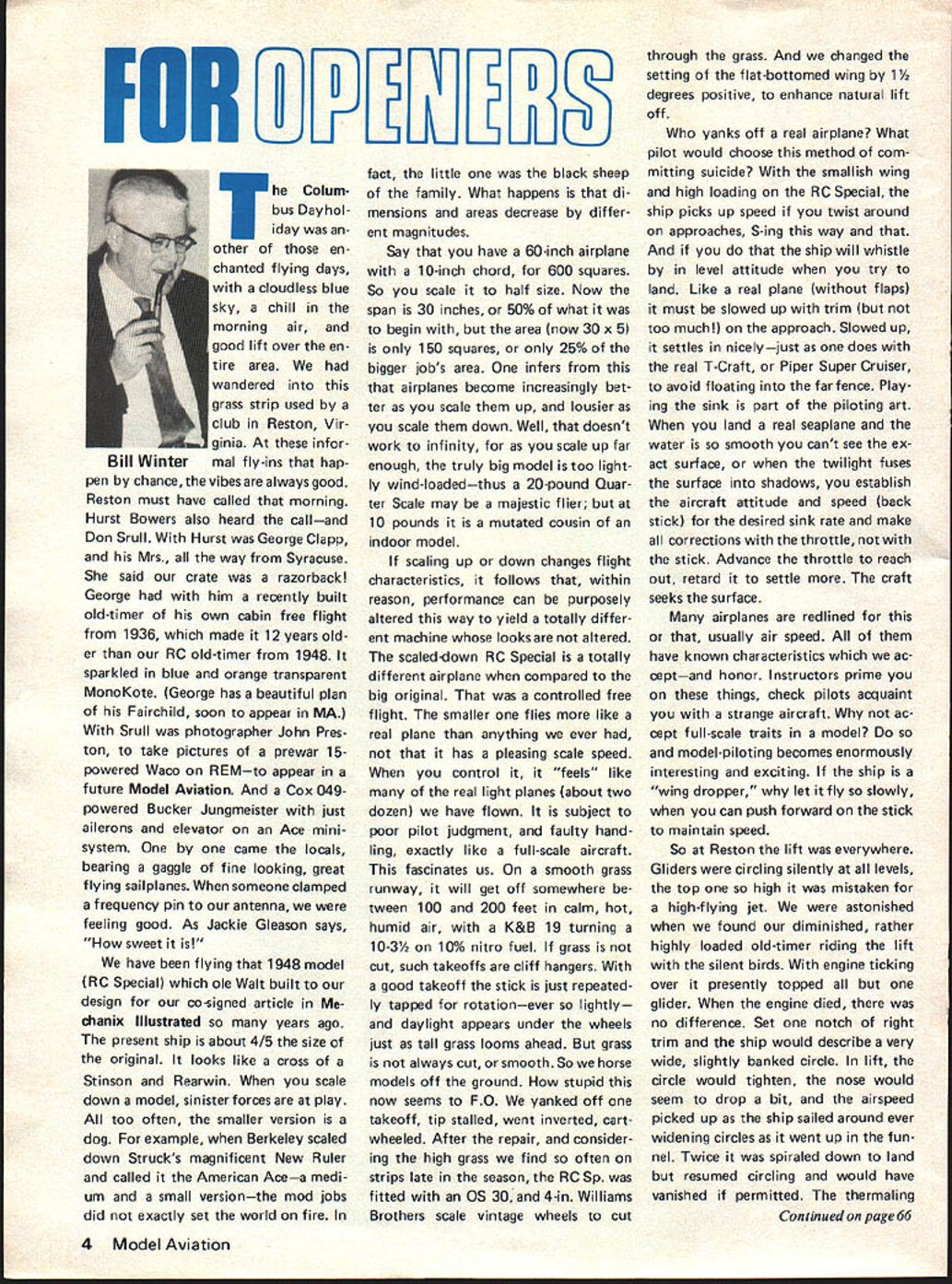
Bill Winter
The Columbus Day holiday was another of those enchanted flying days, with a cloudless blue sky, a chill in the morning air, and good lift over the entire area. We had wandered into this grass strip used by a club in Reston, Virginia. At these informal fly-ins that happen by chance, the vibes are always good. Reston must have called that morning. Hurst Bowers also heard the call—and Don Srull. With Hurst was George Clapp, and his Mrs., all the way from Syracuse. She said our crate was a razorback! George had with him a recently built old-timer of his own — a cabin free flight from 1936, which made it 12 years older than our RC old-timer from 1948. It sparkled in blue and orange transparent MonoKote. (George has a beautiful plan of his Fairchild, soon to appear in MA.) With Srull was photographer John Preston, to take pictures of a prewar 15-powered Waco on REM—to appear in a future Model Aviation. And a Cox 049-powered Bucker Jungmeister with just ailerons and elevator on an Ace minisystem. One by one came the locals, bearing a gaggle of fine-looking, great-flying sailplanes. When someone clamped a frequency pin to our antenna, we were feeling good. As Jackie Gleason says, "How sweet it is!"
We have been flying that 1948 model (RC Special) which ole Walt built to our design for our co-signed article in Mechanix Illustrated so many years ago. The present ship is about four-fifths the size of the original. It looks like a cross of a Stinson and a Rearwin. When you scale down a model, sinister forces are at play. All too often, the smaller version is a dog. For example, when Berkeley scaled down Struck's magnificent New Ruler and called it the American Ace—a medium and a small version—the mod jobs did not exactly set the world on fire. In fact, the little one was the black sheep of the family. What happens is that dimensions and areas decrease by different magnitudes.
Say that you have a 60-inch airplane with a 10-inch chord, for 600 square inches. So you scale it to half size. Now the span is 30 inches, or 50% of what it was to begin with, but the area (now 30 x 5) is only 150 square inches, or only 25% of the bigger job's area. One infers from this that airplanes become increasingly better as you scale them up, and lousier as you scale them down. Well, that doesn't work to infinity, for as you scale up far enough, the truly big model is too lightly wind-loaded—thus a 20-pound Quarter Scale may be a majestic flier; but at 10 pounds it is a mutated cousin of an indoor model.
If scaling up or down changes flight characteristics, it follows that, within reason, performance can be purposely altered this way to yield a totally different machine whose looks are not altered. The scaled-down RC Special is a totally different airplane when compared to the big original. That was a controlled free flight. The smaller one flies more like a real plane than anything we ever had, not that it has a pleasing scale speed. When you control it, it "feels" like many of the real light planes (about two dozen) we have flown. It is subject to poor pilot judgment, and faulty handling, exactly like a full-scale aircraft. This fascinates us. On a smooth grass runway, it will get off somewhere between 100 and 200 feet in calm, hot, humid air, with a K&B 19 turning a 10-3½ prop on 10% nitro fuel. If grass is not cut, such takeoffs are cliff hangers. With a good takeoff the stick is just repeatedly tapped for rotation—ever so lightly—and daylight appears under the wheels just as tall grass looms ahead. But grass is not always cut, or smooth. So we horse models off the ground. How stupid this now seems to F.O. We yanked off one takeoff, tip-stalled, went inverted, cartwheeled. After the repair, and considering the high grass we find so often on strips late in the season, the RC Special was fitted with an OS 30, and 4-in. Williams Brothers scale vintage wheels to cut through the grass. And we changed the setting of the flat-bottomed wing by 1½ degrees positive, to enhance natural lift-off.
Who yanks off a real airplane? What pilot would choose this method of committing suicide? With the smallish wing and high loading on the RC Special, the ship picks up speed if you twist around on approaches, S-ing this way and that. And if you do that the ship will whistle by in level attitude when you try to land. Like a real plane (without flaps) it must be slowed up with trim (but not too much!) on the approach. Slowed up, it settles in nicely—just as one does with the real T-Craft, or Piper Super Cruiser, to avoid floating into the far fence. Playing the sink is part of the piloting art. When you land a real seaplane and the water is so smooth you can't see the exact surface, or when the twilight fuses the surface into shadows, you establish the aircraft attitude and speed (back stick) for the desired sink rate and make all corrections with the throttle, not with the stick. Advance the throttle to reach out, retard it to settle more. The craft seeks the surface.
Many airplanes are redlined for this or that, usually airspeed. All of them have known characteristics which we accept—and honor. Instructors prime you on these things, check pilots acquaint you with a strange aircraft. Why not accept full-scale traits in a model? Do so and model-piloting becomes enormously interesting and exciting. If the ship is a "wing dropper," why let it fly so slowly, when you can push forward on the stick to maintain speed.
So at Reston the lift was everywhere. Gliders were circling silently at all levels, the top one so high it was mistaken for a high-flying jet. We were astonished when we found our diminished, rather highly loaded old-timer riding the lift with the silent birds. With engine ticking over it presently topped all but one glider. When the engine died, there was no difference. Set one notch of right trim and the ship would describe a very wide, slightly banked circle. In lift, the circle would tighten, the nose would seem to drop a bit, and the airspeed picked up as the ship sailed around ever-widening circles as it went up in the funnel. Twice it was spiraled down to land but resumed circling and would have vanished if permitted. The thermaling was like that of a slope soarer.
Why is it that this relatively fast-flying ship, with its conspicuous small wing, loves to ride lift? It is nothing to have 20–25 minute flights on that OS with only a 4-oz. Sullivan slant tank, including several climbs, and perhaps a couple of passes. Incidentally, that OS 30 is a much overlooked engine for the sport flier. Starting, economy, and reliability at low throttle are truly outstanding. That's important to this unreconstructed hand-flipper! Once, we had trimmed to full up when a gust (or thermal) caused the wing to drop and the ship to plummet. Usually, we say this is bad; improve the design. Use washout. But one click forward trim was enough. If it is an airplane, fly it like one. You are a pilot. Right? Regardless of what "Old George" said last month about flying high, that is the only way to hear soul music.
THE MAN AT THE TOP
He solved his flying site problem in a rather unique way. Worth has his fixation: to fly precisely when he feels like it, as close to home as possible, with a prop wrench, small fuel can, a squeeze bulb on the can, and not much else. He's got this Buzzard Bombshell. Any place where he can take a few steps to lay the old crate in the air, where trees and poles are not too close, is a roost for the Buzzard. We are privy to this because, if you have nearby places to fly—like almost any schoolyard or athletic field—you have them all to yourself. Who wants to fly alone? So as the sun sinks in the West, the phone tinkles, the thin query, "Feel like flying?" We always do. And we get to fly the Buzzard—a little!
The Buzzard is a historic crate, a great free flight model built by the many thousands in the late thirties and just after the war. This one has even more going for it. It came from California, in a great big black box a few years ago, packed in purple excelsior and sprinkled liberally with bright colored jelly beans. Bob Harrah—he still has two more Buzzards and says it is his favorite airplane—had revived the historic Joe Konefes Buzzard in RCM, with radio, in about 1972. Silkspar covered, it has all sorts of artistic patches, in many shapes and colors, with pinked edges yet, with crests on booms—all sorts of stuff. A flying crazy quilt with another great sport engine, the Enya .35. J.W. lets it free-flight until the fuel runs out, then "gives it a nudge once in a while." You have got to see this thing soar—like forever. The real buzzards circle with it. Its squarish architecture fits the mood. On one flight that seemed to be up half the afternoon, it was about halfway down when we started to time it—it had to be brought down with down elevator. Nine and a half minutes—even then! Man, we've got to get into this act.
Any great free flight will do, and why bother with cutoff dates? So we have scaled up a Midwest Sniffer to six feet. If the Buzzard is still hanging in there next year, it will be joined by the big Sniffer. You know, the darn buzzards came down with the model and circled overhead at about 50 feet after it landed. Birds of a feather.
As old free flighters, it seemed a whole new world—what we dreamed of decades ago. To be able to watch your genuine free flight model circle and thermal, on and on. When the thermal dies, to seek another. No chase! And to bring it home to your feet every time.
Operator 13 informs us that, on a brief vacation, J.W. hauled the big Buzzard to the beach and put it up repeatedly every day but one, right off the beach. The offseason crowd applauded after each flight, as did folks high on hotel window balconies. F.O. isn't sure if the exec qualifies as a show team, but does think Harrah ought to rush us more of those bright colored jelly beans.
GOOD ISSUES OF MAGAZINES
Good issues of magazines are like good flying sessions. But there are times when, so to speak, bubbles appear around the head bolts, or a pin hole in a feed line drives you up the wall. What you think is a smash proves so-so. What you take for granted may bring a flood of mail. Many people said that last April's issue was the greatest issue of anything they had ever seen. So you examine the thing, scratch your head and think, "What are they talking about?" If you could do the same thing again over and over, you could ride that mythical "great wave." Well, April contained exceptional scale jobs. The scale movement is on fire. Be that as it may, we think this present issue isn't half bad.
There are good things in it that you won't find in other magazines. For example, Glenn Lee presents Part I of an absolutely masterful article on engines (the two great American writers on the subject are named Lee, not related). Another example is Mike Gretz's surprising column on control-line scale subjects. The gist of Mike's presentation is that any good RC scale kit automatically is a good CL subject. Mike describes his approach: engine, control systems, balance—the works. We don't have to point out that this is coming from a master designer and flier and, what is truly significant, a man who is as good with RC scale as he is with the captive variety, for which he is better known.
Since we've had solid approval of our publishing philosophy that good modelers are interested in all phases of the hobby—though a given modeler may build only two or three types—Gretz's broad point of view testifies to the effectiveness of a cosmopolitan approach.
There is also a large group of AMA'ers who describe themselves as "general interest"—24%. Many of these include RC, but it doesn't follow that CL and FF types add up to 24%. They comprise their own groups. Other people are "radio only." But many, if not most, pursue a second or even a third supplementary interest. If you are active in, say, two categories, you do not double your knowledge, skill, and/or enjoyment. Your modeling character improves in an exponential way.
Note that we said "won't find in other magazines." MA does not have an Aladdin's lamp. It's just that we publish under wraps, not wishing to compete head to head with contemporaries. Your editor does not bomb north of the 38th parallel. We do note with genuine pleasure that all of the magazines, which seemed so skittish a few years ago, are now harvesting a fortune in advertising, and look better than ever. If an imagined competition had been feared, the notion, however spooky it may have seemed in a dark room, did result in new achievements in everybody's quality. Nor did anyone's precious advertising diminish; rather the opposite. No advertiser will yank an ad that pays him nobly, even if 20 new magazines appeared. Success should make for secure people.
MA tills its own garden. It brings in new AMA members. Thousands of copies are now sold in the hobby shops. Magazines usually witness a 50% turnover every three issues when copies are sold by display to the public. What happens to the dropouts? They become subscribers. In MA's case, they join AMA, membership grows, association strength grows, and with it influence and benefits and effectiveness. If our contents didn't interest hobby shop customers, MA would be a blunted membership tool.
MA is non-profit. As it grows, the money goes back into the magazine, as for more pages this year. And this allows—with strong allowance for radio—an editorial service to all kinds of modeling, thereby protecting the "endangered species." Our content is designed to be as good as we can make it, without duplicating those lucrative kit reviews in other magazines, and so on, and so on. Model Aviation has duties no profit-minded publisher would live with. We shall keep the faith!
How important is airfoil selection?
There are hundreds, if not thousands, of scientifically developed airfoils, covering every conceivable need in terms of speed, lift, drag, stability, efficiency. Yet, in all the years F.O. has guarded a set of sacred French curves, it has never been evident that a genuine airfoil, say the Clark Y, will fly your model better than something you cook up yourself. We suppose that any modeler worth his salt knows how thick to make a section for his purpose, where to put the high point, what camber he wants, and what to do with the leading edge. The "real" sections have specified coordinates at many stations along the chord. But it was tested at a certain test size, air density, and tunnel airspeed. Reynolds numbers are many times higher than we work with in models. For all we know even that great-looking section of our own may be a dog on a given model. It may be super on an Unlimited Rubber job, but seem to have air brakes on a free-flight gas model. Or no good, or better, on the same model, but in a different size. We've done it both ways many times, and have learned nothing, except that a home-brew thing roughed out for the given design problem always works—and the model flies as good as any other model of its kind. Tear off our epaulets. Beat the drum slowly!
We all have heard of the Zip section, the most famous and most frequently used section in all of modeling. The Zip is not standard; it takes shape from the gleam of an eye. Well-known models made the Zip famous. But we stop short of saying that a scientific section out of the manuals is not best, if applied to the proper size wing, to be flown at the same loading, and at the same airspeed, etc.
Writing in a recent RC Sportsman, Eric Lister, a most knowledgeable engineer whom we read with respect, has been examining families of airfoils. Recently, he reviewed a really famous one, the Grant X-8, and developed interesting derivatives for various purposes. The analysis shows how Charlie's great airfoil (most notably used on the KG) is right on with respect to parameters laid down by eminent authorities. Eric's analysis is accurate. What he says is true.
Also this is true. Charlie Grant developed the X-8 by running a pencil around the outlines of a trout!
Transcribed from original scans by AI. Minor OCR errors may remain.

