
For Openers
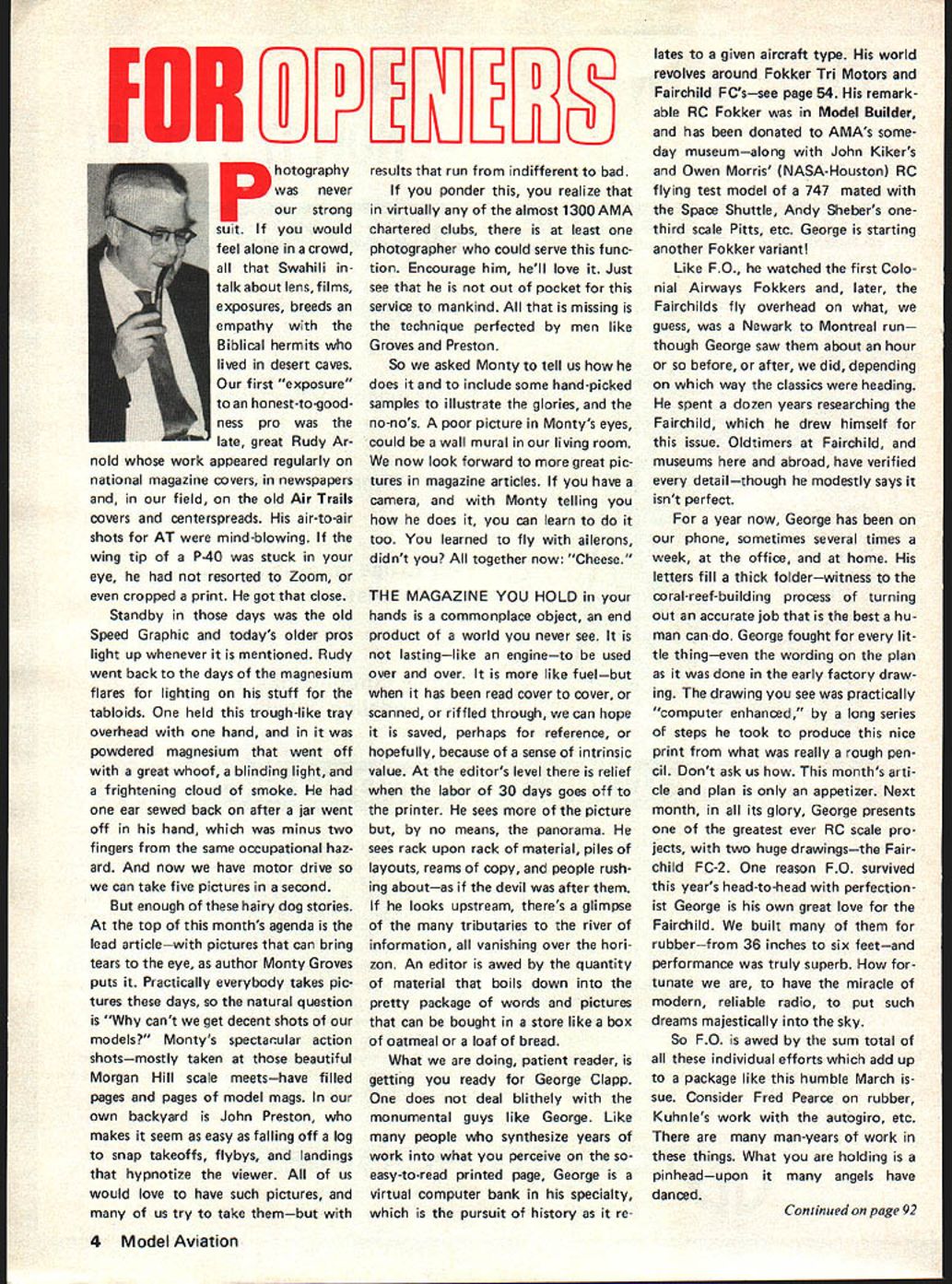
Photography was never our strong suit. If you would feel alone in a crowd, all that Swahili-intalk about lenses, films, and exposures breeds an empathy with the Biblical hermits who lived in desert caves. Our first "exposure" to an honest-to-goodness pro was the late, great Rudy Arnold, whose work appeared regularly on national magazine covers, in newspapers and, in our field, on the old Air Trails covers and center spreads. His air-to-air shots for AT were mind-blowing. If the wingtip of a P-40 was stuck in your eye, he had not resorted to zoom, or even cropped a print. He got that close.
Standby in those days was the old Speed Graphic; today's older pros light up whenever it is mentioned. Rudy went back to the days of magnesium flares for lighting on his tabloid work. One held a trough-like tray overhead with one hand; in it was powdered magnesium that went off with a great whoof, a blinding light, and a frightening cloud of smoke. He had one ear sewn back on after a jar went off in his hand, and he was missing two fingers from the same occupational hazard. And now we have motor drives so we can take five pictures a second.
But enough of these hairy-dog stories. At the top of this month's agenda is the lead article—with pictures that can bring tears to the eye, as author Monty Groves puts it. Practically everybody takes pictures these days, so the natural question is: why can't we get decent shots of our models? Monty's spectacular action shots—mostly taken at those beautiful Morgan Hill scale meets—have filled pages and pages of model mags. In our own backyard is John Preston, who makes it seem as easy as falling off a log to snap takeoffs, flybys, and landings that hypnotize the viewer. All of us would love to have such pictures, and many of us try to take them—but with results that run from indifferent to bad.
If you ponder this, you realize that in virtually any of the almost 1,300 AMA-chartered clubs, there is at least one photographer who could serve this function. Encourage him; he'll love it. Just see that he is not out of pocket for this service to mankind. All that is missing is the technique perfected by men like Groves and Preston.
So we asked Monty to tell us how he does it and to include some hand-picked samples to illustrate the glories and the no-no's. A poor picture in Monty's eyes could be a wall mural in our living room. We now look forward to more great pictures in magazine articles. If you have a camera, and with Monty telling you how he does it, you can learn to do it too. You learned to fly with ailerons, didn't you? All together now: "Cheese."
The magazine and the man behind the plan
The magazine you hold in your hands is a commonplace object, an end product of a world you never see. It is not lasting—like an engine—to be used over and over. It is more like fuel: when it has been read cover to cover, or scanned, or riffled through, we can hope it is saved, perhaps for reference, or hopefully because of a sense of intrinsic value. At the editor's level there is relief when the labor of 30 days goes off to the printer. He sees more of the picture but, by no means, the panorama. He sees rack upon rack of material, piles of layouts, reams of copy, and people rushing about—as if the devil were after them. If he looks upstream, there's a glimpse of the many tributaries to the river of information, all vanishing over the horizon. An editor is awed by the quantity of material that boils down into the pretty package of words and pictures that can be bought in a store like a box of oatmeal or a loaf of bread.
What we are doing, patient reader, is getting you ready for George Clapp. One does not deal blithely with monumental guys like George. Like many people who synthesize years of work into what you perceive on the so-easy-to-read printed page, George is a virtual computer bank in his specialty: the pursuit of history as it relates to a given aircraft type. His world revolves around Fokker Tri-Motors and Fairchild FC's—see page 54. His remarkable RC Fokker was in Model Builder, and has been donated to AMA's someday museum—along with John Kiker's and Owen Morris' (NASA-Houston) RC flying test model of a 747 mated with the Space Shuttle, Andy Sheber's one-third scale Pitts, etc. George is starting another Fokker variant!
Like F.O., he watched the first Colonial Airways Fokkers and, later, the Fairchilds fly overhead on what, we guess, was a Newark-to-Montreal run—though George saw them about an hour or so before, or after, we did, depending on which way the classics were heading. He spent a dozen years researching the Fairchild, which he drew himself for this issue. Old-timers at Fairchild, and museums here and abroad, have verified every detail—though he modestly says it isn't perfect.
For a year now, George has been on our phone, sometimes several times a week, at the office and at home. His letters fill a thick folder—witness to the coral-reef-building process of turning out an accurate job that is the best a human can do. George fought every little thing—even the wording on the plan as it was done in the early factory drawing. The drawing you see was practically "computer enhanced" by a long series of steps he took to produce this nice print from what was really a rough pencil. Don't ask us how. This month's article and plan is only an appetizer. Next month, in all its glory, George presents one of the greatest ever RC scale projects, with two huge drawings—the Fairchild FC-2. One reason F.O. survived this year's head-to-head with perfectionist George is his own great love for the Fairchild. We built many of them for rubber—from 36 inches to six feet—and performance was truly superb. How fortunate we are to have the miracle of modern, reliable radio to put such dreams majestically into the sky.
So F.O. is awed by the sum total of all these individual efforts which add up to a package like this humble March issue. Consider Fred Pearce on rubber, Kuhnle's work with the autogiro, etc. There are many man-years of work in these things. What you are holding is a pinhead—upon it many angels have danced.
For Openers/Winter
continued from page 4
Editors and pattern controversy
Editors are flaky characters. We sit in a "war room" while many trends and developments swirl about us. While it would be to the common good if all took the oath of silence, we are prone to talk ex cathedra. A famous fight manager, a Damon Runyon-type character named Mike Jacobs, famous for his Stengelese malapropisms, told the press after one stink-bomb fight, "I should have stood in bed."
F.O. should have known better. There he was, on a knobby-kneed hoss, lance in hand, drawing a bead on a windmill that was simply asking for it. Hot letters about Novice Pattern goaded him on. When the solvents evaporated, all he had left from a proposed editorial was a pipsqueak observation that Pattern flying might benefit from the equivalent of a Quickie 500—for dubs like us, naturally. We did observe that the four classes—Novice, Advanced, Expert, Master—had been devised to encourage competition at different levels of expertise with then-existent airplanes and, if planes, powerplants, gadgets, and expense followed a natural evolution, so be it.
- The four Pattern classes:
- Novice
- Advanced
- Expert
- Master
Schnuerle engines and pipes, retracts and the ultimate airplanes—just buy a Phoenix, a Dirty Birdy, Curare, etc. Aside from the cost, and the continuous practice with fuel-gobbling 60's, Novices say it is hell trying to climb the Pattern competition ladder because there are crackerjack fliers stalled in the lower classes, and you may never get good enough to climb over them—if only they'd move up! Any guy who seriously flies competition, regardless of class, is darn good. That seems the natural order of things.
We now have editors recommending for the Novice class non-Schnuerle engines, no retracts, no pipes—and even flat-bottomed wings. Proposals exist. In crying for changes, no one considers the law of cause and effect—which usually equates in modeling with the cure being worse than the bite, or a successful operation with a dead patient. When F.O. realized he was thinking of an airplane identical to a Falcon 56 (that ship is still great), thereby turning the clock back 15 years, it would be dynamite to tinker with the Pattern flier's world. So he cut up his lance into trim shims, and melted down old hoss into money-saving "Cold Stuff."
Now he took to bouncing the tough things into Ron VanPutte's court. Ron is our resident Pattern expert. Our letters to him began with a bang and ended with a whimper. Only the continued delivery of his monthly column suggested that, maybe, he was still talking to us. Finally, his last month's column dealt with the touchy matter, and we think he took a logical stand.
To F.O. he said, "I have been thinking about changes to Novice Pattern for a long time. As CD for the Jim Kirkland Memorial, I have had a beginner Novice class for the past two years. I really think the best way to go is to have a special (Editor: Note the word 'Special') which is limited to airplanes with a fixed gear, loop-scavenged engines (without Perry porting) and no tuned pipes. Next year's Kirkland will have such an event.
P.S. A Falcon was my first Pattern airplane."
The RC Special and sport-flyer thoughts
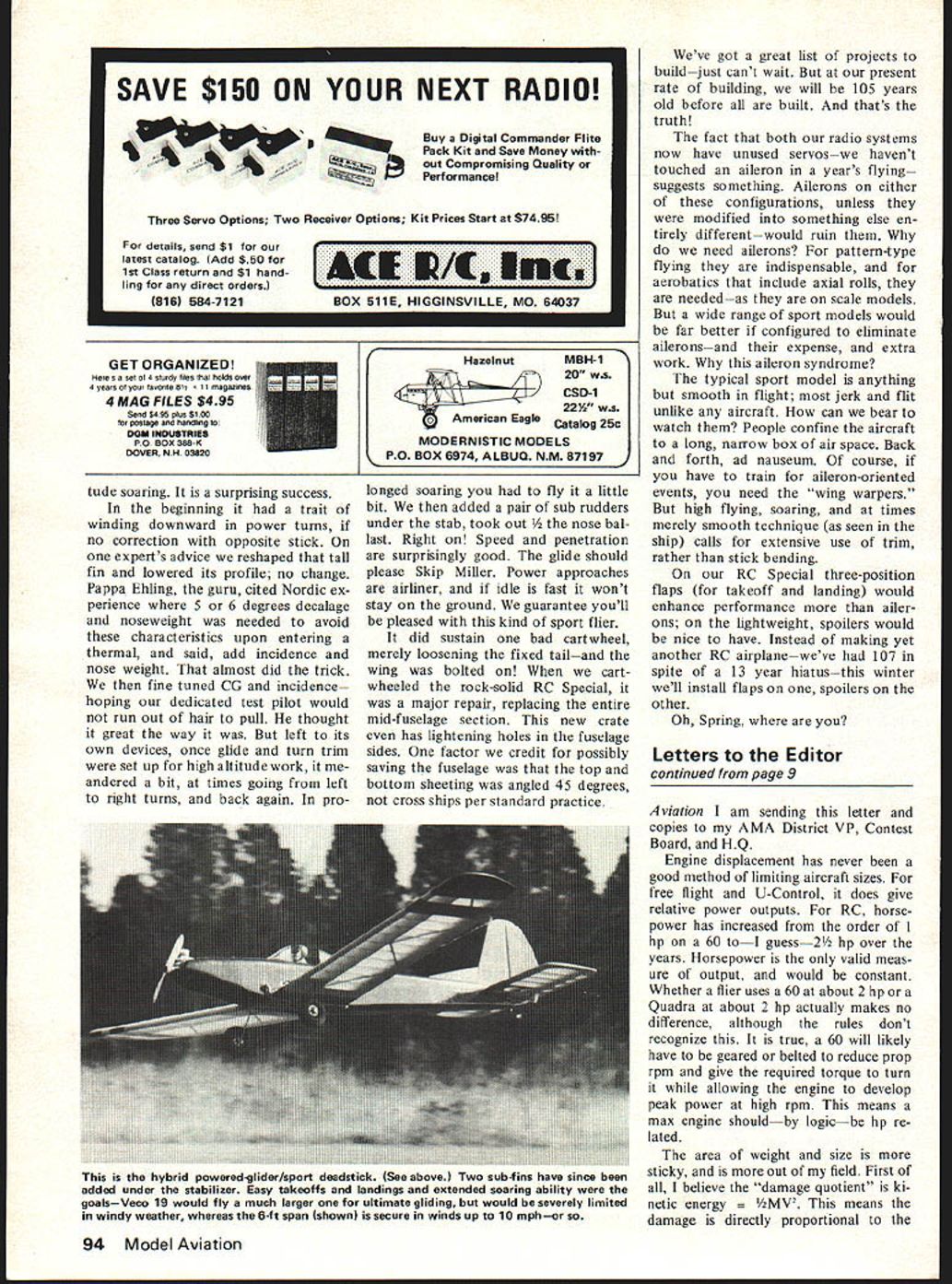
After last month's episode of the "Southern Spy" leaking a picture of our RC Special into ole George's column, we gleefully report that the midnight skulker did not photograph all the secret papers, so, by gosh, you'll find here a flight picture of another odd-ball flying machine. (To get a picture in For Openers, we stood over the prostrate art director with a sharp blue pencil pointed at his throat.)
It is a sporty-looking low-winger that spans six feet, powered by a Veco 19 engine turning a 10×3½ prop which takes up the lightweight so well that it probably could do well with a similar ship scaled up to 8 or 9 feet. A cross between a powered glider and an ordinary sport model, the prototype was designed to achieve easy, almost automatic takeoffs with a taildragger, and clinch landings combined with high-altitude soaring. It is a surprising success.
In the beginning it had a trait of winding downward in power turns if no correction with opposite stick was made. On one expert's advice we reshaped the tail fin and lowered its profile; no change. Papa Ehling, the guru, cited Nordic experience where 5 or 6 degrees of decalage and noseweight were needed to avoid these characteristics upon entering a thermal, and said: add incidence and nose weight. That almost did the trick. We then fine-tuned CG and incidence—hoping our dedicated test pilot would not run out of hair to pull. He thought it great the way it was. But left to its own devices, once glide and turn trim were set up for high-altitude work, it meandered a bit, at times going from left-to-right turns and back again. In prolonged soaring you had to fly it a little bit. We then added a pair of sub-rudders under the stab and removed half the nose ballast. Right on! Speed and penetration are surprisingly good. The glide should please Skip Miller. Power approaches are airliner-like, and if idle is fast it won't stay on the ground. We guarantee you'll be pleased with this kind of sport flier.
It did sustain one bad cartwheel, merely loosening the fixed tail—and the wing was bolted on! When we cart-wheeled the rock-solid RC Special, it was a major repair, replacing the entire mid-fuselage section. This new crate even has lightening holes in the fuselage sides. One factor we credit for possibly saving the fuselage was that the top and bottom sheeting was angled 45 degrees, not crossed as per standard practice.
We've got a great list of projects to build—just can't wait. But at our present rate of building, we will be 105 years old before all are built. And that's the truth!
The fact that both our radio systems now have unused servos—we haven't touched an aileron in a year's flying—suggests something. Ailerons on either of these configurations, unless they were modified into something else entirely different, would ruin them. Why do we need ailerons? For pattern-type flying they are indispensable, and for aerobatics that include axial rolls they are needed—as they are on scale models. But a wide range of sport models would be far better if configured to eliminate ailerons—and their expense and extra work. Why this aileron syndrome?
The typical sport model is anything but smooth in flight; most jerk and flit unlike any aircraft. How can we bear to watch them? People confine the aircraft to a long, narrow box of airspace. Back and forth, ad nauseam. Of course, if you have to train for aileron-oriented events, you need the "wing warpers." But high flying, soaring, and at times merely smooth technique (as seen in the ship) calls for extensive use of trim rather than stick bending.
On our RC Special, three-position flaps (for takeoff and landing) would enhance performance more than ailerons; on the lightweight, spoilers would be nice to have. Instead of making yet another RC airplane—we've had 107 in spite of a 13-year hiatus—this winter we'll install flaps on one and spoilers on the other.
Oh, Spring, where are you?
Transcribed from original scans by AI. Minor OCR errors may remain.

