
For Openers
Fantastic! The gadget we saw last night was so far out... Picture this. You flip the prop on your scale job and the big engine bursts into life. But it does not roar like a model engine. Instead, you hear the popping sound of, say, your five-cylinder Kinner. It is called an "Exhaust Sound Distributor." At a glance, it looks much like a prop-drive setup, but the gearing operates a timed valve arrangement in a cylindrical muffler, from which project five (this number might be varied) short exhaust stacks arranged radially. Flip it while you hold it (dead) and distinctive pops come out of the appropriate stacks. When it runs it isn't loud, and it sounds more like a real engine than a model one. The noise level is not more than that of a 4-cycle engine—no harsh bite. To hear the thing idle is to lose your mind. All we lack now are scale fumes!
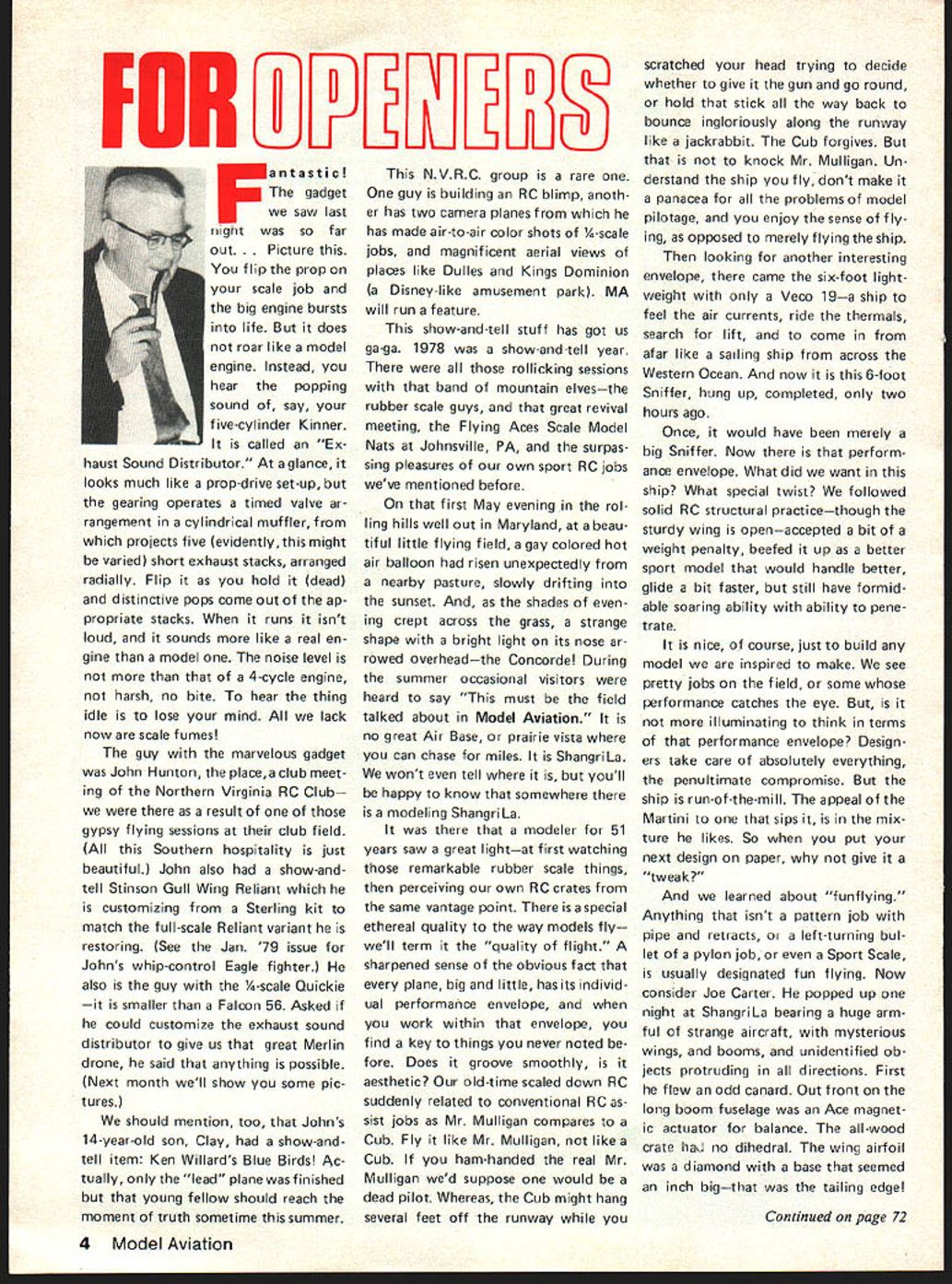
The guy with the marvelous gadget was John Hunton; the place was a club meeting of the Northern Virginia RC Club—we were there as a result of one of those gypsy flying sessions at their club field. (All this Southern hospitality is just beautiful.) John also had a show-and-tell Stinson Gull Wing Reliant which he is customizing from a Sterling kit to match the full-scale Reliant variant he is restoring. (See the Jan. 1979 issue for John's whip-control Eagle fighter.) He also is the guy with the quarter-scale Quickie—it is smaller than a Falcon 56. Asked if he could customize the exhaust sound distributor to give us that great Merlin drone, he said that anything is possible. (Next month we'll show you some pictures.)
We should mention, too, that John's 14-year-old son, Clay, had a show-and-tell item: Ken Willard's Blue Birds! Actually, only the "lead" plane was finished, but that young fellow should reach the moment of truth sometime this summer.
This NVRC group is a rare one. One guy is building an RC blimp, another has two camera planes from which he has made air-to-air color shots of quarter-scale jobs and magnificent aerial views of places like Dulles and Kings Dominion (a Disney-like amusement park). MA will run a feature.
This show-and-tell stuff has got us ga-ga. 1978 was a show-and-tell year. There were all those rollicking sessions with that band of mountain elves—the rubber scale guys—and that great revival meeting, the Flying Aces Scale Model Nats at Johnsville, PA, and the surpassing pleasures of our own sport RC jobs we've mentioned before.
On that first May evening in the rolling hills well out in Maryland, at a beautiful little flying field, a gay-colored hot air balloon had risen unexpectedly from a nearby pasture, slowly drifting into the sunset. As the shades of evening crept across the grass, a strange shape with a bright light on its nose arrowed overhead—the Concorde! During the summer occasional visitors were heard to say, "This must be the field talked about in Model Aviation." It is no great air base, or prairie vista where you can chase for miles. It is Shangri La. We won't even tell where it is, but you'll be happy to know that somewhere there is a modeling Shangri La.
It was there that a modeler for 51 years saw a great light—at first watching those remarkable rubber scale things, then perceiving our own RC crates from the same vantage point. There is a special ethereal quality to the way models fly—we'll term it the "quality of flight." A sharpened sense of the obvious fact that every plane, big and little, has its individual performance envelope, and when you work within that envelope, you find a key to things you never noted before. Does it groove smoothly, is it aesthetic? Our old-time scaled-down RC suddenly related to conventional RC as Mr. Mulligan compares to a Cub. Fly it like Mr. Mulligan, not like a Cub. If you ham-handed the real Mr. Mulligan we'd suppose one would be a dead pilot. Whereas, the Cub might hang several feet off the runway while you scratched your head trying to decide whether to give it the gun and go around, or hold that stick all the way back to bounce ingloriously along the runway like a jackrabbit. The Cub forgives. But that is not to knock Mr. Mulligan. Understand the ship you fly; don't make it a panacea for all the problems of model pilotage, and you enjoy the sense of flying as opposed to merely flying the ship.
Then, looking for another interesting envelope, there came the six-foot lightweight with only a Veco .19—a ship to feel the air currents, ride the thermals, search for lift, and to come in from afar like a sailing ship from across the Western Ocean. And now it is this six-foot Sniffer, hung up, completed only two hours ago.
Once, it would have been merely a big Sniffer. Now there is that performance envelope. What did we want in this ship? What special twist? We followed solid RC structural practice—though the sturdy wing is open—accepted a bit of a weight penalty, beefed it up as a better sport model that would handle better, glide a bit faster, but still have formidable soaring ability and the ability to penetrate.
It is nice, of course, just to build any model we are inspired to make. We see pretty jobs on the field, or some whose performance catches the eye. But is it not more illuminating to think in terms of that performance envelope? Designers take care of absolutely everything, the penultimate compromise. But the ship is run-of-the-mill. The appeal of the Martini to one that sips it is in the mixture he likes. So when you put your next design on paper, why not give it a "tweak"?
And we learned about "funflying." Anything that isn't a pattern job with pipe and retracts, or a left-turning bullet pylon job, or even a Sport Scale, is usually designated fun flying. Now consider Joe Carter. He popped up one night at Shangri La bearing a huge armful of strange aircraft, with mysterious wings and booms and unidentified objects protruding in all directions. First he flew an odd canard. Out front on the long-boom fuselage was an Ace magnetic actuator for balance. The all-wood crate had no dihedral. The wing airfoil was a diamond with a base that seemed an inch big—that was the trailing edge!
For Openers/Winter
The contraption seemed airworthy, but a stupefied expert bystander handed Joe one of his two Ace transmitters—one on some other frequency! Then it was a twin pusher from the 1910 era, precisely duplicated even as to the way the props were butchered. All we can say is that they had good flying models in 1910—apparently. Followed an RC-assisted version of one of England's first gas models, a strange high wing with a funny planform, great sweeping curves, and strange angular rigging. It tore up the sky. When we asked Joe if it might be one of Capt. Bowden's ancients, his eyes lit up. Bowden, he advised us, was the British equivalent of our Charlie Grant. You older guys know what that means!
Bowden named his odd crates things suggestive of mice and insects—and, by gosh, the configurations looked the part. Then Joe wound up this Wakefield-type rubber job and proceeded to steer it all around the field. It was RC! And finally (he has more nifties at home, so "finally" isn't a good word—and he said we should know a friend of his who really builds far-out stuff, and in great quantities!), he had this long stick, like a yardstick, about six feet long. On one end there was a .049 (Half A). About two-thirds of the length of the stick, in the other direction, was a small metal tab. F.O. didn't have the foggiest. Joe started the engine, then grasped a small projecting pivot—so small we hardly saw it—located under the stick, about one-third of its length away from the engine. The stick began to revolve faster and faster with a swishing (the Doppler effect was incredible) sound and it flew off his hand. A helicopter! As it climbed like the Grim Reaper's scythe, it drifted toward the lone tree that is the terror of every local flier, proving thereby that all models are alike. As we gawked, someone said Joe flew this thing out of a hamburger joint parking lot at night, with lights yet, and the spectacle had caused a traffic jam. Do you believe that? F.O. thinks he does.
There must be something about April issues. Many people considered the April issue, 12 months ago, to be the best they had ever seen. We are not sure that magazines don't have souls of their own, or biorhythms, but there is magic in this April 1979 issue. Watching it shape up for weeks, we know it to be a blockbuster. To the editor, this is like winning a door prize. Our first clue that something special was about to happen came when the art editor said, "Where are the cover lines?" Attempting to select just one or two was impossible. Every model between these covers clamored for attention. Their designers are equal to any in the land—to say the least—respected by their, and your, peers.
Notable models and features
- The big Fairchild of Clapp—plans that are a marvel; in flight it stirs the heart, and it looks buildable without unreasonable effort.
- Bill Henn's rubber-scale Chambermaid—the epitome of the art, a structural gem and a truly phenomenal performer. As one Nats winner in that category told us in awe, "That Chambermaid flies forever!"
- Hazen's MO-1—Control-line people, especially hot-shot carrier fliers, will respect it.
- Bill Evan's X-wing Astron—an unorthodox configuration that stunned sport RCers; an aerobatic screamer and a worthy encore to the Simitar.
Consider the columnists. They inspire each other to new heights.
- RC Scale: the Wischers.
- Soaring: Dan Pruss, now a respected correspondent with international awareness—last month he actually interviewed Werner Sitar in Europe. Did the Austrians really fly 242 mph? F.O. thinks so—hand us our bullet-proof vest!
- Other regulars (VanPutte, Meuser, Myers, etc.) each have something to tell you.
As an RCer, F.O.'s chief interest in CL Racing is the frantic aerobatics of the pilots in the center of the circle. You will find Bill Lee (CL Racing) talking about homemade fiberglass props. Bill (and Wynn Paul too) is a guy who endlessly seeks the truth about tanks and things like props—by doing, by experimenting, by finding the parameters. Dave Cheney writes beautifully on RC helicopters (the only column in existence now). Bill Warner, Sport/Scale, will put humor and life into your flying circus. Without guys like this, most of us would never know about hundreds of things that add up to the sum total of our skills.
Brad Powers' lead article on floats for quarter-scale is a landmark article. Model aviation is as old as this century, yet with all the explosion of knowledge, techniques, and products we never dared dream about, what we know about floats would fit in the smallest drawer in your field box. Here is a designer who partook in dozens of famous projects that made history, a modeler to boot, telling us how to design a float for virtually any size model—as well as those monsters which we've yet to see on water. Note who had feed-in—Irwin Ohlsson and the great Ernie Stout, of Convair fame.
What we are suggesting, dear friend, is that this April issue, however exceptional, is only one of 12 for the year. We are talking about your magazine. Within another year—God willing—it will be a thousand light years beyond April of 1976 (MA began in July 1975, in its modern form). We ask you not to be conscious of your magazine in controversial terms, for some other magazines have shown you they'd like to see it dead—but inspect it closely for what it is. We speak especially to the minority of members who did not subscribe to MA in the past. It is yours, and we'd like you to be proud of it.
AS WE GO TO PRESS, the sad news arrives of the passing of Myron (Mike) Schlesinger, recent past president of Top Flite Models. Mike was a respected friend of ours, of the industry, and of innumerable modelers. A true pioneer, he helped start Top Flite on its way. He had chaired the trade show committee in 1956, became a member of the HIAA's board of directors, and served for nearly 10 years as chairman or co-chairman of HIAA's Model Aeronautics Division. Humorous, easygoing, always compassionate and understanding, Mike Schlesinger will be truly missed by all of us.
Bill Winter
Transcribed from original scans by AI. Minor OCR errors may remain.

