
BILL WINTER'S FOR OPENERS
Bob Harrah and "Adventures in Modeling"
The article beginning on page 56, "Adventures in Modeling," starts a unique series. It was supposed to be a product-review feature. All magazines belong to a plug-the-product cult, and we sort of felt we were running around naked by not going with the mob. So eight months ago we began to talk to Bob Harrah about how to deal with products in a way that made reader enjoyment paramount and commercialism secondary. Since Bob lives in San Diego and we on the East Coast, the discussions dragged on like the preliminaries of SALT II.
We decided to take a "We Fly" approach after the manner of flying magazines which report on various aircraft. While, like us, Bob detests unvarnished plugs, he holds the profound view that an energetic industry that gives us so many wondrous things to play with is what really makes our modeling world go round.
He proposed to scratch-build attractive kits—old as well as new—and to equip the aircraft with interesting accessories and products whose use could add new dimensions to enjoyment. We'd play it by ear. There really is only one clear way to describe this undertaking, and that is by its title. Whatever became involved in each chapter, be it a glow driver, a hex wrench, fittings, etc.—he would tell you all about the things the little guys—as well as the trade giants—were doing.
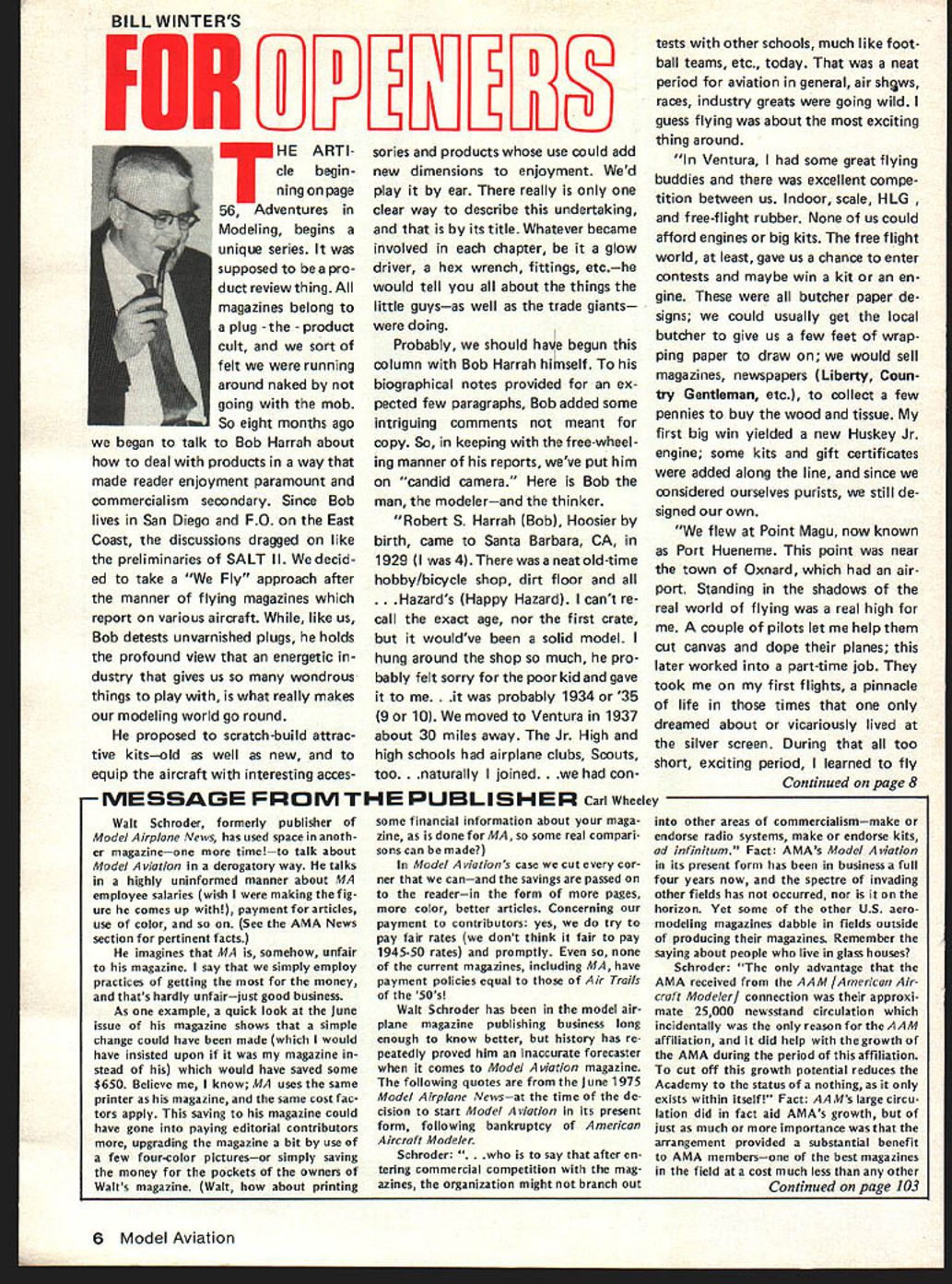
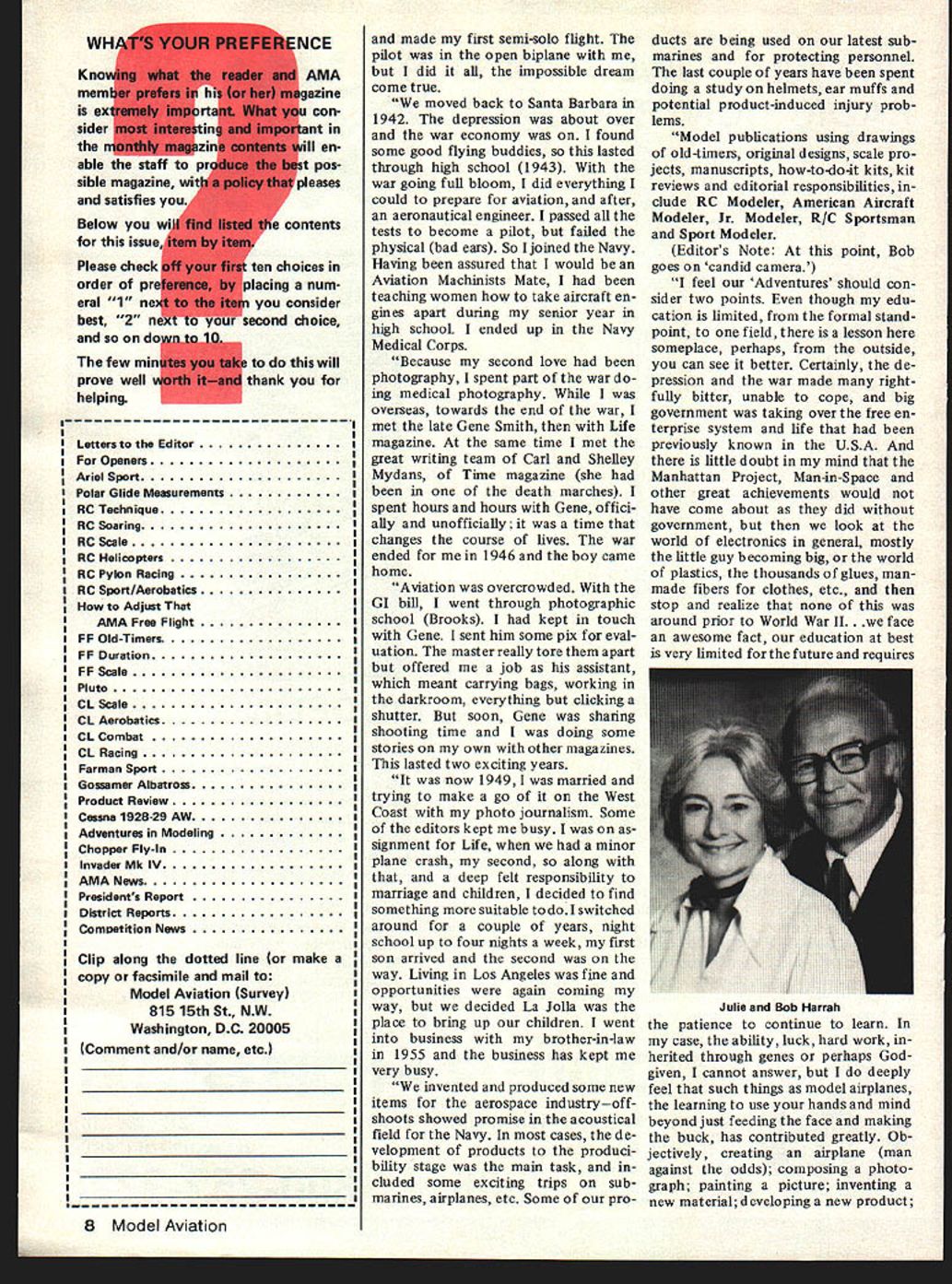
Probably we should have begun this column with Bob Harrah himself. To his biographical notes provided for an expected few paragraphs, Bob added some intriguing comments not meant for copy. So, in keeping with the free-wheeling manner of his reports, we've put him on "candid camera." Here is Bob the man, the modeler—and the thinker.
Bob Harrah — Candid Camera (as told by Bob)
"Robert S. Harrah (Bob), Hoosier by birth, came to Santa Barbara, CA, in 1929 (I was 4). There was a neat old-time hobby/bicycle shop, dirt floor and all—Hazard's (Happy Hazard). I can't recall the exact age, nor the first crate, but it would've been a solid model. I hung around the shop so much, he probably felt sorry for the poor kid and gave it to me. It was probably 1934 or '35 (9 or 10).
"We moved to Ventura in 1937, about 30 miles away. The Jr. High and high schools had airplane clubs, Scouts, too, so naturally I joined. We had contests with other schools, much like football teams today. That was a neat period for aviation in general—air shows, races, industry greats were going wild. I guess flying was about the most exciting thing around.
"In Ventura, I had some great flying buddies and there was excellent competition between us: indoor, scale, HLG, and free-flight rubber. None of us could afford engines or big kits. The free-flight world, at least, gave us a chance to enter contests and maybe win a kit or an engine. These were all butcher-paper designs; we could usually get the local butcher to give us a few feet of wrapping paper to draw on. We would sell magazines and newspapers (Liberty, Country Gentleman, etc.) to collect a few pennies to buy the wood and tissue. My first big win yielded a new Husky Jr. engine; some kits and gift certificates were added along the line, and since we considered ourselves purists, we still designed our own.
"We flew at Point Mugu, now known as Port Hueneme. This point was near the town of Oxnard, which had an airport. Standing in the shadows of the real world of flying was a real high for me. A couple of pilots let me help them cut canvas and dope their planes; this later worked into a part-time job. They took me on my first flights, a pinnacle of life in those times that one only dreamed about or vicariously lived at the silver screen. During that all-too-short, exciting period, I learned to fly and made my first semi-solo flight. The pilot was in the open biplane with me, but I did it all—the impossible dream come true.
"We moved back to Santa Barbara in 1942. The Depression was about over and the war economy was on. I found some good flying buddies, so this lasted through high school (1943). With the war going full bloom, I did everything I could to prepare for aviation, and after, to be an aeronautical engineer. I passed all the tests to become a pilot, but failed the physical (bad ears). So I joined the Navy. Having been assured that I would be an Aviation Machinist Mate, I had been teaching women how to take aircraft engines apart during my senior year in high school. I ended up in the Navy Medical Corps.
"Because my second love had been photography, I spent part of the war doing medical photography. While I was overseas, towards the end of the war, I met the late Gene Smith, then with Life magazine. At the same time I met the great writing team of Carl and Shelley Mydans of Time magazine (she had been in one of the death marches). I spent hours and hours with Gene, officially and unofficially; it was a time that changes the course of lives. The war ended for me in 1946 and the boy came home.
"Aviation was overcrowded. With the GI Bill, I went through photographic school (Brooks). I had kept in touch with Gene. I sent him some pix for evaluation. The master really tore them apart but offered me a job as his assistant, which meant carrying bags, working in the darkroom—everything but clicking a shutter. But soon, Gene was sharing shooting time and I was doing some stories on my own with other magazines. This lasted two exciting years.
"It was now 1949. I was married and trying to make a go of it on the West Coast with my photojournalism. Some of the editors kept me busy. I was on assignment for Life when we had a minor plane crash, my second, so along with that and a deep-felt responsibility to marriage and children, I decided to find something more suitable to do. I switched around for a couple of years, night school up to four nights a week; my first son arrived and the second was on the way. Living in Los Angeles was fine and opportunities were again coming my way, but we decided La Jolla was the place to bring up our children. I went into business with my brother-in-law in 1955 and the business has kept me very busy.
"We invented and produced some new items for the aerospace industry—off-shoots showed promise in the acoustical field for the Navy. In most cases, the development of products to the producibility stage was the main task, and included some exciting trips on submarines, airplanes, etc. Some of our products are being used on our latest submarines and for protecting personnel. The last couple of years have been spent doing a study on helmets, ear muffs and potential product-induced injury problems.
"Model publications using drawings of old-timers, original designs, scale projects, manuscripts, how-to-do-it kits, kit reviews and editorial responsibilities include:
- RC Modeler
- American Aircraft Modeler
- Jr. Modeler
- R/C Sportsman
- Sport Modeler
"(Editor's Note: At this point, Bob goes on 'candid camera.')
"I feel our 'Adventures' should consider two points. Even though my education is limited, from the formal standpoint, to one field, there is a lesson here someplace; perhaps, from the outside, you can see it better. Certainly, the Depression and the war made many rightfully bitter and unable to cope, and big government was taking over the free-enterprise system and life that had been previously known in the U.S.A. And there is little doubt in my mind that the Manhattan Project, Man-in-Space and other great achievements would not have come about as they did without government. But then we look at the world of electronics in general—the little guy becoming big—or the world of plastics, the thousands of glues, man-made fibers for clothes, etc., and then stop and realize that none of this was around prior to World War II. We face an awesome fact: our education at best is very limited for the future and requires the patience to continue to learn.
"In my case, the ability, luck, hard work—inherited through genes or perhaps God-given, I cannot answer—has contributed greatly. I deeply feel that such things as model airplanes, the learning to use your hands and mind beyond just feeding the face and making the buck, has contributed greatly. Objectives include:
- creating an airplane (man against the odds)
- composing a photograph
- painting a picture
- inventing a new material
- developing a new product
- making the pen mightier than the sword
"All of this is creative, inventive, new—but all the same. I know of no other hobby or field of endeavor that can challenge, satisfy, educate and teach the patience necessary for achievement better than this crazy aeromodeling field, especially for the young. The potentials would cover ten pages and you know them all. Sports like golf and tennis offered some challenge; ocean sailboat racing became one of my favorite pastimes. But for some reason, there always seemed to be an aero-type book or photo subject to take up some of my time. I am sure I must have been the big bore in many minds; I can't get excited over most books on the bestseller lists, dime novels were a waste, and movies were something I would sit through and think about something else.
"Reading technical briefs and new product methods became mandated with my work, the deep involvement in my inventions and projects—usually government tasks that had to be successful or no pay. It was a 24-hour-a-day burden and responsibility. The camera and darkroom could sometimes distract the mind, but aeromodeling and its endless challenge was the best remedy; it could tax any brain or set of hands beyond abilities. A harmless form of drugs that can clear the brain for new challenges. Therefore, the portrayal of the aeromodeling world is an endless and challenging adventure that satisfies many needs and can in itself also be useful.
"The second point—we scratched the surface a little on the phone—is industry, products, price. In 1937, a Brown Jr. cost $21.50, Ohlsson was $18.50, Flush Super Ace sold at $21.50 and Bunch was low at $11.35. A set of M&M wheels at $3.50 (3½") and Japanese tissue came in 32 colors, and Model Airplane News sold for 20¢. We can't get good tissue any more, magazines are up ten times (average), wheels are about the same. Engines have started to move out of sight, but overall the industry (compared to homes, food, cars, etc.) has given the aeromodeler one of the best buys and high-quality products year in and year out. A haircut was 25¢, new cars were $800 and wages (if any) were 30¢ an hour and less than a dollar per day if you were in the military. So no matter where the comparison comes from, the aeromodeling industry has supported the modeler.
"The NAA was 50¢ for Junior memberships, and for kids in 1937 that was five hours working in someone's yard, or if you were lucky and knew a prosperous person, $1.00 for a full eight-hour day. At today's wages, the young modeler could pay for the Senior Full Membership and come out ahead of what was paid then for Junior. In order for NAA to survive to become AMA, it would probably have failed without industry, schools and organizations such as Air Scouts. In that same year of 1937, NAA president Dupont offered $300 in prizes for contests, Comet Models was a paying advertiser, and Curtiss-Wright Technical Institute was advertising for students.
"In more recent years, unreliable radios of the '60s that could cost as much as $1,000, and not much less in the early '70s, are now available equal to or better than those for about $100, or a preprogramming radio this year for about $600. It is almost impossible to buy a bad radio today, or a bad engine, or a crate that won't fly. True, the plastic coverings are not quite up to 32 colors to choose from, but then some people will complain about anything.
"Through this span of more than 40 years, aeromodeling has been good for me, others and the country. Since the days of the NAA, now AMA, and the hundreds of manufacturers that have come and gone supporting this aeroworld, I guess I have heard or read about every type of gripe there is. But for every hundred gripes, I am lucky if I have heard one solution or alternative from the modeler who is reaping all these benefits. Critiques are important if they add to, not hurt, the whole industry; and every person that criticizes without a suggestion for improvement is like spitting into the wind.
"The history of modeling is not recognized for its worth, or the lack of appreciation of what industry and AMA are doing for aeromodeling, it reminds me of most leaders who fail. 'The only thing they learn from history is not to learn from history.' This is not really the modeler's fault, when one considers that this country does not really recognize the creative talents of men and women like other countries do, and it is now lacking in our educational system. It seems the measure of culture, talent and life is more material possessions than brains and ability. Sure it has always been, but at least some culture has survived, so I can't really blame the negativities. We can still try to be positive and add to.
"And that is why we called it 'Adventures in Modeling.'"
DEAR WALT (SCHRODER)
I would like to thank you for the five-figure raise you gave me (and several associates) in your Publisher's Message in your June issue of MB. Walt, old buddy—and you will always be that—you will recall your telephone call to me after your appraisal of MA's finances and your prediction of disaster for AMA (in 1975), in which you said you had been wrong, had fallen on your face, and that you'd never learn. And you will recall my reminder to you of that call late in 1978 just before the last "magazine flap" and your departure from MAN in New York for balmier climes.
While it was nice to see that you've moved beyond the previous published nonsense in MAN of claiming that MA was dragging down the AMA, you now zero in on a new area of confusion, and you've stumbled yet again over interpreting AMA finances.
MAN—since the first of the year—has no quarrel with MA or AMA, yet at Model Builder you renew the onslaught. Your widely distributed (MAN) Position Paper, long before the Model Aviation "flap," took issue solely with AMA—and, while you were at MAN, that magazine did not support the Nationals, and for many years sponsored no Nats trophies. MAN is a Nats trophy sponsor this year. For 13 years you have fired this feud with AMA.
May we offer you some professional advice? Your competition is not MA, Walt. Your title says RC Model Builder. Your competition is RC Modeler and Model Airplane News. Your problem, quite simply, is to approach their sales (the word is "sales," not "circulation" or "distribution") and to duplicate more of their full-rate advertising. If MA disappeared from the face of the earth, your problems would remain, and you'd not gain a cent by our demise. MAN, sitting in at the last Council meeting, stated they have little concern about MA—and MAN prospered while you were there and MA was in reality no threat to you then, any more than it is now.
If you are going to compete with MAN, and especially RCM—and Dewey is the most highly successful publisher and editor since the 1950s—you'd be well advised to abandon this now 13-year-old vendetta with AMA and concentrate on the great task before you. Lots of luck!
Transcribed from original scans by AI. Minor OCR errors may remain.

