
BILL WINTER'S FOR OPENERS
It used to be said that a pilot was most dangerous to himself after he had logged 250 hours. What statistics reveal today we do not know, but the point—that after one assumes he has mastered the art, he is then most vulnerable—has an interesting parallel in model flying. You will find that the greater the hours and years in the cockpit, the more these veteran pilots affirm that the learning process is never over. They are ever watchful. F.O. finds himself painfully reminded that none of us will ever know everything about this hobby. We were back on square one several times this past month. One flying experience was incredible.
Sniffer and the Buzzard
On the fourth flight of that 6-foot Sniffer we showed you a picture of, the performance was a joy to behold, but when trimmed at cruise there was a mild right which required several clicks of left rudder trim. So we took out the two degrees of right thrust. Then, a week later, we joined Worth one balmy Sunday afternoon with his big Buzzard.
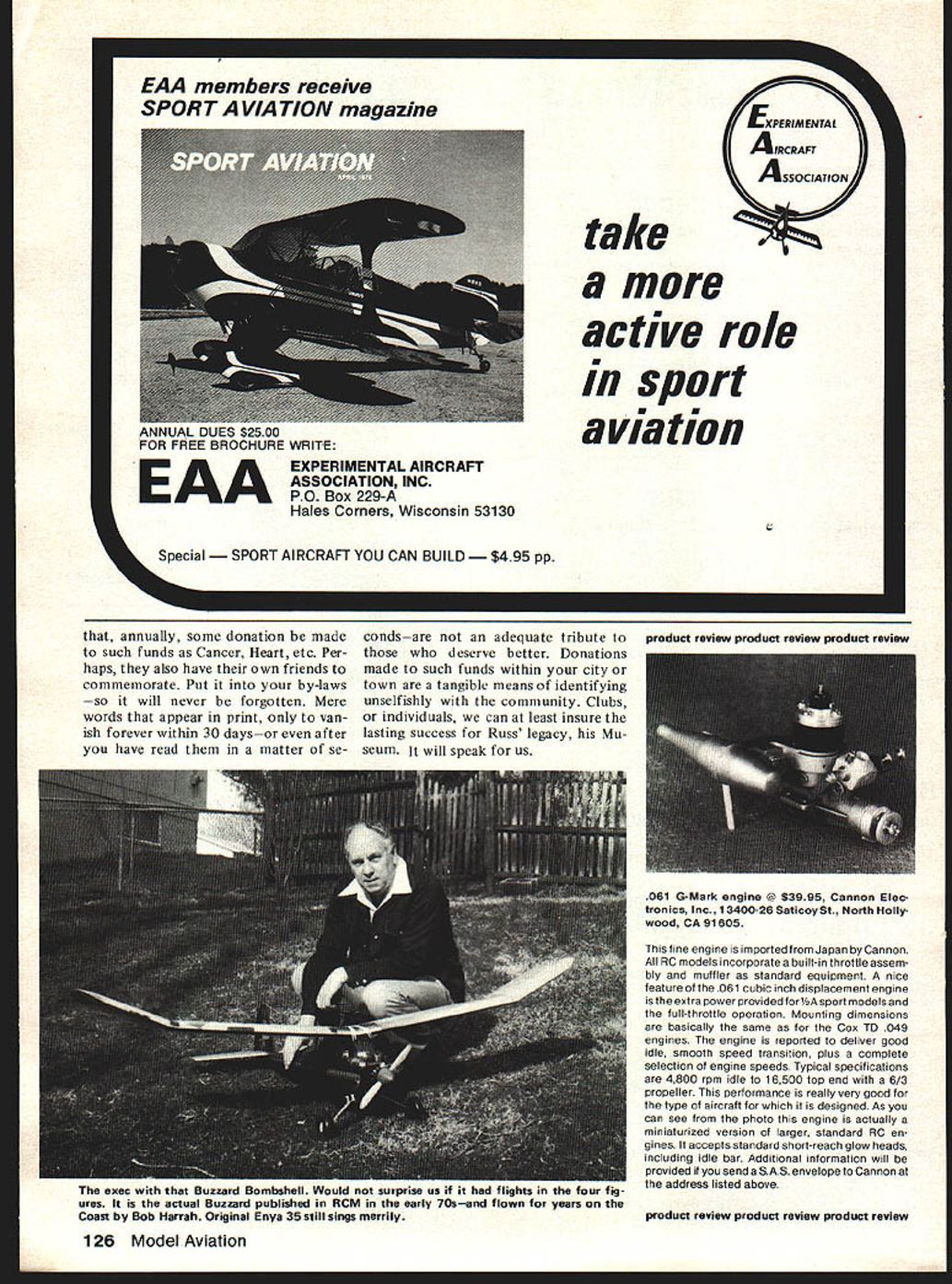
If we may digress, that Buzzard had been published by Bob Harrah in RCM in the early '70s and has had hundreds of flights in California and in the East (it was a top selling plan for RCM for years—do get one). The Sniffer is beefed up like a Bridi .40 trainer—keep that in mind.
John launched the Sniffer, its OS .35 spinning the 11x3-1/2 in prop in grand style. Did it go left? Did it go straight? Not on your tin-type. It had a vicious right turn, and was power-stalling all over the place. We jumped a tree holding left rudder, kept adding left and down trim until we reached the stops, and were hitting full left on a sensitive rudder about every three seconds. Back came the throttle to level-flight cruise. The Sniffer now was flying in 150-foot right-hand circles. All this because two degrees right thrust were removed?
Now the Buzzard was in the air. It was sunny with a gentle breeze and the real buzzards began to circle with the model on high as they always do. Tired of humming around in low-altitude circles, we held some steady left, gave the Sniffer two clicks of high. It started up. Soon both ships were almost specks in lift, at about a 45-degree downwind angle. There was this cloud, gray and motionless. Off in the distance in the other downwind quadrant was an approaching rainstorm.
Then the cloud turned black and moved toward the rainstorm. Still we soared, out in front of it, frolicking together. Then, out of the harmless sky upwind, came this terrible torrent of air, like the wind in front of a thunderstorm. Instantly we thought "both ships are doomed." We killed the engine and put the Sniffer in a prolonged 60-degree dive. Now we saw what a great safety device a lifting tail can be—although the section is only 50% of scale for a Sniffer. The sturdy ship came boring back, never flaring, perhaps 1,500 feet off to the side. (Now, if you figure a warp had something to do with that offset thrust mystery, forget it—the deadstick dive was arrow-true.) It got into the field about 50 feet away with considerable down to keep headway.
During our approach we heard John cry, "It won't come down." The Buzzard would dive until it went squirrely, and spins hardly offset the monstrous lift. Meanwhile, the cloud rushed to meet the rainstorm, formed a sharp front and tornado tendrils worked down and receded. The Buzzard was still under control, way, way off, and finally disappeared behind the distant tree line. (It was found about 2½ miles away in deep woods by a custodian out for a walk.) The whole incredible nightmare adventure took place in a matter of minutes.
Would you put left thrust in the Sniffer? Would you restore the right thrust? Four degrees left would seem needed. Only one thing is evident, and that is that the direction of the slipstream on the fuselage had changed, and the high cabin side area had acted like a pylon model, say a Zipper. But if left is added, what effect will the severely angled slipstream have on that left side of the cabin? And much more downthrust now seems needed—it already has two degrees built in. All we are going to do is trim in some left rudder with the clevis, to open up the right power turn to a wide diameter, with enough transmitter trim left to be able to get straight hands-off flight if wanted. And maybe we'll speed it up a bit with more lead in the nose—it already has 3½ ounces to balance at 35% of chord. Incidence is about half what the Sniffer is supposed to have, and the angular difference, while adequate, was reduced drastically from true Sniffer by putting the stab at zero instead of several degrees negative. The outer panels have half the poly called for. But don't knock it; it is a remarkable gliding, soaring, and responsive machine, and as sturdy as the proverbial outhouse. Guys with answers will please line up on the right!
Inverted Flight
Inverted flight is nothing special anymore. But a week after the bizarre encounter with the freak storm we were back at square one. In the early fifties there was a Californian, Alec Snyder, who flew a 7-foot Cub to a national championship using a 5-channel reed receiver made by the late Ed Rockwood. Ed pioneered both 3- and 5-channel equipment before the war and probably is the true father of modern RC. He used servo motors from some English-made toy—it was something else. Alec's Cub didn't look much like a Cub, but one can confer any name he chooses on his pet crate. Alec told us that he used enough down only to obtain a moderate dive—this being a precaution to minimize the impact angle ... just in case. But Bob Beckman assures us he saw Alec fly inverted—which suggests Alec probably flew off the top of a half inside loop, down being limited.
About that time, DeBolt was sprucing up his big Live Wire—incidentally, distributors would not handle the kit because of its exorbitant price. Fifteen raspbucknicks! Ha! I was forever stealing marches—he had all that uke experience you see. One variation was called the Over and Under—it had a symmetrical airfoil at zero, just like now. Two of the locals built them for 5-channel reeds—we had one with escapements and moving those barndoor elevators with an escapement was comparable to solving the energy crisis with lightning bugs. So we reasoned that a "semi-symmetrical" airfoil might be better for us—it was a flat-bottomed world at the time. So we had a K & B .15 original that could perform a half outside and fly out inverted for as long as down was held.
Meanwhile, the other two guys were seeking to fly around the field inverted on their reeds (the late Frank Smith's 5-ch. radio, which was an improvement on the Rockwood). For us, this line of development yielded an escapement airplane which could outside-loop all day. One time it stuck in down and went out of sight after dozens of consecutive loops. It could fly inverted in the glide. To get there, you did a dead-engine outside loop and continued to hold down to the bitter end. After the loop it would enter a second loop, whip-stall at the top, try to enter a third outside but then hold inverted. Its remarkable glide in that dirty configuration—gear sticking up, flippers down, cathedral now, airfoil with most of its lift downward—haunts us after 25 years. Never understood it. Well, the world went reed crazy. Everybody was doing three consecutive rolls—Saturday Night Fever. You punched in down each time as it went inverted. Very soon, inverted became a cinch, as easy now as falling off a barstool.
For two years now we have been flying R/C. If we had ailerons they'd know what a flyer they were. Now they aren't sure. You may have seen a recent picture with this column of a lightweight 6-foot low wing, a cross between a glider and sport job—cockpit and dummy pilot yet. It takes off and lands like a baby carriage—when our buddies fly it, at least—and dives nicely and loops, although its forte is perpetual glide. You'd have about as much chance of making it snap roll as you would a Mirage. Bear in mind that it has a thick, flat-bottomed airfoil, narrow-chord elevators with the clevis on the outermost hole of a long horn, plenty of incidence, and goodly angular difference. So this pilot asks us if the wings are strong. We replied that it had six wide bands holding it on, that we had dived it enough to know that it would tuck, but we had never pushed it. So he pushes over, holds down, and flew it inverted across the field. Then he came back the same way, remarking that it steered better inverted than right-side up. Now we ask you: What in tarnation is a crate like that doing inverted? Or should we check the glider boys? We considered that ship to be a Split-S special. How much longer must we go on learning?
Square One
Probably will not live down this column. Should you say "square one," we will know what you are talking about. For roughly 30 years we have been writing about radio control. All of us who inflict such mental anguish on the unsuspecting multitudes think we have it down pat. The trouble is we view the subject from the side and describe it in the way a used car salesman or a realtor describes their products. Where are we now? Square One.
We have had some pretty good modelers among our offspring, but now there is this guy, Mike—he tends to think like F-11s and A-10s—who wants to start off with full-fledged fireworks. "Give me ailerons," he sez. He probably never heard of the FCC and, at 30, he hasn't even made an ROG. Our correspondence has turned into a chess game by mail. What a revelation! So we have him keeping a loose leaf, and every few days we outline something—it is growing into a book. Right at the beginning, we had a "chapter" on safety. For him, for other people. You can't talk radio to a rank beginner without falling over the safety thing and it has more offshoots than an elm has roots.
When we resumed flying two years ago, George Myers, the pro instructor, said to get a .40-powered Bridi trainer. Since, in the dead-dead days beyond recall, no one dared fly a 52-in. airplane with more than a vintage .19, we figured, trainer or not, it sounded like a bomb.
Glory be, there was no kit-and-engine combo better suited to Mike, the rank beginner, and his demands than the .40 Trainer. Now, if you are going this route, you must have a flying site, you must have instruction, and someone to help you. That probably means a club. They all have "instructors" to make sure accidents don't happen. If you are getting into radio, join a club if you can find one. We sent Mike a list of all the clubs in New York state. Told him to find guys who flew, to watch and listen, to ask questions when he got to know them. Right now he has the raw kit, burning enthusiasm, and a competent flier to show him the ropes—otherwise he'd be an ex-hobbyist with the first yank on the stick, or the flick of an aileron. All this got us into fascinating telephone conversations with Joe Bridi. And he is working up a special trainer for Mike—so far it will have one more bay on each panel and use a semi-symmetrical airfoil. Joe also will work up, over the next 18 months, an advanced trainer and a real fun sport job. We'd be surprised if pattern-man Bridi is thinking of a sway-back horse when he says sport. Like you, we gotta wait. Damn.
Remembering Russ Barrera
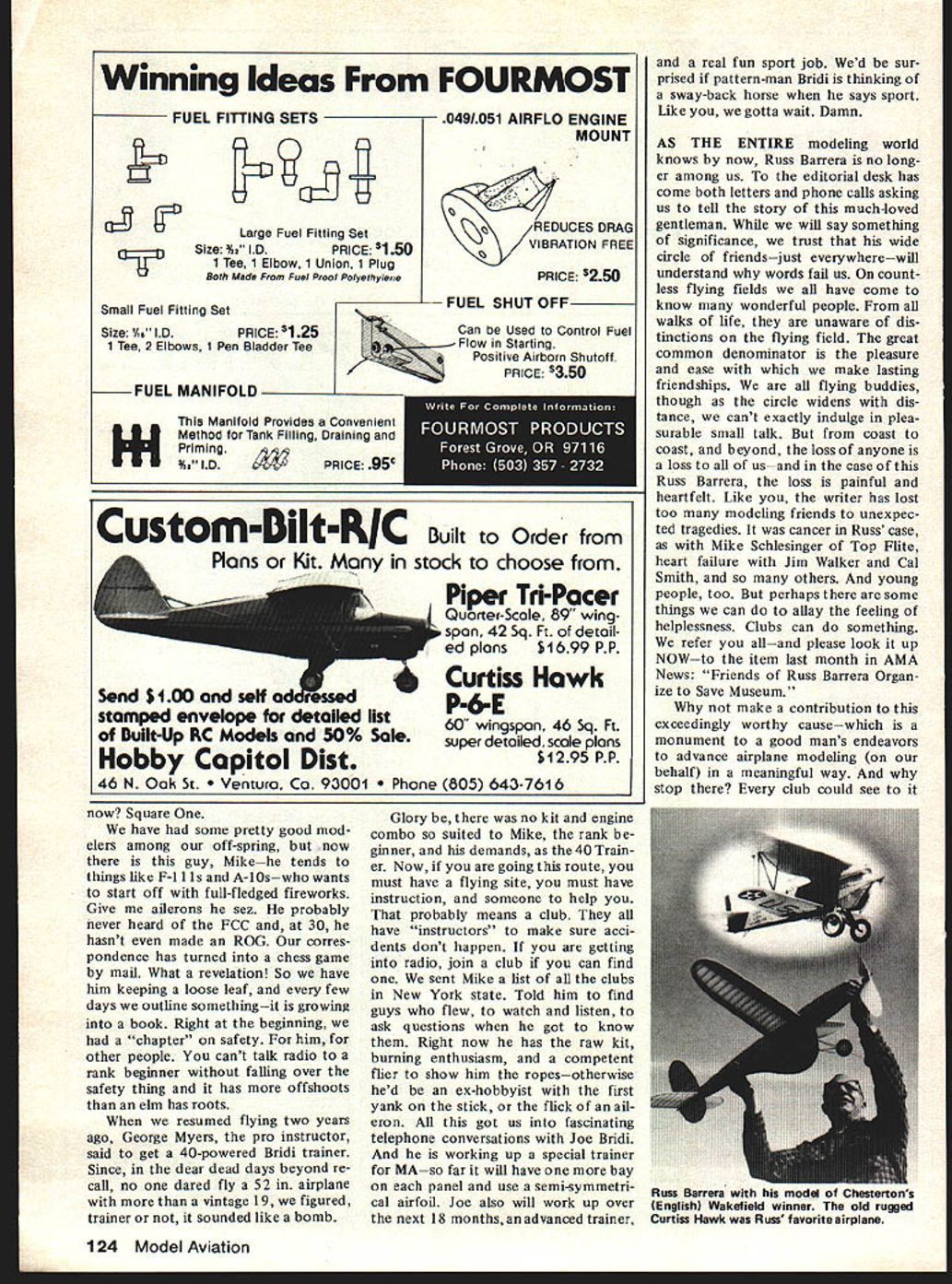
As the entire modeling world knows by now, Russ Barrera is no longer among us. To the editorial desk has come both letters and phone calls asking us to tell the story of this much-loved gentleman. While we will say something of significance, we trust that his wide circle of friends—just everywhere—will understand why words fail us. On countless flying fields we all have come to know many wonderful people. From all walks of life, they are unaware of distinctions on the flying field. The great common denominator is the pleasure and ease with which we make lasting friendships. We are all flying buddies, though as the circle widens with distance, we can't exactly indulge in pleasurable small talk. But from coast to coast, and beyond, the loss of anyone is a loss to all of us—and in the case of this Russ Barrera, the loss is painful and heartfelt.
Like you, the writer has lost too many modeling friends to unexpected tragedies. It was cancer in Russ' case, as with Mike Schlesinger of Top Flite; heart failure with Jim Walker and Cal Smith; and so many others. And young people, too. But perhaps there are some things we can do to allay the feeling of helplessness. Clubs can do something. We refer you all—and please look it up NOW—to the item last month in AMA News: "Friends of Russ Barrera Organize to Save Museum."
Why not make a contribution to this exceedingly worthy cause—which is a monument to a good man's endeavors to advance airplane modeling (on our behalf) in a meaningful way. And why stop there? Every club could see to it that, annually, some donation be made to such funds as cancer, heart, etc. Perhaps they also have their own friends to commemorate. Put it into your by-laws—so it will never be forgotten. Mere words that appear in print, only to vanish forever within 30 days—or even after you have read them in a matter of seconds—are not an adequate tribute to those who deserve better. Donations made to such funds within your city or town are a tangible means of identifying unselfishly with the community. Clubs, or individuals, we can at least ensure the lasting success for Russ' legacy, his Museum. It will speak for us.
Transcribed from original scans by AI. Minor OCR errors may remain.

