
FOR OPENERS
Competition and Beginner Events
An editor should not take sides in discussions between readers and columnists, but be a bystander. Since the first AMA rules were written long ago, we have come to appreciate the conflicting philosophies in the evolution of endless "beginner" events into competitive nightmares. Few of the hundreds of at-first-enthusiastic modelers turn out to have the skills and the fat wallets required to seriously fly that event when time and "progress" get done with it.
Although the writer is not interested in CL racing events—beyond spectator fascination and curiosity about designs—he is caught up in Bill Lee's column on Racing. Bill's observations, as well as those of dissident readers, apply to practically everything:
- Manhattan and Pennyplane in Indoor
- FF Power and Glider
- Pylon
- and so on
The writer recalls when Half A was viewed as a shot in the arm to free flight popularity and when Rat Race was the "poor man's Team Race." Can you believe that? Fast Combat bred Slow Combat—that would bolster support! (You've heard the saying that "Hell is paved with good intentions.") Pylon gave birth to Quickie 500, or Club Pylon, for similar reasons—by dawn's early light, that flag still waves. Half A Pylon would save the world. But it takes $50 now to make competitive the best Half A engine in the world—special bushings, needle valves, etc. Do we belabor the obvious?
After watching these ritualistic dances for so many years, one concludes the problem is bigger than all of us. We must better understand the nature of the beast, and we must be more determined to persevere in the things we start. Simply making gooey-goodie resolutions which we speedily forget marks us as a bunch of cookie-cutters.
There is nothing wrong with competition. It is the natural order of things that competition breeds an evolution of skills and technocracy to an order so high that many, if not most, of the original enthusiasts drop out. Then they point the finger at the guys who are always at the top. We can't blame them either. If we would have events we all can fly competitively, we have to be serious about locking in simple restrictive rules for so-called fun or stepping-stone events. Even then, the evolving expert grows unhappy. That "expert" may drop out in disgust. He knows that we always have a chance of beating him. If he has a Peter Principle mentality in that he wishes to hang around with the "kids" forever in order to comfort himself with meaningless trophies, we'll have to live with him. If a fancy machine shop and a fat wallet can't make him king, we have made progress. So he quits. Dare we say without fear of the critics that we won't miss him—or shed a tear?
In the fun-event context—we are talking of fun—are we commanded to devise grandfather clauses for a few who simply cannot stand to have their lollipops taken away? Why not write in letters of stone what this simple event(s) is, and will remain? Again, we talk not of the serious competitive events. Leave them be. The hot shots can take care of themselves, and our "graduates" can join them. Is it better to bring up ten, or a hundred new people, than it is to lose one or a few (but to other things)? What we now justify in the name of progress for the multitudes of the less gifted is the very antithesis of progress.
The other side of the coin: why do we all have to be winners? Good fliers drop out of some contests rather than face better competitors. We hackers would be happier if we set a goal of not placing last, then seeing how high up the list we can place. It is fun, and a challenge, to see how well we can do against the guys who always place. Some events are too far gone for us to do this, true, but the well-attended events allow one to get lost in the crowd while we improve ourselves. What does it matter if we never win anything, provided we have fun while flying with a modicum of skill?
On Safety
The Executive Council has directed that Model Aviation publish an ongoing column on safety. This is something close to our heart. While AMA is demonstrably safety-conscious and has achieved an extraordinary record by putting out the word, mainly through clubs, it would be well to publicize mishaps of all kinds so that we all can learn through the experience of others.
Why hasn't this been done? Consider a fatality. If we talk about it, will some nervous-Nelly agency then ban the activity? People have been killed while flying kites, riding skateboards, and deaths by automobile are greater in number than the casualties of all American wars combined. The harvest of death is accepted like incurable diseases, although much has been done to make driving safer. The model airplane projects too frivolous an image to some people ever to be granted such immunity.
Once, the airlines did not talk about ice—and ice was a menace that could, and did, bring down airliners of the day. Goodyear did not want to talk about de-icers—a great safety measure—because that implied "ice." The airline customers didn't like that. When Doug Rolfe illustrated a feature on de-icers for the old AT, Goodyear sent a three-man task force to our office to convince us that we should not talk more about de-icers. You get the point.
But deaths have occurred in modeling: from electrocution of foolish people who tried to fly beneath powerlines, from a broken propeller (recently in Europe), and from a humble tool such as a balsa knife. We all now know not to put a fuel can in the immediate vicinity of battery leads or terminals. And we know better than to carry tins of fuel in a car trunk. For every story related, many more go unreported. Safety requires painstaking analysis. To that end, we have engaged John Preston to man this new column, beginning with the December issue. John works in a related area in government, is an active and uncommonly well-informed modeler who is not a stranger to media ways.
As part of his column, readers are solicited to file accident reports—this is much more of an overview than just pranging a model at the flying site. Like so many modelers, the writer considered accidents things that happen to other people until our big Sniffer bit us. This strange mishap occurred during a hand-launch when we waved our left hand too high and too far forward—into the whirling prop, snapping the prop at the hub. For a time, plastic surgery loomed for our battered index finger. And we have been hand-launching airplanes for about 50 years.
We remarked to Preston, and he agreed, that accidents are composed of multiple factors: if this or that hadn't taken place, something else could not have happened—an escalation of cause and effect. So what were the contributing factors to this accident, and how can they be eliminated in the future?
Accident Case and Lessons
The ship is large at six feet, not a lightweight. If it had been held solidly in the right hand, the left hand could not have been injured. So why was the left hand used? To help steady the ship. No airplane should be hand-launched that cannot be held securely with one hand—whether because of size, weight, or high wing loading, or because of wind.
Why did the Sniffer require steadying? The Monokote was slippery. Why was it slippery? Oil from a rich-running engine. So why wasn't the ship wiped off between flights? Carelessness, laziness, over-confidence. Do wipe the surface between flights.
But what about a slippery handhold in the first place? For a better grip we removed sections of Monokote from the two sides of the cabin and replaced it with fine wet-and-dry sandpaper. Moisture—as from hands—removes the bits of sand from ordinary paper.
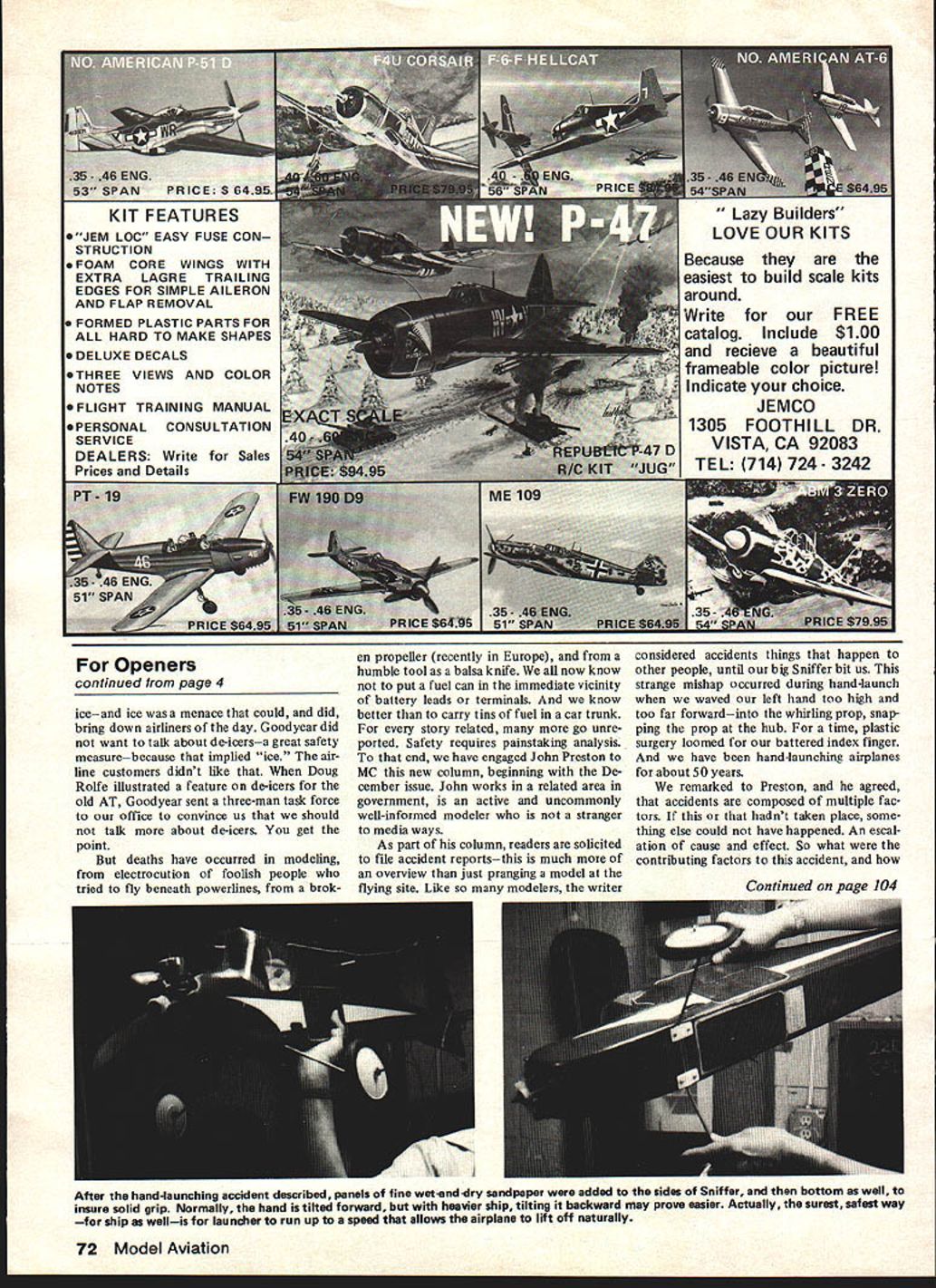
Hefting the ship, we then noted that with the one-hand launch, the ship rotates within that one hand, the bottom of the fuselage resting on the side and then the back of the hand, with a finger or two subconsciously placed beneath the fuselage to help steady the grip. We added a wet-and-dry panel to the bottom. (See pictures.) Moreover, if two hands must be used—a no-no—then train yourself to remove the forward hand down and away; know where it is before you get up steam. (We don't know what to say about guys who can manage "catapult" launches.) The Sniffer does have a short nose, a relatively low thrust line, and a big propeller. Study the thing in your hands and you are surprised by the scant safety margin that exists—it is close quarters.
Had we been flying alone, we would have been in real trouble—practically helpless to gather gear and then drive to a hospital. The moral is: never fly alone. One flier suffered a heart attack and was found by another late-arriving flier. This may be difficult self-discipline—but be smart. The man still lives.
Call for Safety Reports
We'd like inputs quickly for Preston's safety column. The first one is done, but the sooner we can work with actual case histories, the more quickly we can get the word out to save indignities, minor scrapes, and perhaps something serious. Of course, safety holds down insurance costs; accidents drive them sky-high. Whether the incident involves earmuffs, face masks, safety goggles, fumes, dust, tools, airplanes, engines, whatever—please write to help us, your fellow modeler—and yourself.
Since discussing our "accident," we have been told many incredible stories. One guy could not start his engine and used a fuel bulb to squirt fuel into the exhaust. Fuel in the cylinder was slow burning. The resultant flash fire exploded the bulb, fortunately in such a way that the fire path followed the direction of the spout opening. The airplane was covered with burned-through spots. There was no injury. Another friend failed to start up his engine, then stood up. The engine suddenly fired up and dragged the crate into his leg. Flukes, but accidents. It must be emphasized, this is not a dangerous sport—the record proves that. For example, it doesn't hold a candle to the zany things that happen with golf carts. But let's make it even safer.
Quarter-Scale Aristocrat Project
To all the guys who have contributed to our 1/4-scale Aristocrat project, we are grateful. Ten thousand people can make a better monster than your editor. We may yet cause a better job of it before this thing is finished. We've sworn not to give up. NASA's computers predict sometime between June 18, 1980 and November 17, at 11:55 p.m. Meuser chides us. Says he, of his fictitious 1/4-scale Gee Bee in which he would like to be a hero, that he is giving it up, but not before he changes it to 1/6-scale—more prestige that way. Thanks!
We have roughly inked drawings of an entire airplane from one gentleman, pictures, booklets, brochures from all over. Real expert help came from Henry Haffke, who suggested a Williams Wasp 2-in. scale for our Warner, who told the scale was wrong and reminded us that a Wasp was a much bigger engine than the Warner and that the cylinders (we must turn them around to put pushrods in the back) would be equal in size to 1/4-scale Warner cylinders (if they existed). What a lift that tip was! And all those suggestions on how to make 7½ in. diameter wheels with 1¼ in. dia. tires! So what cooks? We have a bare-bones fuselage that weighs 5 pounds—we threw away weight in the nose in the form of ply because ballast will be needed anyway to achieve a CG located at 25% of chord.
Shangri La and a Schoolyard Fly-in
SHANGRI LA, a 45-mile haul, is a casualty of the gas shortage. But we have flying sites coming out of our ears with the lightly loaded crates we fly. So to this lovely greensward of a much nearer high school—a nice, big open field where neighbors have not been annoyed by noise—we repaired with a veritable Lafayette Escadrille of schoolyard-scale types.
When, lo and behold, there appeared this group of Executive Council types, including President Earl Witt and Exec. John Worth with that bloody orbiting Buzzard Bombshell. Skull delighted with impressive flights of a rubber profile Japanese Shinden—a canard fighter. He put up an Aristocrat with an Albon Dart Diesel. Talk about silent flight. Ned Kragnes, who is about a hundred other things we didn't tell you about in that MA story some months ago, had a sistership with a mechanical retractable and numerous full-scale goodies, but, alas, a balky Cessna which had seen better days.
Hurst Bowers put up still another with a Cox running so rich it bubbled—on and on. Dreamy. And his Luton Minor with another bubbled Cox on Ace pulse rudder—this thing will take off and fly round like a Peanut in a gym. But here he hand-launched. Talk about slow, tight, and scale-like speeds! As it circled in the twilight, above the line of fairly distant trees, it evoked the spirit of Old Warden. This is the way to fly, he whispered. Tongue hanging out we replied intelligently, "Yeah, yeah." The Buzzard got sky high, and our big low-wing cruised on high with it. The Council types watched knowingly. But they said nothing. Wonder what they thought of this strange slow-motion fly-in at a strange schoolyard in Northern Virginia. All was peaceful.
One of the VPs who watched is building a little Aristocrat. He said he had forgotten what flying could be like, with everyone relaxed and enjoying himself, flying whenever he wished. He's a dedicated competitor—who also wants to get back to things the way they were. One doesn't have to give up his things—but he can add considerable pleasure to his hobby, and the fun things there are just for the taking.
Transcribed from original scans by AI. Minor OCR errors may remain.

