
For Openers
The Nationals — Then and Now
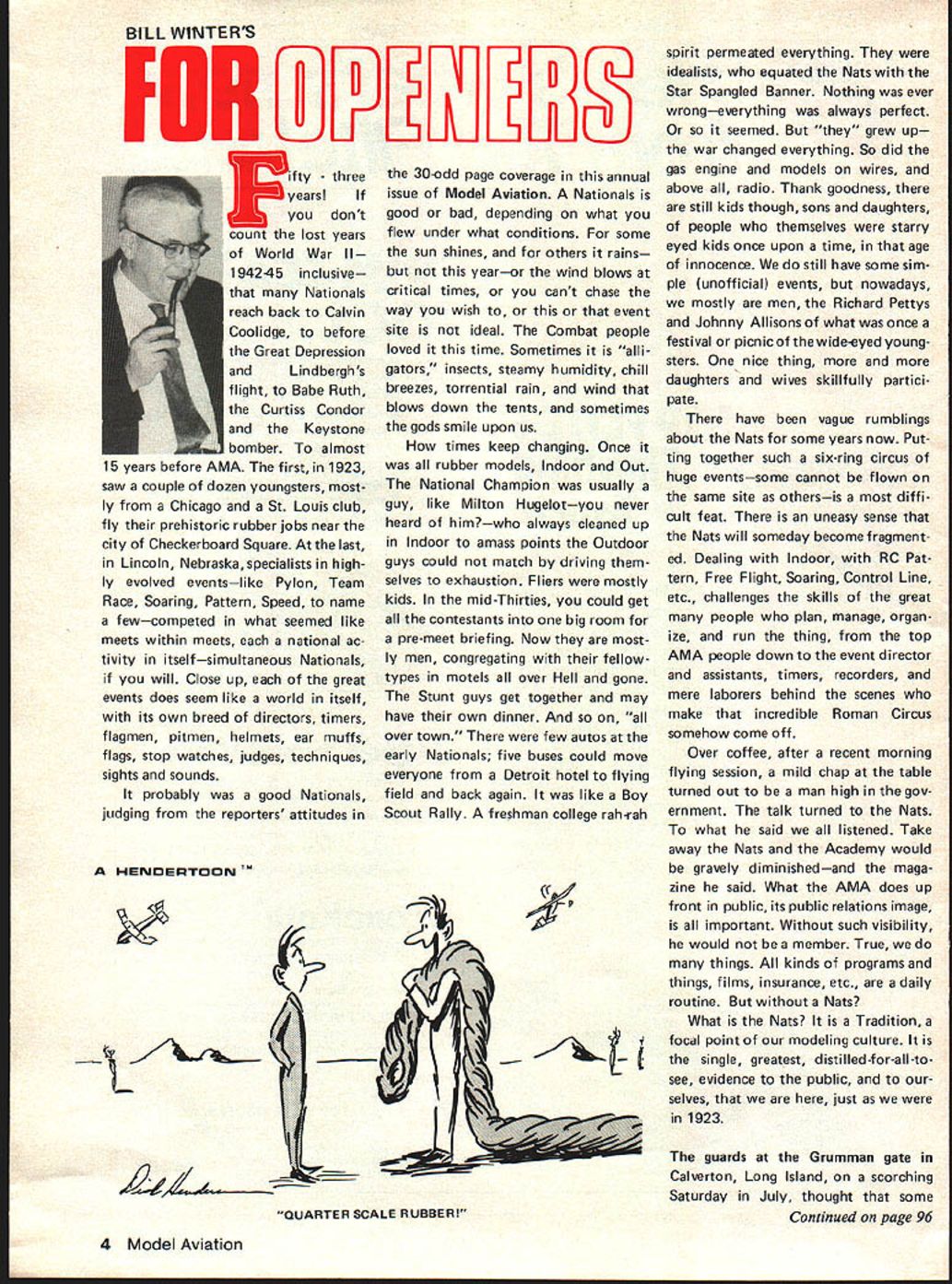
Fifty-three years! If you don't count the lost years of World War II—1942–45 inclusive—that many Nationals reach back to Calvin Coolidge, to before the Great Depression and Lindbergh's flight, to Babe Ruth, the Curtiss Condor and the Keystone bomber. To almost 15 years before the AMA. The first, in 1923, saw a couple of dozen youngsters, mostly from a Chicago and a St. Louis club, fly their prehistoric rubber jobs near the city of Checkerboard Square. At the last, in Lincoln, Nebraska, specialists in highly evolved events—like Pylon, Team Race, Soaring, Pattern, Speed, to name a few—competed in what seemed like meets within meets, each a national activity in itself—simultaneous Nationals, if you will. Close up, each of the great events does seem like a world in itself, with its own breed of directors, timers, flagmen, pitmen, helmets, ear muffs, flags, stop watches, judges, techniques, sights and sounds.
It probably was a good Nationals, judging from the reporters' attitudes in the 30-odd page coverage in this annual issue of Model Aviation. A Nationals is good or bad, depending on what you flew under what conditions. For some the sun shines, and for others it rains—but not this year—or the wind blows at critical times, or you can't chase the way you wish to, or this or that event site is not ideal. The Combat people loved it this time. Sometimes it is "alligators," insects, steamy humidity, chill breezes, torrential rain, and wind that blows down the tents, and sometimes the gods smile upon us.
How times keep changing. Once it was all rubber models, indoor and out. The National Champion was usually a guy, like Milton Hugelot—you never heard of him?—who always cleaned up in Indoor to amass points the Outdoor guys could not match by driving themselves to exhaustion. Fliers were mostly kids. In the mid-Thirties, you could get all the contestants into one big room for a pre-meet briefing. Now they are mostly men, congregating with their fellow types in motels all over Hell and gone. The Stunt guys get together and may have their own dinner. And so on, "all over town." There were few autos at the early Nationals; five buses could move everyone from a Detroit hotel to the flying field and back again. It was like a Boy Scout rally. A freshman college rah-rah spirit permeated everything. They were idealists, who equated the Nats with the Star Spangled Banner. Nothing was ever wrong—everything was always perfect. Or so it seemed. But "they" grew up—the war changed everything. So did the gas engine and models on wires, and above all, radio. Thank goodness, there are still kids though, sons and daughters, of people who themselves were starry-eyed kids once upon a time, in that age of innocence. We do still have some simple (unofficial) events, but nowadays, we mostly are men, the Richard Pettys and Johnny Allisons of what was once a festival or picnic of the wide-eyed youngsters. One nice thing: more and more daughters and wives skillfully participate.
There have been vague rumblings about the Nats for some years now. Putting together such a six-ring circus of huge events—some cannot be flown on the same site as others—is a most difficult feat. There is an uneasy sense that the Nats will someday become fragmented. Dealing with Indoor, with RC Pattern, Free Flight, Soaring, Control Line, etc., challenges the skills of the great many people who plan, manage, organize, and run the thing, from the top AMA people down to the event director and assistants, timers, recorders, and the laborers behind the scenes who make that incredible Roman circus somehow come off.
Over coffee, after a recent morning flying session, a mild chap at the table turned out to be a man high in the government. The talk turned to the Nats. To what he said we all listened. Take away the Nats and the Academy would be gravely diminished—and the magazine, he said. What the AMA does up front in public, its public relations image, is all important. Without such visibility, he would not be a member. True, we do many things: all kinds of programs and services, films, insurance, etc., are a daily routine. But without a Nats?
What is the Nats? It is a tradition, a focal point of our modeling culture. It is the single, greatest, distilled-for-all-to-see evidence to the public, and to ourselves, that we are here, just as we were in 1923.
At Calverton: A Flying Session
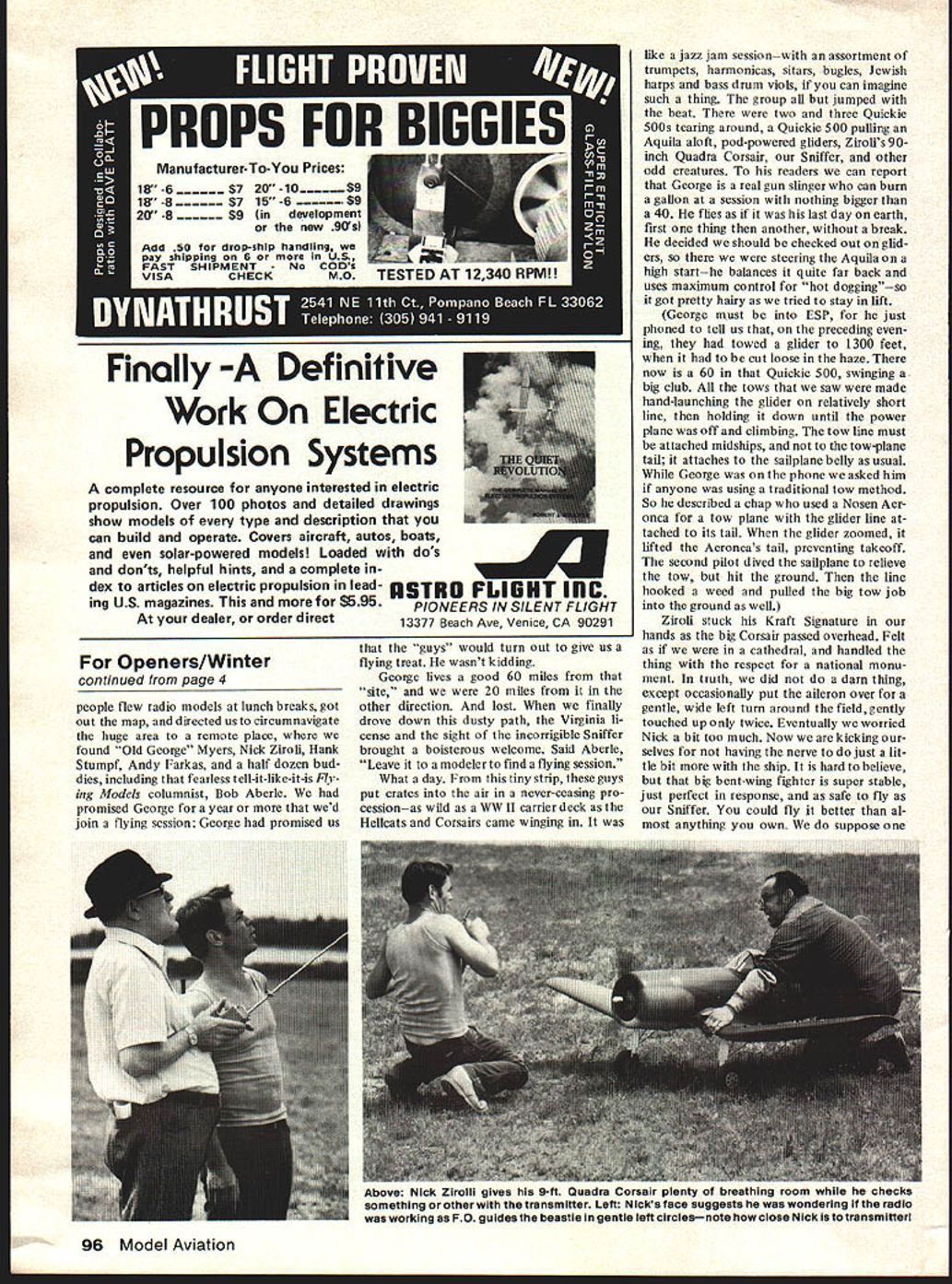
The guards at the Grumman gate in Calverton, Long Island, on a scorching Saturday in July, thought that some people flew radio models at lunch breaks. They got out the map and directed us to circumnavigate the huge area to a remote place, where we found "Old George" Myers, Nick Ziroli, Hank Stumpf, Andy Farkas, and a half dozen buddies, including that fearless, tell-it-like-it-is Flying Models columnist, Bob Aberle. We had promised George for a year or more that we'd join a flying session; George had promised us that the "guys" would turn out to give us a flying treat. He wasn't kidding.
People who turned out that day included:
- "Old George" Myers
- Nick Ziroli
- Hank Stumpf
- Andy Farkas
- Bob Aberle
- and a half dozen other buddies
George lives a good 60 miles from the "site," and we were 20 miles from it in the other direction. And lost. When we finally drove down this dusty path, the Virginia license and the sight of the incorrigible Sniffer brought a boisterous welcome. Said Aberle, "Leave it to a modeler to find a flying session."
What a day. From this tiny strip, these guys put crates into the air in a nerve-creasing procession—as wild as a WWII carrier deck as the Hellcats and Corsairs came winging in. It was like a jazz jam session—with an assortment of trumpets, harmonicas, sitars, bugles, Jewish harps and bass drum viols, if you can imagine such a thing. The group all but jumped with the beat. There were two and three Quickie 500s tearing around, a Quickie 500 pulling an Aquila alto, pod-powered gliders, Ziroli's 90-inch Quadra Corsair, our Sniffer, and other odd creatures. To his readers we can report that George is a real gunslinger who can burn a gallon at a session with nothing bigger than a .40. He flies as if it was his last day on earth, first one thing then another, without a break.
He decided we should be checked out on gliders, so there we were steering the Aquila on a high start—he balances it quite far back and uses maximum control for "hot dogging"—so it got pretty hairy as we tried to stay in lift.
(George must be into ESP, for he just phoned to tell us that, on the preceding evening, they had towed a glider to 1,300 feet, when it had to be cut loose in the haze. There now is a .60 in that Quickie 500, swinging a big prop. All the tows that we saw were made by hand-launching the glider on relatively short line, then holding it down until the power plane was off and climbing. The tow line must be attached midships, and not to the tow-plane tail; it attaches to the sailplane belly as usual. While George was on the phone we asked him if anyone was using a traditional tow method. So he described a chap who used a Nosen Aeronca for a tow plane with the glider line attached to its tail. When the glider zoomed, it lifted the Aeronca's tail, preventing takeoff. The second pilot dived the sailplane to relieve the tow, but hit the ground. Then the line hooked a weed and pulled the big tow job into the ground as well.)
Ziroli stuck his Kraft Signature in our hands as the big Corsair passed overhead. It felt as if we were in a cathedral, and we handled the thing with the respect of a national monument. In truth, we did not do a darn thing, except occasionally put the aileron over for a gentle, wide left turn around the field, gently touching up only twice. Eventually we worried Nick a bit too much. Now we are kicking ourselves for not having the nerve to do just a little bit more with the ship. It is hard to believe, but that big bent-wing fighter is super stable, just perfect in response, and as safe to fly as our Sniffer. You could fly it better than almost anything you own. We do suppose one cannot make mistakes on the approach and landing any more than you would with a big plane. Nick dragged in for some picture-book carrier-type landings, and short approaches that sometimes bounced a bit. Doubt that Nick will ever damage it. It gets out with real authority in a surprisingly short run—better than most sport models. Slow rolls were magnificent.
All these guys fly each other's airplanes. So George put our Sniffer on low motor, into a great thermal, set up a rather fast-turning flight, handed it back and we stayed in that lift for 15 minutes. Aberle said of the Sniffer that, if anyone "can't learn to fly with that, they will never learn to fly anything." Amazing how many people remember Wally Simmers' old Sniffer. It must have been a much-loved model.
Late in the day, drinking warm Coke, it was just George and F.O., talking about George's column, the field, the readers. He is so busy that he talks into his recorder as he drives—pauses between swerves to avoid other drivers. He put this thing on top of the car and there was George talking to us from two places at once. My God! He sounds like Quincy recording an autopsy.
The voice went on, describing what he was finding as he took apart some new gadget (while driving!), layer by layer, like one of the guys in England in WWII who defused bombs and had to describe every action in case the things went off. As the sun sank into the West, we took our leave. On the field was Old George, in his car talking into his machine. Wonder what he was saying?
In Memoriam: Matty Sullivan (August 1979)
With his passing, we modelers have lost a dedicated friend, another of the old guard of the early industry that grew with us, a truly exceptional man. Matty was one of a handful of manufacturing types who liked to be with his customers, the modelers, who got out on hot fields the better to determine their needs, and to whom you could always talk one-on-one, at shows. He looked at everything from the point of view of how it could be done better. He had sample foam wings at the Nats in the late Forties—far ahead of their time. He became fascinated with nylon when it was something to make stockings out of. He was first to fill the need for a starter. He perceived the need for lines and things for control line even before the war was over, and Sullivan products were a part of our lives for over 30 years. Golden rods, tanks of all kinds, and sorts of good things—everything fitting a need. His ingenuity and enthusiasm were limitless.
Matty was an early dirt-track racer—a good one. (We had an unforgettable ride in his MG one Nats evening long ago.) He became a bricklayer. When he got into the model business, and times were lean, he'd hang in there by spells of bricklaying. He would do anything for the good of the industry, and for the AMA. He talked up such things, and put his shoulder to the wheel in meaningful ways without anyone being the wiser.
We remember the day in the Forties when he came to New York from Philly just to stunt a U-control model in an armory, for the benefit of a Life magazine photographer who got stunning pictures by strobe. When, after a hiatus in the country following the editorship of Air Trails, the writer had come to Model Airplane News as its new editor, Matty phoned from nearby—he had caught an early train from Philly—and said, how about having breakfast with me. Now, there had been a rift between Matty and MAN, and he had not advertised in a year. He handed us his ad, the first of many, and went home. Said he wanted to show his support. Years ago, the Academy was out of money—it ran short every year before renewal time bailed it out—and Matty asked then-director Russ Nichols why he was gloomy. When Russ replied that the payroll could not be met, and disaster was at hand, Matty pulled out his checkbook and may have saved your Academy. Matty had survived severe heart attacks and kept up the good fight, only to lose the big one to lung cancer.
He was nominated recently for the Hall of Fame—a last-minute telegram telling him of this honor he had framed and hung on his hospital room wall. To say he will be missed is a mere cliché. He leaves a void. He was one of a kind. He was one of us.
Transcribed from original scans by AI. Minor OCR errors may remain.

