
BILL WINTER'S FOR OPENERS
Young beginners and what a trainer should be
One of the more gratifying things observed at the little-used flying fields we are fond of visiting—where we can make long flights and chase elusive thermals without tying up several other people on the same frequency—is the fairly frequent appearance of teenagers with their first radio jobs. They are surprisingly determined. They seem to have much more luck than guys in their twenties who, perhaps having a somewhat broader base, tend to opt for colorful but off-beat crates, scratch-built from magazines. We are impressed by the giant leaps the kids can make when some older hand lends friendly help. From all this, our own confused notions about what a trainer should be—is there one among us who is not confused by this question?—are acquiring a sharper perspective.
The young beginner listens—he does not have a mind-set. The older one struggles with the application of half-truth fixes of uncertain origins and often repulses all comments until he is in a bind. This past weekend we saw a very young pilot, with simple advice, enjoy his new Falcon Junior, while an older one adjusted some Pietenpol-type thing—not a kit—until he had zero in the wing, about 5 or 6 degrees positive in the stabilizer, and spectacular upthrust (the CG was traveling incognito). How would you like to fly that machine?
It is too easy to theorize about what a trainer should be. Opinions abound. A rough definition might be anything one succeeds in flying without unrepairable damage. If the airplane manages to fly at all, one must admit that it teaches something, regardless of what it is. Just seeing a model in flight demonstrates quickly that all airplanes must be guided differently when the ship comes toward you, as compared to going away. And there probably are many thousands of people, left to their devices and out of touch with organized activities, who must run the chancy mill of trial and error.
Industry has busted a gut to perfect ready-to-fly little things which hopefully factor out ugly little gremlins. But we watched an expert flying erratically one such model for many months—and then one day some grizzled veteran of sport flying suggested a bit of downthrust and adding a little weight to the nose. The only weight available was a small, flat plug wrench and this was rubber-banded into place. A sliver of wood for a shim provided the downthrust. That little ship really came alive, climbed high without stalling or mushing or need for desperate correction. It grooved—an element we all strive for; approaches were right on. The point is that it would fly, after a fashion, in anyone's hands, but trimmed, it flew the way the designer and manufacturer hoped it would. No two airplanes are alike, even if ground out by some fabulous "stamping" machine.
One has to hope that, having flown this little rudder-only thing—which after all puts a minimum dent in the pocketbook, and may well be the maximum that thousands of people can afford—the newcomer will be inspired to go back to the hobby shop. We can hope some clerk will minister to his needs intelligently. There are two stages of help: the basic, verbal one at the hobby shop, and the second at the field where, if the newcomer is fortunate enough to contact them, experienced hands will make the most out of what the hobby shop began.
Since most people who fly power wish to do aerobatics, including rolls, a more advanced trainer featuring ailerons can, in many cases, be the correct choice. However, one does not teach himself to fly a real airplane. There is an instructor. The penalties of a crashed model are not as severe as in full scale, but the magic of instruction at the flying site is virtually compulsory if results are to be bright. Deep instruction as given by some clubs to new or prospective members is ideal. But short of that, it sometimes takes only little things to bring a guy to the point where he can guide his machine right-side up, without wild dives and twists and out-of-phase responses.
Let's go back to those two kids with the Junior Falcon. A quiet observer who just happened to be there made the first flight, and after suggesting a few changes in control movements and trim, momentarily handled the sticks on the second flight, then quickly turned the ship over to its young pilot and quietly talked him into flying it gently on rudder only. Now the kid could fly about the field in very mild turns, experienced stick reversal as the ship came toward him. He could fly—the first time! He couldn't do much, true, but successive flights allowed him ever so gently to feel out his machine. What sticks in the mind was the safety and efficacy of rudder early on, and the fact that a ship which will respond to rudder when needed—and all Falcons will do that—is a great advantage.
Many other ships will do this, too. Slight dihedral should seem important to fortify that quality—witness some of the Sig aileron jobs, and even the red-hot Bridi trainer at 52 in. with a roaring .40, which our own "kid" is learning on.
Help at the field: an example
We have mentioned our 30-year-old son Mike and his first airplane—the Bridi .40. It scared F.O. to death. But with help in setting up the ship—good linkages, solid hinging, proper CG location, warps removed, movements correct (nose wheel should move very little)—he got real help from some splendid guys at an upstate New York field.
These guys started him out taxiing about—and from what we hear that must have been rather wild, with guys chasing the ship all around the place, like catching a greased pig. On the third flight, he took off. They had him flying on rudder only, just steering about to get the feel of things (rudder/throttle on the left stick, ailerons/elevator on the right). On his fifth flight, he got involved with a gusty condition (they told him to be careful) and banged the elevator stick, then tried to pull out, so now he has modest damage. This is what help means—you can get by with a good performing airplane. When Mike masters his Bridi he'll fly anything.
He soon will have the best of two worlds—good aileron stuff where the guys fly—and a .19-powered Concept Models Scout (a winter project kit swiped from the old man who had cast loving eyes on it). This he can fly anywhere—farms all about—by himself, from a hand launch. It should fly as well as our big Sniffer, which means last-forever soaring flights. He'll opt for ailerons, we imagine, and it should be a dream: a sport model with a wide spectrum of performance capabilities, from soaring to monkey business. What would he have tried if he had been an "outsider"?
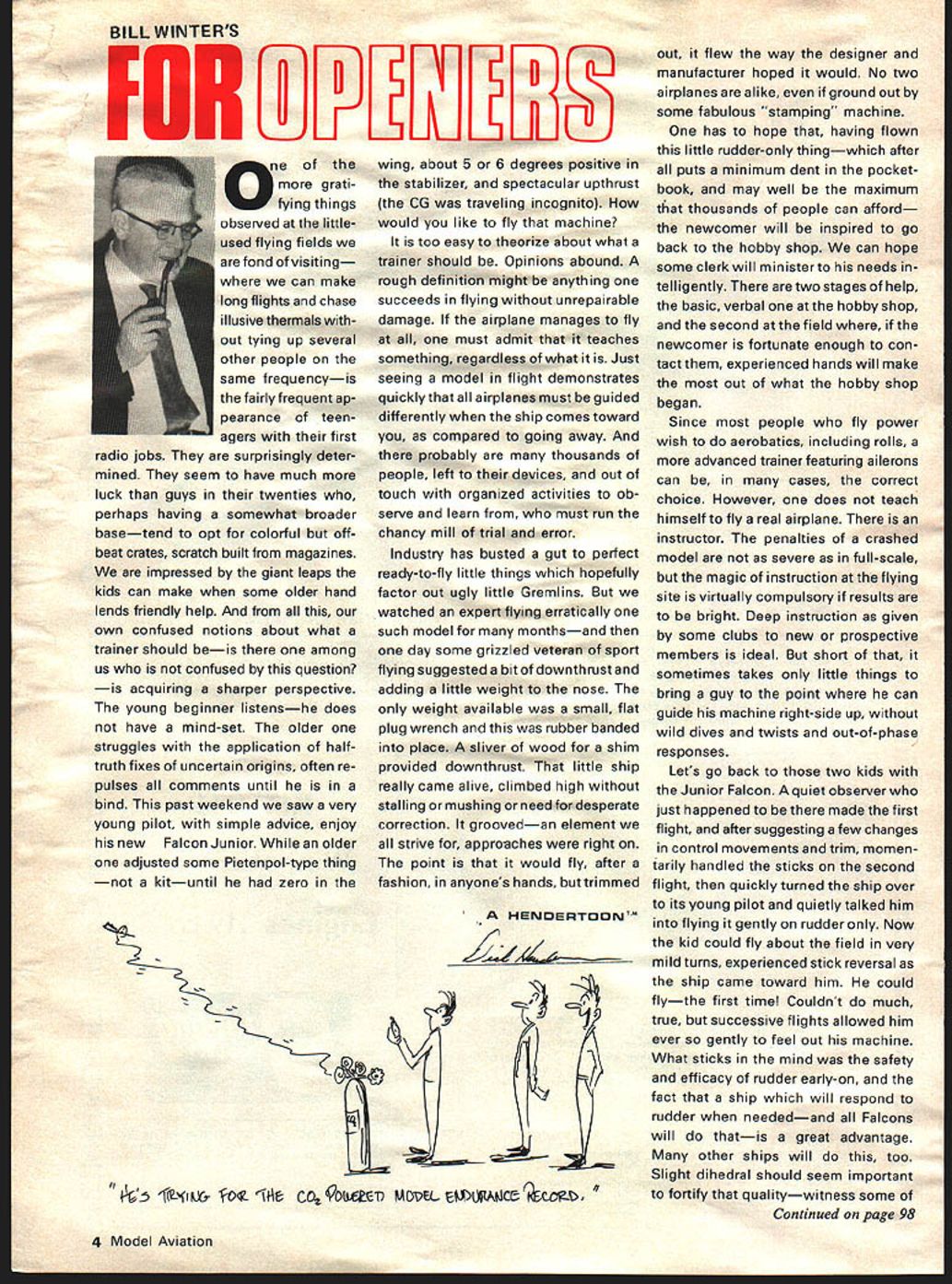
All of us agree that help is half the answer. We can help those who show up and ask for it. But what about the thousands who are living desperate adventures by themselves? A suggestion—not necessarily unique, and perhaps utilized before. Noting that Piper, Cessna, etc., long ago hit upon a wonderful ploy in advertising to the public by offering a cheap get-acquainted ride, it would be most interesting to see what would happen if all RC clubs followed the same tactics, even if only via a poster at the hobby shop. Invite people to come out and fly a radio-control model—for free. If that doesn't bridge the gap, and bring things under better control, we don't know what will. You'll have fun doing it. Some tricycle-geared shoulder- or high-wing with ailerons. Color it yellow. Perhaps members have a few staunch crates knocking about which can be pressed into service, or guys could get together to whip out a bird or two in a couple weeks. It can double as a club trainer. The "Yellow Peril" lives again!
We are aware this will drive some of you guys up the wall. You have all the fliers you can handle at a flying site. But it is good to know where all those transmitters will be when they come on while you are flying. And we've seen several nearby clubs deal with many members—well over 300 in the case of D/C/RC. When everyone had to be on 27, years ago, we saw western-style range wars, complete with fences across access roads. F.O. was frozen out! It was just plain stupid.
Support equipment and why it's worth it
Anyone who has been on the RC scene almost from the very beginning—RCers of the Thirties are the true pioneers, like the Good brothers, Lorenz, DeSoto, Jim Walker, etc.—is amazed by today's ever-increasing variety of clever gadgets, and wonders if he passed into the happy hunting ground. The writer was brought up on tools literally chipped from stone, and frill-less flight equipment. Having at long last done something about the former situation by springing for a Dremel MotoShop and MotoTool and Drill Press, and the latter with a good power panel and chargers capable of checking and recycling the batteries, he feels like the ditch-digger who crashed a cocktail party. Good flight-support equipment is certainly worth its weight in gold.
There are many fine products on the market, so the following is not meant to be an endorsement. It just happens that we are using an L.H. Taylor Super Power Panel with an Acu-Charger for its 12-volt gel-cell (it fast-charges up to a point, then goes on trickle), and the Power Pacer (which allows us to both charge and recycle the flight equipment).
The biggest shock of our life came when we realized that for 40 years of RC—or that part of it since nicads—that we have been consistently overcharging by as much as 400%. We have the Power Panel in a small field box (it says "Winter" on one side, so George Myers suggested printing "Summer" on the other—which could be mind-boggling to the spectator). It includes an expanded-scale voltmeter to read Rx and Tx voltages, and another scale for glow-plug drain when using the glow driver feature. There are outlets for a fuel pump (we haven't got ritzy enough to use it yet), although we did obtain a Sullivan starter which we don't use because we find hand-starting our K&B .40, Veco .19, Fox .19, OS .30 and OS .35 ridiculously easy. There is a knob selector for the glow driver, for fast-charging the flight-system batteries, and for ready Tx and Rx voltages. It has taught us many useful things in a big hurry.
For example, after a 75-minute air-time session, we found that we could have flown many more flights—and the slow charger in the Power Pacer at home had both sets of batteries off scale in an hour and a half. Even when slow charging we have discarded overnight charging when a late-afternoon session is planned. (You should not be misled by what we've said, because there is very little servo use in the winter's present kind of flying.)
On a day-long session we can check the battery situation any time we wish with the Power Panel and, if a boost is necessary, there is always that fast-charge feature. It takes about 15 minutes. The little red light (LED) sometimes goes out almost as quickly as it is turned on.
Of course, you don't need such a panel to get a glow driver. Take our word for it, a glow driver is a super-good investment. Our panel has a pot to adjust the plug to whatever degree of glow we wish to work with, and then it holds that glow under all starting conditions, including a wet engine. It cuts back when the engine runs—not news to most of you guys. You get particular about plugs—the meter shows that various plugs draw varying amounts of current, some as much as three amps; some glow white hot. Although one can reset the pot to take care of this, the reasonable solution is to standardize on one make and type of plug and adjust the pot for it.
Since we "never could afford" such goodies, why do they seem a good investment now? In two years we have not had a glitch or a missed signal, even at sailplane ranges. We run the above engines on 4-ounce tanks, and at half throttle or even less we have 16–18 minute runs and go high in lift. Decent support equipment solves our "energy problem." The money that once went into repairs and parts can justify marvelous apparatus that makes flying a genuine pleasure. This stone-age hacker is impressed.
Toy-market trainers and the need for instruction
When it comes to beginner problems, no one on earth knows more about them than Cox and Testors, for both have marketed ready-to-fly airplanes through toy outlets for many years—by the millions. These products are a marvel of design and manufacturing at truly low prices, all the more amazing because engines are included. They will fly. Yet many of them never do. We, hardy experienced modelers, have ambivalent feelings about the whole thing, for we tend to see other forms of models as being better trainers. But as a practical matter, if such models were made available on roughly the same basis, it is quite possible, if not probable, the problems would be greater, not less. These people are dealing with the totally uninstructed public, with all the doubtful capabilities the situation implies. We don't think either manufacturer would relish our labeling these products as toys. They are much more than that. Yet they are moved primarily as toys.
It all comes back to instruction, or the lack of it.
"Personal instruction is best, but impractical," states Testors. If we constantly see guys on the flying field who have troubles starting and running engines, what can be expected of the unvarnished public? The problems call for heroic measures, and both manufacturers have taken heroic measures, with rather impressive results.
Like the auto manufacturers, Cox has tried a hot line for awhile on which the public could call for help and information. Testors is using phonograph records.
It will come as no surprise that the biggest complaint is an inability to start the engine. That any completely inexperienced person can run a model engine always amazes us. Many a fine engine the writer has used was a hobby-shop disaster, where the irate customer demanded his money back. There was never anything wrong with any engine we got that way. Powered models, according to Testors, are returned to the manufacturer primarily because the engine would not start. Yet, fully 98% of those engines have been found in perfect condition. Testors assumed that written starting instructions were insufficient.
In 1978, Testors took a draconian step—the instructional recording—thereby bringing the expert's voice to the beginner's ear. The recording is a kind of personal instruction. (Wouldn't it be great if someone had recordings on R/C, CL and all the rest of it?) In a simple step-by-step format, engine-starting procedures are orally explained. Customers who could misinterpret, or totally ignore, written instructions can now listen to them—over and over until they become clear.
Transcribed from original scans by AI. Minor OCR errors may remain.

