
FOR OPENERS
Aerodynamics and model aircraft
Aerodynamics is a science. Since the days of the visionaries and the dreamers, going back to before the Wrights were born, countless minds have struggled with its fundamentals, studied it in wind tunnels and laboratories, and evolved theories into laws. In wartime its refinement took quantum jumps. In our lifetime we have seen aviation advance — in step with many related sciences: metallurgy and electronics, to name just two — from a point where a new plane was not proved airworthy until a daring test pilot tried it out, frequently losing his life, to today's ability to project a multi-million-dollar jumbo jet or a supersonic fighter which are sold by the many hundreds before the prototype even takes shape in the factory.
But while aerodynamic laws are immutable, so that the experimenter would seem a thing of the past, there being nothing unknown to "discover," restless minds continue to divine new ways to apply those laws. On the one hand, engineering task forces equipped with computers project a craft of desired characteristics, performance, and capacity (as the 747). On the other, we see the designer equivalent of the old test pilot, who perceives those laws as an outline with never-ending areas to be filled in. When the Convair F-102 refused to break the sound barrier, Whitcomb came up with the "coke bottle" fuselage, a theory having to do with the cross-sectional area (and its proper location) of a machine as a whole. He also devised the winglet, as seen on the Varieze home-built and on the new Learjet. No aerodynamic magna charta can begin to define the infinite ways old laws can be applied for "new" answers.
Variations in configurations are as many as the pebbles on a beach. We refer not to normal differences between a light plane and an airliner (that is, variations due to intended purpose), but to VTOL, blown wings, lifting bodies, and so on. There are deltas, flying wings, canards, circular wings. You name it and it exists. But in this world of full-scale aerodynamics everything comes full circle. However bizarre, any machine that works only confirms what the rules of the science proscribe. But who knows what other things are there for the finding?
Model aerodynamics is more cut-and-try than cut-and-dried. We often argue over how many angels can dance on the head of a pin. Although we are bound by the same laws of nature, it sometimes seems a different ballgame. We will debate until the cows come home whether or not a symmetrical airfoil mysteriously lifts at zero degrees. Full-scale engineers who happen to be active modelers remind us in no uncertain terms that this is an impossibility. Sure it is impossible, but... If it is impossible, then one must provide a mite of "up" if the ship is flying upright, a tad of down if it is flying inverted. Yet when you fly these things, you swear that a control-line stunter, like an RC pattern job, will stay where you put it, and that it will fly steadily for a reasonable time upright or inverted once positioned. Or are you feeding in such a tiny input you aren't aware of it? Like the horse that can be led to water but cannot be made to drink, the writer has an "open" mind on this and a few dozen other modeling "phenomena." Or is it a "closed" mind? Darned if we know.
Joe Wagner, a one-time prominent kit designer — the Dakota was his, a biplane with more left thrust by far than anyone had used, before or since — stated that the symmetrical airfoil somehow changes its angle of attack (or something) at such a high frequency, continuously oscillating, to seek its flyable angle — but that the eye cannot perceive it.
Frank Zaic expounded a circular airflow concept which affects the way a model circles in a bank — and we've debated that for at least 25 years. You have heard of the center-of-lateral-area debate. That one is still unsettled after a good 40 years. It may never be. If you argue it with anyone, pro or con, be encouraged by the fact that your grandpappy used to blow steam out of his ears when he argued about it. Friends have been known not to talk to each other for years because of CLA.
Is there such a thing as CLA? The writer thinks so but... If a plane has weathercock stability, it is to be presumed that the center of its side area lies sufficiently behind the CG to make it track — like the feathers on an arrow, or the profile of a weathervane. But the traditional argument was that if the CLA was too far above the CG, the plane would be forced into a spiral dive as it banked and turned, because of the skidding effect of the airflow from the outside of the circle, exerting a leverage in proportion to the moment arm between the CG and the CLA. Then came Goldberg with the Zipper pylon gas model which spiraled upward under power. This shook up the hardline traditionalists, but not for long. Their "theory" was revised to account for two CLAs! One was in front of the CG and the other behind it, and a line drawn between the two would impart a nose-up attitude if the forward CLA was higher than the rearward one. The inclination of that line was the barometer. You might say the emphasis on forward profile in the pattern airplane to improve knife-edge is an example of that revised theory.
But how then do you account for Walt Mooney's comic free flights which have no dihedral, but have a huge funny pilot profile (really a fin) sticking up from the cockpit? Or is this really just more of the same?
Low-speed aerodynamics never were developed to remotely compare with full-scale knowledge. We can't even make up our minds if a smooth wing or a rough one is better. We fiddle with turbulators and multispars to turbulate the upper surface over a model wing and, we presume, to keep that flow from breaking away prematurely from the top surface of the airfoil. So it sounds contradictory: why is it that a spanky new little scale model seems to improve with age, as patches, dings, and dints begin to appear? It may not be as fast as it once was but it appears to become a flying carpet. Reynolds number (RN) is a mighty factor, a stern taskmaster.
The world of indoor is different, you'll agree. But a fast pattern job — when RN goes up — is at its best with glass-like wings. And that seems true of FAI RC sailplanes. It is as if the full-scale world deals with a well-defined set of rules — although in reality there is a great void between a Cub and a jetliner as far as wing efficiency and lifting capacity are concerned; but in our world, there appears to be level upon level (note the majestic flight of a 1/4 scale), where design parameters are stretched like rubber bands. All of which seems to tell us that by comparison with full-scale aerodynamics, the laws of nature have left us modelers with worlds still to explore.
You believe we know everything? That we know all the basic rules that determine a configuration? Consider the fact that a wing must somehow be stabilized to hold it in its optimum position for flight. If you have ever seen a free-flight wing depart from a model high in the sky and then rotate around some spanwise axis, you know what the lack of such a stabilizing force really means. As the angle of attack of that loose wing increases with the first pitch-up, we know that the center of pressure (lift) moves forward on the airfoil to destabilize it (on a flat plate, like a sheet balsa wing, the CL moves rearward). Convex sections reduce the distance the CL will shift. So how can a wing be made stable when no stabilizer is present?
We incorporate sweepback and we still have to supply further stabilization by wing twist — exaggerated washout at the tips, or providing up-tilted surfaces at the tips for the same purpose, and so on. It is even possible through airfoil variations and other tricky stuff to contrive in this limited space to have a stable "flying plank." Without all this hoopla, we will all agree that for an orthodox wing there simply must be a stabilizing force, the stabilizer, a wing-like horizontal area at the tail.
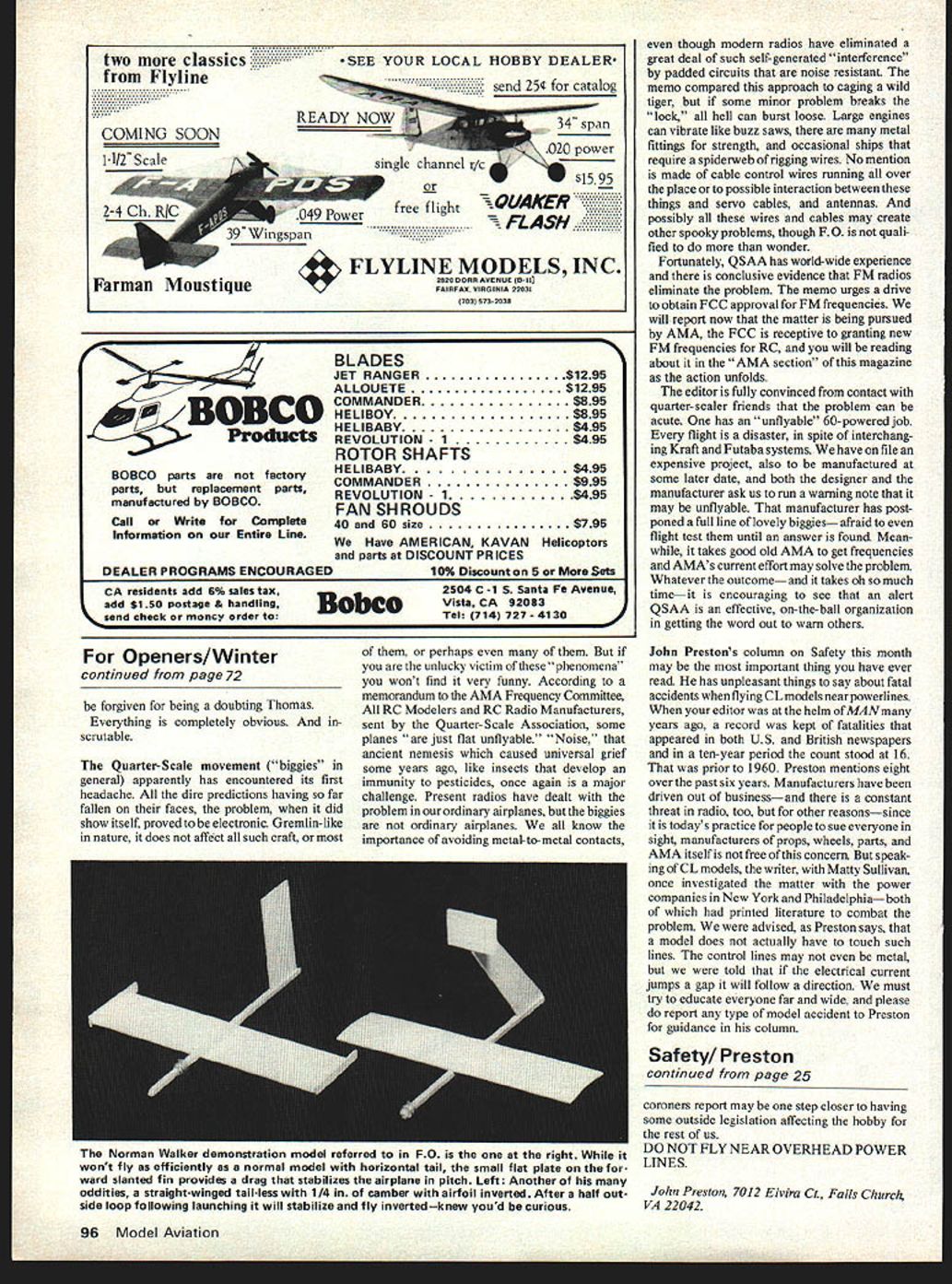
Some years ago, Mr. Norman K. Walker gave a lecture to members of the D.C./R.C., entitled "The Stability and Control of Model Aircraft." It was a long and intriguing lecture which presented diagrams and a variety of strange models to make his points. Among them was a strange beastie shown in the accompanying photograph. Instead of the conventional stabilizer, it achieved the necessary stability from a small flat plate mounted on the front of the fin. After you have figured it out, you will perceive the notion that there are many ways of skinning a cat. The laws of aerodynamics may be fixed, everything however strange conforming to them in the end, but their employment by the model designer eloquently suggests that many adventures lie in the future.
We draw "precise" airfoils, yet for the majority of sport models — rubber, gas, radio — an offhand "zip" can perform just as well if not better. We speak of "downwash" angles and where to put the stab. But who really knows where the downwash is on a given model, which may be as slow as molasses or fast enough to duplicate homebuilt speeds. A typical indoor model may weigh one gram, two with rubber. Consider that wing loading — would you bet your life that the model has tip vortices? The air pressure at the tip borders on the non-existent. Would it agitate a tissue streamer? Aerodynamics is a science; it meanders into still waters at the low Reynolds numbers we work with in some cases. Low-speed aerodynamics, as we know it, proves only that one man's educated guess is as good as another's. One may be forgiven for being a doubting Thomas. Everything is completely obvious. And inscrutable.
Quarter-scale movement and radio problems
The Quarter-Scale movement ("biggies" in general) apparently has encountered its first headache. All the dire predictions having so far fallen on their faces, the problem, when it did show itself, proved to be electronic. Gremlin-like in nature, it does not affect all such craft, or most of them, or perhaps even many of them. But if you are the unlucky victim of these "phenomena" you won't find it very funny.
According to a memorandum to the AMA Frequency Committee, "All R/C Modelers and R/C Radio Manufacturers," sent by the Quarter-Scale Association, some planes "are just flat unflyable." "Noise," that ancient nemesis which caused universal grief some years ago, like insects that develop an immunity to pesticides, once again is a major challenge. Present radios have dealt with the problem in our ordinary airplanes, but the biggies are not ordinary airplanes. We all know the importance of avoiding metal-to-metal contacts, even though modern radios have eliminated a great deal of such self-generated "interference" by padded circuits that are noise resistant. The memo compared this approach to caging a wild tiger, but if some minor problem breaks the "lock," all hell can burst loose.
Large engines can vibrate like buzz saws, there are many metal fittings for strength, and occasional ships require a spiderweb of rigging wires. No mention is made of cable control wires running all over the place or to possible interaction between these things and servo cables and antennas. Possibly all these wires and cables may create other spooky problems, though the writer is not qualified to do more than wonder.
Fortunately, the Quarter-Scale Association (QSAA) has worldwide experience and there is conclusive evidence that FM radios eliminate the problem. The memo urges a drive to obtain FCC approval for FM frequencies. We will report that the matter is being pursued by the AMA, the FCC is receptive to granting new FM frequencies for R/C, and you will be reading about it in the AMA section of this magazine as the action unfolds.
The editor is fully convinced from contact with quarter-scaler friends that the problem can be acute. One has an "unflyable" 60-powered job. Every flight is a disaster, in spite of interchanging Kraft and Futaba systems. We have on file an expensive project, also to be manufactured at some later date, and both the designer and the manufacturer ask us to run a warning note that it may be unflyable. That manufacturer has postponed a full line of lovely biggies — afraid to even flight-test them until an answer is found. Meanwhile, it takes good old AMA to get frequencies and AMA's current effort may solve the problem. Whatever the outcome — and it takes time — it is encouraging to note that QSAA is an effective, on-the-ball organization in getting the word out to warn others.
Safety
John Preston's column on safety this month may be the most important thing you have ever read. He has unpleasant things to say about fatal accidents when flying control-line models near power lines. When your editor was at the helm of MAN many years ago, a record was kept of fatalities that appeared in both U.S. and British newspapers and in a ten-year period the count stood at 16. That was prior to 1960. Preston mentions eight over the past six years.
Manufacturers have been driven out of business — and there is a constant threat in radio, too, but for other reasons — since it is today's practice for people to use everyone else's stuff: manufacturers of props, wheels, parts, and AMA itself is not free of this concern. But speaking of control-line models, the writer, with Matty Sullivan, once investigated the matter with the power companies in New York and Philadelphia — both of which had printed literature to combat the problem. We were advised, as Preston says, that a model does not actually have to touch such lines. The control lines may not even be metal, but we were told that if the electrical current jumps a gap it will follow a direction.
We must try to educate everyone far and wide. Please report any type of model accident to John Preston for guidance in his column.
Transcribed from original scans by AI. Minor OCR errors may remain.

