
BILL WINTER'S FOR OPENERS
Birds and models
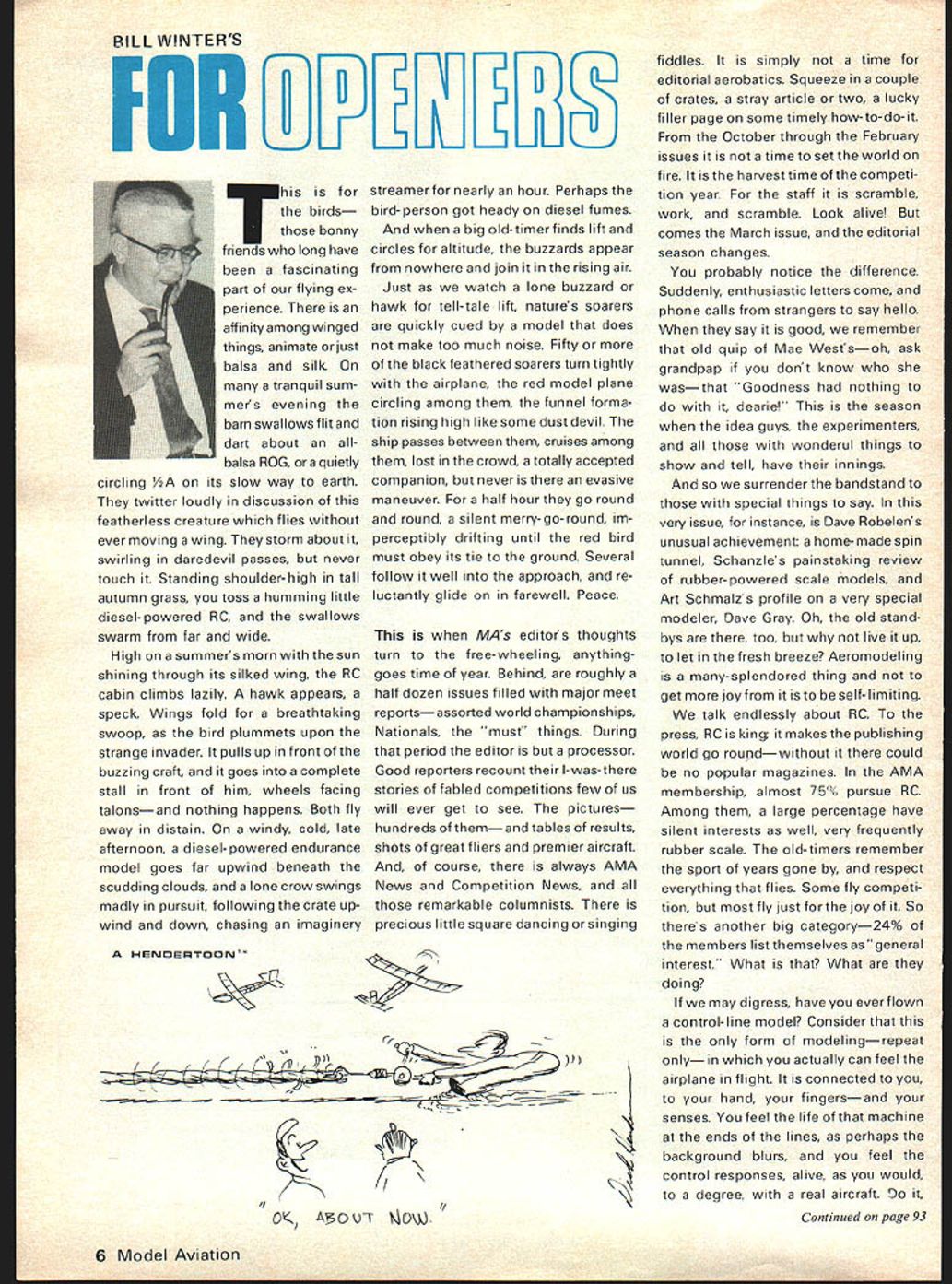
This is for the birds—those bonny friends who long have been a fascinating part of our flying experience. There is an affinity among winged things, animate or just balsa and silk. On many a tranquil summer evening the barn swallows flit and dart about an all‑balsa ROG, or a quietly circling 1/2 A on its slow way to earth. They twitter loudly in discussion of this featherless creature which flies without ever moving a wing. They storm about it, swirling in daredevil passes, but never touch it. Standing shoulder‑high in tall autumn grass, you toss a humming little diesel‑powered RC, and the swallows swarm from far and wide.
High on a summer morn with the sun shining through its silked wing, the RC cabin climbs lazily. A hawk appears, a speck. Wings fold for a breathtaking swoop, as the bird plummets upon the strange invader. It pulls up in front of the buzzing craft, and it goes into a complete stall in front of him, wheels facing talons—and nothing happens. Both fly away in disdain. On a windy, cold, late afternoon, a diesel‑powered endurance model goes far upwind beneath the scudding clouds, and a lone crow swings madly in pursuit, following the crate upwind and down, chasing an imaginary streamer for nearly an hour. Perhaps the bird‑person got heady on diesel fumes. And when a big old‑timer finds lift and circles for altitude, the buzzards appear from nowhere and join in the rising air.
Just as we watch a lone buzzard or hawk for telltale lift, nature's soarers are quickly cued by a model that does not make too much noise. Fifty or more of the black‑feathered soarers turn tightly with the airplane, the red model plane circling among them, the funnel formation rising high like some dust devil. The ship passes between them, cruises among them, lost in the crowd, a totally accepted companion, but never is there an evasive maneuver. For a half hour they go round and round, a silent merry‑go‑round, imperceptibly drifting until the red bird must obey its tie to the ground. Several follow it well into the approach, and reluctantly glide on in farewell. Peace.
Editorial seasons and the March issue
This is when MA's editor's thoughts turn to the free‑wheeling, anything‑goes time of year. Behind are roughly a half dozen issues filled with major meet reports—assorted world championships, Nationals, the "must" things. During that period the editor is but a processor. Good reporters recount their I‑was‑there stories of fabled competitions few of us will ever get to see. The pictures—hundreds of them—and tables of results, shots of great fliers and premier aircraft. And, of course, there is always AMA News and Competition News, and all those remarkable columnists. There is precious little square dancing or singing fiddles. It is simply not a time for editorial aerobatics. Squeeze in a couple of crates, a stray article or two, a lucky filler page or some timely how‑to‑do‑it.
From the October through the February issues it is not a time to set the world on fire. It is the harvest time of the competition year. For the staff it is scramble, work, and scramble. Look alive! But comes the March issue, and the editorial season changes.
You probably notice the difference. Suddenly, enthusiastic letters come, and phone calls from strangers to say hello. When they say it is good, we remember that old quip of Mae West's—that "Goodness had nothing to do with it, dearie!" This is the season when the idea guys, the experimenters, and all those with wonderful things to show and tell have their innings.
And so we surrender the bandstand to those with special things to say. In this very issue, for instance, is Dave Robelen's unusual achievement: a home‑made spin tunnel, Schanzle's painstaking review of rubber‑powered scale models, and Art Schmalz's profile on a very special modeler, Dave Gray. Oh, the old standbys are there, too, but why not let it up, to let in the fresh breeze? Aeromodeling is a many‑splendored thing, and not to get more joy from it is to be self‑limiting.
RC, membership, and other forms
We talk endlessly about RC. To the press, RC is king; it makes the publishing world go round—without it there could be no popular magazines. In the AMA membership, almost 75% pursue RC. Among them, a large percentage have silent interests as well, very frequently rubber scale. The old‑timers remember the sport of years gone by, and respect everything that flies. Some fly competition, but most fly just for the joy of it. So there's another big category—24% of the members list themselves as "general interest." What is that? What are they doing?
If we may digress, have you ever flown a control‑line model? Consider that this is the only form of modeling—repeat, only—in which you actually can feel the airplane in flight. It is connected to you, to your hand, your fingers—and your senses. You feel the life of that machine at the ends of the lines, as perhaps the background blurs, and you feel the control responses, alive, as you would, to a degree, with a real aircraft. Do it, and you know why so many others find their satisfaction in what we think is just a captive model, a brick on a string. But don't conversely say that to a CL flier—he'll pity you.
Or have you experienced the sight of your own well‑adjusted rubber model, climbing to the right, its wings rather flat in the turn—to hit that combo right on is feeling good. Or a little free flight flown just for the hell of it. Working simple adjustments, as you'd tune a violin, and then seeing the wonder of a steep spiral climb transition smoothly into a picture‑book glide.
The joy of simple models
It doesn't take all winter to build any of these things. No maintenance. No reliability problem. No charging or cycling. A bit of mild chasing, perhaps, but even a loss is easier to live with than the deadening crunch of some multi‑hundred‑dollar flying machine just because the link between your mind and the stick to tweak wasn't up to it. To give up what you enjoy most is not the point. The point is to allow your horizons to expand, and not miss out on so much that is good. The air belongs to all these things—RC, CL and FF in all their variations—and to their fliers, just as it did to the Wrights, Penaud, Langley. (And our bird friends!)
Although F.O. has not built a rubber job for oh‑so‑long, the most inspiring sight of the past two years has been the incredible life‑like performance of the rubber scale jobs—they surpass belief. Some Mustang, or Waco, or Thompson‑type in gently climbing circles, around and around at a possibly scale‑like speed, while gradually drifting across some wide grassy field cannot be forgotten. What you see flashes across the mind afterwards, over and over again. The inspiration never fades.
At these affairs, we notice the wide‑eyed kids who watch by the hour, who wish they had one, who ask how to build one, where to get it. Is it easy to do? How much does it cost? They relate. Whether it be a stick or an Embryo, it is the same. And adults, too.
Kits and helping newcomers
Many subjects considered taboo are really remarkable fliers. Kits we've scorned actually make excellent fliers with eye‑opening performance. There are kits all over the place—if you look. You can make one on the side, not giving up anything. Some kits are better than others. Most of us don't know many that exist. Construction is truly an art form, rewarding even if never flown. Kids write the magazine, asking the most elemental questions. So many people need help. We don't help because the stuff is beneath our dignity. How blind we are.
Schanzle's round‑up
Now it isn't easy for an editor to bite the bullet in springing for a major feature on rubber jobs. Allan Schanzle, like dozens of guys we've bumped into lately—he also flies Sport RC and gliders—seems to know every kit ever made, or still obscurely available, to be found at some hobby shops, or at many non‑hobby outlets—dime stores, shopping centers, discount chains, etc. So we asked him to put together this once‑in‑a‑lifetime round‑up of rubber subjects (they are not all scale). Those pages could accommodate yet another RC design, CL stunt job or hot free flight classic. Allan's opus is a badly needed "public service." Perhaps you will enjoy what was his act of giving. When people, kids, ask you about your old timer body, you'll be able to do more than scratch your head. You can tell them where to go, how to start, and in a kind concerned way. Not to relive past enjoyments can make you a modeling loser.
Anyway, you know where to find this one‑time‑only briefing. Remember the March 1980 issue for Schanzle's labor of love.
Transcribed from original scans by AI. Minor OCR errors may remain.

