
FOR OPENERS
A little innocent fun is always good for the soul. We've been poking fun at Mother Aerodynamics and so far have not been deafened by thunder or blinded by lightning. That's probably because, like a woodchuck, we've been careful to have hidden escape tunnels. The fine print always states that apparent contradictions and seemingly unexplainable things come full circle and bow to the decrees of aerodynamic laws. In plain English: we don't relish having our ears pinned to the wall by erudite engineers among our audience. So here we go again.
Flat-plate experiments
Consider the flat plate. We stated that with increasing angle of attack its center of pressure moves rearward — not forward as with a normal airfoil. That happens to be true (and perhaps makes a good argument for the flat stabilizer). That statement prodded the whimsical mind of Warren Shipp, who frequently astounds us — as do guys like Kragness and Schoaf — with his encyclopedic lore of aircraft history and the way things fly.
Besides running novel little tests in a parlor laboratory that would baffle a magician like Orson Welles, Warren constructed a flotilla of tiny scale profile gliders. They all have flat-plate wings and scale stabilizers — in crates like the Aristocrat or some old Morane-Saulnier this is completely ridiculous. They all fly and try to tell us baffling things.
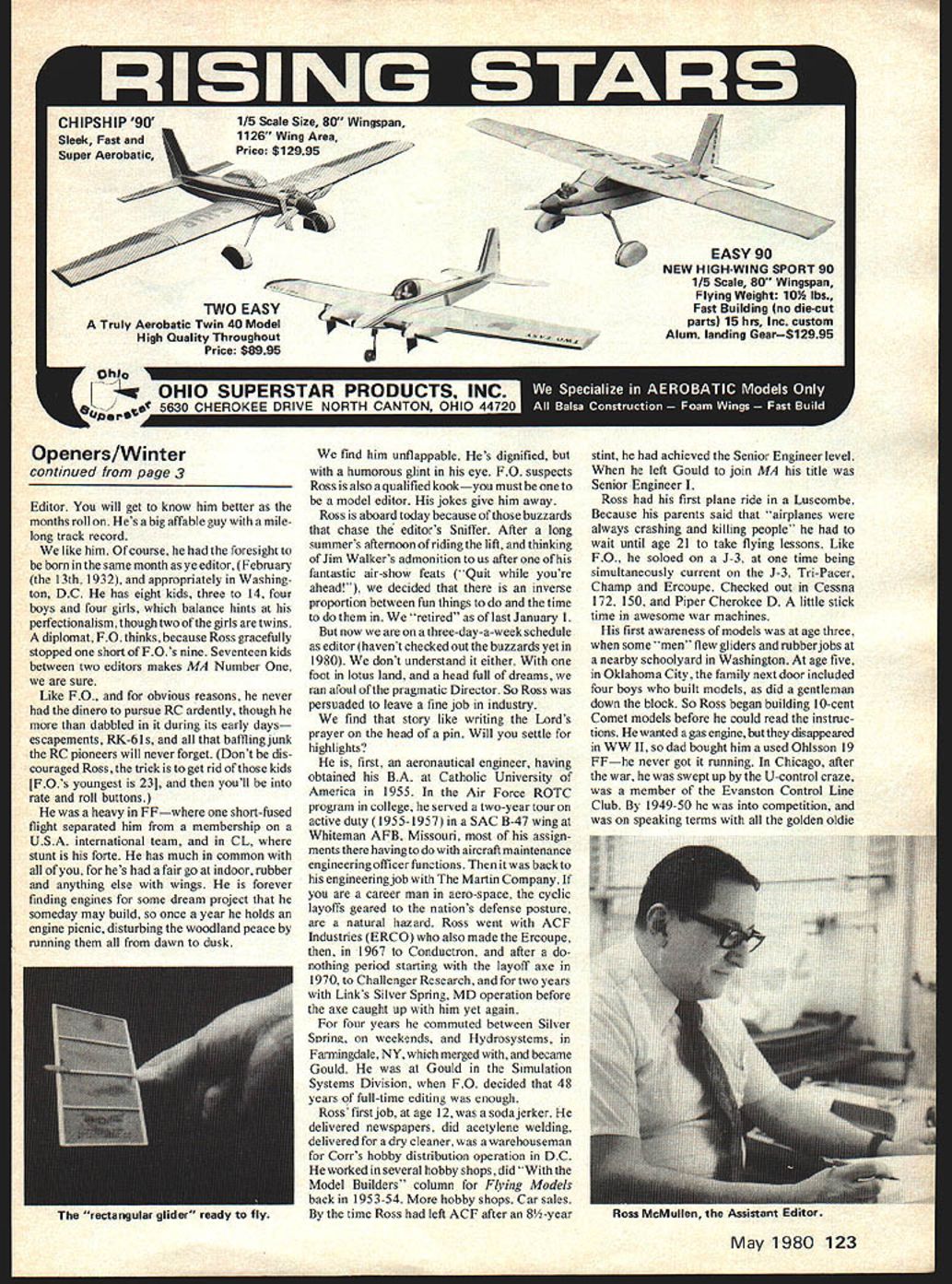
F.O. is holding in hand right now (we type no-hands) a Japanese Superfine tissue-covered rectangle that measures 6-1/2 x 2-1/4 inches, with a cross piece (rib) at the center and at each semi-span. A blob of clay is attached at the centerline on the leading edge. The wing is board flat, and the covering is on one side only, just as is done with a tissue R.O.G.
Model specs and setup:
- Size: 6-1/2 x 2-1/4 inches
- Construction: board-flat, single-surface tissue covering (one side only)
- Internal structure: cross piece (rib) at center and each semi-span
- Mass trim: blob of clay on centerline at leading edge
Observations:
- Single-surfaced wings are normally covered on the top. If you launch this model paper side up it will instantly do a half outside loop and then glide "inverted" across the room.
- Launch it paper side down and it glides across the room without shenanigans.
- There is nothing to stabilize it (no separate stab), yet it can be launched or dropped in any attitude and it will level off and then glide paper side down.
- You can launch it wing-tip first or drop it vertically wing-tip first — the same behavior occurs.
- If you cover both sides of the wing it will always glide with the smoother surface down.
- It works with cathedral and with dihedral — always the smooth side down.
- The crazy thing seems completely stable, at least indoors, without anything to stabilize it. The weight can be moved back to as much as one-third chord, but then the model must be heavier.
Dynamic behavior:
- If you launch an ordinary glider a bit fast it will stall and recover repeatedly and eventually damp out. The flat plate appears to oscillate imperceptibly, with peaks about one chord length apart; it seems to flutter so slightly you may not notice it.
- Warren wonders what effect a disturbing gust of air might have — whether the wing has the stability to recover quickly — and whether a symmetrical airfoil wing without a stabilizer would react as does the flat plate. He doubts it.
Related note:
- Mooney recently completed a model of the Stevenson Owl racer using a symmetrical airfoil so he could use a scale-size horizontal stabilizer, remarking that the "scale" stab was very adequate, possibly even oversize.
One supposes we have been putting the wing on an R.O.G. upside down all these years — and we make it fly the way it doesn't want to fly by adding incidence (angular difference between wing and stab). In a recent column we remarked about a demo model with a cambered single-surface wing — it behaved like Shipp's flat plate. If, indeed, Mother Nature's laws do come full circle, the old gal obviously knows how to square a circle. As for us, we're getting out of here while we still have all our marbles.
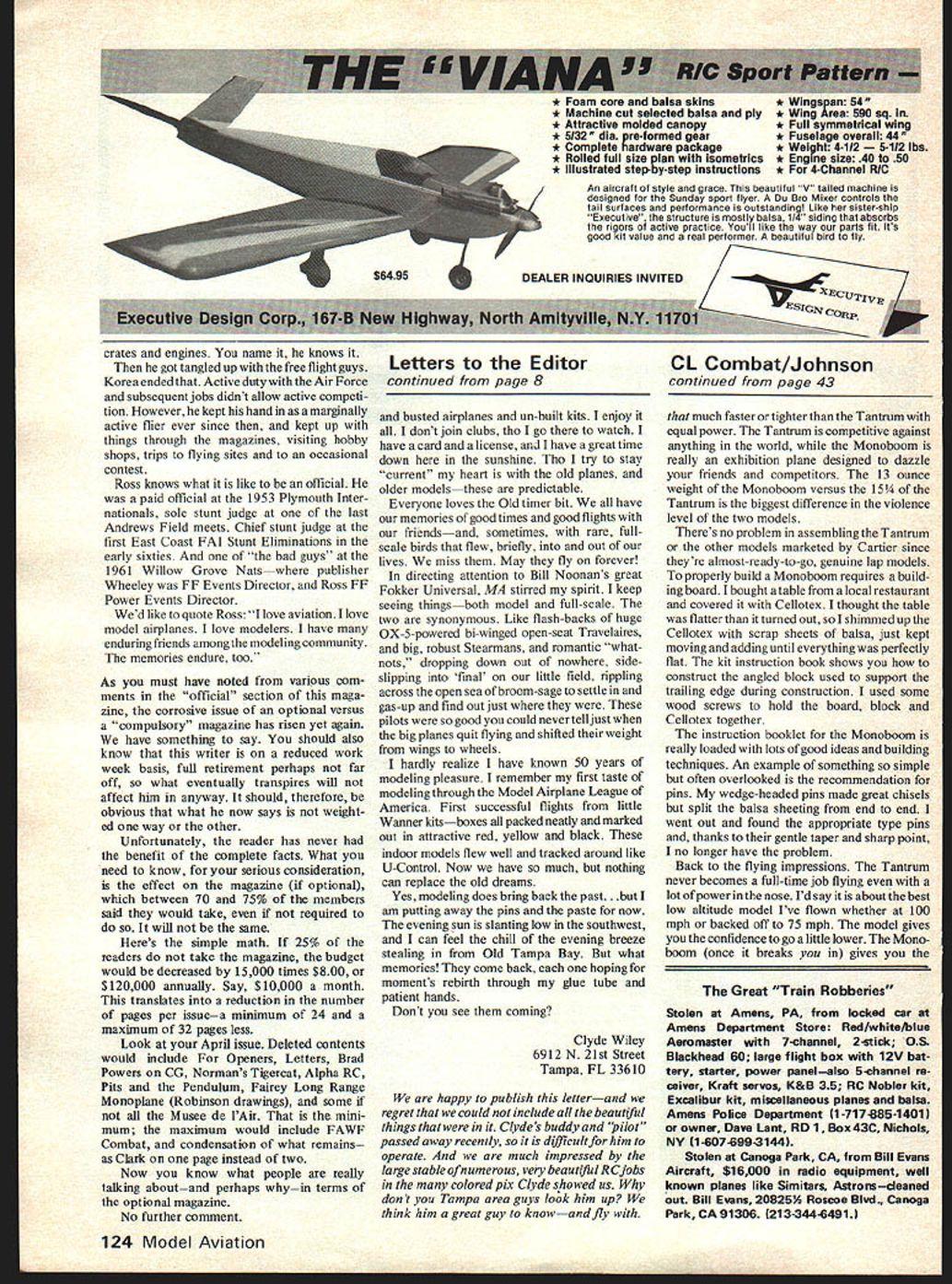
Assistant Editor: Ross McMullen
This is about a guy named McMullen. Call him Ross. You may have noted Ross's name recently added to the staff as Assistant Editor. You'll get to know him better as the months roll on. He's a big, affable guy with a mile-long track record.
Personal and family
- Born: February 13, 1932, Washington, D.C.
- Family: Eight children, ages roughly three to fourteen; four boys and four girls (two of the girls are twins).
- F.O. notes Ross "stopped one short" of F.O.'s nine children; between the two editors they make seventeen kids.
Ross is unflappable, dignified with a humorous glint in his eye. F.O. suspects Ross is also a qualified kook — you must be one to be a model editor — and his jokes give him away.
Career highlights
- Education: B.A. in Aeronautical Engineering, Catholic University of America, 1955.
- Military: Air Force ROTC in college; two-year active tour (1955–1957) in a SAC B-47 wing at Whiteman AFB, Missouri, performing aircraft maintenance engineering officer duties.
- Industry:
- Returned to the Martin Company after active duty.
- ACF Industries (ERCO), makers of the Ercoupe.
- 1967 — moved to Conduction (company name as given).
- Layoff in 1970 led to a period of inactivity.
- Challenger Research.
- Link's Silver Spring, MD operation (about two years) before another layoff.
- Commuted between Silver Spring and HydroSystems in Farmingdale, NY; HydroSystems merged and became Gould. At Gould he worked in the Simulation Systems Division.
- Title progression: By the time he left ACF after an 8½-year stint he had achieved Senior Engineer level. When he left Gould to join M/A his title was Senior Engineer I.
Ross was persuaded to leave a fine job in industry to join the magazine when F.O. decided 48 years of full-time editing was enough and shifted to a three-day-a-week schedule. The details of that decision are like "writing the Lord's Prayer on the head of a pin" — too much to tell here, so we'll settle for highlights.
Early jobs and modeling background
- First job at age 12: soda jerk.
- Other early work: delivered newspapers, did acetylene welding, delivered for a dry cleaner, worked as a warehouseman for Curt's hobby distribution in D.C., and worked in several hobby shops.
- Wrote the "With the Model Builders" column for Flying Models in 1953–54.
- Also sold cars for a time.
Flying and modeling experience
- First plane ride: in a Luscombe.
- Family caution: parents feared airplanes were dangerous, so Ross waited until age 21 to take flying lessons.
- Soloed in a J-3; at one time was current on the J-3, Tri-Pacer, Champ, and Ercoupe. Also checked out in Cessna 172, 150, and Piper Cherokee D.
- Early model experience:
- First awareness of models at age three, watching gliders and rubber ships at a nearby schoolyard in Washington.
- At age five, in Oklahoma City, he began building 10-cent Comet models before he could read the instructions.
- Wanted a gas engine as a youngster, but wartime shortages removed that option; his father bought him a used Ohlsson .19 for free flight, which he never got running.
- In Chicago after the war, he was swept up by the U-control craze and became a member of the Evanston Control Line Club.
- By 1949–50 he was competing and was on speaking terms with many of the "golden oldies."
Interests and personality
Ross dabbled in RC early on (escapements, RK-615s), was heavily involved in free flight and control-line stunt work, and is forever finding engines for dream projects that someday he may build. Once a year he holds an "engine picnic," disturbing the woodland peace by running them all from dawn to dusk.
We like him. He is forever cheerful, capable, and has a fair bit in common with many readers — indoor, rubber, and everything else with wings.
Transcribed from original scans by AI. Minor OCR errors may remain.

