
For Openers
It has been our good fortune to partake in all of the great revolutions, as well as border skirmishes, in what is joyfully known as progress—rubber to gas, free flight to control line and CL into radio—the sport of kings which Chet Lanzo described as the ability to pick out your point of crash.
Ignition to glow, and Ray Arden's glow plug. Twin pushers to fuselage tractors. Paper to mike in indoor—too much for our "surgeon's" fingers. Cabin gas to the pylon. CO-2 was in, then out, is back again. So is ignition for old-timer purists and monster scale zealots. And electric power—and ready-to-fly and its half brother, almost-ready-to-fly. Prop drives and on-board starters. Props that can decapitate a chicken. Now, once again strange things are happening.
Ready-to-Fly and Industry Changes
One manufacturer is spending over $1,000,000 to promote a new line of ready-to-fly models, both gas and electric. Two others are pushing campaigns bigger than any we have known. One of them advises that 90% of his business is now in beginners—the other 10% consists of crotchety activists who drive him up the wall. Big things are coming down the pike. F.O. doesn't know whether to be gloomy or happy. Good news, and bad news. Since Walpole promised that he would defend to the death our right to say it, even if he disagreed, we say it. It's good news.
We are deeply into another book on RC. This ready-to-fly thing has caused an anguished revision in midstream. We have numerous samples before us—they are getting rapidly better. One was assembled in 15 minutes with a Phillips head, while on rapid charge. They tend to be bigger—and the engineering is first rate. We want to fly them. That's telltale—but, of course, our crash building program is wearing, and we are desperate for a lively flying season.
Did you know that a Max 10 in a Kraft Chipmunk is a challenge to the expert, and an instant crash for the first-time flier? It does four-point rolls! That grabs us. Our Southeast Asian friends who know a big export market when they see one offer all manner of wild crates to American manufacturers. One is pushing a ready-to-fly Fokker triplane. It is fully stuntable—one of our spies put it through its paces.
If you have ever popped the airborne pack into place in a matter of minutes, you have got to realize that we ignore useful technology. No servo rails, grommets, screws, tray, plywood concoctions—or three days trying to get the little bugs out of your installation. We have a dream ship in mind for 1981, and by golly we are going to fit foam pieces together as a block installation. We have not radically improved the Biblical way of sticking radios in our crates for a generation. There must be something better.
They are doing new things with foam. That triplane has four different densities depending on the parts. One manufacturer has a new foam technique, lighter and skinned, as it comes. When we told one guy we think of these things as toys, the tycoon said how about Byron's big Pitts; that's not much different and you can move the decimal point one place in the hours it takes to put together an ultimate airplane. F.O. is not a shill.
"Toy" and Public Perception
Consider that word "toy." We hate having our pets called toys. We have spent over the years much time and money to convince the public they are not toys. So the public is listening. A ready-to-go scale airplane is not a toy to them. We can't have this both ways. How did we expect the public to react to all this gospel singing? We made our point. Now we will be joined by hundreds of thousands of new fliers at every crossroad and cow pasture.
How do we control this monster we have helped create? All of us who thirsted for expansion of RC may have to heed the clarion call of progress. Cozy little groups hidden away in the bullrushes may have to confront the changing world and learn to live with it. There are millions of hobbyists who don't read magazines, who never heard of AMA—or anything else you can think of—and if they go from plastics and little rubber jobs and simple profile ukies into the dream we too once shared—RC—we are like the ranchers who hated the coming of barbed wire.
Maybe we'll never see any of these guys. Some surely will learn about us and come hopefully to visit and fly. People write this magazine—believe it or not—asking us to have experts show them in print what to do with a kit. What to do with a kit? Good God. These new, growing technologies will creep relentlessly into the kind of kit and building we know today. There are too many bad plans, too many tough-to-build kits, generally lousy instructions. We have already accepted foam cores, fiberglass—and much is to come. It may be awhile, but the handwriting may be on the wall. It is time to investigate this stuff. Of course, we all have our regular airplanes, no less loved than ever. Let's think positively and make the most of what our promotion against the so-called "toy" image has helped create. You have to be excited. RC will have a new name—Hungry Jack.
Like politics and religion—and the CLA theory—we should not discuss airfoils. You can get a black eye. I am a wiz. You are a wiz. Collectively we could be a bunch of knot heads.
Warren Shipp's Flat Wing
You may still be wondering about Warren Shipp's kooky experiments with a flat wing, touched upon last issue. If you missed it, he had built a flat frame, paper-covered wing, measuring about 6-1/2 x 5-1/2 inches. No tail, no nothing, but a blob of clay on the leading edge. Covered on one side, it always wants to fly paper side down, and will half outside loop, then glide across a room in what we'd consider inverted flight. Covered on both sides, the wing will always glide with the tighter or smoother side down.
Since this demonstration of Mother Nature's perversity in aeronautical matters resulted from F.O.'s statement that the center of pressure moves rearward on a flat plate, the opposite of an airfoil shape, Shipp politely said it isn't that simple. If the thing is made of sheet balsa the C.L. does move rearward, as we stated—but the paper covering thing demonstrates that the wing prefers to glide paper side down. A slightly curved, or cambered, sheet-balsa wing—now with an airfoil—will glide only with the concave side up. That should panic the Bonanza-loving public, who need some long overdue support—articles, plans and kits!
Daniel Habaugh U.S. Army, MED-SAO APO, NY 09671
Sig has a new big .60 Bonanza and we think House of Balsa had a good Half A. Dan is overseas and like many others doesn't hear all the scuttlebutt. Inventory prevents MA assigning a Bonanza but our dear editorial friends may please copy.
He wonders about adding Jetex—there are no moment arms, at all! He thinks CO-2 might do the same thing—he thinks maybe no torque, but there we fell off at the last turn.
Airfoils and Joukowski
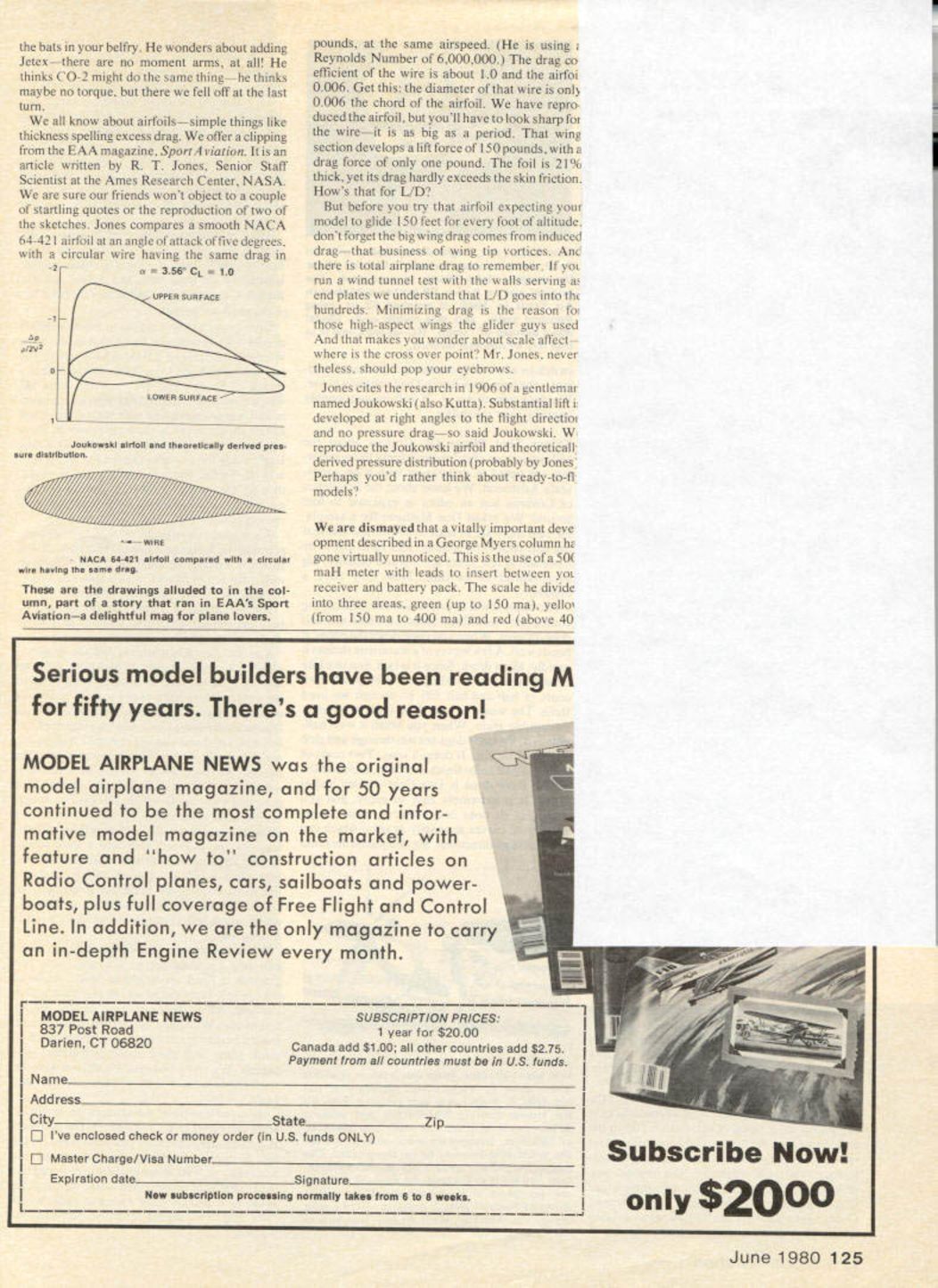
We all know about airfoils—simple things like thickness—spelling excess drag. We offer a clipping from the EAA magazine, Sport Aviation. It is an article written by R. T. Jones, Senior Staff Scientist at the Ames Research Center, NASA. We are sure our friends won't object to a couple of startling quotes or the reproduction of two of the sketches. Jones compares a smooth NACA 64-421 airfoil at an angle of attack of five degrees, with a circular wire having the same drag in a Joukowski airfoil and theoretically derived pressure distribution.
These are the drawings alluded to in the column, part of a story that ran in EAA's Sport Aviation—a delightful mag for plane lovers.
Jones uses a Reynolds Number of 6,000,000. The drag coefficient of the wire is about 1.0 and the airfoil 0.006. Get this: the diameter of that wire is only 0.006 of the chord of the airfoil. That wing section develops a lift force of 150 pounds, with a drag force of only one pound. The foil is 21% thick, yet its drag hardly exceeds the skin friction. How's that for L/D?
But before you try that airfoil expecting your model to glide 150 feet for every foot of altitude, don't forget the big wing drag comes from induced drag—that business of wing tip vortices. And there is total airplane drag to remember. If you run a wind tunnel test with the walls serving as end plates we understand that L/D goes into the hundreds. Minimizing drag is the reason for those high-aspect wings the glider guys used. And that makes you wonder about scale effect—where is the cross over point? Mr. Jones, nevertheless, should pop your eyebrows.
Jones cites the research in 1906 of a gentleman named Joukowski (also Kutta). Substantial lift is developed at right angles to the flight direction and no pressure drag—so said Joukowski. We reproduce the Joukowski airfoil and theoretically derived pressure distribution in the original column. Perhaps you'd rather think about ready-to-fly models?
Low-Cost mA Meter
We are dismayed that a vitally important development described in a George Myers column has gone virtually unnoticed. This is the use of a 50¢ mA meter with leads to insert between your receiver and battery pack. The scale he divides into three areas: green (up to 150 mA), yellow (from 150 mA to 400 mA) and red (above 400 mA).
With it you can check current drain of your system, of free-running servos, of jamming loads on servos due to faulty linkage.
It is stupid to say that when you have a hard-to-move surface that the servo can move six pounds. If jammed it draws over 400 mA, off scale with the whole system activated. We found a servo reading 400 mA plus on low motor, and this plane thermals for as much as a half hour on low motor. (No wonder we had to keep quick charging at the field.) As linkages are activated you note flicks in the yellow area, some of them almost up to the red danger area. All this on a 450 mAh pack, and moving two to three servos simultaneously. Interference, bad cells—baloney. We present two revealing pictures with the thing connected to our Cox. The meter is a Lafayette Radio bargain; George gave it to us when we flew with the Long Island guys last summer. Actually, he has a switch to allow both charge and discharge readings—the former we haven't had occasion to use. We urge you to try it. It will unquestionably improve your reliability.
Things That Please Us
Curious about the widespread use of polyester drapery lining materials, we opted to experiment with it on our 1/4-scale Aristocrat. We know about the excellence of Coverite but an editor is expected to fool around. We asked Doc Mathews for a sample. He said there are at least five varieties, and that Sig had something similar. This turns out to be Coverall. A few years ago it was a disaster. Sig says—it was ahead of its time. Now they have a market.
How to apply Coverall:
- Apply it wet as you would silk, first having coated the wood three times with half-and-half dope/thinner.
- When you dope down the edges, it bonds well.
- Use a warm iron to shrink it rapidly, like a drum.
- Since it is taut, use Lite Coat to avoid the build-up pull of butyrate.
- Two coats of half-and-half fill it—though we used three.
The weave is very fine; there is a barely discernible grain. When you brush it with half-and-half, the dope does not run through and glob as it does on silk. It doesn't snag. Two coats of half-and-half color finish it off and, incidentally, all Sig color dope is Lite Coat—which makes sense. It is extremely easy to apply, and you work fast. It does not, however, form around compound curves as readily as silk—which you can pull in all directions. Sig also joined the ranks of iron-on film producers—will try that soon.
At World Engines, Harry Roe gave us a convincing spiel about the new Tartan, a 1.34 cc for the Aristocrat. It is relatively light and compact—very short to the drive washer. It runs either direction—good for pushers. The lower rod has a ball bearing, the upper rod bronze-bushed. It lands in the middle of our proposed dummy Warner. Harry says an extension shaft as long as three inches can be used because the engine has a rear bearing with the crankshaft slung auto fashion. We need 1 1/2 inches to get it behind the dummy.
After an afternoon with Ned Kragnes—and hunting for metric taps and dies—we had a beauty. He'll turn a new big back washer, knurled on the prop face, and drilled and steel-pinned to engage holes drilled into the front face of the shaft extension.
The Tartan is supposed to turn an 18 x 6 at 7,500. We'd settle for less if that be the case. We are a full scale so 7,500 is a lot of moxy. The real one turned less than 2,000. We also have a choice of Davis's conversion of our Max 60, which turns a 16 x 4 at 10,000. Port temperature is 450 degrees compared with 900 on glow, and almost all the noise is the prop—sounds like a monster electric fan. And he has Duke's new Eagle ready for us—also Dieselized. We'll start with the Tartan, and when the crate is debugged, then try the Diesel 60s. We expect those 60s to get this 20-pound, 13 1/2 sq. ft. crate off a smooth runway.
We snapped through the 60 with normal compression (no fuel) and it swung the prop back and painfully rapped the hand. You pull it through with a fist full of fingers, with a shot-putt follow-through. We'll use our Sullivan starter.
The Tartan is glow, burns 1 oz. per minute full bore. At half-throttle cruise, that will drop away—not too bad.
We also like Klett aileron linkage hinges—great for hinging controls on monsters. Our new Cox/Sanwa four is light years ahead of the old model we have used for three years—of course, the rate switches on ailerons and elevators fascinate us (we're new to them). We can fine-tune our leisurely sport and soar crates. It will go into our Aristocrat, with two large servos in the panels. No long leads. Servos in roots with mechanical linkage to ailerons.
We are delighted with both Goldberg and Du-Bro fittings for pushrod attachment to servo wheels and arms. We've been using Goldberg's piece with a hole for the pushrod wire and a lock screw—instant adjustment. Du-Bro ball links are neat and sturdy; that ball link has to be pried off. We prefer the screw-on type, rather than the popular nylon washer under the wheel which locks onto an indent. A tight nut is so assuring.
While we have the Cox in two ships, we aren't buttering up these guys. We also have two Futabas, a Kraft Sport, and an MRC. As far as we can tell, every brand we see performs well at the field, and a failure can occur on any, regardless of cost. With hundreds of thousands of many makes being turned out, it begs providence to think some tiny thing won't sometimes give trouble. We saw a National Champion wipe out a lovely twin, and then another on the same radio.
A peculiar wavering of the expanded scale volt meter on a Taylor panel turned out to be a battery strap—the kind you push down on the two terminals. Evidently these things are not soldered—at least some of them—and creep has accumulated on one terminal inside the strap. We soldered it and now the swarm-at radio which wrecked two planes functions perfectly, he warned.
Transcribed from original scans by AI. Minor OCR errors may remain.

