
For Openers
Bill Winter
What is past is prologue. Those words from Shakespeare's Tempest are engraved upon a brooding statue in front of the National Archives building in your nation's capital. Figuratively speaking, they are engraved upon this July issue of Model Aviation by Paul Plecan (Milestones in RC), which evokes for us much more than a glimpse of the past. He is not an RC man. Yet his commentary on 16 significant aircraft, starting with the Good Brothers' Big Guff and ending with Hanno Prettner's Curare, touches feelingly on planes and people, as if we were there.
The past and present are fused in his text and drawings, and one supposes that the present—all that is happening in RC now—is prologue, too. We can see another 10 blank pages after his climactic drawing of the Curare—what will they be filled with in your lifetime? With the exception of the Curare, we have seen all of these planes fly, have known the designers (except Prettner), and have built many of the aircraft.
Sorely tempted to put it all down, something holds us back. Most likely, awe. We yield a little. In the early days of the Big Guff, any plane that began a circle was considered doomed. They wound down into shattering crashes. Several years before the war, at a Detroit Nats, the Guff defied gravity with aplomb, sailing across the field at high altitude as if on rails. Like the Wrights, people struggled to achieve a turn. Had the crates not tried to turn, they probably would have flown off into eternity.
At a pre-war Chicago Nats, Walt Good slung down to kill altitude and put the Big Guff on a spot at our feet—right there! That's why the BG was great. The Goods, just kids in Detroit, probably based their thinking on the earlier work of Ross Hull, who was electrocuted by his headphones. Hull also had the answers, like the Wrights, yet destiny made him the Langley of our field.
DeBolt did so many things—basic logic from his U-control mastery. He pops up three times. When he planned a graduated series of U-control models, we persuaded him RC was the wave of the future. The Live Wire resulted. His use of the symmetrical airfoil (Over and Under)—we had tried to argue him into a delta, and we then went halfway with the 1/3–2/3 airfoil—and his strip ailerons, which all of you use.
We flew Foxworthy's own Hoosier Hot Shot. Remarkable. You will do well to build one if you are into old-timers. And a Smog Hog. We guarantee you can fly at least as well with it as any cabin type on today's market. A truly magnificent bird. Everything that came after, starting with the Astro Hog, is modern to F.O.
To boil down this list of 16 to the landmark craft that turned things upside down, we'd give you the Big Guff, because it pulled together all the pioneering efforts that made it inevitable. And Walt Good's Rudder Bug—like the Smog Hog—was loaded with advanced features which catapulted us down the path to genuine progress.
We were too close to our friend DeBolt to think of his crates as great, as they probably were, but the symmetrical airfoil was obviously a revolutionary development, and perhaps a shade less important, the strip aileron. For revolutionary developments of the whole airplane, we'd opt for the Astro Hog, after the Smog Hog—no one believed a long wing could be flown. It was so easy; merely try one.
You probably do not know that a good reed (non-proportional) man could fly an airplane—and with all those sticks—as smoothly as you can today with the world's best equipment. You could fly proportionally. Walking down a runway, Kazmirskis's Orion passed over our head on final, rock steady, no evidence of control being used. Every damned servo was working like mad—a continuous buzzing of grinding motors and gears.
What do we think of the Curare? The world's best pilot, that's what! With a skilled engineering mind that works ceaselessly on the improvement of aerobatics—by an imaginative use of spoilers and air brakes to maintain smooth airspeed. He probably would have done the same with the Phoenix, or a Dirty Birdy, etc. Curare is a thinking man's perfection. One airplane? Give us the Smog Hog. Do build one. "What is past is prologue." "The future is now." A time to live it up!
For years Walt Good has been trying to write a series on the history of RC for MA. We think we now understand why he puts it off. We think he, too, is awed.
Joe Ott
Joe Ott is an 80-year-old man living in Niles, Illinois. He should be in the Hall of Fame. We felt that way, too, about Merrill Hamburg, who fortunately was finally remembered. And Charley Grant—now 85, whose wife watches him to make sure he won't jog; and Jim Walker—every one of them gigantic figures who gave us what we have today. And Percy Pierce, and Cecil Peoli—twin pusher fame, who died barnstorming in Japan in 1913. At the end of his career, Ott was a big manufacturer, like Comet, who once employed 500 people in the days of the big fliers. Comet was like visiting Willie Wonka's Chocolate Factory.
This is what Joe meant to a 17-year-old boy. In the late twenties he ran a series of rubber jobs in Popular Aviation—now Flying. We built lots of them. They were light and could stand up to today's contest entries. Our first scale was his 20-in. Fokker Super Universal. It weighed 1 1/2 ounces. Not bad for 50 years ago. His SE-5, a DH-4, a Triplane, a Halberstadt, a Nieuport 17 which flew like a big ROG. The SPAD scared us. We scaled them up as years ticked by. His Lockheed Vega was fantastic. On a calm spring evening, walking across the field with the SE-5 loping along overhead at about 25 feet—a 30-in., 17-in., then a 45-in. one—some reader wrote us to quote something we said about that big Nieuport—in 1969!
We had wound it at deep dusk. Off it went, rising from the ground. After a while it was silent—where was it? Then, in the distance beyond the length of a football field, small and white, beyond and over high-tension lines, it passed across the face of a huge orange moon—like a witch on a broom.
Designing Our Own
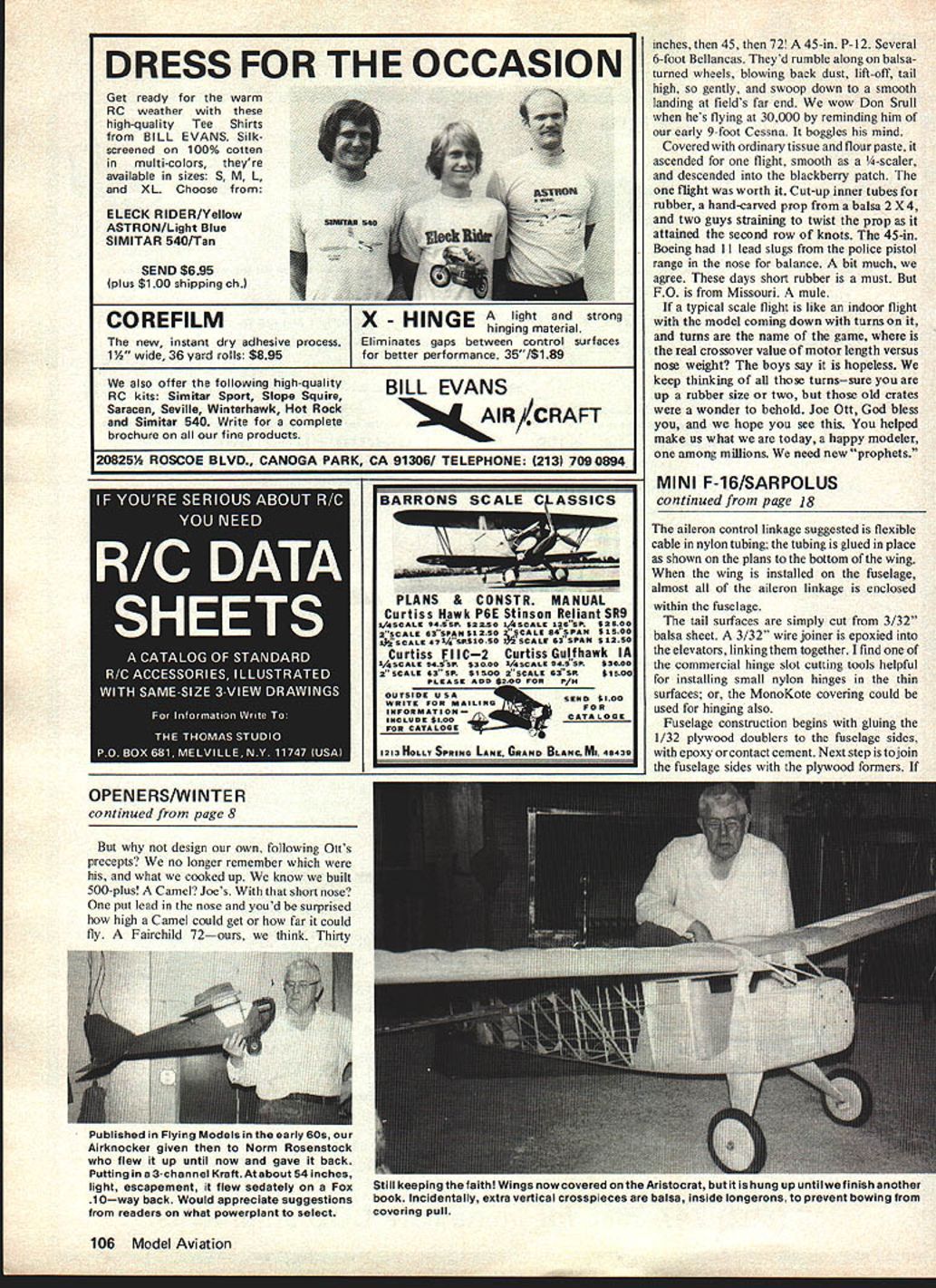
But why not design our own, following Ott's precepts? We no longer remember which were his, and what we cooked up. We know we built 500-plus! A Camel? Joe's. With that short nose? One put lead in the nose and you'd be surprised how high a Camel could get or how far it could fly. A Fairchild 72—ours, we think. Thirty inches, then 45, then 72! A 45-in. P-12. Several 6-foot Bellancas. They'd rumble along on balsa-turned wheels, blowing back dust, lift off, tail high, so gently, and swoop down to a smooth landing at the field's far end. We wow Don Srull when he's flying at 30,000 by reminding him of our early 9-foot Cessna. It boggles his mind.
Covered with ordinary tissue and flour paste, it ascended for one flight, smooth as a 1/4-scaler's, and descended into the blackberry patch. The one flight was worth it. Cut-up inner tubes for rubber, a hand-carved prop from a balsa 2 x 4, and two guys straining to twist the prop as it attained the second row of knots. The 45-in. Boeing had 11 lead slugs from the police pistol range in the nose for balance. A bit much, we agree. These days short rubber is a must. But F.O. is from Missouri. A mule.
If a typical scale flight is like an indoor flight with the model coming down with turns on it, and turns are the name of the game, where is the real crossover value of motor length versus nose weight? The boys say it is hopeless. We keep thinking of all those turns—sure you are up a rubber size or two, but those old crates were a wonder to behold. Joe Ott, God bless you, and we hope you see this. You helped make us what we are today, a happy modeler, one among millions. We need new "prophets."
Transcribed from original scans by AI. Minor OCR errors may remain.

