
For Openers
Mark Twain's comment that everybody talks about the weather, but no one does anything about it, describes very well the present state of the expensive, expensive-to-operate, pattern airplane. The heavy, fast, powerful, highly specialized aerobatic machine relates to the Pattern event in the same way that the Foyt Coyote relates to Indianapolis.
But, whereas all of us thirsted after the ultimate thrills of pattern when a Taurus could be flown, much as you could drive a car during the week and still be respectable at some congenial weekend meet, we now know beforehand that Pattern separates the men from the boys.
The Pattern fliers are an elite band. Typically, the planes they fly have near identical specifications, are made from glass and foam, and, maybe, a little balsa. Common to virtually all, are pumps, pipes, retracts and, on the transmitter, roll and rate buttons.
They are beautiful, expressive things, these highly bred, thoroughbred creations.
But their intolerable cost per flight—when total outlay is considered—is turning off all those who are not dedicated "followers of the tournaments." In general, manufacturers know that 60-powered kits (not just in Pattern) are risky—the swing is to the 40. Do not mistake us. We don't quarrel with Pattern the way it is. It's just that inflation and the high cost of the ultimate technology is compelling the average flier to rethink his ways.
Harold deBolt's "Solution," the first of a number of what was to be Sport Pattern 40 jobs commissioned by Model Aviation (page 13) is a prime example of the new breed. But note the words "what was to be." We had asked Hal to design a 40-powered Sport/Aerobatic machine. It was quickly apparent that one cannot hobble an old fire horse. We should have known. Since the early days of indoor, free flight, control line, and all through radio control, Hal has contributed an endless string of fundamental developments. What he came up with in this instance is a head-on challenge to the supremacy of the 60-Pattern competition machine. We had expected a clever airplane, but not this! Not only is the Solution a high-performance, much more economical plane for the sport flier, but it is a superb competition machine. We urge the reader to evaluate his article, as well as the plan.
By now, many of you have already found that a good 40 can turn the typical pattern 11-7 prop better than some non-Schnuerle 60's. Take off two or more pounds of airplane weight and, obviously, speed and climb are not going to suffer. And with its familiar dimensions and areas, the 40-powered Solution is superior in some respects—lighter loadings make it easier to fly. It has no pipe but we understand Hal's concession to the retractable gear (Rhom). A taildragger simply is not the problem some think—this one does not bounce a landing. Racing techniques—both Pylon and CL Team—are applied by a master who pioneered such things as pressure-cowl cooling. The removable power pod is a proven thing. Hal has thrown the gauntlet into the ring—the 40 obviously is competitive.
If the nice things that happen in life make it worthwhile, this hobby can add ten years to your stay—if you let it. The more you rummage around in this special store, the more pleasurable things you'll find. We came upon this barn.
It all began with a picture of a diesel engine sent in by one of those mysterious little guys who run those tiny display ads. We have a thing for these little stinkers—diesels, that is! The smell of ether and kerosene was always perfume to us. The first diesel we ran, a long time ago, was the Mills .08. There was something classic about its ungainly, ancient look; it was not powerful but it was a delight to start and run. Then there was one of those stove-pipe early E.D.'s that went zing, zing, zing when run too rich, and it puffed out a little white cloud with every zing. And those Amco 29's! One of the nicest diesels we had was a twin-stack E.D. 246-a-15. So here is this picture of the 2.46, modernized a bit, and with an R.C. throttle!
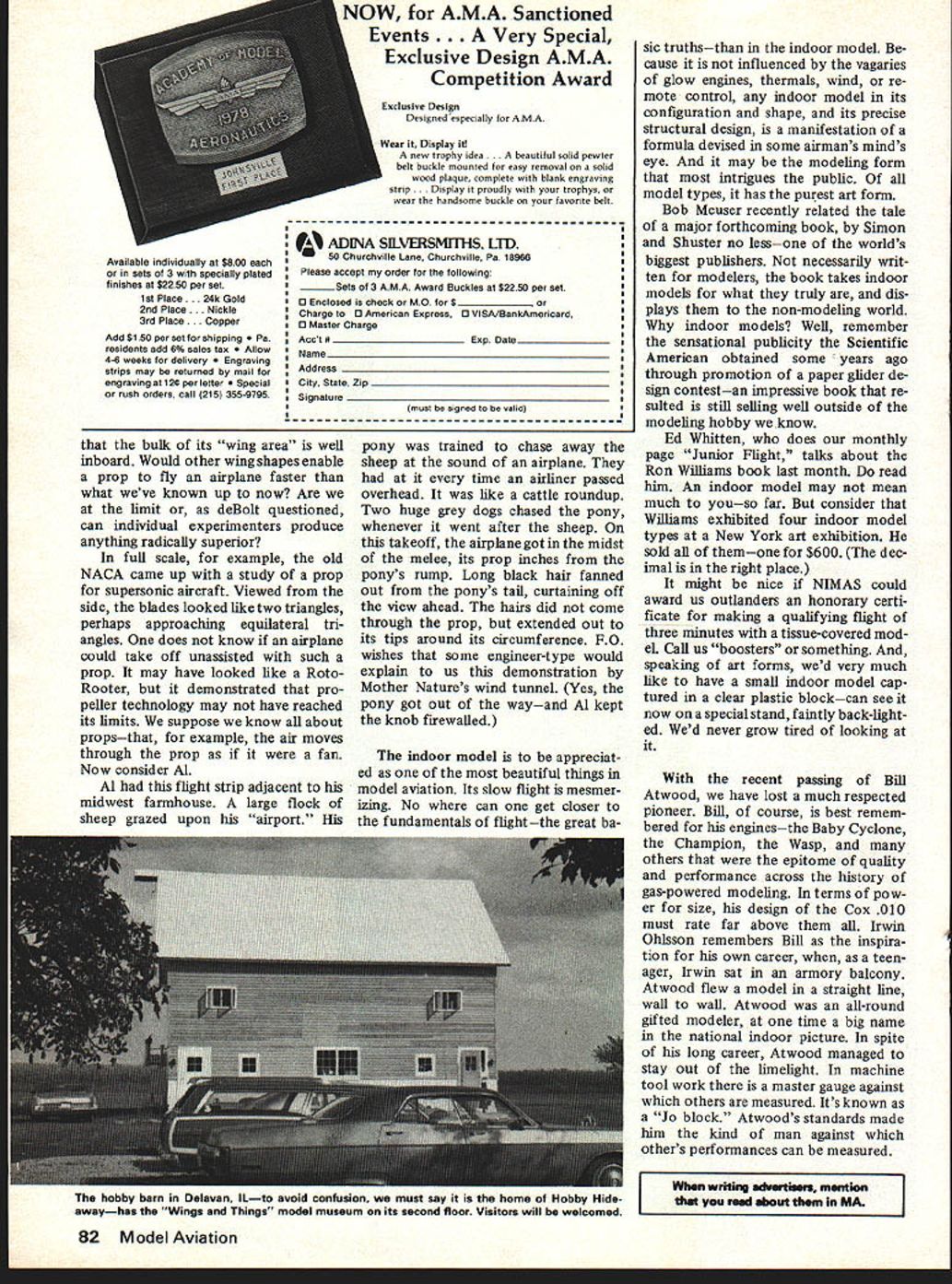
So we ordered one from a place called Hobby Hideaway, run by Dave Shipton who authored a charming "Catalog and Diesel Handbook." He really got it all together—in a barn. Not just an old cow barn, mind you, but a storybook barn at the end of a modeler's yellow brick road. Besides an impressive spic and span hobby shop—we spy in one pic an elderly lady knitting in the midst of things—Dave uses the old hay mow for a lifetime collection of his models, plus those of many famous modelers. He calls it the "Wings and Things Museum." On display is such memorabilia as an Air King fuselage (we had a barnstorming Air King in the next town and this is the first time we have seen the name in print), a Pietenpol frame, an American Eagle frame, wings of a Dole Derby entry (City of Peoria), Jenny props, and the first gas model kit ever produced—a Megow Cub—and the model built from its plans. Like an old-fashioned hardware store that smelled deliciously of tools and oils, Dave's barn is genuine Americana. You know, wooden pegs and square nails—a cider press, iron kettles, a fernery, a 1921 cash register (don't think he is using that!). Walls and counters are old weathered siding boards. Doors and counters were made from the original doors.
Dave's catalog may be a collector's item. It is full of planes, engines, plans and stuff, much of it rare and unusual. He handles Aeromodeller plans, too, with photos of the subjects that will send you into flights of fancy.
If you think this is just another plug, you'll spoil our fun.
Having talked diesels, it seems appropriate to pass on to curious sport fliers (not experts), a few tips to counter the old wives' tales of how balky these things can be—if you ever watched Bob Davis flip one of his Half A jobs, you'll know that is baloney. Shipton runs the engines he sells, and you get a card which shows for your engine, the setting of the head, the jet needle, and how many turns to open the valve. It was our observation that nine out of ten fliers made a common mistake. As soon as the engine started they immediately raised the head compression for maximum rpm. As engine temperature rose, this compression was too high, and the engines ran hot, and groaned in flight like a lean-run glow engine. It is better to raise the compression only enough to make the engine run at moderate speed then, after 30 seconds or more, slowly raise compression and rpm. But don't be hungry.
Before mufflers, we primed diesels in the stack—or choked them. The prime had to be light. On the first flip, the engine might pop. This was the time to back off a 1/4 turn or more on the head, because the next flip often was a brutal surprise. You then flipped with the compression down from what it was at the first pop, until it started, then slowly raised compression, even if a couple of starts became necessary. The additional variable—the head screw—affords a fascinating combination of adjustment controls. If too lean, the exhaust sounds ragged—tattered. It is fascinating to play with the head and the needle by, say, backing off the head and opening the needle. After you master that interplay of compression and mixture, you'll feel like Houdini. We don't mean to make the diesel a novelty. It has great torque and can turn diameters and pitches of props that could be handled only by bigger glow engines. That's an asset—as in medium-size scale where toothpick props are lost in front of most cowlings.
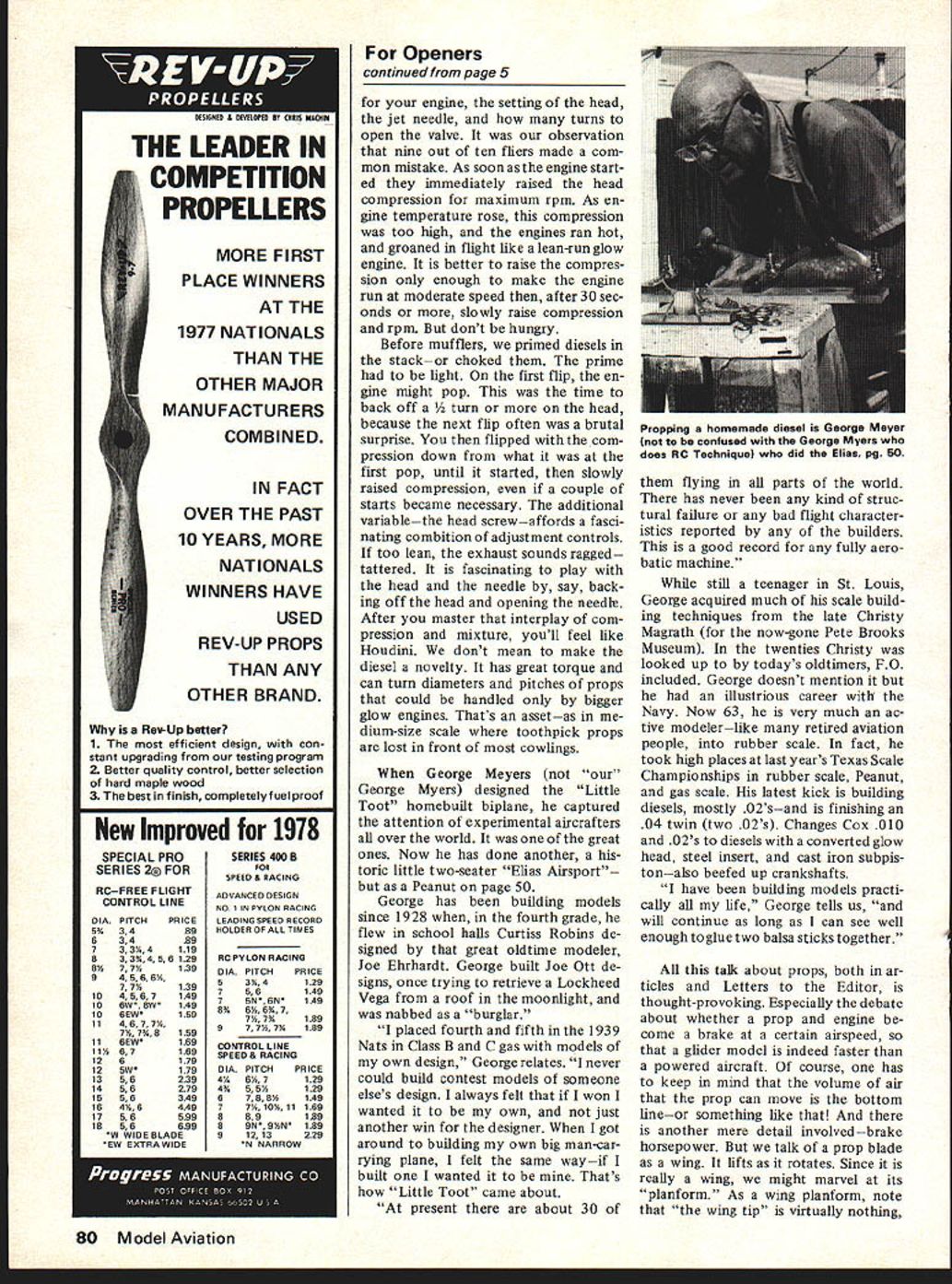
When George Meyers (not "our" George Meyers) designed the "Little Toot" homebuilt biplane, he captured the attention of experimental aircrafters all over the world. It was one of the great ones. Now he has done another, a historic little two-seater "Elias Airsport"—but as a Peanut on page 50.
George has been building models since 1928 when, in the fourth grade, he flew in school halls Curtiss Robins designed by that great oldtime modeler, Joe Erhardt. George built Joe Ott designs, once trying to retrieve a Lockheed Vega from a roof in the moonlight, and was nabbed as a "burglar."
"I placed fourth and fifth in the 1939 Nats in Class B and C gas with models of my own design," George relates. "I never could build contest models of someone else's design. I always felt that if I won I wanted it to be my own, and not just another win for the designer. When I got around to building my own big man-carrying plane, I felt the same way—if I built one I wanted it to be mine. That's how 'Little Toot' came about.
"At present there are about 30 of them flying in all parts of the world. There has never been any kind of structural failure or any bad flight characteristics reported by any of the builders. This is a good record for any fully acrobatic machine."
While still a teenager in St. Louis, George acquired much of his scale building techniques from the late Christy Magrath (for the now-gone Pete Brooks Museum). In the twenties Christy was looked up to by today's oldtimers, F.O. included. George doesn't mention it but he had an illustrious career with the Navy. Now 63, he is very much an active modeler—like many retired aviation people, into rubber scale. In fact, he took high places at last year's Texas Scale Championships in rubber scale, Peanut, and gas scale. His latest kick is building diesels, mostly .02's—and is finishing an .04 twin (two .02's). Changes Cox .010 and .02's to diesels with a converted glow head, steel insert, and cast iron subpiston—also beefed up crankshafts.
"I have been building models practically all my life," George tells us, "and will continue as long as I can see well enough to glue two balsa sticks together."
All this talk about props, both in articles and Letters to the Editor, is thought-provoking. Especially the debate about whether a prop and engine become a brake at a certain airspeed, so that a glider model is indeed faster than a powered aircraft. Of course, one has to keep in mind that the volume of air that the prop can move is the bottom line—or something like that! And there is another more detailed involved—brake horsepower. But we talk of a prop blade as a wing. It lifts as it rotates. Since it is really a wing, we might marvel at its "planform." As a wing planform, note that "the wing tip" is virtually nothing, that the bulk of its "wing area" is well inboard. Would other wing shapes enable a prop to fly an airplane faster than what we've known up to now? Are we at the limit or, as deBolt questioned, can individual experimenters produce anything radically superior?
In full scale, for example, the old NACA came up with a study of a prop for supersonic aircraft. Viewed from the side, the blades looked like two triangles, perhaps approaching equilateral triangles. One does not know if an airplane could take off unassisted with such a prop. It may have looked like a Roto-Rooter, but it demonstrated that propeller technology may not have reached its limits. We suppose we know all about props—that, for example, the air moves through the prop as if it were a fan. Now consider Al.
Al had his flight strip adjacent to his Midwest farmhouse. A large flock of sheep grazed upon his "airport." His pony was trained to chase away the sheep at the sound of an airplane. They had at it every time an airliner passed overhead. It was like a cattle roundup. Two huge grey dogs chased the pony whenever it went after the sheep. On this takeoff, the airplane got in the midst of the melee, its prop inches from the pony's rump. Long black hair fanned out from the pony's tail, curtaining off the view ahead. The hairs did not come through the prop, but extended out to its tips around its circumference. F.O. wishes that some engineer-type would explain to us this demonstration by Mother Nature's wind tunnel. (Yes, the pony got out of the way—and Al kept the knob firewalled.)
The indoor model is to be appreciated as one of the most beautiful things in model aviation. Its slow flight is mesmerizing. Nowhere can one get closer to the fundamentals of flight—the great basic truths—than in the indoor model. Because it is not influenced by the vagaries of glow engines, thermals, wind, or remote control, any indoor model in its configuration and shape, and its precise structural design, is a manifestation of a formula devised in some airman's mind's eye. And it may be the most intriguing form that most intrigues the public. Of all model types, it has the purest art form.
Bob Mcuser recently related the tale of a major forthcoming book, by Simon and Shuster no less—one of the world's biggest publishers. Not necessarily written for modelers, the book takes indoor models for what they truly are, and displays them to the non-modeling world. Why indoor models? Well, remember the sensational publicity the Scientific American obtained some years ago through promotion of a paper glider design contest—an impressive book that resulted is still selling well outside of the modeling hobby we know.
Ed Whitten, who does our monthly page "Junior Flight," talks about the Ron Williams book last month. Do read him. An indoor model may not mean much to you—so far. But consider that Williams exhibited four indoor model types at a New York art exhibition. He sold all of them—one for $600. (The decimal is in the right place.)
It might be nice if NIMAS could award us outlanders an honorary certificate for making a qualifying flight of three minutes with a tissue-covered model. Call us "boosters" or something. And, speaking as art forms, we'd very much like to have a small indoor model captured in a clear plastic block—can see it now on a special stand, faintly back-lighted. We'd never grow tired of looking at it.
With the recent passing of Bill Atwood, we have lost a much respected pioneer. Bill, of course, is best remembered for his engines—the Baby Cyclone, the Champion, the Wasp, and many others that were the epitome of quality and performance across the history of gas-powered modeling. In terms of power or size, his design of the Cox .010 must rate far above them all. Irwin Ohlsson remembers Bill as the inspiration for his own career, when, as a teenager, Irwin sat in an armory balcony. Atwood flew a model in a straight line, wall to wall. Atwood was an all-round gifted modeler, at one time a big name in the national indoor picture. In spite of his long career, Atwood managed to stay out of the limelight. In machine tool work there is a master gauge against which others are measured. It's known as a "Jo block." Atwood's standards made him the kind of man against which other's performances can be measured.
Transcribed from original scans by AI. Minor OCR errors may remain.

