
For Openers
Bill Lee, whose informative column contributes to the state of the art in Control Line Racing, wondered out loud last month (September, pg. 38) about the popularity cycles that occur in many new events. He registered a smash hit with at least this reader. Like a great many other sport modelers, F.O. has always been fascinated with the sad fate of so many once-pleasant events that spring into life with a fanfare of trumpets, as the lasting answer to this or that need. You see it all across the board.
Popular Events — examples
- Radio Control: Club 500 Pylon Race (presently going strong).
- Rubber Scale: Walnut.
- Control Line: Slow Combat and Slow Rat.
- Free Flight: Embryo Endurance and Manhattan (still belong to the fun fliers).
There is a relationship between what Bill Lee observed and our topic. As a competitor, Bill notices that a new "official" CL event will come on strong, then taper off, finally to be stabilized on some lower competitive-popularity plane by the die-hard practitioners of that event. F.O. recalls the birth of Rat Racing—at one time a highly popular event—as a "poor man's" Team Race. Rat Racing today is every bit as demanding as Speed—and we sport fliers could no more hack it than the man in the moon. When a new event grows out of modelers' folklore, it is usually fated, with success, to become an official event.
Events begin life as local fun things, acquire national interest, then comes the push to make them "provisional" in anticipation of future rules-book designation as "official." Then the peasants, for whom or by whom the thing was originally devised, are turned off by the rigors of competition with the real pros, and by the ever-increasing, impossibly demanding techniques which a relative few can master. Now we are not about to take away anybody's "gusto," but who speaks for the major groups—the sport fliers?
Many things tend to modify original concepts of events intended to be forever popular. Forgive us, dear sirs, but you lost doddering F.O. to Wakefield and Coupe when flight times—a practical problem we concede, alas—compelled limitations to rubber weight and consequent changes to configurations. It now takes a mighty talented guy to attain success in those events. But that's OK.
Rules and competition
In all these things, particularly the "official" events, what intrigues an old sport modeler is the endless changes to rules. You can follow the evolution in the rules. It would not surprise us to be told that, say, 10,000 rules changes have occurred in the life of the AMA. For the less gifted sport modelers—less gifted only in terms of competition—each new release seems to lower the limbo pole. If you have a file of old rule books, try tracing the action in, say, Goodyear or Rat.
When, after the war, the Thompson Trophy races were dominated by surplus P-51s, et al., Goodyear was devised. Practical, simple rules were drawn up—and they pretty well stuck with them through the ensuing years. When we are faced with similar situations, and the event(s) become official, the rules are forever afterwards pulled and hauled for all manner of reasons and opinions, with every rules-making cycle. It's like hunting season. At the official opening date, a nondescript army fills the air with flying shot. One shudders to think what would happen to baseball, basketball, or football if a similar procedure were followed. Most proposals and changes are nitpicking. Is this necessary? (Of course, some rules changes are always essential.)
Naturally, one cannot ignore the fact that competition exists to determine winners. Being a winner is a hard business. Almost none of us can compete with a Miller, a Brown, or a Prettner in Pattern. One man can always walk faster than another, or run faster, or fly a particular kind of model better than his peers. We don't even compare with local hotshots at the nearby flying site. But in many events the technical fine points as mirrored by the rules evolve into something utterly devastating. But what is the point of this soapbox wailing?
Simply this: when the have-nots flock to some bright new form of competition, like the Club 500 racer in RC, all might be well advised to leave the damned thing alone. Don't make it more difficult. If some shortcomings appear, better perhaps to live with them than to see a fly-for-pleasure event—especially if its popularity augurs its becoming "official"—become the turf of a few percent of the modelers. Competition modelers already are ears-deep in the favored events. Nothing is lost and much can be gained by reserving to the deserving masses the ingenious special events which keep them happy.
Bill Warner this month worries about the tendency now to change the Peanut rules. What a disaster that would be! But even Bill thinks a "few" concessions may be necessary. One of them is a nine-inch fuselage option. We all know that the simple span requirement of 13 inches has resulted in the competitive supremacy of planes with very low aspect ratios. The Lacey and the Fike, for example, give you payoff wing areas and, incidentally, a rather long fuselage with perhaps a rubber length advantage. But the event is a nationwide sensation, a shot in the arm to Scale, something enjoyed by many thousands who resurrect hundreds of airplane types that no one would ever model otherwise.
A nine-inch fuselage on a Bellanca, for example, will yield an 18-inch wing—that's Walnut now. And some guy will find a pod-type flying wing, and we'll see 24- or maybe 30-inch Peanuts. (Like Royall Moore, he can use gears, too.)
Gosh, even a fun-only event can become a repulsive monster if we get to fiddling with rules—even without the threat of becoming provisional or official. It should be noted that "popular" events, required to be spelled out in the beginning, need limitations essential to their continuous acceptance. Club 500 (RC) is a perfect example, as was Peanut.
Schoolyard Scale
F.O. is still trailing that merry band of Maryland and Virginia scale modelers who fill the Friday evening air with marvelous craft of all periods, nationalities, and descriptions. Well, we have had our eyes opened—really opened—to Schoolyard Scale. The word "schoolyard" may produce visions of little crates bouncing around, running into fences and walls, while dragging about monotonously. Nothing could be further from the truth.
As an old scale builder and R/Cer, F.O.'s concern that one-piece models with all struts in place were nice, but probably a bit impractical, was put to rest. There is this authentic colored Fairchild 22 in spectacular red and black, flown by Hurst Bowers. Its span is 48 inches and the inverted OS .10 handles it beautifully and realistically. Just rudder, elevator and throttle—gosh, he was using an old Bonner system—produced smooth flying and heart-warming flybys.
Don Srull was flying this 52-inch silver-winged E-2 Cub, with a Cox QRC (the "quiet one"), with two channels for rudder and elevator. It had scale dihedral—and no ailerons! It is light and slow, about as near to scale speed as anyone could hope for. And it flew just like a real Cub—the one on which we learned to fly. Simply out of this world. Looking up as it passed high overhead, you could occasionally see the bit of yaw induced by a "heavy foot" on the rudder. Bill Piper, Sr., always upset his salespeople by claiming that anyone could fly the Cub simply—just by booting rudder. He did it that way and the heck with coordination—and he said so in Life magazine. Srull's E-2 would have pleased him.
Don also flew a Waco biplane, one of the older cabin models, with an OS .15. This, too, was in one piece. They don't get knocked around, or damaged, so why not? In two-inch grass, the Waco would lift off smoothly within 25 feet as Don held full up and steered a bit with rudder. Rock steady, the Waco flew as handily as any sport cabin model, and proves a .15 is quite practical. If you have doubts about Scale but would like to try a copy of the real thing, don't hold back. Try Schoolyard. Perhaps we are all a bit intimidated by AMA Scale and the sport-scale things we see in pictures or at meets. Aviation offers hundreds of subjects that are inspiring to look at, pleasant to fly, and as durable models as anyone can ask.
Lost Airplanes
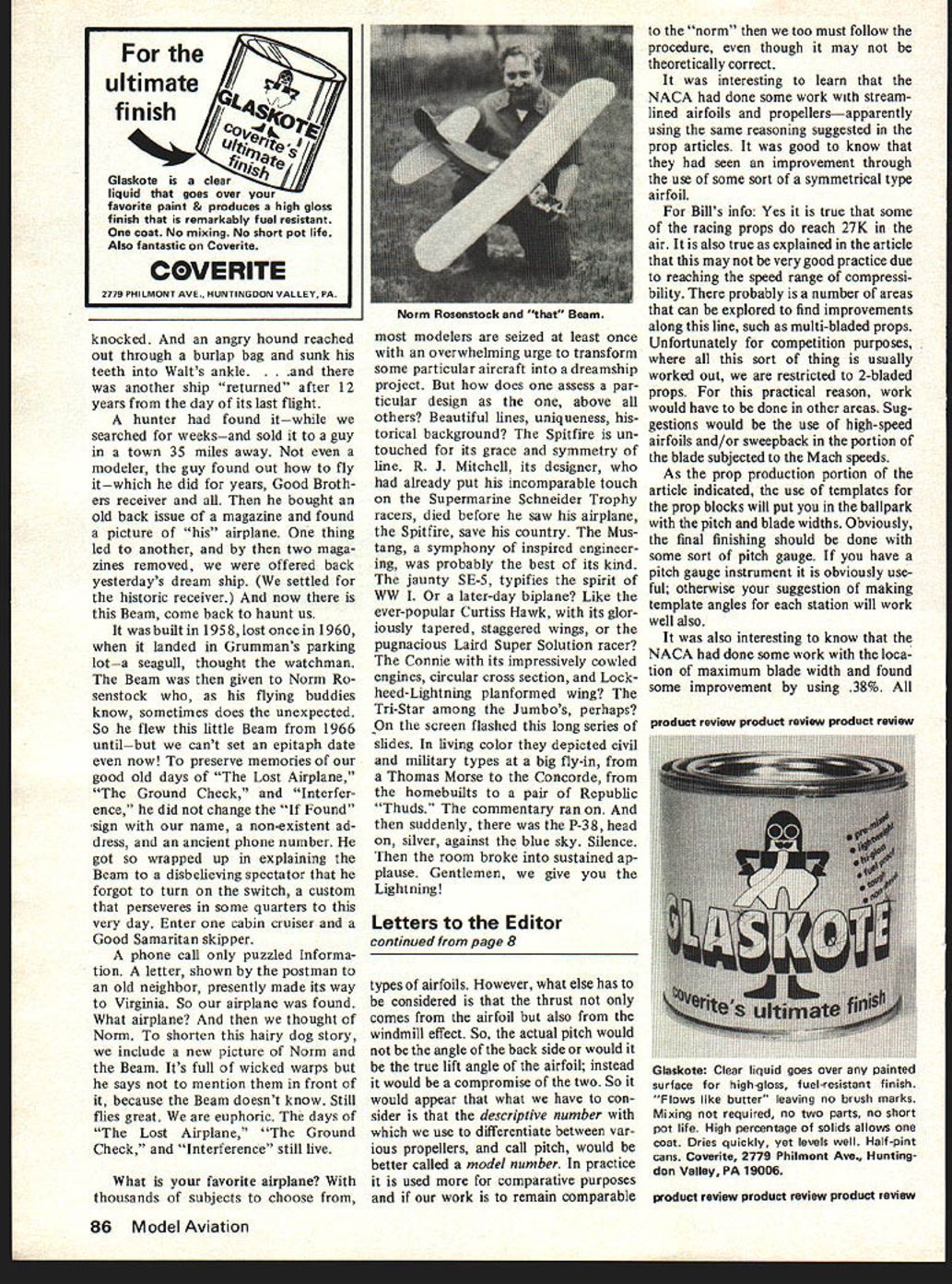
"We found your airplane drifting in Long Island Sound," stated this strange letter like a familiar voice out of the B.C. days of radio control. For one thing, we had lived in the Washington area for 13 years, and the only airplane we made during the drought was just recently finished and hangs in plain sight. But someone had found our airplane. Impossible! A little mood music now, Vladimir, please.
During the 10 years following the war, our hobby was distinguished by semi-religious rituals, the most serious being "The Lost Airplane" and "The Ground Check." To these, in the early fifties, was added "Interference"—which had to be called out in alarm when anything went wrong, preferably before the thud. What was wrong, of course, was "The Lost Airplane," after the world's longest "Ground Check." "The Lost Airplane" led to wonderful "there I was at 30,000 feet" stories. F.O.'s life was filled—still is apparently—with lost airplanes.
We'll never forget the episode with Walt Schroder when a model was recovered from a Tobacco Road shack in the dark of a Connecticut night. The ship had appeared over this hunter, when the engine stopped and it spun down upon him, scattering his dogs with yelps of terror. He thought the Germans were bombing him—this in 1948. The unlighted shack had burlap bags hanging over many holes in its walls. Dogs howled inside. So we pushed ol' Walt forward. He felt along the floor and came up with the ship, which turned out to be ours. The hunter's wife was so excited she jumped on the kitchen table and slapped ol' Walt on the back. "You found my husband's airplane!" she cried. He didn't turn it over to them. We insisted he accept a reward—a ham—and he did.
Choosing a Subject
Most modelers are seized at least once with an overwhelming urge to transform some particular aircraft into a dreamship project. But how does one assess a particular design as the one, above all others? Beautiful lines, uniqueness, historical background?
The Spitfire is untouched for its grace and symmetry of line. R. J. Mitchell, its designer, who had already put his incomparable touch on the Supermarine Schneider Trophy racers, died before he saw his airplane, the Spitfire, save his country. The Mustang, a symphony of inspired engineering, was probably the best of its kind. The jaunty SE-5 typifies the spirit of WW I. Or a later-day biplane? Like the ever-popular Curtiss Hawk, with its gloriously tapered, staggered wings, or the pugnacious Laird Super Solution racer? The Connie with its impressively cowled engines, circular cross section, and Lockheed-Lighting planform wing? The Tri-Star among the Jumbos, perhaps?
On the screen flashed this long series of slides. In living color they depicted civil and military types at a big fly-in, from a Thomas Morse to the Condor, from the homebuilts to a pair of Republic "Thuds." The commentary ran on. And then suddenly, there was the P-38, head on, silver, against the blue sky. Silence. Then the room broke into sustained applause. Gentlemen, we give you the Lightning!
Transcribed from original scans by AI. Minor OCR errors may remain.

