
Opposing Views: Earhart Story Questioned
Editor's Note
It seems we've started quite a little controversy with our February cover. That's not such a bad thing—one could say we've also started a dialogue on an issue of vast interest to aviation enthusiasts, including many modelers. In this case, the issue is the fate of Amelia Earhart's plane.
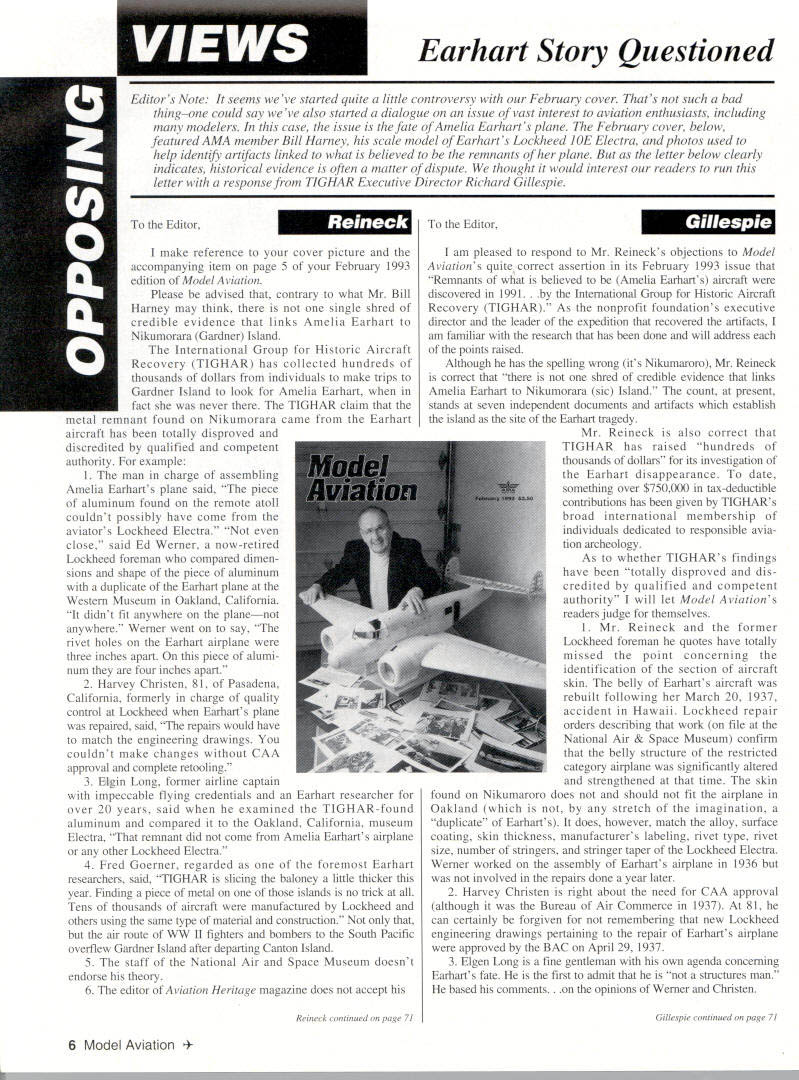
The February cover featured AMA member Bill Harney, his scale model of Earhart's Lockheed 10E Electra, and photos used to help identify artifacts linked to what is believed to be the remnants of her plane. But as the letter below clearly indicates, historical evidence is often a matter of dispute. We thought it would interest our readers to run this letter with a response from TIGHAR Executive Director Richard Gillespie.
To the Editor,
Reineck
I make reference to your cover picture and the accompanying item on page 5 of your February 1993 edition of Model Aviation.
Please be advised that, contrary to what Mr. Bill Harney may think, there is not one single shred of credible evidence that links Amelia Earhart to Nikumaroro (Gardner) Island.
The International Group for Historic Aircraft Recovery (TIGHAR) has collected hundreds of thousands of dollars from individuals to make trips to Gardner Island to look for Amelia Earhart, when in fact she was never there. The TIGHAR claim that the metal remnant found on Nikumaroro came from the Earhart aircraft has been totally disproved and discredited by qualified and competent authority. For example:
- The man in charge of assembling Amelia Earhart's plane said, "The piece of aluminum found on the remote atoll couldn't possibly have come from the aviator's Lockheed Electra. 'Not even close,'" said Ed Werner, a now-retired Lockheed foreman who compared dimensions and shape of the piece of aluminum with a duplicate of the Earhart plane at the Western Museum in Oakland, California. "It didn't fit anywhere on the plane—not anywhere." Werner went on to say, "The rivet holes on the Earhart airplane were three inches apart. On this piece of aluminum they are four inches apart."
- Harvey Christen, 81, of Pasadena, California, formerly in charge of quality control at Lockheed when Earhart's plane was repaired, said, "The repairs would have to match the engineering drawings. You couldn't make changes without CAA approval and complete retooling."
- Elgin Long, former airline captain with impeccable flying credentials and an Earhart researcher for over 20 years, said when he examined the TIGHAR-found aluminum and compared it to the Oakland, California, museum Electra, "That remnant did not come from Amelia Earhart's airplane or any other Lockheed Electra."
- Fred Goerner, regarded as one of the foremost Earhart researchers, said, "TIGHAR is slicing the baloney a little thicker this year. Finding a piece of metal on islands is no trick at all. Tens of thousands of aircraft were manufactured by Lockheed and others using the same type of material and construction. Not only that, but the air route of WWII fighters and bombers to the South Pacific overflew Gardner Island after departing Canton Island."
- The staff of the National Air and Space Museum doesn't endorse his theory.
- The editor of Aviation Heritage magazine does not accept his theory.
To the Editor,
Gillespie
I am pleased to respond to Mr. Reineck's objections to Model Aviation's quite correct assertion in its February 1993 issue that "Remnants of what is believed to be (Amelia Earhart's) aircraft were discovered in 1991..." by the International Group for Historic Aircraft Recovery (TIGHAR). As the nonprofit foundation's executive director and the leader of the expedition that recovered the artifacts, I am familiar with the research that has been done and will address each of the points raised.
Although he has the spelling wrong (it's Nikumaroro), Mr. Reineck is not correct that "there is not one shred of credible evidence that links Amelia Earhart to Nikumaroro (sic) Island." The count, at present, stands at seven independent documents and artifacts which establish the island as the site of the Earhart tragedy.
Mr. Reineck is also correct that TIGHAR has raised "hundreds of thousands of dollars" for its investigation of the Earhart disappearance. To date, something over $750,000 in tax-deductible contributions has been given by TIGHAR's broad international membership of individuals dedicated to responsible aviation archaeology.
As to whether TIGHAR's findings have been "totally disproved and discredited by qualified and competent authority," I will let Model Aviation's readers judge for themselves.
- Mr. Reineck and the former Lockheed foreman he quotes have totally missed the point concerning the identification of the section of aircraft skin. The belly of Earhart's aircraft was rebuilt following her March 20, 1937 accident in Hawaii. Lockheed repair orders describing that work (on file at the National Air & Space Museum) confirm that the belly structure of the restricted-category airplane was significantly altered and strengthened at that time. The skin found on Nikumaroro does not and should not fit the airplane in Oakland (which is not, by any stretch of the imagination, a "duplicate" of Earhart's). It does, however, match the alloy, surface coating, skin thickness, manufacturer's labeling, rivet type, rivet size, number of stringers, and stringer pattern of the Lockheed Electra. Werner worked on the assembly of Earhart's airplane in 1936 but was not involved in the repairs done a year later.
- Harvey Christen is right about the need for CAA approval (although it was the Bureau of Air Commerce in 1937). At 81, he can certainly be forgiven for not remembering that the Lockheed engineering drawings pertaining to the repair of Earhart's airplane were approved by the BAC on April 29, 1937.
- Elgin Long is a fine gentleman with his own agenda concerning Earhart's fate. He is the first to admit that he is "not a structures man." He based his comments on the opinions of Werner and Christen.
- Fred Goerner seems to know a great deal about what is easy to find on islands he has never been to. For all the talk about how common the piece of aluminum is, and despite exhaustive searches by TIGHAR and its critics, no one has come up with a better fit on any part of any aircraft than the match to Earhart's.
- The Smithsonian Institution holds the copyright on the 1989 book by Doris Rich, Amelia Earhart: A Biography, which takes a "no one will ever know" stance regarding the mystery. When questioned about Earhart the National Air and Space Museum staff simply repeats the party line. A feature article in Smithsonian Air & Space magazine, however, admits that "TIGHAR's artifacts are, in fact, persuasive."
- The editor of Aviation Heritage, like Mr. Reineck, relied solely on secondhand and often badly distorted press accounts of TIGHAR's evidence. Nonetheless, unlike Mr. Reineck, he heartily endorsed further work on Nikumaroro to find more evidence.
- As any reader of Air Classics knows, the magazine has long had an anti-TIGHAR editorial stance that has much less to do with Amelia Earhart than it does with a philosophical disagreement about principles of aviation historic preservation.
- The NTSB lab generously did exactly what TIGHAR asked it to do—tell us what the stuff we found was made of. To do more would have meant a full Board investigation of a 56-year-old airplane accident. Is that how Mr. Reineck wants his tax dollars spent?
- Mr. Reineck seems to feel that the validity of results is somehow directly proportional to the number of years spent in research. He fails to appreciate that TIGHAR is a large international network with many researchers contributing to a common effort. In four years (not three) the TIGHAR organization has assembled more original source material and accomplished more field investigation than could any single individual in a lifetime.
The "legitimate and competent researchers" Mr. Reineck refers to share his own conviction that it's all a big conspiracy. They are the last diehards of the old "Japanese-man-take-captive-Saipan" school of Earhart theorizers to whom lack of evidence is proof of a cover-up and denials of knowledge are admissions of guilt. When Senator Inouye tells them that there simply are no secret government files on Amelia Earhart their response is sure to be "Aha!"
In the meantime, TIGHAR will present its evidence before a panel of scholars at the U.S. Naval Institute in Annapolis, Maryland, on April 28, 1993, and, in September, will return to Nikumaroro to try to learn more about the last days of Amelia Earhart. Model Aviation readers who would like to learn more about TIGHAR may write for a free information packet to TIGHAR, 2812 Fawkes Drive, Wilmington, DE 19808.
Richard E. Gillespie Executive Director, TIGHAR
Transcribed from original scans by AI. Minor OCR errors may remain.

