
Where are the Juniors?
Stephen Kanyusik
Where are tomorrow's model builders? This question is often asked by present-day modelers.
We come up with various reasons why youngsters are not becoming involved. Some say it is the economic aspect — it's too costly. This is not a good excuse: if youngsters want inline skates, video games, computers, or other expensive items, they manage to get them. Check out the cost of trail bikes, surfboards, or attending a camp for snowboarding!
Modelers need to spark up an interest in model building within the youngsters in their own families and communities by introducing them to this most enjoyable, satisfying, and educational hobby. We must keep reminding them that, "Yes, there was a life before television!"
The Cloudbusters Model Airplane Club in Detroit, Michigan, has been involved with a model-building program for youngsters for more than 25 years. Several hundred young people are introduced to the program throughout the year.
Only by personal involvement
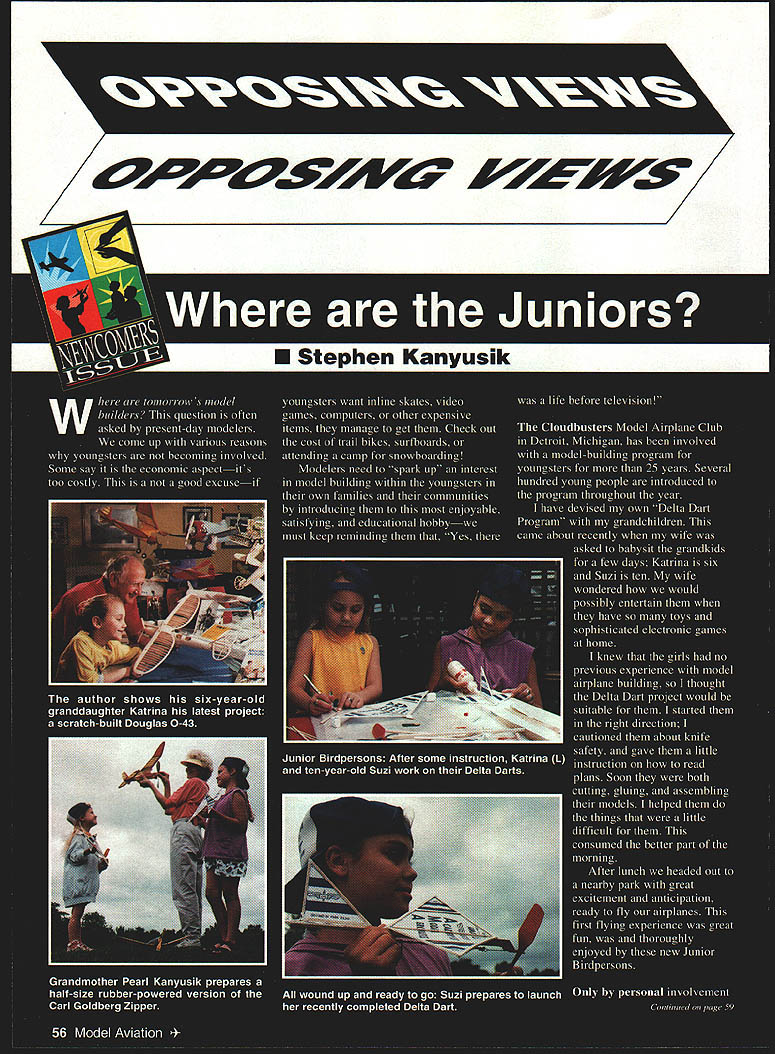
I devised my own "Delta Dart Program" with my grandchildren. This came about recently when my wife was asked to babysit the grandkids for a few days. Katrina is six and Suzi is ten. My wife wondered how we would possibly entertain them when they have so many toys and sophisticated electronic games at home.
I knew that the girls had no previous experience with model airplane building, so I thought the Delta Dart project would be suitable for them. I started them in the right direction; I cautioned them about knife safety and gave them a little instruction on how to read plans. Soon they were both cutting, gluing, and assembling their models. I helped them do the things that were a little difficult for them. This consumed the better part of the morning.
After lunch we headed out to a nearby park with great excitement and anticipation, ready to fly our airplanes. This first flying experience was great fun and was thoroughly enjoyed by these new Junior Birdpersons.
Only by personal involvement and encouragement from present-day modelers will youngsters become interested in the hobby. From small acorns, mighty oaks grow.
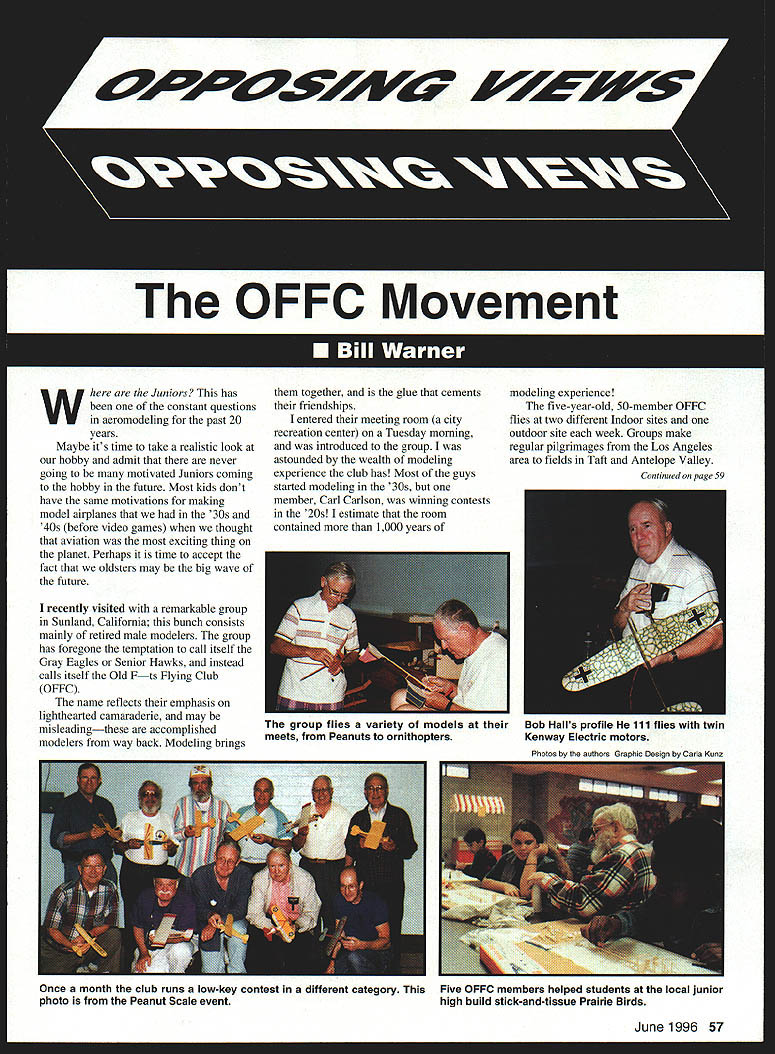
The OFFC Movement
Bill Warner
Where are the juniors? This has been one of the constant questions in aeromodelling for the past 20 years. Maybe it's time to take a realistic look at our hobby and admit that there are never going to be many motivated juniors coming to the hobby in the future. Most kids don't have the same motivations for making model airplanes that we had in the '30s and '40s (before video games) when aviation seemed the most exciting thing on the planet. Perhaps it is time to accept the fact that the oldsters may be the big wave of the future.
Old F—ts Flying Club (OFFC)
I recently visited a remarkable group in Sunland, California. This bunch consists mainly of retired male modelers. The group has foregone the temptation to call itself the Gray Eagles or Senior Hawks and instead calls itself the Old F—ts Flying Club (OFFC). The name reflects their emphasis on lighthearted camaraderie. These are accomplished modelers from way back: most of the guys started modeling in the '30s, and one member, Carl Carlson, was winning contests in the '20s. I estimate that the room contained more than 1,000 years of modeling experience.
The 50-member OFFC flies at two different indoor sites and one outdoor site each week. Groups make regular pilgrimages from the Los Angeles area to fields in Taft and Antelope Valley. Once a month the club runs a low-key contest in a different category. Five OFFC members helped students at the local junior high build stick-and-tissue Prairie Birds. Present-day modelers induct and encourage youngsters into modeling.
Club activities
On an indoor flying day approximately 30 members participated. The session began with a meeting at 9 a.m., followed by a flying session in the gym that lasted until 12:30 p.m. Indoor electric free-flight models, controlled by tiny 10-ohm potentiometers, shared the gym with Peanuts, EZBs, flying wings, 14-gram Bostonians, ornithopters — almost everything else you could think of. Once a month they have a low-key competition in a different category. After flying, members meet at a local restaurant; the usual lies and hangar flying round out a great morning.
The obvious success of the growing Flying Aces Club movement is largely fueled by old-time, retired modelers getting back into the hobby. The Flying Aces Nationals brings together modelers from the U.S. and Canada for great extended-family reunions. OFFC is an ongoing local phenomenon; these "recycled modelers" are rapidly becoming a force to be reckoned with, providing individuals and families with kindred souls and a means for society to carry on its best modeling tradition.
Why seniors matter
Time magazine recently reported that rates of depression and alienation have doubled in industrialized countries in the past ten years. The centrifugal forces of modern life have brought a loneliness our grandparents could never have imagined. Television, an economic system with an emphasis on individual gain, isolation in the workplace, the breakup of the family, and the Internet have all played a part in making us more individualized. We must start bringing back some of the group values we have lost.
The bonding provided by groups like OFFC and the Flying Aces movement brings back a sense of belonging to those of us no longer involved in the workforce and in need of social contact. A supportive group that shares interests can provide much. Modeling is about a lot more than just sticking balsa wood together and flying — it provides emotional fulfillment and social connection.
Seniors have many advantages when it comes to modeling:
- They can obtain flying sites such as recreation centers that are often underutilized in morning hours (kids are in school, younger people are at work).
- They usually have cars and the means to get to flying sites.
- They have the money to buy materials and the time to apply old wisdom and learn new techniques.
A call to clubs
Instead of bemoaning the fact that the hobby isn't what it used to be (with kids banging on the hangar doors to get in), let's begin to adjust our thinking and make the most of our principal resource and strength: our senior citizens. If the hobby is to grow, what better way than in the formation of more local "fly-for-fun" groups that emphasize the club as an important entity for togetherness? It is in the direction of this grassroots movement that the AMA's attention should be focused. Only a tiny fraction of modelers are interested in going to Top Gun–type events, but hundreds of thousands would like to participate in OFFC-type activities.
Remember, even new retirees can be potential model builders! Don't forget girls and women.
The group spirit in the OFFC is a shining example of what can be and should be done in modeling. I submit this in the hope that clubs across the country will take it to heart and make the hobby more appealing to the senior segment of our population.
If you are in the Los Angeles area, stop by one of the OFFC sessions and see what modeling is all about: having fun, being part of an important affinity group, and not taking yourself too seriously. Call Clary Ames at (818) 846-8053 for more information.
Transcribed from original scans by AI. Minor OCR errors may remain.

