
Optimizing Prop Performance
Don Brooks
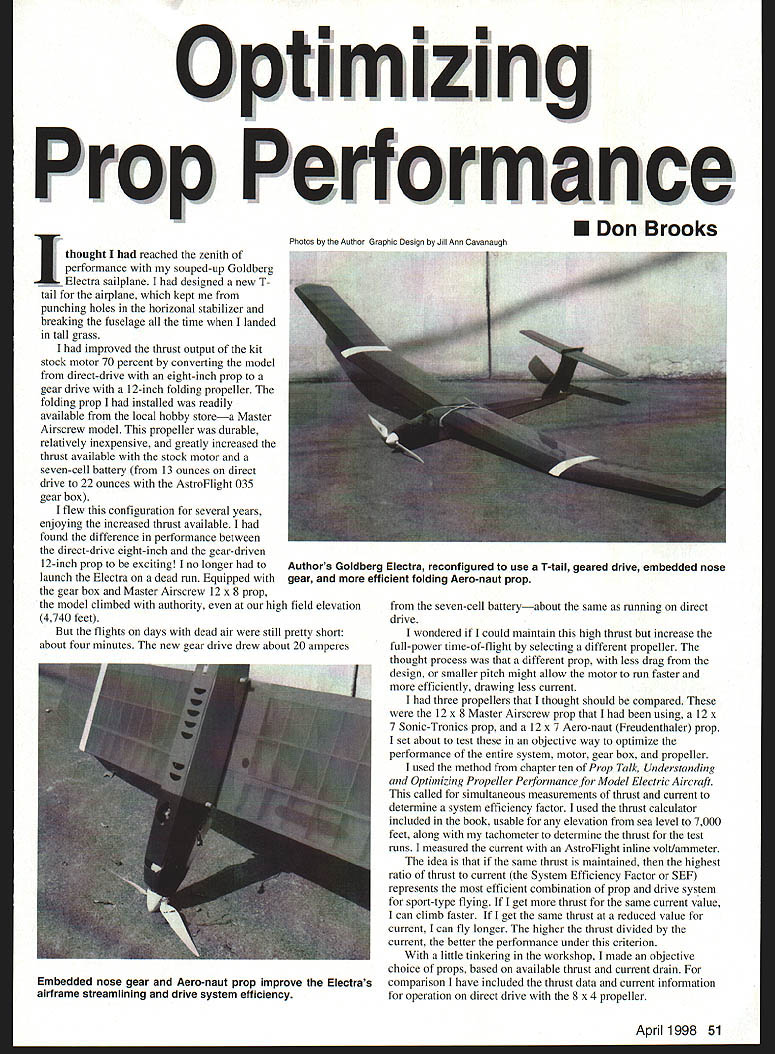
I thought I had reached the zenith of performance with my souped-up Goldberg Electra sailplane. I had designed a new T-tail for the airplane, which kept me from punching holes in the horizontal stabilizer and breaking the fuselage all the time when I landed in tall grass.
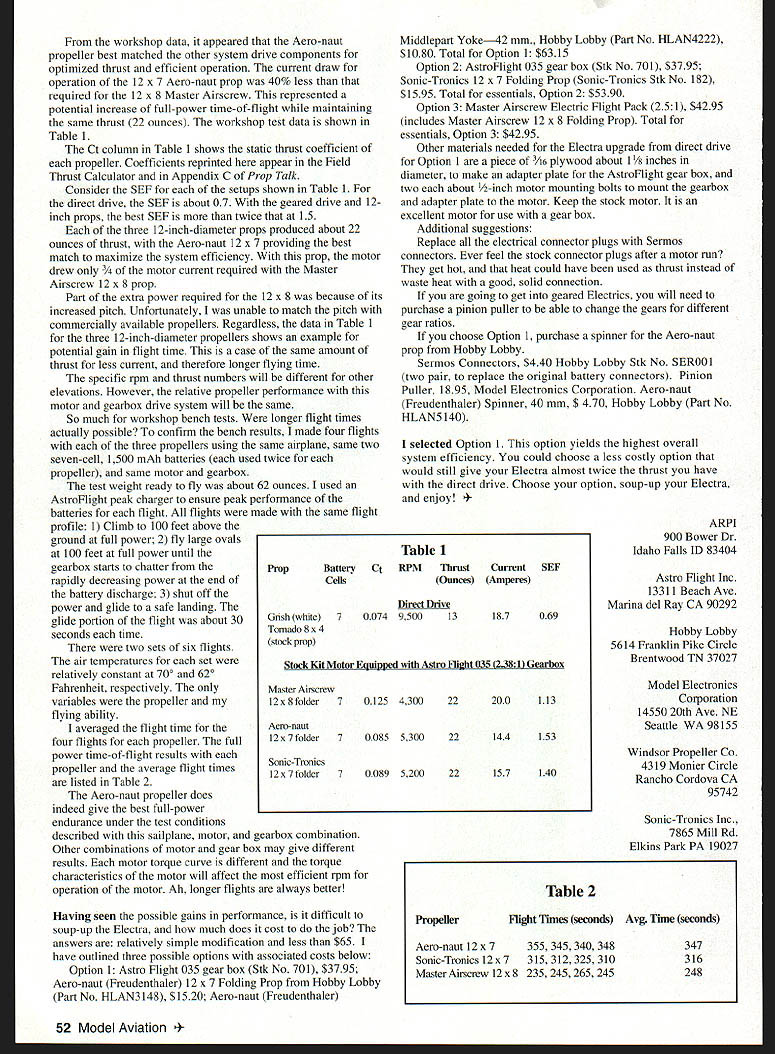
I had improved the thrust output of the kit-stock motor 70 percent by converting the model from direct drive with an eight-inch prop to a gear drive with a 12-inch folding propeller. The folding prop I had installed was readily available from the local hobby store — a Master Airscrew model. This propeller was durable, relatively inexpensive, and greatly increased the thrust available with the stock motor and a seven-cell battery (from 13 ounces on direct drive to 22 ounces with the AstroFlight 035 gearbox).
I flew this configuration for several years, enjoying the increased thrust. The difference in performance between the direct-drive eight-inch and the gear-driven 12-inch prop was exciting! I no longer had to launch the Electra on a dead run. Equipped with the gearbox and Master Airscrew 12 x 8 prop, the model climbed with authority, even at our high field elevation (4,740 feet).
But flights on days with dead air were still pretty short: about four minutes. The new gearbox drew about 20 amperes from the seven-cell battery — about the same as running on direct drive.
I wondered if I could maintain high thrust but increase the full-power time-of-flight by selecting a different propeller. The thought was that a different prop, with less drag from the design or smaller pitch, might allow the motor to run faster and more efficiently, drawing less current.
Propellers Tested
I had three propellers to compare:
- Master Airscrew 12 x 8 (the prop I had been using)
- Sonic-Tronics 12 x 7
- Aero-naut (Freudenthaler) 12 x 7
I set about testing these objectively to optimize the performance of the entire system: motor, gearbox, and propeller.
Test Method
I used the method from chapter ten of Prop Talk, Understanding and Optimizing Propeller Performance for Model Electric Aircraft. This called for simultaneous measurements of thrust and current to determine a system efficiency factor. I used the field thrust calculator from the book (usable for any elevation from sea level to 7,000 feet), along with a tachometer to determine RPM for the test runs. I measured current with an AstroFlight inline volt/ammeter.
The idea: if the same thrust is maintained, the highest ratio of thrust to current (the System Efficiency Factor, SEF) represents the most efficient combination of prop and drive system for sport-type flying. If I get more thrust for the same current, I can climb faster. If I get the same thrust at reduced current, I can fly longer. The higher the thrust divided by current, the better the performance under this criterion.
Workshop Results
With some tinkering in the workshop, I made an objective choice based on thrust and current drain. For comparison I included the thrust data and current information for operation on direct drive with the 8 x 4 propeller.
From the workshop data, the Aero-naut propeller best matched the other system components for optimized thrust and efficient operation. The current draw for the Aero-naut 12 x 7 was 40% less than that required for the Master Airscrew 12 x 8 — representing a potential increase in full-power time-of-flight while maintaining the same thrust (22 ounces).
The Ct column in Table 1 shows the static thrust coefficient of each propeller. Coefficients reprinted here appear in the Field Thrust Calculator and in Appendix C of Prop Talk.
Consider the SEF for each setup shown in Table 1. For direct drive the SEF is about 0.7. With the geared drive and 12-inch props, the best SEF is more than twice that at about 1.5.
Each of the three 12-inch-diameter props produced about 22 ounces of thrust, with the Aero-naut 12 x 7 providing the best match to maximize system efficiency. With this prop, the motor drew only three-quarters of the motor current required with the Master Airscrew 12 x 8.
Part of the extra power required for the 12 x 8 was because of its increased pitch. I was unable to match that pitch with commercially available props. Regardless, the data in Table 1 for the three 12-inch props shows an example of potential gain in flight time: the same thrust for less current, and therefore longer flying time.
The specific RPM and thrust numbers will differ at other elevations. However, the relative propeller performance with this motor and gearbox drive system should be the same.
Flight Tests
To confirm the bench results, I made four flights with each of the three propellers using the same airplane, the same two seven-cell 1500 mAh batteries (each used twice for each propeller), and the same motor and gearbox.
Test weight ready to fly was about 62 ounces. I used an AstroFlight peak charger to ensure peak battery performance for each flight. All flights used the same flight profile:
- Climb to 100 feet above ground at full power.
- Fly large ovals at 100 feet at full power until the gearbox began to chatter from rapidly decreasing power near the end of battery discharge.
- Shut off power and glide to a safe landing. Glide portion was about 30 seconds each time.
There were two sets of six flights. Air temperatures for each set were relatively constant at 70° and 62° F, respectively. The only variables were the propeller and my flying ability.
I averaged the flight times for the four flights with each propeller. The full-power time-of-flight results and averages are listed in Table 2.
The Aero-naut propeller gave the best full-power endurance under the test conditions described with this sailplane, motor, and gearbox combination. Other motor/gearbox combinations may yield different results — each motor’s torque curve is different and will affect the most efficient RPM for operation.
Ah, longer flights are always better!
Options and Costs
Is it difficult to soup-up the Electra, and how much does it cost? Relatively simple modification and less than $65. Three options with associated costs:
- Option 1
- AstroFlight 035 gearbox (Stk No. 701): $37.95
- Aero-naut (Freudenthaler) 12 x 7 folding prop (Hobby Lobby Part No. HLAN3148): $15.20
- Aero-naut middlepart yoke — 42 mm (Hobby Lobby Part No. HLAN4222): $10.80
- Total: $63.95
- Option 2
- AstroFlight 035 gearbox (Stk No. 701): $37.95
- Sonic-Tronics 12 x 7 folding prop (Sonic-Tronics Stk No. 182): $15.95
- Total: $53.90
- Option 3
- Master Airscrew Electric Flight Pack (2.5:1) — includes Master Airscrew 12 x 8 folding prop: $42.95
- Total: $42.95
Other materials needed for the Electra upgrade from direct drive for Option 1:
- A piece of 3/16" plywood about 1½ inches in diameter to mate the adapter plate for the AstroFlight gearbox.
- Two 1/2-inch motor mounting bolts to mount the gearbox and adapter plate to the motor.
- Keep the stock motor — it is an excellent motor for use with a gearbox.
Additional Suggestions
- Replace all electrical connector plugs with Sermos connectors. Stock connectors get hot after a motor run; a good solid connection reduces wasted heat.
- If you plan to use geared electrics, purchase a pinion puller to change gears for different gear ratios.
- If you choose Option 1, purchase a spinner for the Aero-naut prop from Hobby Lobby.
Suggested accessories and prices:
- Sermos connectors (two pairs to replace original battery connectors): $4.40 — Hobby Lobby Stk No. SER001
- Pinion puller: $18.95 — Model Electronics Corporation
- Aero-naut (Freudenthaler) spinner, 40 mm: $4.70 — Hobby Lobby Part No. HLAN5140
I selected Option 1. This yields the highest overall system efficiency. You could choose a less costly option and still get almost twice the thrust of direct drive. Choose your option, soup-up your Electra, and enjoy!
Table 1 — Workshop Test Data
Prop Battery Cells Ct RPM Thrust (oz) Current (A) SEF Direct Drive Grish (white) Tornado 8 x 4 (stock prop) 7 0.074 9,500 13 18.7 0.69
Stock kit motor equipped with AstroFlight 035 (2.38:1) gearbox Master Airscrew 12 x 8 folder 7 0.125 4,300 22 20.0 1.13 Aero-naut 12 x 7 folder 7 0.085 5,300 22 14.4 1.53 Sonic-Tronics 12 x 7 folder 7 0.089 5,200 22 15.7 1.40
(Note: Ct = static thrust coefficient. SEF = thrust (oz) divided by current (A), system efficiency factor.)
Table 2 — Flight Test Results
Propeller Flight Times (s) Avg. Time (s) Aero-naut 12 x 7 355, 345, 340, 348 347 Sonic-Tronics 12 x 7 315, 312, 325, 310 316 Master Airscrew 12 x 8 235, 245, 265, 245 248
Suppliers
- ARPL
- 900 Bower Dr.
- Idaho Falls, ID 83404
- Astro Flight Inc.
- 13311 Beach Ave
- Marina del Rey, CA 90292
- Hobby Lobby
- 5614 Franklin Pike Circle
- Brentwood, TN 37027
- Model Electronics Corporation
- 14550 20th Ave. NE
- Seattle, WA 98155
- Windsor Propeller Co.
- 4319 Monier Circle
- Rancho Cordova, CA 95742
- Sonic-Tronics Inc.
- 7865 Mill Rd.
- Elkins Park, PA 19027
Transcribed from original scans by AI. Minor OCR errors may remain.

