
Original Veco: Thunderbird
Tom Dixon
“From the first flight it worked fine. Each flight demanded another and another.” Bob Palmer’s classic Veco Thunderbird continues to provide a special kind of stunting pleasure. Here it is in the original and in our author’s updated version.
Design background
Since 1983, regular readers of Model Aviation know I’ve been flying and publishing various modifications and updates of Bob Palmer’s designs. At some point I felt as though I’d gone about as far as I could with the various Nobler‑derived designs and was looking for something classic—something that would get me away from the then‑current idiom of Stunters exemplified by the Stiletto, Genesis, and other jet‑type designs. Bob Palmer’s designs, most of which were kitted by Veco, proved just the ticket—timeless in their aesthetics and Nats winners.
The Thunderbird design was never published in its original form; it went directly into production as a Veco kit. Curious, I wrote to Bob Palmer to learn how the design came about. Here’s what he had to say:
“I went to work for Lockheed in 1951 and at the same time built the Smoothie. I designed its wing and airfoil to help it fly in the wind. Since I worked in the wind tunnel, I had the opportunity to observe and to talk to the engineers about turbulence that was apparent on wing tips and at the high point of the airfoil. All the engineers said the British Spitfire had the most efficient wing shape; so I went to the elliptical tip shape and airfoil with an aft high point to reduce the turbulence. When I first flew the Smoothie, it sure lived up to its name. It was definitely smooth—even in high winds. It wouldn't turn tight, though, and I was disappointed.
Later, when the Pattern requirements changed from a 60‑ to a 45‑degree elevator, I needed a new and better plane—one that could make the tighter turns now necessary. This plane was the first Thunderbird. It had a thicker and better airfoil and a better platform. The earlier design had an Orwick .32 on glow. From the first flight it worked fine... Each flight demanded another and another.”
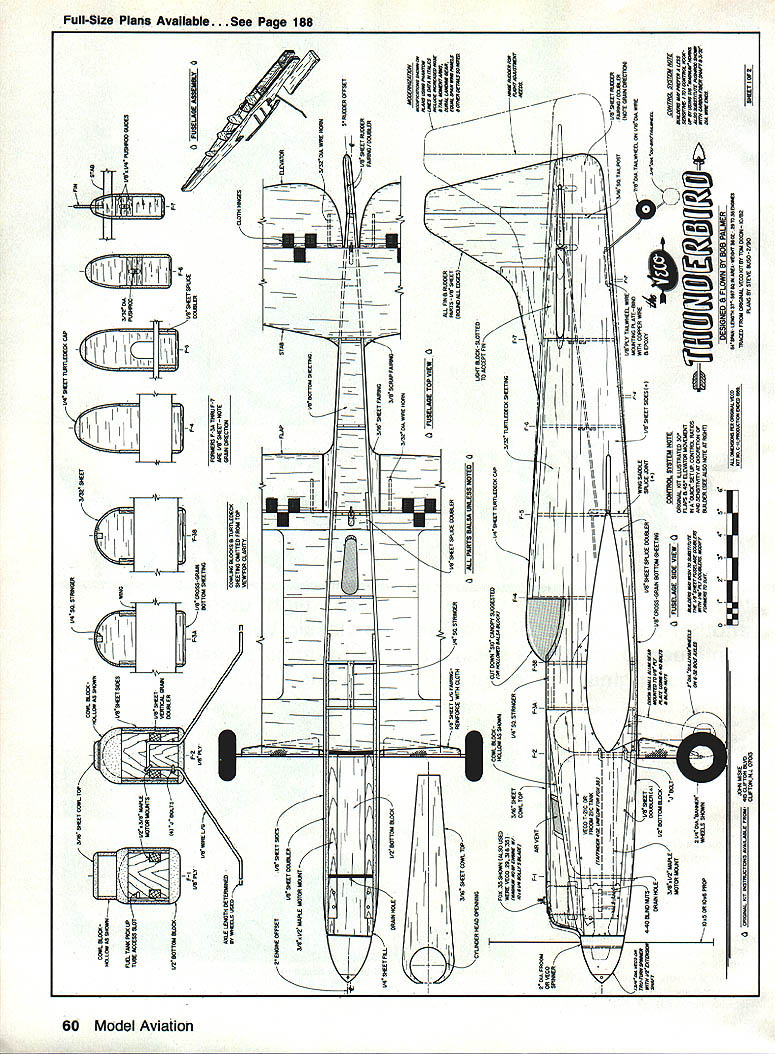
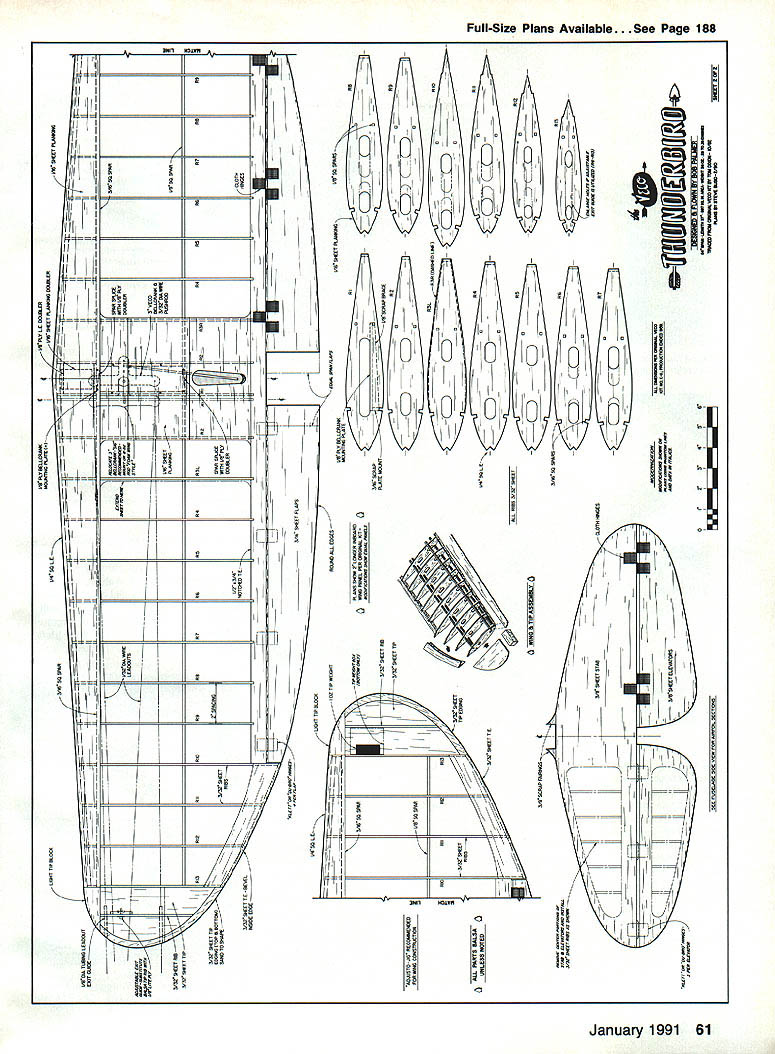
Designed & flown by Bob Palmer (Traced from original Veco kit sheet)
Full‑Size Plans Available... See Page 188
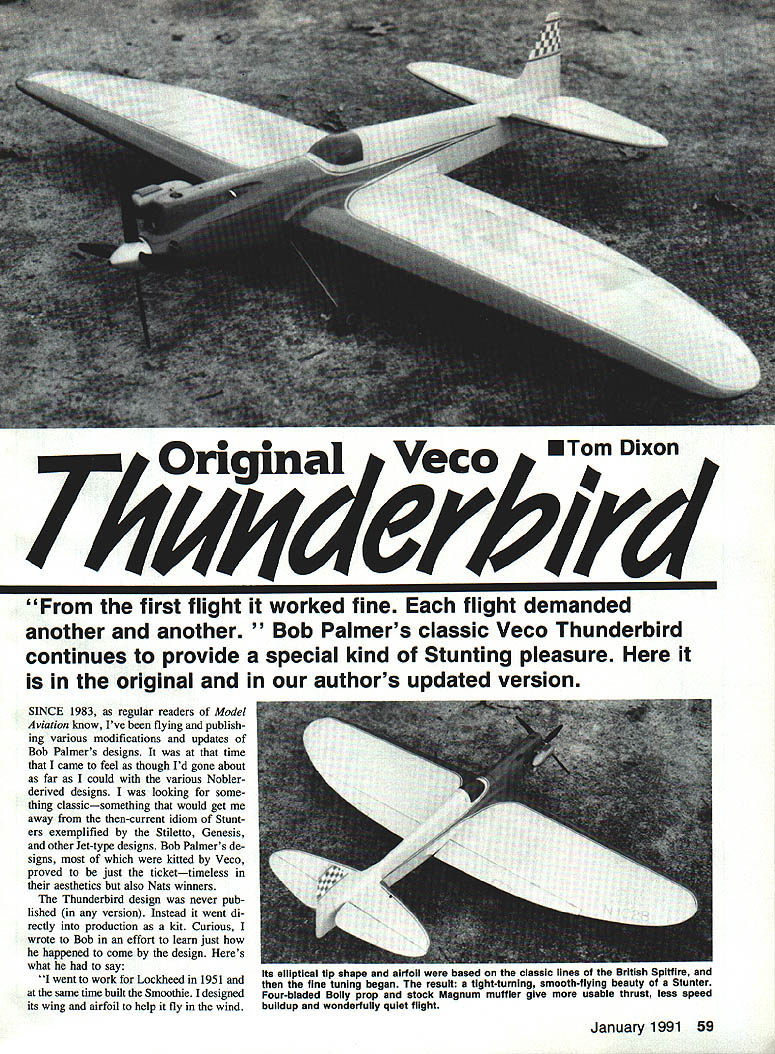
The Thunderbird (author’s replica and updates)
The old‑style Thunderbird is the plane I have been using in my logo, so it seemed appropriate to build one of the first‑version planes just to have on hand. The model presented here was built to conform to contemporary standards, but the wing and tail areas of the original have been maintained. Moment arms have been lengthened, the wings have been made equal in size, and the control system uses a one‑to‑one flap‑to‑elevator ratio. The landing gear has been moved rearward and “Giesekeized” for better landings (with a nod and a tip of the hat to famed stunter Bob Gieseke).
When these photos were taken I’d been flying the model for over two years—mostly for fun. I felt it wasn’t quite precise enough for competition, so for experimentation’s sake I tried two new trim changes.
Flight modifications and results
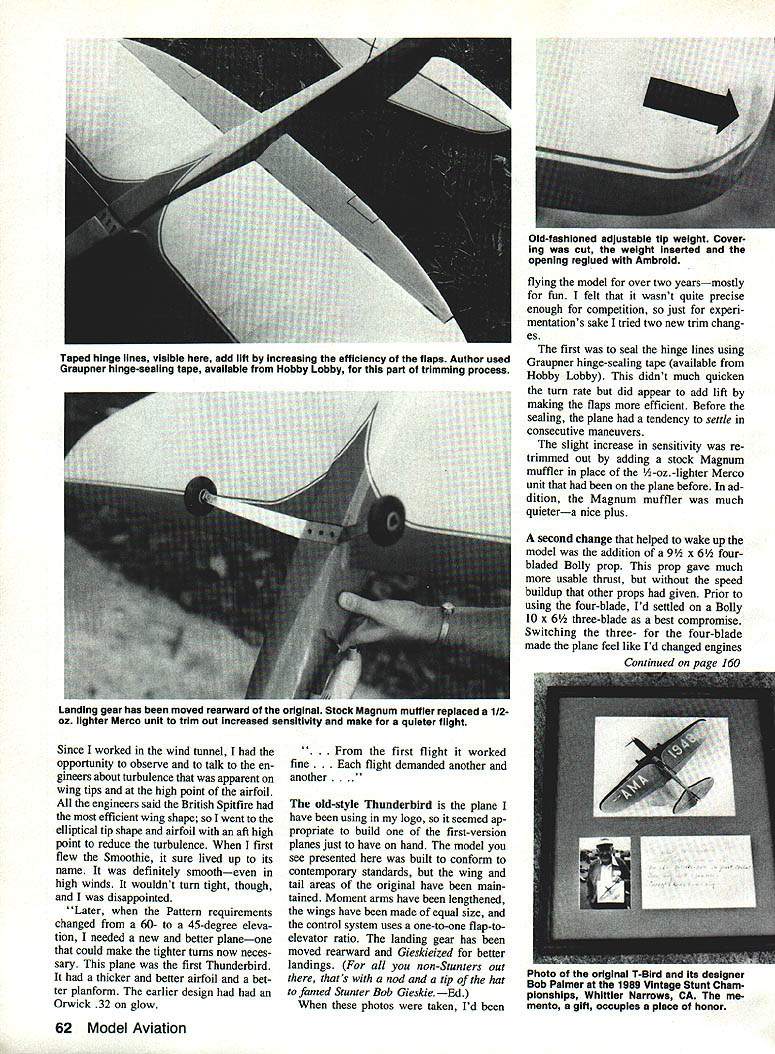
- Hinge sealing: I sealed the hinge lines using Graupner hinge‑sealing tape (available from Hobby Lobby). This didn’t much quicken the turn rate but did appear to add lift by making the flaps more efficient. Before sealing, the plane had a tendency to settle in consecutive maneuvers.
- Muffler swap: The slight increase in sensitivity was re‑trimmed out by adding a stock Magnum muffler in place of the 1/2‑oz.‑lighter Merco unit previously on the plane. The Magnum muffler was much quieter—a nice plus.
- Propeller change: Adding a 9‑1/2 x 6‑1/2 four‑bladed Bolly prop gave much more usable thrust without the speed buildup other props had produced. Prior to the four‑blade, I’d settled on a Bolly 10 x 6‑1/2 three‑blade as a best compromise. Switching from the three‑ to the four‑blade made the plane feel like I’d changed engines.
I also experimented with engine sizes—from a .35 to a .45. The Magnum .40 GP has no trouble pulling it.
A four‑bladed Bolly prop and the stock Magnum muffler give usable thrust with less tendency to build excessive speed and provide a wonderfully quiet flight.
The replica version of the Thunderbird meets the PAMA rules for Nostalgia Stunt.
Construction
Unlike other elliptical‑wing T‑Birds, this one does not have to be built in a jig (although I would recommend using one).
- Carefully pin the ribs into the notches in the trailing edge (TE).
- Add the rear and main spars.
- Add the leading edges (LE).
- Pin or tape everything into place and align all ribs.
- When satisfied with alignment, hit all the joints with gap‑filling Zap.
- Add the TE tip sheeting and the LE sheeting; then add the tips and tip blocks.
- Install the bellcrank either before or after sheeting the leading edge.
Notes:
- The kit‑type plywood platform is shown on the plans, but I use a foam‑wing‑style bellcrank mount.
- If building the kit version, use a 3/8:1 flap‑to‑elevator ratio, and set up the system so that about 45 degrees of bellcrank movement gives about 30 degrees of elevator movement. A four‑inch bellcrank might be a good idea in this case. I think the original kit hookup is too quick unless a very narrow spacing is used.
- Remaining construction is straightforward.
- You might be tempted to leave the helmet off the cowl to expose the engine (lots of T‑Birds were built that way in the Fifties), but I prefer to keep the helmet; that cowl is an integral part of the character of the design.
Designed & flown by Bob Palmer.
Transcribed from original scans by AI. Minor OCR errors may remain.

