
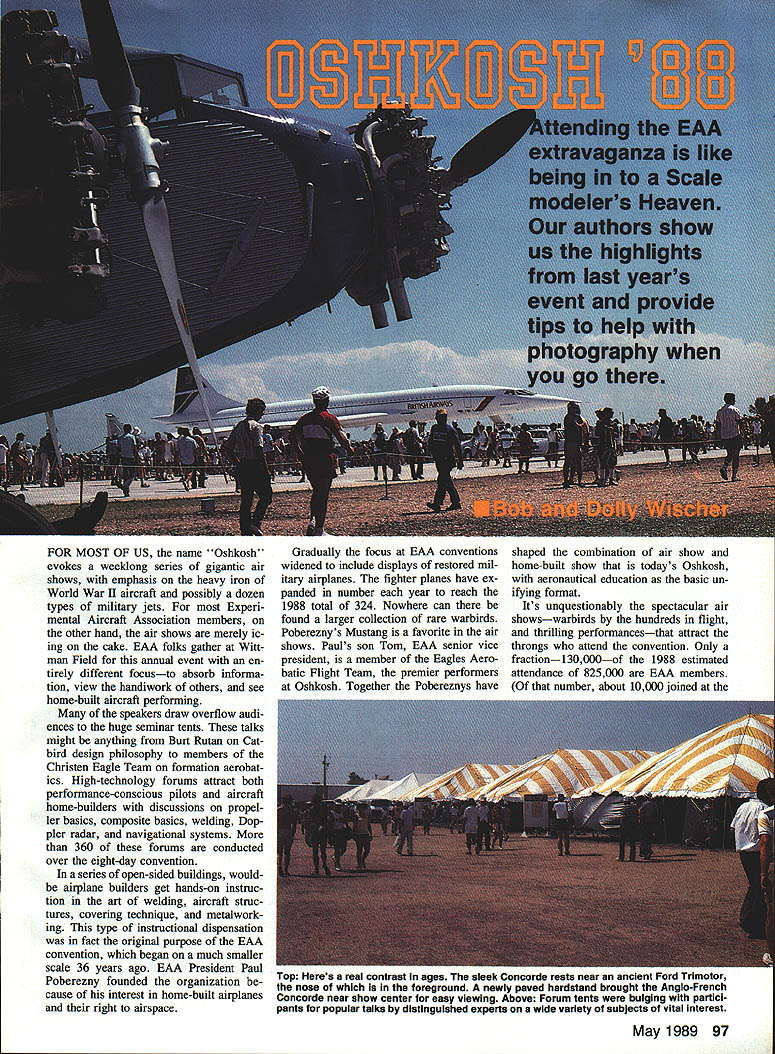
OSHKOSH '88
By Bob and Dolly Wischer
Overview
Attending the EAA extravaganza at Wittman Field is like visiting a scale modeler’s heaven. For many, "Oshkosh" evokes weeklong air shows emphasizing World War II aircraft and military jets. For Experimental Aircraft Association (EAA) members, however, the air shows are only part of the attraction. The convention’s primary focus is education: absorbing information, viewing the handiwork of others, and seeing home-built aircraft perform.
More than 360 forums are conducted over the eight-day convention, and open-sided buildings provide hands-on instruction in welding, aircraft structures, covering techniques, and metalworking. The EAA convention began on a much smaller scale 36 years earlier; Paul Poberezny founded the organization out of interest in home-built airplanes and their place in the airspace community.
Seminars and Workshops
- Overflow audiences gather in huge seminar tents. Topics range from Burt Rutan and Catbird design philosophy to formation aerobatics by the Christen Eagle Team.
- High-technology forums cover propeller basics, composite construction, welding, Doppler radar, and navigation systems.
- Open-sided instructional buildings allow hands-on lessons in welding, structures, covering, and metalworking.
Air Shows and Warbirds
- The spectacular air shows—hundreds of warbirds and thrilling performances—draw the largest crowds. Sunday’s air show set a record crowd of about 300,000.
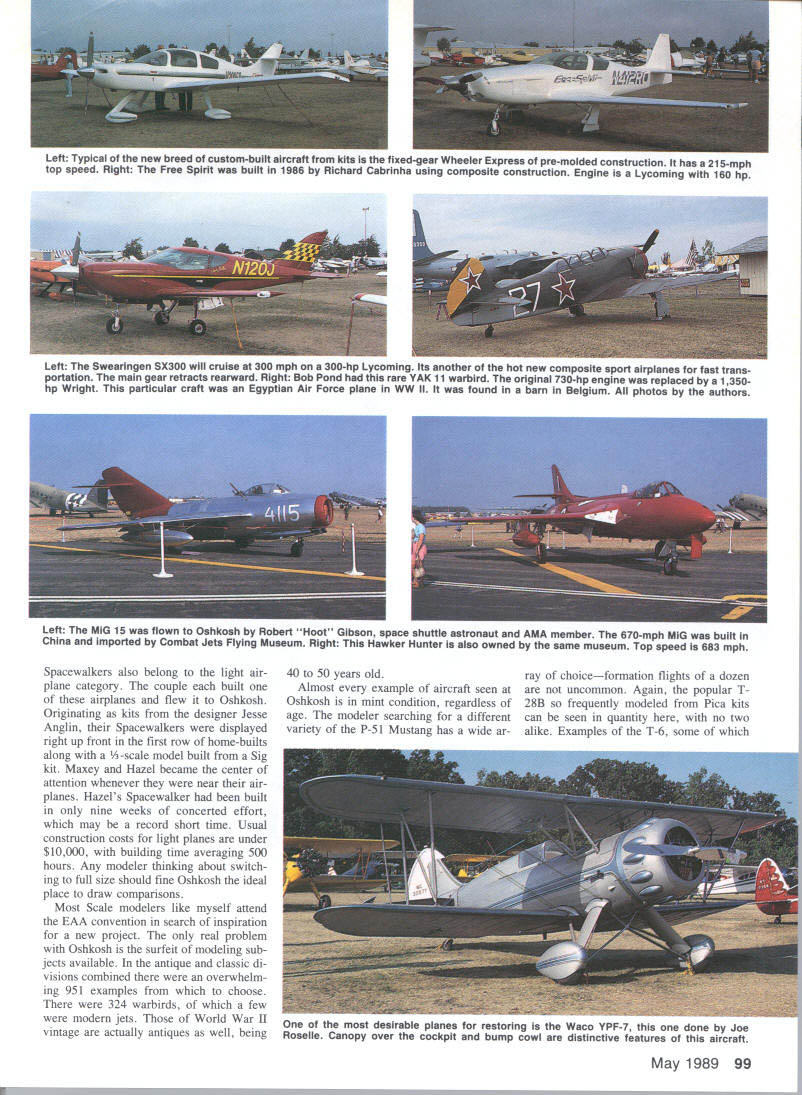
- Fighter and warbird displays grew to 324 in 1988, creating one of the largest collections of rare warbirds anywhere. Examples included a MiG‑15 (imported from China and piloted at Oshkosh by Robert “Hoot” Gibson), a Hawker Hunter, a Lockheed F‑104D, and an F‑100 Super Sabre.
- Special appearances included the Rockwell B‑1B (notably loud) and the hovering Harrier (sustained close-up noise).
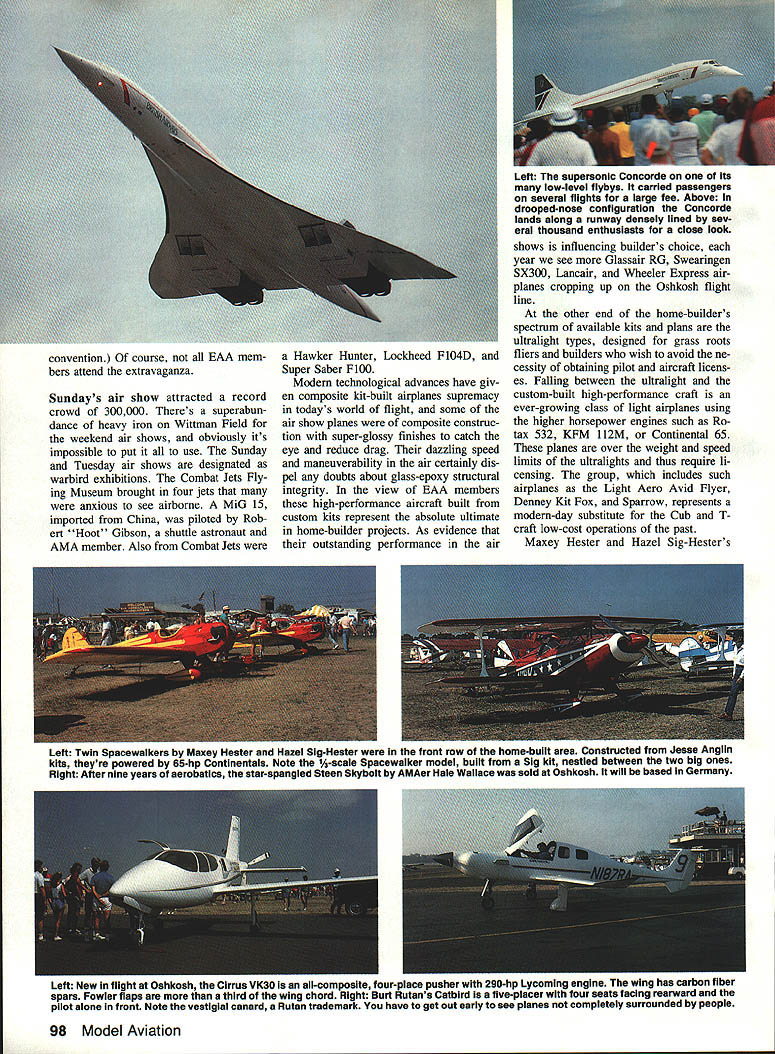
- Concorde made several low passes and dramatic climbs for show flights, with tickets priced at about $895 ($795 for EAA members). For the show the airliner flew light and performed fighter-like maneuvers.
Homebuilt, Kit, and Composite Aircraft
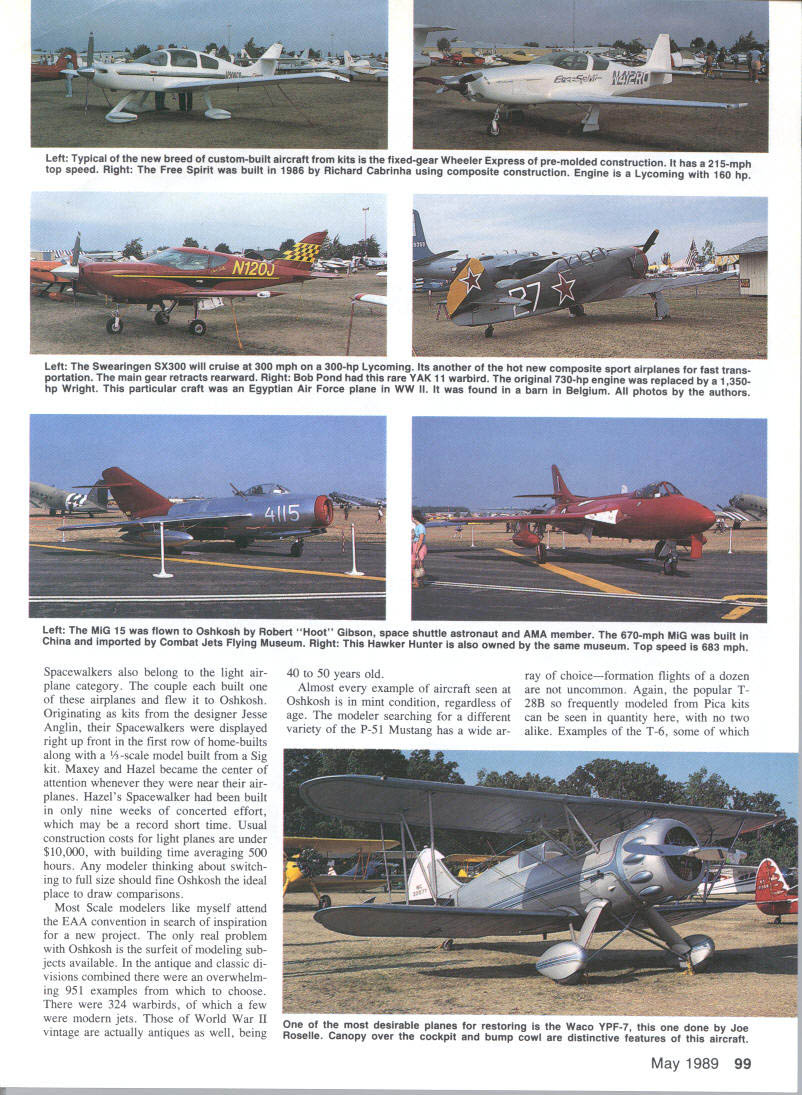
- Modern composite kit-built airplanes are prominent, with glossy finishes, high speed, and impressive maneuverability that demonstrate glass-epoxy structural integrity. Popular kit types seen on the flight line included Glassair RG, Swearingen SX300, Lancair, and Wheeler Express.
- Kit-built Grand Champion: Glassair RG.
- Plans-built Grand Champion: Sidewinder.
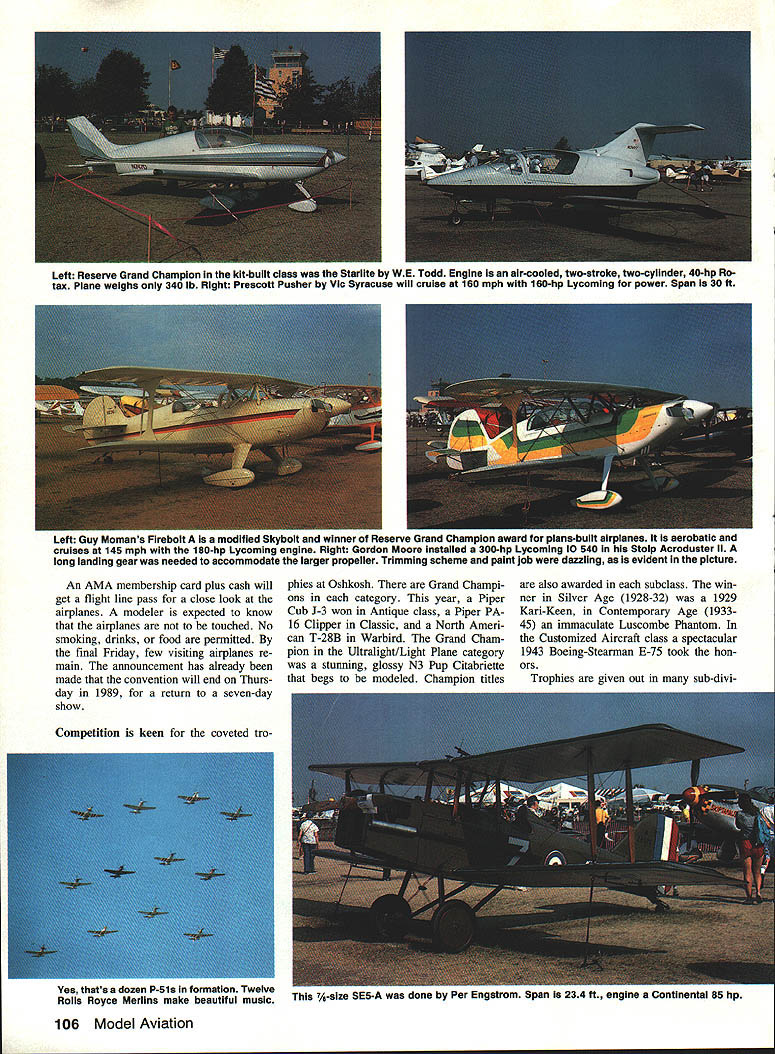
- Reserve Grand Champions included a Starlite (kit-built) and a Firebolt (modified Steen Skybolt, plans-built).
- Other kit-built winners: Christen Eagle, Quickie, Wag-a-Bond.
- Reserve Grand Champions among plans-built types included Osprey 2, Mustang II, Long-EZ, Starduster, Merkel Mk. II, RV‑4, and Midget Mustang.
Light and Ultralight Aircraft
- At the low end are ultralights aimed at grassroots fliers who wish to avoid pilot/aircraft licensing requirements.
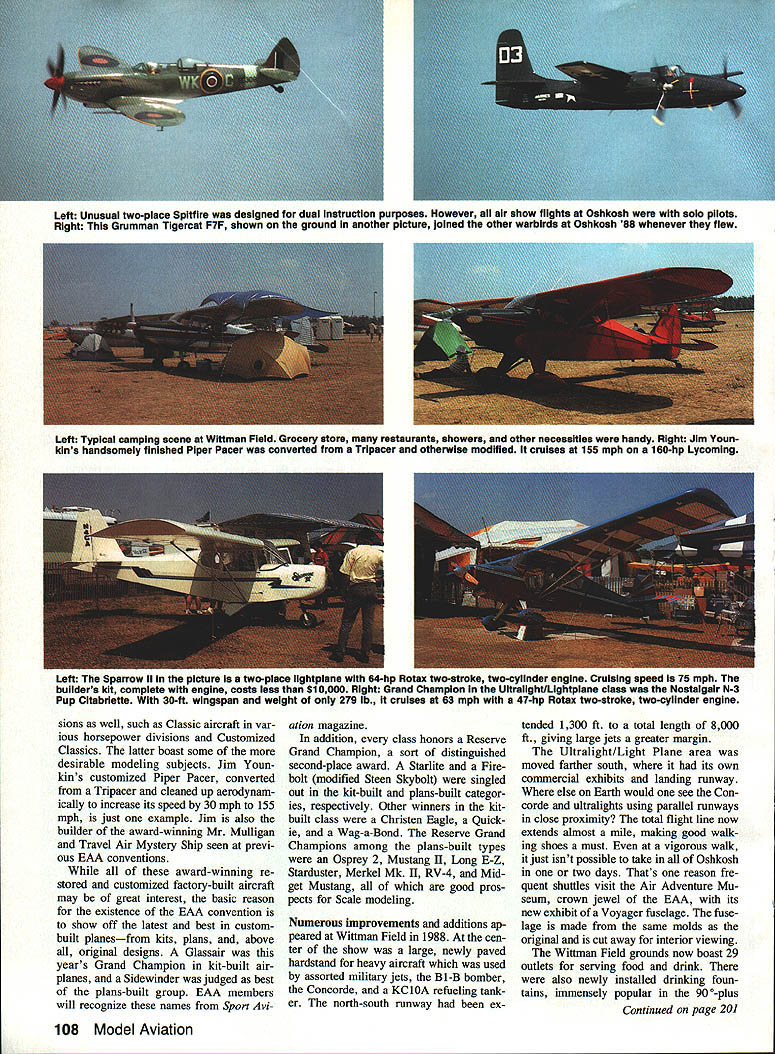
- Between ultralights and high-performance kit aircraft is a growing class of light airplanes using higher-horsepower engines (Rotax 532, KFM 112M, Continental 65). These require licensing and include types such as the Light Aero Avid Flyer, Denney Kitfox, and Sparrow—modern substitutes for Cub-type low-cost operations.
- Spacewalkers (kits by Jesse Anglin) were well represented; one builder completed a Spacewalker in nine weeks of concerted effort. Construction costs for light planes often run under $10,000, with average building time around 500 hours.
Scale Modeling and Inspiration
- Scale modelers attend Oshkosh for inspiration; the sheer number of subjects can be overwhelming. In 1988:
- Show aircraft totaled about 2,053.
- Classic class included 800-plus examples.
- Custom-built class had more than 600 examples.
- Antique and classic divisions together offered some 951 examples.
- Popular modeling subjects included many P‑51 Mustangs in varied configurations and formation groups of T‑28s and T‑6s.
- Tips for modelers:
- Arrive by Sunday to see the maximum number of aircraft; many pilots depart Monday and Tuesday, leaving gaps by Wednesday.
- Some visitors arrive as early as Tuesday or Wednesday to secure desirable parking spots on the flight line.
- An AMA membership card plus cash can obtain a flight-line pass for closer viewing. Rules on the flight line typically forbid touching aircraft and carrying food, drinks, or smoking.
Attendance and Field Operations
- Estimated 1988 attendance: 825,000; only a fraction (about 130,000) were EAA members (roughly 10,000 joined at the convention).
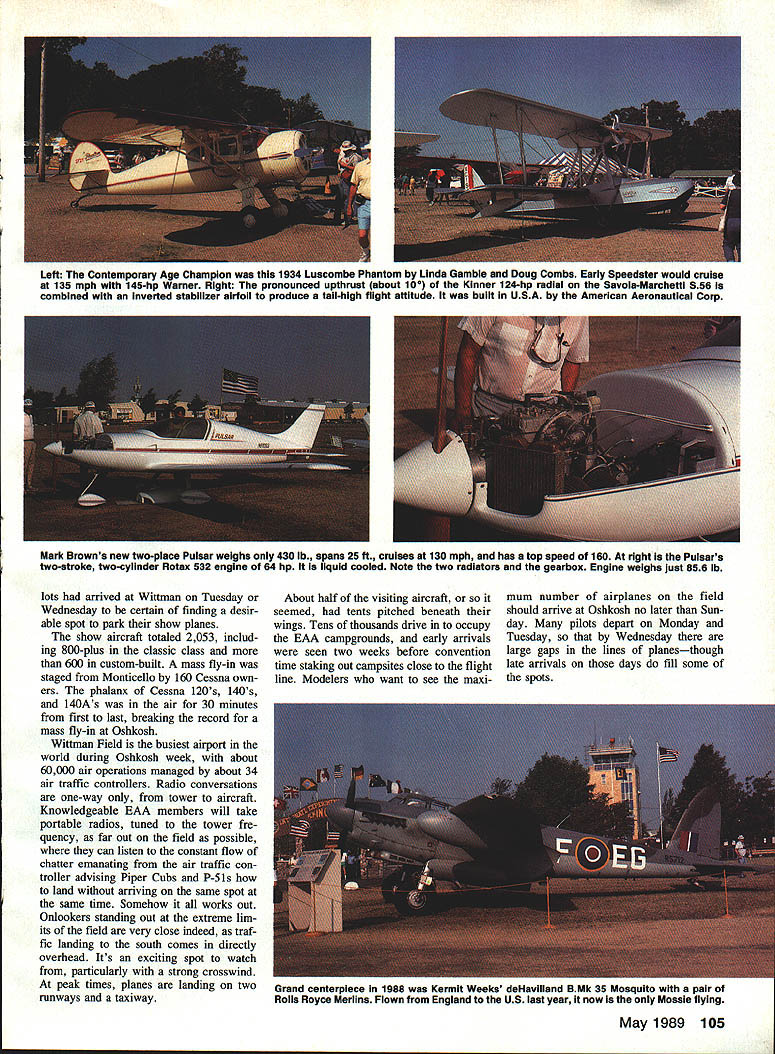
- Wittman Field becomes extremely busy—about 60,000 air operations were managed by roughly 34 air traffic controllers during the week. Radio traffic is one-way (tower to aircraft); many attendees use portable radios tuned to the tower to listen in.
- At peak times, aircraft landed on two runways and a taxiway; some approaches pass directly over spectators at the field’s limits—an exciting vantage point, especially in crosswinds.
- A mass fly-in from Monticello by 160 Cessna owners set a record for Oshkosh, with a phalanx of Cessna 120/140/140A aircraft in the air for 30 minutes.
Competition and Awards
- Grand Champions by category in 1988:
- Antique: Piper Cub J‑3.
- Classic: Piper PA‑16 Clipper.
- Warbird: North American T‑28B.
- Ultralight/Light Plane Grand Champion: a glossy N3 Pup Citabria.
- Subdivision winners included Silver Age (1928–32) — 1929 Kari-Keen; Contemporary Age (1933–45) — Luscombe Phantom; Customized Aircraft — 1943 Boeing-Stearman E‑75.
- Trophies are awarded across many subclasses and divisions.
Notable Aircraft and Exhibits
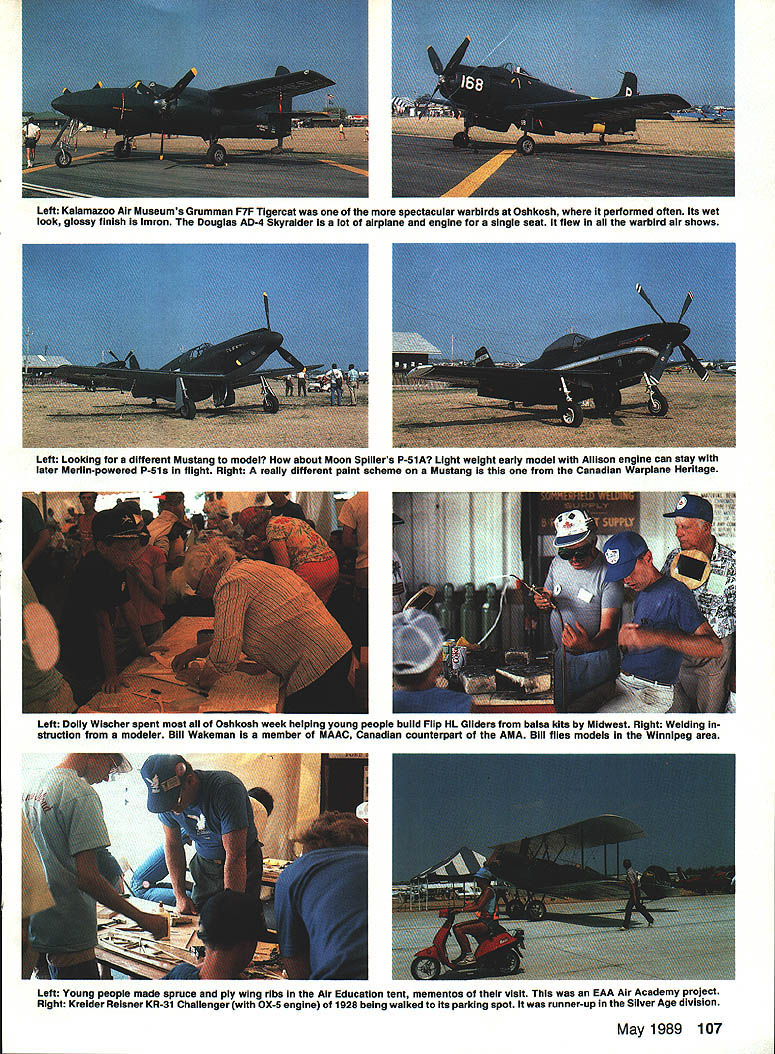
- Kalamazoo Air Museum’s Grumman F7F Tigercat (wet, glossy Imron finish).
- Douglas AD‑4 Skyraider—a large single-seat airplane with a powerful engine.
- Moon Spiller’s P‑51A (lightweight early model with Allison engine).
- A distinctive Mustang paint scheme from the Canadian Warplane Heritage collection.
- Kreider Reisner KR‑31 Challenger (OX‑5 engine, 1928) — runner-up in the Silver Age division.
Facilities, Improvements, and Amenities
- New large paved hardstand at the center of the show for heavy aircraft (used by military jets, B‑1B, Concorde, KC‑10A tanker).
- North-south runway extended by 1,300 ft to 8,000 ft to better accommodate large jets.
- Ultralight/Light Plane area moved farther south with its own exhibits and runway—allowing Concorde and ultralights to operate on parallel runways in close proximity.
- The total flight line extends almost a mile—good walking shoes are essential.
- The Air Adventure Museum offers shuttles and featured a cutaway Voyager fuselage for interior viewing.
- The grounds provided 29 food-and-drink outlets and newly installed drinking fountains (popular in 90+-degree heat). End-of-week paper-cup usage tallied about 480,458.
AMA and Youth Programs
- AMA participated with a display tent at the Fly-Mart and programs in the Air Education tent.
- The Air Education tent served as headquarters for the EAA Air Academy; volunteers helped about 600 young people make two-foot wing ribs from spruce-and-plywood kits.
- The AMA program taught young people to build Flip Hand‑Launched Gliders from Midwest kits. Dolly Wischer served as a construction instructor during the week.
- Glider flying on the Wittman Field flight line was forbidden, so participants could not test their creations on site.
Final Notes
Oshkosh is a unique combination of air show spectacle, hands-on education, and an unrivaled display of home-built and restored aircraft. For modelers and builders considering moving from scale to full-scale projects, Oshkosh provides an ideal place to compare designs, finishes, and construction techniques—and to gather inspiration for the next project.
Transcribed from original scans by AI. Minor OCR errors may remain.

