
Oshkosh 93
Overview
The 1993 Experimental Aircraft Association (EAA) Fly-In at Oshkosh, Wisconsin—the 41st edition of the world's largest aviation event—was a success. Airplanes and people arrived from all 50 states and dozens of countries. With the exception of one rainy afternoon, the weather was spectacular. Despite the number and variety of flying machines, there was only one accident of note; the pilot was out of the hospital in a couple of days.
Since the inclusion of organized competitions, Oshkosh has remained a popular crowd pleaser. Casual flying has decreased as airshow showcase events have increased in popularity, accompanied by hundreds of technical forums and workshops and a static display of a couple thousand homebuilts, antiques, classics, warbirds, rotorcraft and ultralights.
Spotlight airplanes
- Curtiss P‑6E / Hawk: The original P‑6E is in the U.S. Air Force Museum; the Oshkosh example was a true homebuilt constructed from factory drawings. The Curtiss Hawk, though inferior to earlier Curtiss biplanes it was meant to replace, remains an iconic, beautifully styled airplane of the pre‑World War II era.
- Grumman F3F: The chubby Grumman two‑winger with struts, wires and windup landing gear drew admiration as the ultimate Grumman Navy biplane pursuit. The Oshkosh example was one of four built by Herb Tischler.
- Short Sunderland: The majestic RAF World War II patrol bomber is one of the last of its line still flying. After a career hunting submarines for Britain, Canada and Norway, it changed owners several times. In late 1992 aerobatic ace and museum owner Kermit Weeks purchased the Sunderland and ferried it from Southampton, England, to Oshkosh; he made daily demonstration flights and moored it on nearby Lake Winnebago.
- Homebuilts and restorations: Unlike increasingly common kit‑built, molded‑composite airplanes, many restorations and one‑off homebuilts at Oshkosh demanded unusual skills, patience and determination—qualities rewarded by continuous praise from the crowd.
Grumman F3F and Herb Tischler
Herb Tischler built four F3Fs and has expanded into a mini‑factory operation: he set out to build a half‑dozen slightly modernized Messerschmitt Me 262 jet fighters, several of which had already been sold. His operation occupies a unique niche in sporting aviation—situated between homebuilding and manufacturing.
Short Sunderland and Kermit Weeks
Kermit Weeks bought the Sunderland in late 1992 and flew it to Oshkosh from Southampton, England. He used the aircraft for daily demonstration flights during the Fly‑In, showcasing the graceful water‑borne bomber.
Special Events
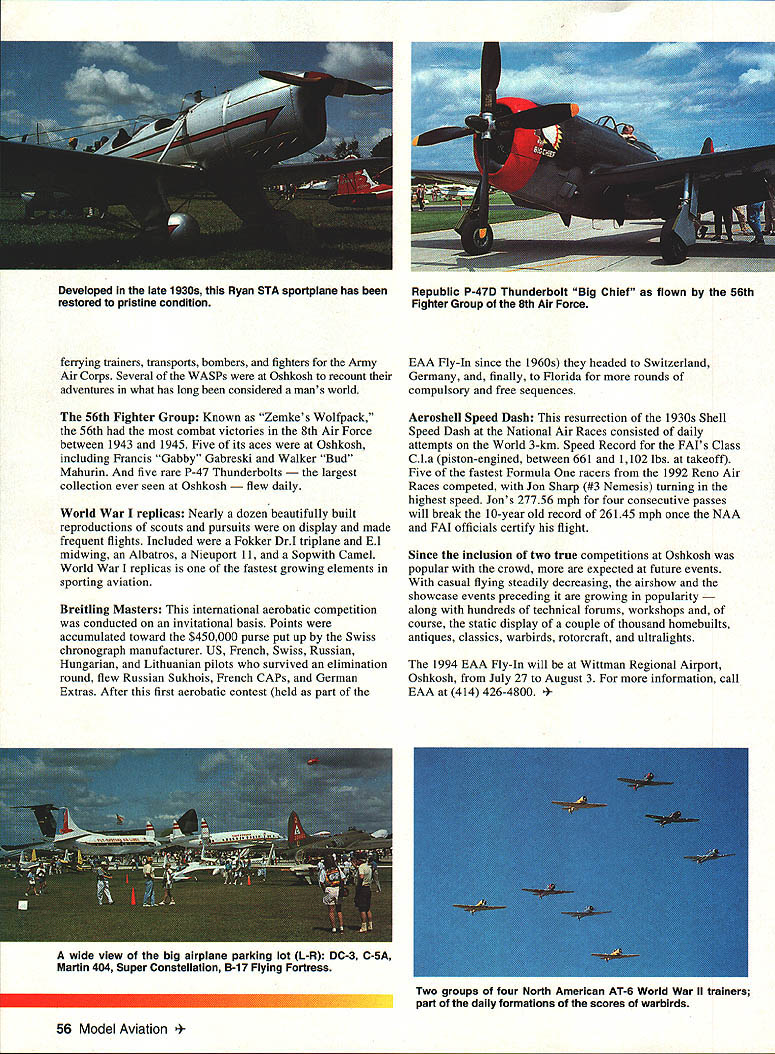
- WASPs (Women Airforce Service Pilots): WASPs were recognized for their vital World War II service. Several restored late‑1930s Ryan STAs and other trainers were on display; several former WASPs attended and recounted their experiences ferrying trainers, transports, bombers and fighters for the Army Air Corps.
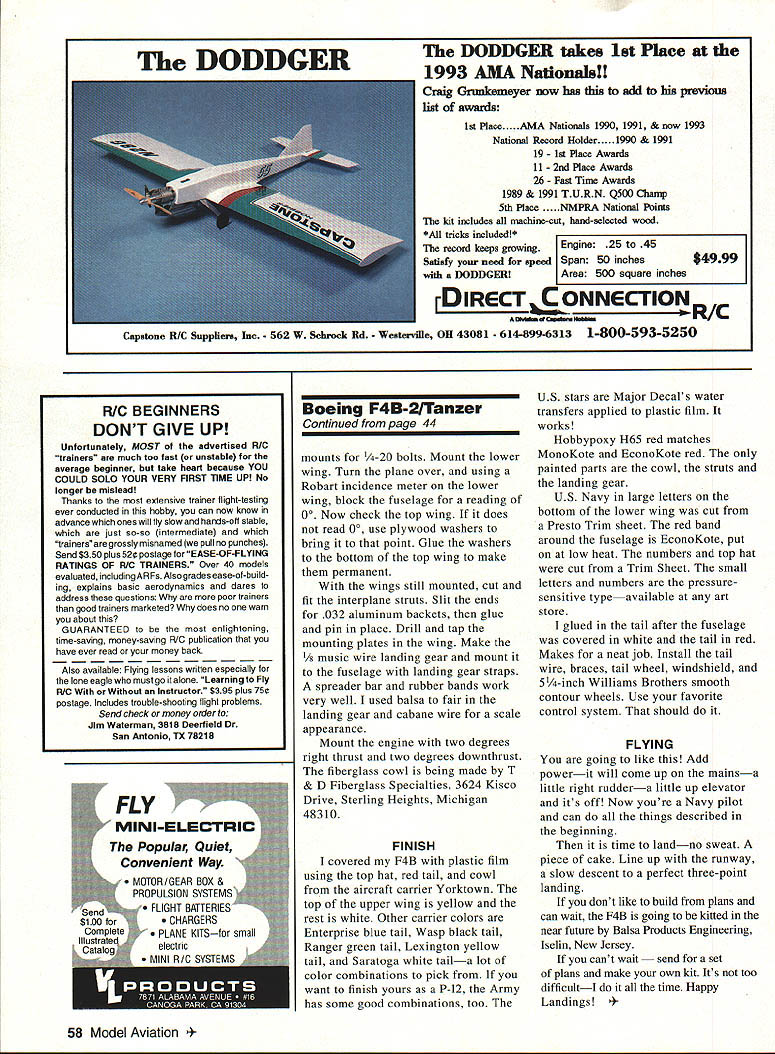
- 56th Fighter Group (Zemke's Wolfpack): The 56th scored the most combat victories in the 8th Air Force between 1943 and 1945. Five of its aces, including Francis "Gabby" Gabreski and Walker "Bud" Mahurin, attended Oshkosh. Five rare P‑47 Thunderbolts made up one of the finest collections ever seen at the Fly‑In.
- World War I replicas: Nearly a dozen beautifully built reproductions of scouts and pursuits were on display and flew frequently. Examples included a Fokker Dr.I triplane, an Albatros D.V, a Nieuport 11 and a Sopwith Camel. World War I replicas continue to be one of the fastest growing elements of sporting aviation.
- Breitling Masters (international aerobatic competition): Conducted by invitation, pilots accumulated points toward a $450,000 purse sponsored by the Swiss chronograph manufacturer. Competitors from the U.S., France, Switzerland, Russia, Hungary and Lithuania advanced through elimination rounds flying Russian Sukhois, French CAPs and German Extras.
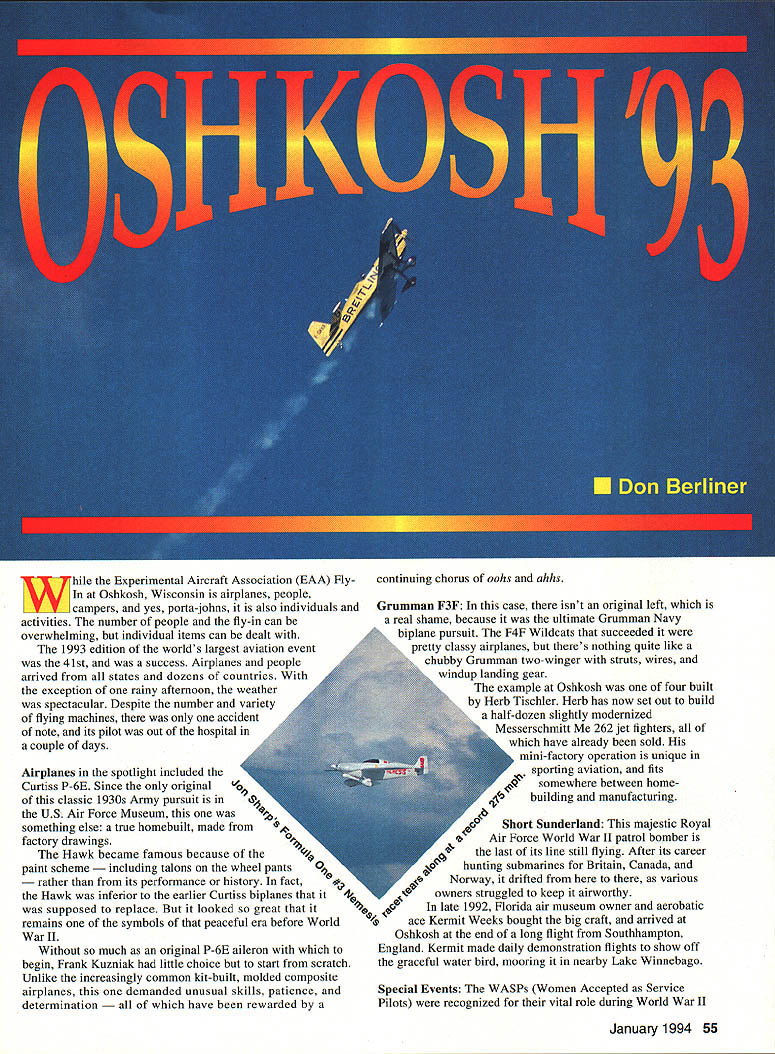
- Aeroshell Speed Dash: A resurrection of the 1930s Shell Speed Dash from the National Air Races, this event consisted of daily attempts at the world 3‑km speed record (FAI Class C‑1a, piston‑engined aircraft with takeoff weight between 661–1,102 lb). Five of the fastest Formula racers from the 1992 Reno Air Races competed. Jon Sharp, flying #3 Nemesis, turned the highest speed—277.56 mph over four consecutive passes—which, pending NAA/FAI certification, would surpass the 10‑year‑old record of 261.45 mph.
Looking ahead
The 1994 EAA Fly‑In was scheduled for Wittman Regional Airport, Oshkosh, from July 27 to August 3. For more information, contact EAA at (414) 426‑4800.
Transcribed from original scans by AI. Minor OCR errors may remain.

