
Ozone Radio Control Club Teaches Kids
Camp Sunshine
Camp Sunshine looks like any other camp. Campers sleep in cabins, swim, play sports, and do arts and crafts. They put on skits at night, give each other silly names, and receive awards for their plucky spirit.
But the week-long camp, at K.C. Abbey Camp north of Covington, Louisiana, is unlike any other. Directed by the New Orleans chapter of the Muscular Dystrophy Association, the camp was created for children with neuromuscular diseases. This year the camp was held May 25–30.
Each of the 60 youngsters has a counselor who stays with him throughout the week. Some of this year's counselors came from Jesuit High School in New Orleans; others were Louisiana State University nursing students. Some counselors come back year after year to work at the camp.
The Project
On the last full day of Camp Sunshine, members of the Ozone Radio Control Club taught these special campers how to build and fly a balsa-and-paper airplane — the Delta Dart.
Ozone Radio Control Club members had been preparing for that exciting day for two months, soliciting sponsors for the supplies and ordering kits from the Academy of Model Aeronautics. Covington modeler Joey Mouton collected the supplies. Glen Weber, another modeler, donated 75 bottles of white glue. To be sure there would be no surprises, members met twice to practice building Delta Darts.
Club members created and distributed kits consisting of:
- a full page of instructions
- 10 pieces of balsa wood
- a paper sheet from which the wings would be cut
- a propeller
- a long rubber band
After the morning's cheering and yelling died down, club president Paul Frederick explained that the campers and counselors would be building the planes to be flown in a mass launch later that morning.
Building the Delta Dart
To some, it all looked complicated. But Dee Manning, a counselor from New Orleans, said, "These kids can manage just about anything."
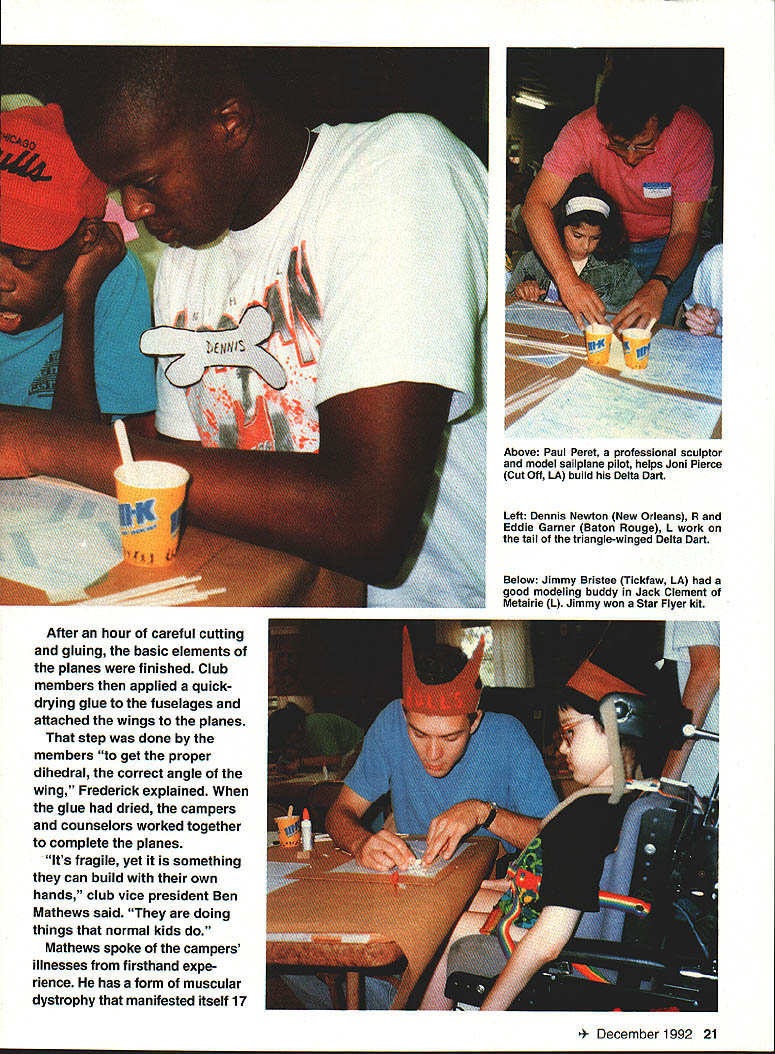
After an hour of careful cutting and gluing, the basic elements of the planes were finished. Club members then applied a quick-drying glue to the fuselages and attached the wings to the planes. That step was done by the members "to get the proper dihedral, the correct angle of the wing," Frederick explained. When the glue had dried, the campers and counselors worked together to complete the planes.
"It's fragile, yet it is something they can build with their own hands," club vice president Ben Mathews said. "They are doing things that normal kids do."
Mathews spoke of the campers' illnesses from firsthand experience. He has a form of muscular dystrophy that manifested itself 17 years ago, when he was 30. "The most I have to expect is that I'll be in a wheelchair," he said. "What these kids have is much more devastating. With the onset (of a neuromuscular disease) when they are so young, it is much more limiting."
A Flight to Remember
Jerome Brown, of Slidell, Louisiana, watched carefully as his counselor, David Tanner, glued the tiny strips of wood to the paper. The 11-year-old didn't think he would be able to make the plane fly. "I can't throw," he said.
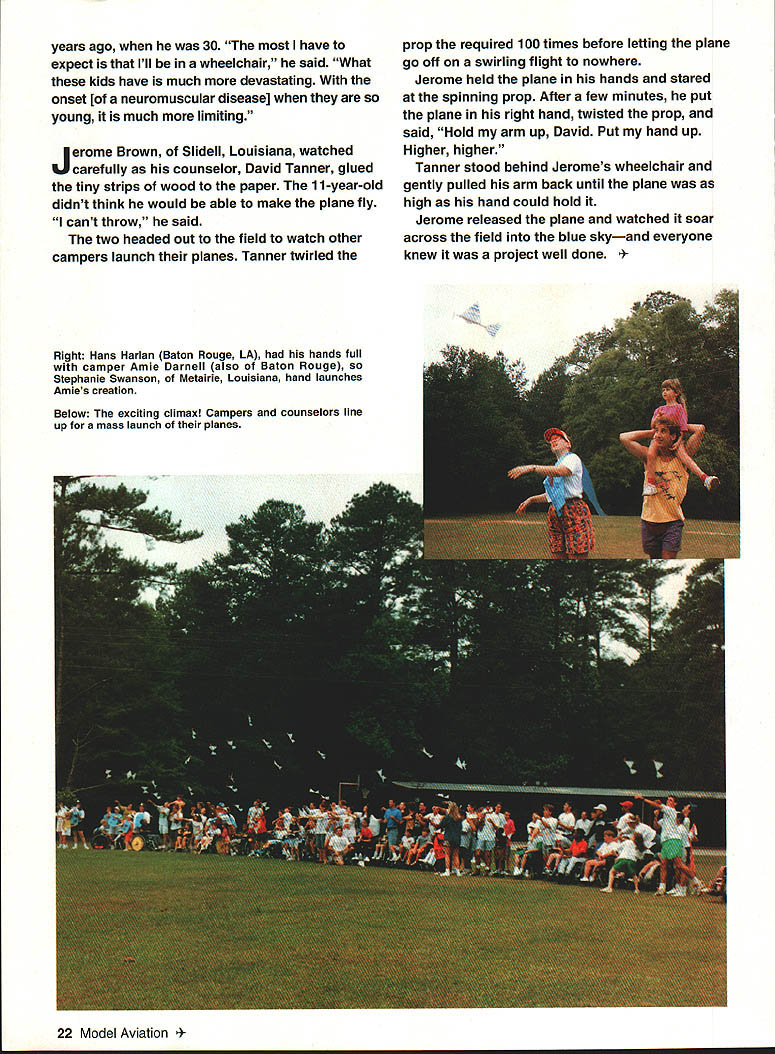
The two headed out to the field to watch other campers launch their planes. Tanner twirled the prop the required 100 times before letting the plane go off on a swirling flight to nowhere.
Jerome held the plane in his hands and stared at the spinning prop. After a few minutes, he put the plane in his right hand, twisted the prop, and said, "Hold my arm up, David. Put my hand up. Higher, higher."
Tanner stood behind Jerome's wheelchair and gently pulled his arm back until the plane was as high as his hand could hold it. Jerome released the plane and watched it soar across the field into the blue sky — and everyone knew it was a project well done.
Transcribed from original scans by AI. Minor OCR errors may remain.

