
Paris Air Show
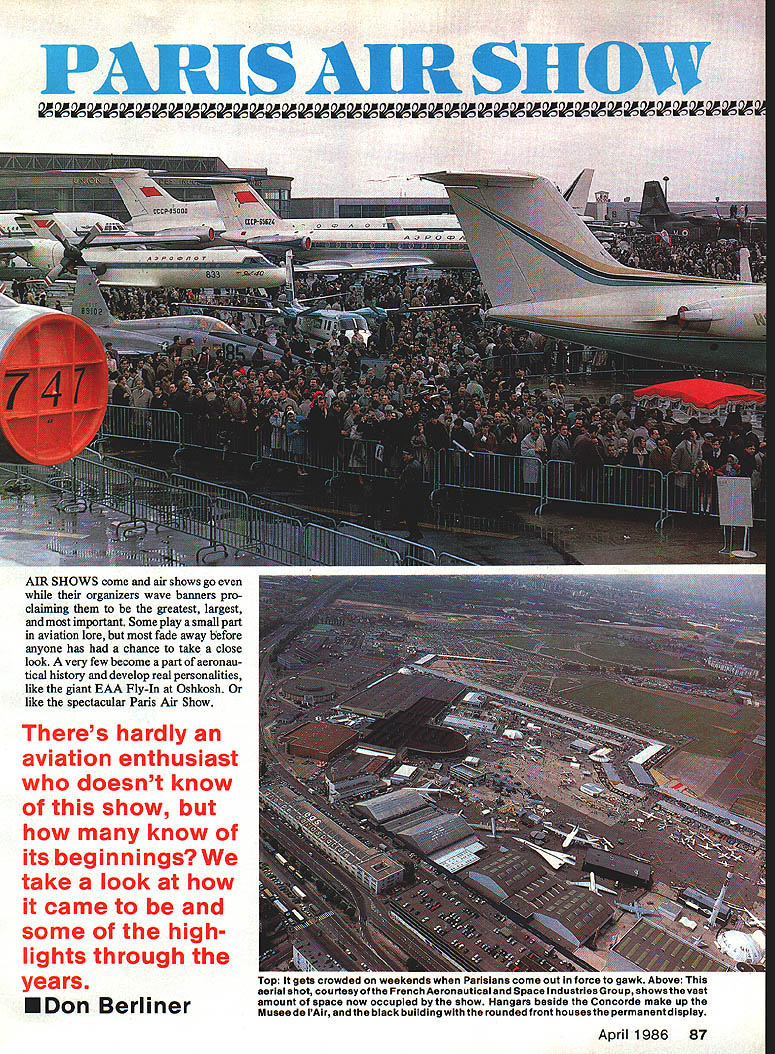
AIR SHOWS come and air shows go even while their organizers wave banners proclaiming them to be the greatest, largest, and most important. Some play a small part in aviation lore, but most fade away before anyone has had a chance to take a close look. A very few become a part of aeronautical history and develop real personalities, like the giant EAA Fly-In at Oshkosh. Or like the spectacular Paris Air Show.
There's hardly an aviation enthusiast who doesn't know of this show, but how many know of its beginnings? We take a look at how it came to be and some of the highlights through the years.
Don Berliner
A huge sign at the entrance announces that it is the "Salon International de l'Aéronautique et de l'Espace." But to those who are more interested in airplanes than in fancy words, it is the biennial Paris Air Show at Le Bourget Airport. Since its flamboyant beginnings in a magnificent palace in downtown Paris, it has been the unquestioned premier display and marketplace of the aviation (now aerospace) industry.
More important airplanes have made their public debuts at Paris than anywhere else. More people have seen brilliant flying at Paris than anywhere else. More airplanes have been sold and more champagne poured and more brochures handed out at Paris than at all the other shows combined.
Beginnings: 1908–1913
When it all began, France was just starting to recover from the aeronautical trauma caused by the sensational flying by Wilbur Wright at Le Mans in 1908. Prior to that, Europeans had achieved almost nothing with airplanes, and they believed almost nothing that was being said about the Wrights' mastery of the air. But when Wilbur calmly took off and flew under full control until his fuel ran out, they were shocked and awed. The Americans were so far ahead that comparisons were meaningless.
To their great credit, the French did not sit and mope. They set out to push the bounds of progress as fast as they could. And 1909 was the great year for progress. In July, Louis Blériot made the first important cross‑country flight when he bridged the English Channel and changed history. In August, the French invented air racing with a great surge of record‑breaking activity.
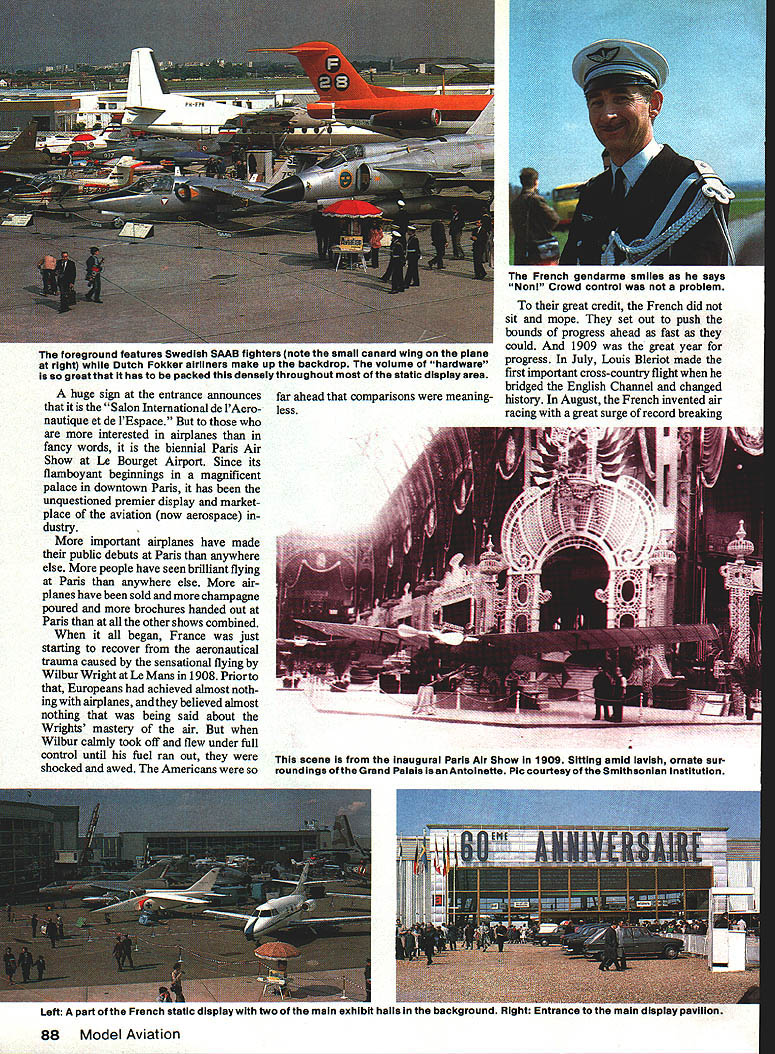
In September 1909 organizers staged the first static display of aircraft, engines and equipment — the initial Exposition Internationale de l'Aéronautique — held in the ornate Grand Palais just off the Champs‑Élysées. The Grand Palais, festooned with multi‑colored bunting and elaborate decorations characteristic of the era, was a marvelous sight. Parisians and visitors jammed the palace for 23 days and people could get very close to the airplanes. In a short period the first five years of aviation were displayed in splendid fashion: a vast hall with a spherical balloon suspended from the ceiling, directly under which sat Blériot's Channel crosser. Surrounding stands honored examples of some famous airplanes of the day — Farman, Wright, French‑built Antoinette, REP. Also on display was the original 1903 Wright Flyer, which was tucked away in a small room at the top of the grand staircase.
The hall was lined with tastefully decorated commercial displays of airplanes, propellers, and engines. The roof of the building was filled with balloons and one small dirigible. Much of the attention of the professional guests (aside from that of the flood of curious spectators) was on the radical designs, such as the De Dion‑Bouton 10‑winged craft that had four propellers driven by a single 100‑hp V8 engine.
While most of the nearly 30 complete aircraft on display were flimsy-looking biplanes and monoplanes, there was one novel device that should have attracted more attention than it did. The Vinton helicopter, while it probably never flew, was a continuation of the serious effort in France to develop vertical‑rising craft. The marginal flights of no fewer than three helicopters prior to the 1909 show were apparently unknown even to the majority of aviation professionals.
By the time the second Paris Air Show was held, in October 1910, aviation had made great gains. In the words of the correspondent of the British weekly Flight, "The aeroplane in one brief year has become known in all the corners of the earth. Flights have been made on the plains of India and over the snows of Russia. The inscrutable Sphinx has seen them pass and repass. The deepest valleys of the Alps and the greatest heights of the Catskills have borne their shadows ..."
The surprising increase in the number of armed versions of standard airplanes moved some people to express concern over the possible use of airplanes in war. The same British writer commented, with an unfortunate lack of foresight, "Let such people remember that in the accumulated terrors of war lie the surest guarantee of peace."
Among the interesting new ideas was the propeller‑less Coandă monoplane which was intended to be driven through the air by some sort of turbine. Had it worked (and there is no evidence that a flight was ever attempted), it might have sped the introduction of the jet airplane by several decades.
The most intriguing trend of the show was the move away from ailerons for lateral control to the older idea of wing‑warping. One can only assume that the first ailerons were very badly designed if they were replaced by a system that offers such poor response.
In just its second running, the Paris Air Show presented to the world the pace and direction of aeronautical progress. Designers and builders did their level best to create new and better airplanes for the distinguished crowd. They, in turn, spent many hours studying the work of their rivals whose originality quickly became standard practice.
The third show, in December 1911, showed major growth in both the variety and quality of the displays. There were 42 different airplanes from 28 manufacturers and 71 different engines from 24 manufacturers. The aviation industry was a fact, as inventors and experimenters were joined by men skilled in production, management, and sales.
One of the healthy results of the first two shows was the increased attention paid to airplanes that were well built. By 1911 there had been a marked improvement in the construction and finish of most of the airplanes on display. And while aerodynamic and structural design were still at a crude stage, there was no shortage of skilled woodworkers and metalworkers whose efforts were not covered by sheet aluminum as they are today.
The fourth Paris Air Show, in October 1912, was about the same size as the previous one, but there were strong signs that there was something new and exciting in airplane design: streamlining. Some of the new designs, like the Deperdussin monoplane, were cleaned up from spinner to tail post. The others, while still showing the awkwardness of early thinking, had fully covered fuselages and often neat fairings around landing gear struts.
There were fewer balloons and airships than in prior years, but more planes with pontoons in place of wheels, though many of them showed little awareness of hydrodynamics. Louis Blériot, one of the true pioneers, showed an airplane with novel construction that would not be appreciated for half a century. The fuselage of his two‑seater was a paper‑cork‑fabric laminate of the same philosophy as the modern composite.
The fifth show, in late 1913, was the last to be held before Europe plunged itself into the bloodbath called World War I. It was very much a French show, with almost no displays from other countries, and little that was new even from France. There was strong evidence of a trend away from wooden structures and toward steel frames for airplanes. Other trends which were to continue far into the future were the increased concern for the comfort of the pilot—and the drop in interest in water‑borne craft. There were fewer military airplanes on show, probably because the manufacturers were so busy filling orders.
World War I and the immediate aftermath
From 1914 through 1918, all Europe was engaged in destroying itself with an efficiency never before known. Among the clever new ways of doing this was with airplanes carrying machine guns and bombs. Types of airplanes that previously had been built by the dozens now appeared by the thousands. Fortunes had been made, and tens of thousands of young men had learned to fly these fascinating machines. The world was ready for a great leap of aeronautical progress, and the Paris Air Show was the place to see it and sell it.
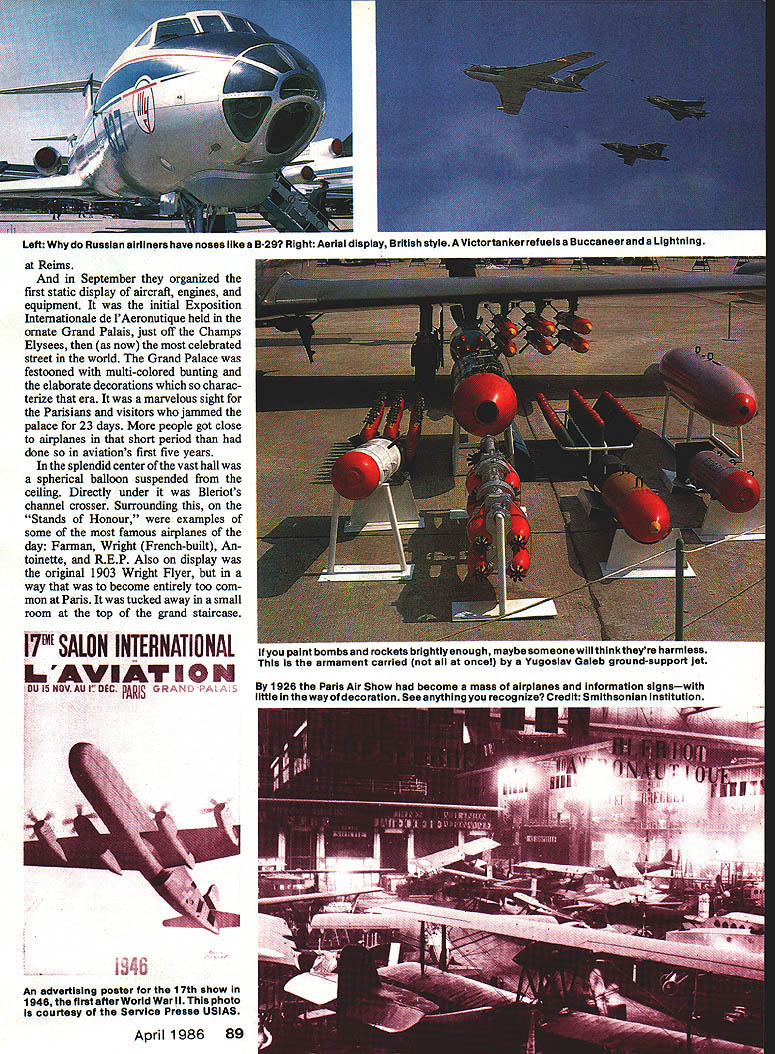
In December 1919 the sixth show was held in the Grand Palais with lots of new types and material. Flight magazine's coverage of the show was speeded up by flying the stories from Paris to London. The whole world was speeding up.
The most significant new idea was the adding of a small flying display at Le Bourget Airport, north of the city. And in what must have been one of the first displays of historic airplanes (after all, aviation was only 16 years old, and few people were thinking of it in terms of history), the French government showed off eight war airplanes. All survived a second war and went on to the Musée de l'Air and can be seen today at Chalais‑Meudon, for which France deserves great credit.
The 1920s: commercialization and technical advances
The 1921 Paris Air Show was remarkable for the number of large (for those days) multi‑engined airplanes meant to carry passengers for a price. They were given names like "mammoth," "leviathan," and "juggernaut." And while they would look tiny parked next to a modern 747 or L‑1011, they got people thinking about passenger comfort and ways of reducing the cost of flying in order to make a profit.
The year 1922 saw the sudden prominence of duralumin in the structures of French airplanes, at least partly because France did not produce thin sheet steel and was forced to innovate. The development of airliners slowed noticeably, but the first real helicopter was on display. The Pescara would soon set the first official records for VTOL craft by flying almost a half mile in early 1924. Among the technical advances were superchargers and variable‑pitch propellers, both of which would play major roles once they were perfected.
In 1924 the Paris Air Show became biennial, a practice continued to this day. An annual show had become too expensive for the manufacturers, few of which were making much money. And the obvious signs of progress were fewer, so a show every two years would offer enough new products and ideas to excite the public and the press.
There was increasing dissatisfaction with the way the French were running the show . . . with obvious bias toward French companies and foreign displays pushed into the background. Nevertheless, the show continued to gain international stature, with the crowd including most of the leading figures in the world of aviation.
In 1924 there were more new airplanes than in many years, with quite an increase in the popularity of sesquiplanes — those biplanes with very small lower wings. They were supposed to combine the structural advantages of biplanes with the aerodynamic advantages of monoplanes, but they soon faded out. Metal props made a strong showing, with most being of the Reid type in which a formed piece of metal was twisted to shape.
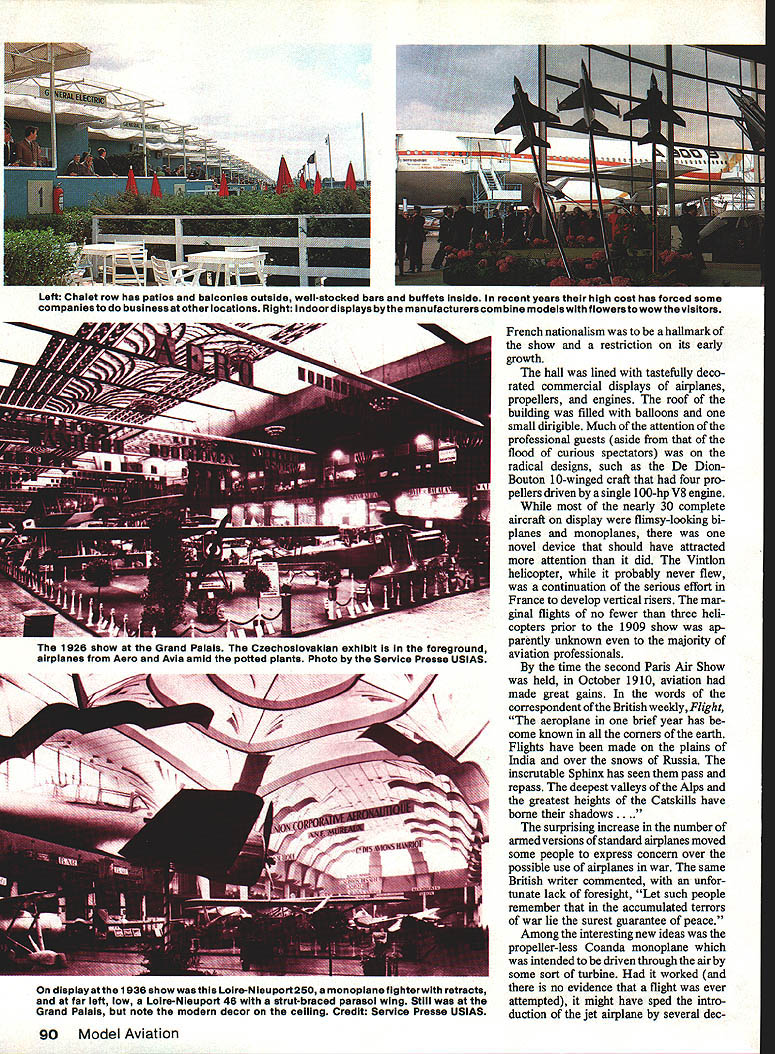
The 1926 Paris Air Show at the Grand Palais offered strong evidence the aircraft industry was becoming more businesslike. There were few of the "freak" prototypes seen in the earlier shows (presumably exhibited for shock or entertainment value). All of the airplanes showed much higher standards of design and construction. Already, the sesquiplane was being replaced (briefly, at least) by the parasol monoplane.
The Paris Air Show blossomed as an international event in 1928, with four other countries showing airplanes. The prophet of them was Germany, present for the first time since the war. Its airplanes were low‑powered trainers and sport planes, while those from Italy were military types, plus the Macchi M.52R racing seaplane which held the World Speed Record at 319 mph.
The first U.S. participation in the Paris Air Show would have occurred in 1930, except that the Ford Trimotor wouldn't fit through the doors of the Grand Palais, and the French refused to tear down part of a wall to let it in. The general trend toward large commercial planes was accompanied by indications of a coming boom in personal planes. No doubt about it, Paris was the place to get a feel for what was about to happen in aviation.
The 1930s: militarization and streamlining
Through the early 1930s, there was less in the way of new technical ideas than people had come to expect from the Paris Air Show. Metal construction became more popular, especially among the increasingly common military airplanes. Both twin‑row radial and inverted V‑12 engines grew in size and power. Streamlining was evident in all classes of airplanes, though the cantilevering of wings was still rare, and so struts and wires were everywhere.
Trimotor airliners and bombers were popular, even though it was widely recognized that the middle engine might not make a lot of difference. In 1936 the first of what would soon become famous as World War II airplanes appeared, in particular the Bristol Blenheim from Great Britain. France showed models and prototypes which suggested her industry was developing modern combat planes.
In 1938 the Hawker Hurricane was placed on display, after having failed to get government permission two years before. It was accompanied by the new Spitfire and the soon‑to‑be‑immortal Rolls‑Royce Merlin engine. Other new military types included Germany's Dornier Do.17 medium bomber and several designs from Poland, then assumed to be a major airplane‑design country. Most French military planes were held back for security reasons and because there was no need to push for sales.
Eight months after the 1938 Paris Air Show, many of these airplanes were in action as Germany rumbled across Poland to start World War II. The scores of sales which had been generated by the Paris Air Show were wiped out, and the show itself was suspended for the duration of the war.
World War II and the postwar shift
When it resumed in 1946, the show had lost much of its previous status and glamour; the Grand Palais was no longer used, the show was moved to Le Bourget permanently, and its character had changed.
Aircraft production during the war had been immense. By the time the terrible conflict had ended, more than a half‑million aircraft had been built, including almost 100,000 built in the U.S. in 1943 alone.
Along with amazing technical developments made during the seven years of war—laminar‑flow airfoils, jet engines, airborne radar—there were more ominous "advancements." In World War I, the airplane was able to drop small bombs with little accuracy on civilian and military targets. But in World War II, bomb loads of many tons were routinely dropped with great precision on cities as well as factories and airfields, bringing war to the home front and to innocent civilians.
The first postwar Paris Air Show, held as usual in the Grand Palais in December 1946, showed the results of years of enormous technical effort. The ultimate propeller‑driven fighters were there, along with the first of the really fast jets like the Gloster Meteor F Mk. IV. The age of electronics was becoming evident, along with the impact of truly scientific work in all phases of aviation.
Despite the awful damage suffered by France during the years of Nazi occupation, its aircraft industry was beginning to return to life, especially in the area of lightplanes. Several French jets were on show, along with models of many more. Only a few American firms had displays, and there was nothing at all from the U.S.S.R. (because of political tensions) or Germany (because of limitations imposed by the victorious Allies).
But it was clear that aviation was riding high, and future Paris Air Shows would demonstrate this on an international level to a far greater extent than before the war.
Major changes began to occur with the next show. It was moved from late 1948 to the spring of 1949 so there would be less conflict with the annual Farnborough Air Show in England. And it would then be possible to add a flying display, as the weather would be better. In 1949 there was only one day of flying, at Orly Airport, but the impact was considerable.
Move to Le Bourget and the jet era: 1950s–1960s
For 1951 the show remained at the Grand Palais, but the flight demonstrations were held at Le Bourget Airport, where Lindbergh landed at the end of his historic solo flight across the Atlantic in 1927. There was a growing feeling that the size and number of airplanes that manufacturers wanted to exhibit was just too great for an indoor show. And that didn't even include the giant American B‑36 bombers which overflew Le Bourget in 1951.
Consequently, in 1953 the Paris Air Show moved permanently to Le Bourget, where special buildings had been erected by the Association of French Aircraft Manufacturers and where more buildings would be added every few years. International participation was on the rise, with a particularly large showing by the U.S. Most of the people in the huge crowd had a new experience: their first sonic boom, courtesy of an RAF pilot flying a Canadian‑built North American F‑86 Sabre.
In 1955 there were more airplanes and helicopters than ever before, and more of them were powered by gas‑turbine engines. Highlight of the expanded flying display was the launch of the French Leduc 0.21, a ramjet‑powered research craft whose pilot lay inside the center‑body of its engine. It was carried aloft on top of a four‑engined Languedoc airliner.
Through the late 1950s the show grew in size and variety—not only among flying machines, but in the displays of electronics and engines and instruments and other vital parts of modern aviation which lack some of the glamour of airplanes. V/STOL became an important part of the show, and it seemed everyone claimed his airplane fit this category (even if the pilot had to empty his pockets before the takeoff to hold down the weight!).
The Russians finally appeared in 1957 with the first of their jet airliners. Since the early Tupolevs were so inefficient, they must have been there for political reasons rather than for sales. And this was true for other exhibits, as the show had developed into more than a marketplace (with a growing number of commercial corners or customer entertainment areas and demonstration rides for potential customers) and a slam‑bang air show aimed at the people of France and anyone else who appreciated airplanes in action.
As the size of the show increased, so did its stature in the world of aviation. More and more new designs were held back so they could be introduced at Paris with a fair sure to be noticed by the international press. Competition between manufacturers and between countries led to increasingly ambitious flight demonstrations as each tried to show that his aircraft was more maneuverable—especially at low speed—than any rival's.
In 1961 an American B‑58 Hustler supersonic delta‑wing bomber flew to the show from New York at a record 1,089 mph. But after putting on a very impressive show, it went into a cloud and crashed soon after. On the positive side, this was the first year for the display of space hardware and people. The prestige to be gained by a country that could show off its astronauts or cosmonauts was considerable.
The 1963 Salon was a VTOL parade ranging from huge Sikorsky and Sud Frelon helicopters down to the tiny, crowd‑pleasing Bell Rocket belt used by a test pilot to fly over the grounds. Each day had a theme, though some like "Stamp Collectors' Day" were a puzzle to Americans. This was one of those years when half the airplanes seemed to be Mirages of one sort or another.
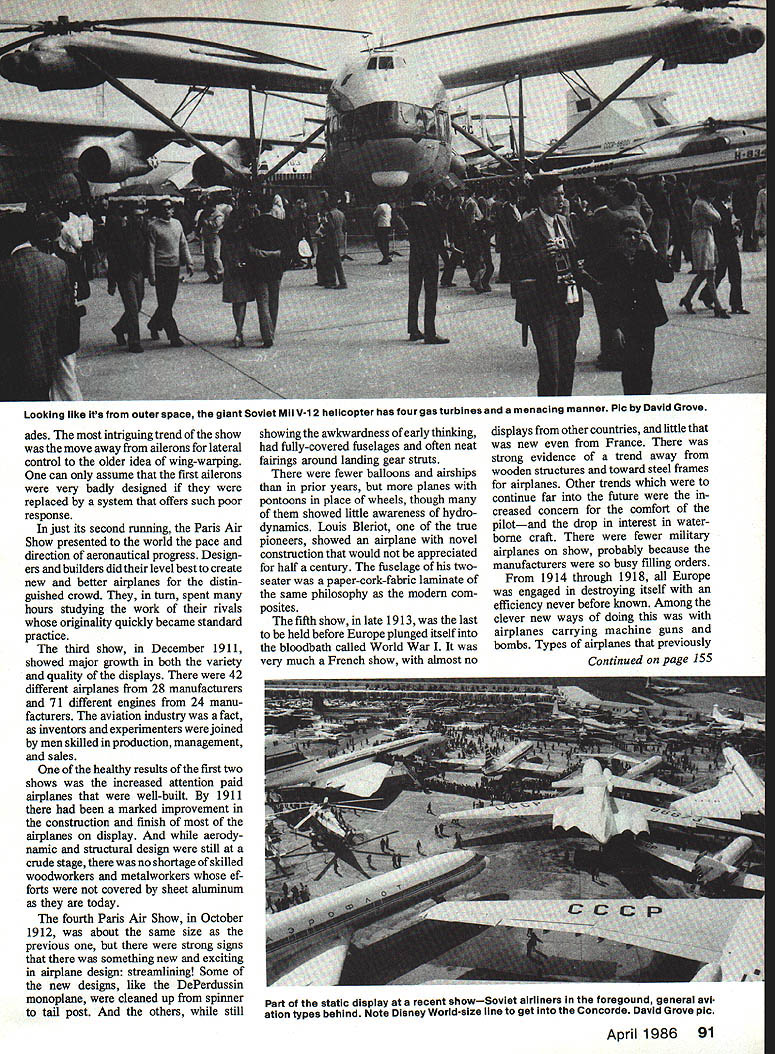
In 1965 the Soviet participation expanded to include several jet airliners, the hefty An‑22 turboprop transport, and models of the much‑talked‑about Tu‑144 supersonic transport. There were several large and very impressive Soviet helicopters on the static and flying displays. But an Italian Fiat G.91 fighter crashed during formation aerobatics.
The international show grew noticeably in 1967, with a large, unified U.S. national display full of all sorts of advanced hardware and salesmen eager to take orders. The large Soviet display, centered around a huge Vostok spacecraft and its launcher, was a great contrast, lacking even the most basic information and spokesmen. A full‑size and very realistic mock‑up of the long‑awaited Concorde SST dominated the outdoor display area.
The SSTs, jumbo jets and the 1970s
After years of promises, the SSTs finally arrived in 1969. Two Concordes were seen in the air at the same time (well separated for safety), and one was then parked not far from the Tupolev Tu‑144. The talk was mainly of these futuristic craft and of the enormous Boeing 747 which was making its public debut. On the historic side were flying reproductions of the fragile monoplane that flew across the English Channel by Blériot 50 years earlier.
As the 1970s dawned, the Paris Air Show had grown to unprecedented size with more than 600 exhibitors, 200 corporate chalets, and solid indicators of international cooperation. In 1973 the spotlight was on NASA's Skylab, a twin to the giant craft recently orbited. The low spot was the crash of the Soviet Tu‑144 whose pilot apparently tried too hard to match the fancy flying of a rival.
In 1975 there were about 230 aircraft displayed by more than a dozen countries. And there was growing concern over the American domination of aircraft manufacturing. The Europeans saw their airlines buying from Boeing, Lockheed, and McDonnell‑Douglas, and their private pilots flying Cessnas, Pipers, and Beechcraft. They set out to invest the money and technical know‑how in a major effort to correct this imbalance.
The year 1977 saw the end of scheduled airline service at Le Bourget after almost 60 years, as the nearby Charles de Gaulle Airport offered more modern facilities. This left more space for the show, and it was promptly grabbed up. Among the new entries in the high‑technology businesses showing their stuff were previously‑unnoticed countries like Brazil, Australia, Israel, and Poland. The Soviets finally displayed a wide‑bodied airliner, the Ilyushin Il‑76, but it was years behind the West.
By 1979 the show was taking up 10 times the display space it had in 1953, the first year at Le Bourget. There were 700 exhibitors, 290 of which rented chalets for wining and dining customers. The Soviets showed an An‑72 STOL transport that was obviously a scaled‑down Boeing YC‑14.
The 1980s: size, politics, and spectacle
In 1981 the growth continued, even though more of the big companies complained about the high cost of doing business at Paris. Almost 800 took part, displaying more than 250 aircraft. It was a year dominated by the terrible battle to capture the market for medium‑range airliners, with Airbus Industrie and Boeing working the hardest.
The 1983 show was a letdown after a long string of successes. The Soviets weren't there, and several American manufacturers ignored Le Bourget and did business more economically from expensive hotel suites in downtown Paris. Viewed through gloomy glasses, the 1983 Paris Air Show could cause one to wonder about the future of this classic event.
But it had gone on for almost 75 years—longer than the history of the airplane—and enough companies had sold enough to keep them feeling friendly toward the show.
Besides, it still had enough stature to warrant NASA's sending a Space Shuttle and its 747 carrier on a trip never envisioned when the project was begun. Millions saw America's proudest space achievement thanks to the lure of Le Bourget.
In 1985 the Soviets moved back into the spotlight with the debut of their huge Antonov An‑124, an obvious counterpart to the Lockheed C‑5A Galaxy military freighter. The U.S. had nothing to counter this, but it could be expected to make another try for attention at Paris in 1987 with something from the space program, since spectacular new airplanes are now rare.
Looking ahead
You can be safe in marking your calendar for the next show: June 12 to 17, 1987. If you like the latest in flying machines, it will be the place to be. And if you know how to find one of the many reasonably priced hotels in allegedly‑expensive Paris, you can have a ball.
Transcribed from original scans by AI. Minor OCR errors may remain.

