
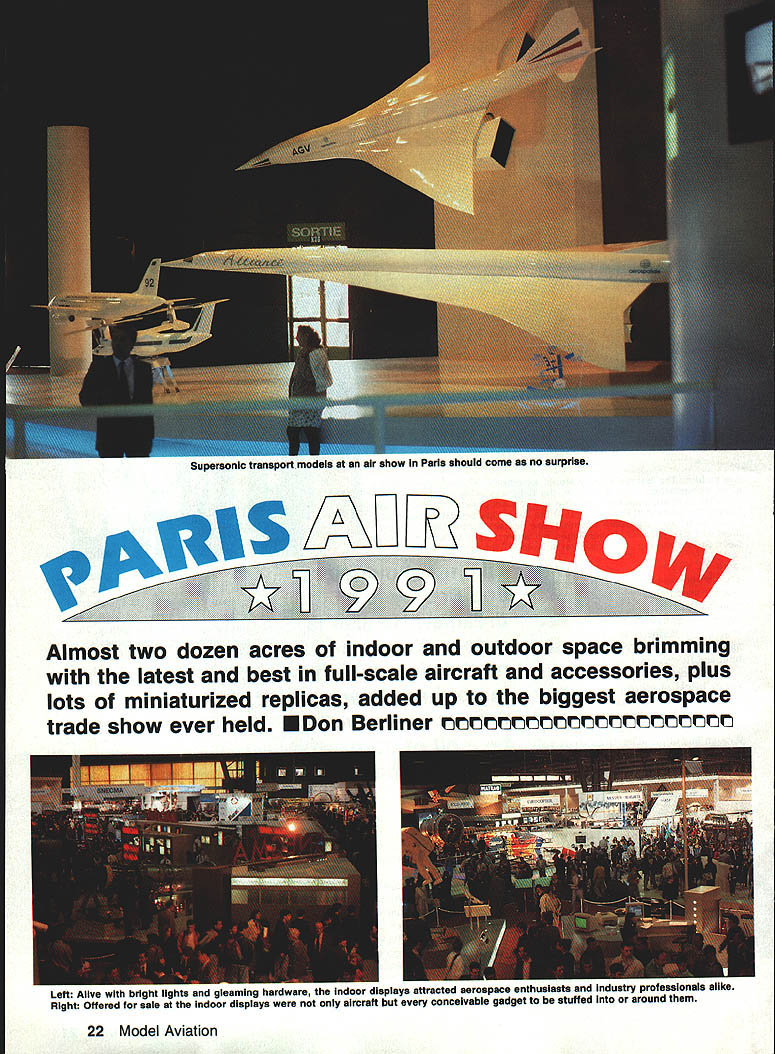
Paris Air Show: 1991
Don Berliner
Almost two dozen acres of indoor and outdoor space, brimming with the latest and best in full-scale aircraft and accessories — plus lots of miniaturized replicas — added up to the biggest aerospace trade show ever held.
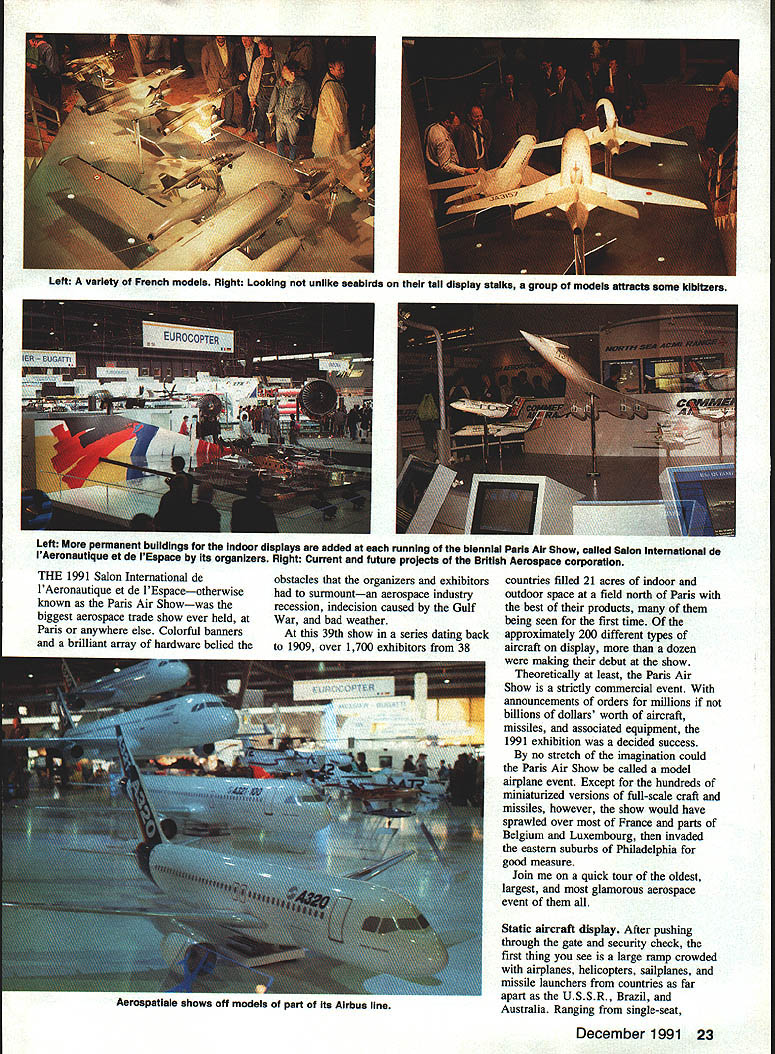
THE 1991 Salon International de l'Aéronautique et de l'Espace — otherwise known as the Paris Air Show — was the largest aerospace trade show to date, at Paris or anywhere else. Colorful banners and a brilliant array of hardware belied the obstacles that the organizers and exhibitors had to surmount: an aerospace industry recession, indecision caused by the Gulf War, and bad weather.
At this 39th show in a series dating back to 1909, over 1,700 exhibitors from 38 countries filled 21 acres of indoor and outdoor space at a field north of Paris with the best of their products, many of them being seen for the first time. Of the approximately 200 different types of aircraft on display, more than a dozen were making their debut at the show.
Theoretically, at least, the Paris Air Show is a strictly commercial event. With announcements of orders worth millions if not billions of dollars for aircraft, missiles, and associated equipment, the 1991 exhibition was a decided success.
By no stretch of the imagination could the Paris Air Show be called a model airplane event. Except for the hundreds of miniaturized versions of full-scale craft and missiles, however, the show would have sprawled over most of France and parts of Belgium and Luxembourg, then invaded the eastern suburbs of Philadelphia for good measure.
Join me on a quick tour of the oldest, largest, and most glamorous aerospace event of them all.
Static aircraft display
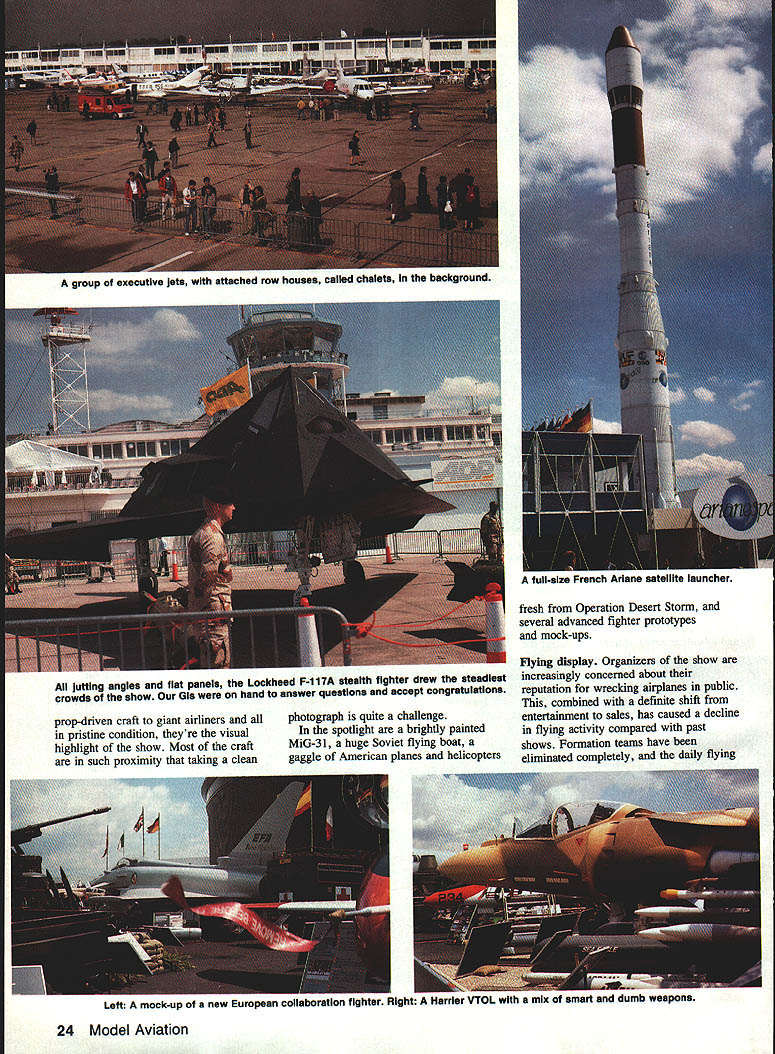
After pushing through the gate and the security check, the first thing you see is a large ramp crowded with airplanes, helicopters, sailplanes, and missile launchers from countries as far apart as the U.S.S.R., Brazil, and Australia. Ranging from single-seat, prop-driven craft to giant airliners and all in pristine condition, they are the visual highlight of the show. Most of the craft are in such proximity that taking a clean photograph can be quite a challenge.
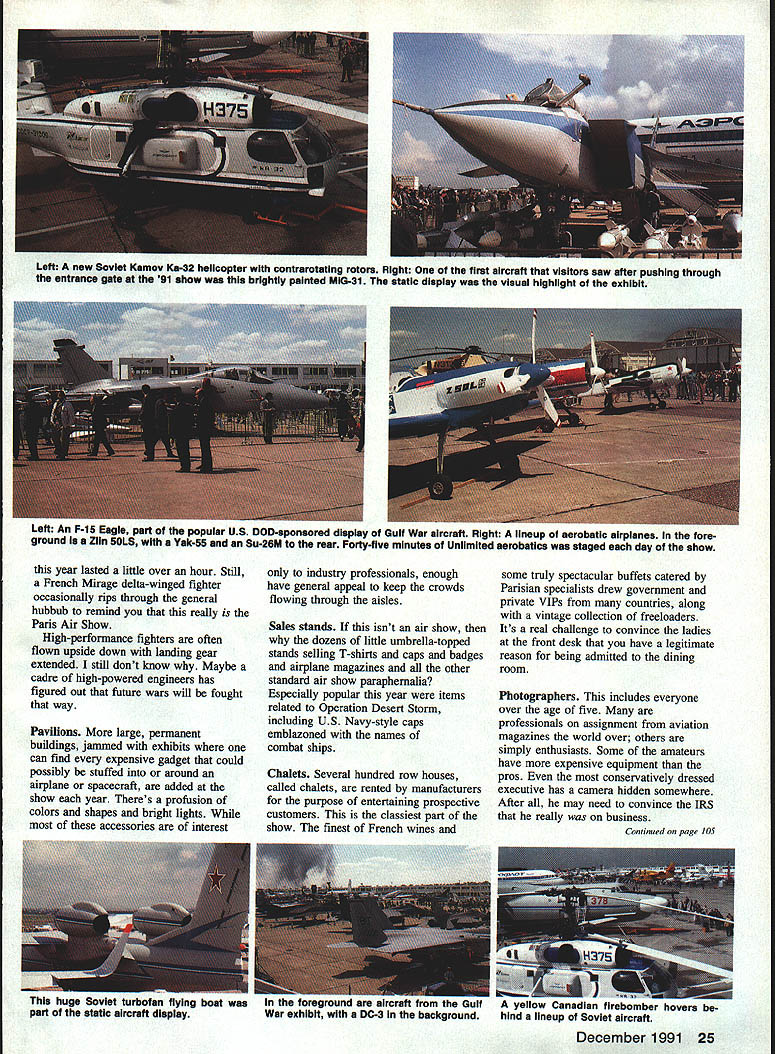
In the spotlight were a brightly painted MiG-31, a huge Soviet flying boat, a gaggle of American planes and helicopters fresh from Operation Desert Storm, and several advanced fighter prototypes and mock-ups.
Flying display
Organizers of the show are increasingly concerned about their reputation for wrecking airplanes in public. This, combined with a definite shift from entertainment to sales, has caused a decline in flying activity compared with past shows. Formation teams have been eliminated completely and the daily flying display has been pared back. The extensive aerobatic sessions once common at Paris have been significantly reduced.
Still, the French Mirage delta-wing fighter occasionally ripped through the hubbub to remind visitors that this is really the Paris Air Show. High-performance fighters are often flown upside down with landing gear extended — the reason is unclear, but it makes for dramatic flying.
Pavilions
Large permanent buildings jammed with exhibits contained every expensive gadget that could possibly be stuffed around an airplane or spacecraft added to the show this year. There was a profusion of colors, shapes, bright lights, and accessories to interest industry professionals. While most accessories appeal mainly to industry insiders, enough have general appeal to keep the crowds flowing through the aisles.
Sales stands
If this isn't an air show, then why the dozens of little umbrella-topped stands selling T-shirts, caps, badges, airplane magazines, and all the other standard air-show paraphernalia? Especially popular this year were items related to Operation Desert Storm, including U.S. Navy–style caps emblazoned with the names of combat ships.
Chalets
Several hundred row houses, called chalets, are rented by manufacturers for the purpose of entertaining prospective customers. This is the classiest part of the show. The finest of French wines and some truly spectacular buffets catered by Parisian specialists drew government and private VIPs from many countries, along with a vintage collection of freeloaders. It's a real challenge to convince the ladies at the front desk that you have a legitimate reason for being admitted to the dining room.
Photographers
This includes everyone over the age of five. Many are professionals on assignment from aviation magazines; others are simply enthusiasts. Some amateurs have more expensive equipment than the pros. Even the most conservatively dressed executive has a camera hidden somewhere — after all, he may need to convince the IRS that he really was on business.
Food
Surprisingly ordinary sandwiches and soft drinks were sold at concession stands on the ramp. But aside from the delectable goodies offered in the chalets, several restaurants served meals well above the air-show standard — and at much higher prices. In fact, the prices were so seriously out of line that restraint was in order, at least until you could get back into the city and its uncountable thousands of mostly terrific restaurants.
Dogs and babies
Like most air shows, this one draws people who can't bring themselves to leave Junior or Fido at home — never mind that the billions of dollars' worth of hardware on display cannot be expected to appeal to infants or poodles. Fortunately, both groups were kept on short leashes and caused no discernible problems.
Traffic
Paris is famous for drivers who obviously trained as New York City cabbies, and it takes a brave tourist to rent a car. But the city has a wonderful subway system, Le Métro, that connects with special air-show buses. Total cost can be as little as $1.50 each way, with the drivers absorbing all the stress.
Noise
Time was when the Paris air shows were wonderfully noisy. Throaty radial engines echoed off the buildings, and screaming jets blotted out conversation. It's a lot quieter these days, yet far from silent. Visitors at the 1991 exhibition were treated to acrobatic flying with Lycoming engines shrieking through the air — a fine sound to be sure, but it didn't quite fit the image of this classic show.
Museum
The Musée de l'Air (or Museum of the Air) is second only to the National Air and Space Museum of the Smithsonian Institution in Washington, D.C., in the number of truly historic and interesting aircraft on display. The French collection is now housed in a string of hangars left vacant when Bourget Aerogare lost its airline service to the new Charles de Gaulle Airport. The well-restored craft are easy to view up close and easy to photograph. Another plus is that Charles Lindbergh ended his historic 1927 flight at Bourget.
Collectors
While the show officially is strictly for business, countless people seem to attend for the primary purpose of collecting things. Lapel badges and literature are everywhere. Many manufacturers distribute neat little pins of their latest creations to people they want to impress; collectors snap them up to wear on caps and jackets.
As for literature, not a display booth in all the huge buildings is without at least a stack of glossy brochures and catalogs and a box of free promotional bits. Model kits and scale plans are plentiful, though often you have to ask for them to get a copy.
Languages
Much else besides French is spoken. I identified English, Arabic, German, and Russian for certain, along with what sounded like Polish, Swedish, Italian, and Spanish. It makes an American feel downright illiterate, especially when so many people switch from one language to another in mid-sentence. Still, an increasing number of people speak at least a little English, and many who are involved in international commerce are fluent in it. The background babble of many languages is yet another element of the Paris Air Show that is missing elsewhere. It also makes you resolve once again to learn another language.
Weather
It wasn't very good. Europe had a pretty crummy spring, which spilled over into the air show. There was lots of cloud cover with frequent light rain, and temperatures rarely climbed above the sixties. While that's not bad if you're perusing the indoor displays, it's a real nuisance when you're outside trying to take pretty pictures. With patience and a readiness to move fast whenever the sun poked through the overcast, the determined photographer could manage.
Credentials
Important people at the Paris Air Show wear 2 x 3½‑in. badges that modestly indicate the nature of their importance. But since practically everyone has some sort of badge, there's little to distinguish the notables from all the rest. Can there really be that many important people? Apparently so, at least in Paris — a city that attracts the truly important and the self-important in great numbers.
Desert Storm
With far less fanfare than accompanied displays of Gulf War equipment at home, the U.S. Department of Defense fielded a large section of the ramp with fighters, bombers, attack planes, and helicopters used in Operation Desert Storm. This was the most popular exhibit at the show. The Lockheed F-117A stealth fighter drew the most attention. All sharp corners, flat panels, and jagged projections, this flat-black attack bomber looks menacing even on the ground. A group of GIs was there to answer questions and to accept the thanks of people from around the world.
Aerobatics
Some of the top competitors in the world flew Unlimited aerobatics for 45 minutes each day of the show. Such pilots as Lynda Meyers, Jurgis Kairys, and Petr Jirmus performed in the Pitts S-2B, CAP 231, Yak-55, Sukhoi Su-26M, Zlin 50LS, and other aircraft. The bright colors and violent maneuvers contrasted sharply with the linear flying that otherwise prevailed. It is to the everlasting credit of Breitling, a Swiss watch manufacturer, that the crowd got a taste of the kind of flying once so popular at these shows.
Metric
Remember when the U.S.A. was on its way to becoming a metric country, in step with the rest of the world? What happened, anyway? In Paris, one must be able to understand meters, km/h, and jet engines that produce thrust measured in kN. Sometimes the English equivalent can be found, but usually it's up to you either to translate or to think in metric.
Converting can be tedious, as when you're about to buy gas that costs 5.29 French francs per liter and want to know if that's a bargain. It isn't, by the way, since it works out to around $3.40 a gallon.
Spotters — and other airplane nuts
During the week, the Paris Air Show is supposedly restricted to industry people and the press. So how come the place is full of guys with notebooks and binoculars? Somehow the dedicated European enthusiast has figured out how to get through the gate on days when the crowds are low. If there are airplanes to be seen and photographed, the hobbyist will find a way.
After seven decades of running the Paris Air Show, the French know how to do it with flair and as much efficiency as can be expected at such a huge event. Most things go off on schedule, although some of the gates don't open when they're supposed to. The displays are thoroughly professional, and long-prepared announcements of sales are made on schedule. If the show didn't work so well, it wouldn't continue to grow.
The next edition — number 40 — was planned for June 10–20, 1993, at the same venue. International political and economic developments will partly determine what will be on display. As always, however, the show will be big and bright and loaded with the very latest in the aerospace world — including some designs that have never been shown before.
Transcribed from original scans by AI. Minor OCR errors may remain.

