
Part 1: When Model Airplanes First Went to War
These forerunners of modern RPVs helped train WWII gunnery crews to shoot down enemy aircraft. Part One of a two-part article.
Hugh Maxwell
The army called them OQs. The navy called them TDDs (Target Drone, Denny). By either name they proved to be highly effective antiaircraft training tools.
The WWII antiaircraft gunnery crews loved them. Until then, the men had pretty much been limited to towed target sleeves for practicing their aim. These sleeves had several drawbacks. They flew only in a straight line. They didn't look like airplanes. And you couldn't be sure you'd hit one until someone reported the color of the paint around the bullet holes in the sleeve.
With the advent of radio-controlled miniaturized target planes, the gunnery crews had a chance to practice on something that looked, sounded, and acted like full-scale airplanes. At about one-third the size and one-third the speed of a full-scale plane, a drone at 200 yards' distance approximated a full-size pursuit plane at 500 yards and could simulate all maneuvers and attack conditions of its larger counterpart.
The forerunners of modern RPVs, these scaled-down RC target planes offered some of the excitement of combat with none of the obvious drawbacks. The gunnery crews could hardly wait to get at them. Watching a drone's 100-octane gas tank explode was very satisfying, and shooting off a wing and then watching the drone spin in made the day worthwhile. Even better was a hit that set the target plane on fire and simultaneously opened the parachute, so that the burning hulk floated gently down to the water.
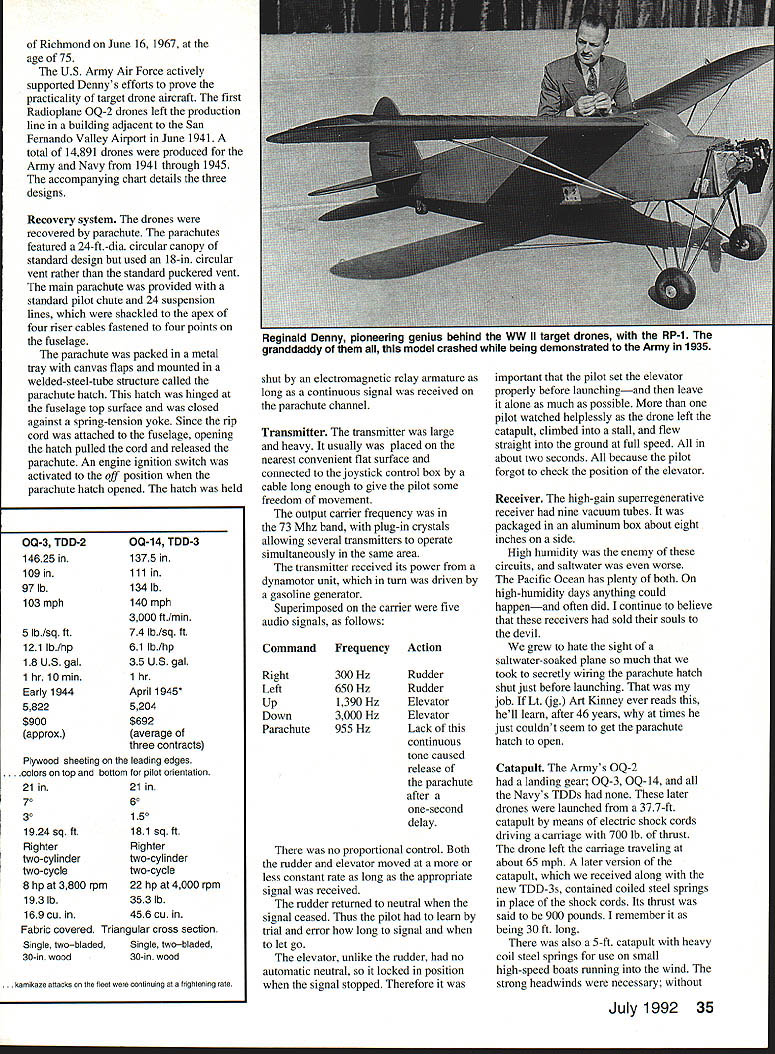
The pioneering genius behind the remote-control aircraft industry in America was a multitalented aviation enthusiast named Reginald Denny. Though better known as a Hollywood movie star, Denny, born in England in 1891, was also a sportsman pilot, an aerial gunner in the Royal Flying Corps in World War I, and an RC model enthusiast who owned a Hollywood model airplane shop. In addition to performing for the silver screen, Denny sang baritone in a traveling opera troupe.
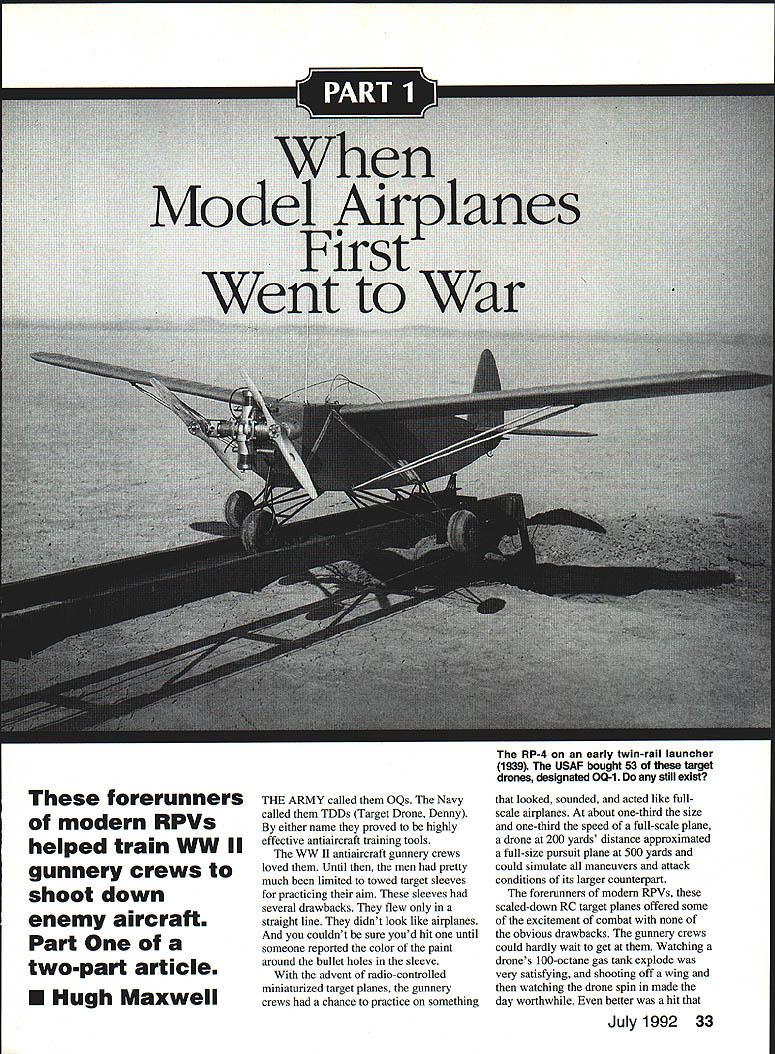
Denny demonstrated the first RC target drone, the RP-1, for the U.S. Army at Fort MacArthur, California, in 1935. A nine-foot, high-wing, balsa-and-plywood design, it was fitted with a 2-1/2-hp engine spinning a single, two-bladed propeller. Control was marginal, and the model crashed during the demonstration.
This was followed in 1938 by the RP-2. Built of basswood, it was a little larger than its predecessor and traveled at 50 mph. The RP-3 was introduced a year later. It featured a welded-steel-tube fuselage, recovery parachute, and flew at 60 mph.
Only a single example of each of the first three prototypes was built. The first prototype to go into production was the RP-4. Similar to the RP-3, it was upgraded with a 6.5-hp engine driving outrigger-type counterrotating propellers. It moved at 70 mph.
The RP-4 prototype was completed in November 1939. The U.S. Army purchased 53 of these drones, designating them OQ-1.
Meanwhile, in the early 1930s Denny had hired an electronics engineer, Kenneth Case, to help him develop his ideas for remotely controlled aircraft.
In 1939, Denny founded the Radioplane Company. Two years earlier he had sponsored a design competition for model airplane engines. Walter Righter, a 1928 graduate of the California Institute of Technology, submitted the winning entry. Between 1937 and 1945 Righter designed and built most of the thousands of engines for Radioplane's target drones. Case and Righter served as Denny's key technical experts throughout Radioplane's early years.
In 1952 the company became the Radioplane Division of Northrop Aircraft, Inc. A decade later it was renamed the Ventura Division; the designation by which it is still known today.
Reginald Denny remained active in the Radioplane Company and continued to oversee his model airplane shop until the early 1950s, when he returned to his native country. He died in his home village.
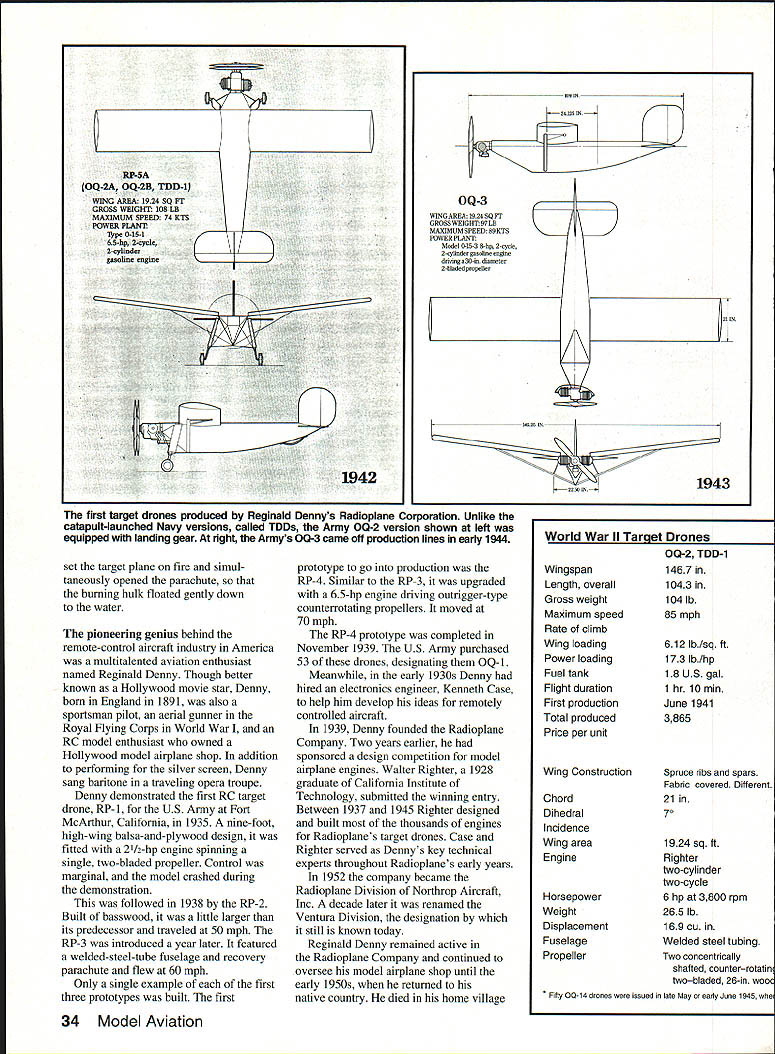
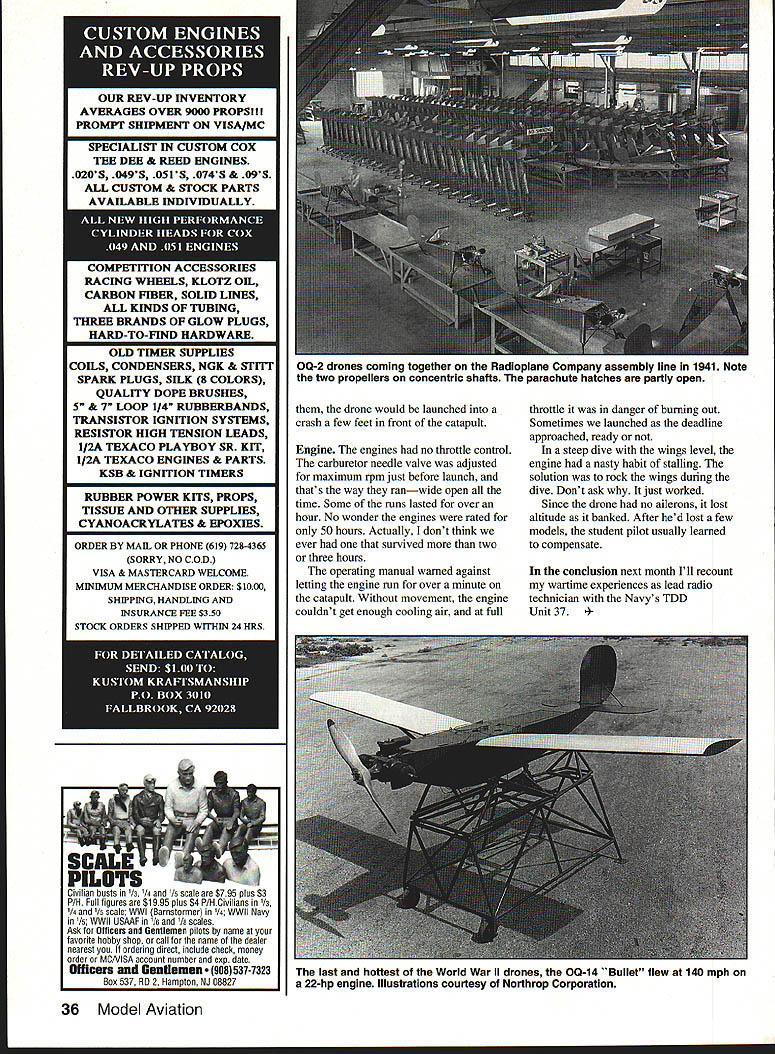
The U.S. Army Air Forces actively supported Denny's efforts to prove the practicality of target drone aircraft. The first Radioplane OQ-2 drones left the production line in a building adjacent to the San Fernando Valley Airport in June 1941. A total of 14,891 drones were produced for the Army and Navy from 1941 through 1945. The accompanying chart details the three designs.
Recovery system
The drones were recovered by parachute. The parachutes featured a 24-ft.-diameter circular canopy of standard design but used an 18-in. circular vent rather than the standard puckered vent. The main parachute was provided with a standard pilot chute and 24 suspension lines, which were shackled to the apex of four riser cables fastened to four points on the fuselage.
The parachute was packed in a metal tray with canvas flaps and mounted in a welded-steel-tube structure called the parachute hatch. This hatch was hinged at the fuselage top surface and was closed against a spring-tension yoke. Since the rip cord was attached to the fuselage, opening the hatch pulled the cord and released the parachute. An engine ignition switch was activated to the off position when the parachute hatch opened. The hatch was held shut by an electromagnetic relay armature as long as a continuous signal was received on the parachute channel.
Transmitter
The transmitter was large and heavy. It usually was placed on the nearest convenient flat surface and connected to the joystick control box by a cable long enough to give the pilot some freedom of movement.
The output carrier frequency was in the 73 MHz band, with plug-in crystals allowing several transmitters to operate simultaneously in the same area.
The transmitter received its power from a dynamotor unit, which in turn was driven by a gasoline generator.
Superimposed on the carrier were five audio signals, as follows:
- Command: Right — Frequency: 300 Hz — Action: Rudder
- Command: Left — Frequency: 650 Hz — Action: Rudder
- Command: Up — Frequency: 1,390 Hz — Action: Elevator
- Command: Down — Frequency: 3,000 Hz — Action: Elevator
- Command: Parachute — Frequency: 955 Hz — Action: Lack of this continuous tone caused release of the parachute after a one-second delay
There was no proportional control. Both the rudder and elevator moved at a more-or-less constant rate as long as the appropriate signal was received.
The rudder returned to neutral when the signal ceased. The pilot had to learn by trial and error how long to signal and when to let go.
The elevator, unlike the rudder, had no automatic neutral, so it locked in position when the signal stopped. Therefore it was important that the pilot set the elevator properly before launching—and then leave it alone as much as possible. More than one pilot watched helplessly as the drone left the catapult, climbed into a stall, and flew straight into the ground at full speed. All in about two seconds. All because the pilot forgot to check the position of the elevator.
Receiver
The high-gain superregenerative receiver had nine vacuum tubes. It was packaged in an aluminum box about eight inches on a side.
High humidity was the enemy of these circuits, and saltwater was even worse. The Pacific Ocean has plenty of both. On high-humidity days anything could happen—and often did. I continue to believe that these receivers had sold their souls to the devil.
We grew to hate the sight of a saltwater-soaked plane so much that we took to securing the parachute hatch shut just before launching. That was my job. If Lt. (jg.) Art Kinney ever reads this, he'll learn, after 46 years, why at times he just couldn't seem to get the parachute hatch to open.
Catapult
The Army's OQ-2 had a landing gear; OQ-3, OQ-14, and all the Navy's TDDs had none. These later drones were launched from a 37.7-ft. catapult by means of electric shock cords driving a carriage with 700 lb. of thrust. The drone left the carriage traveling at about 65 mph. A later version of the catapult, which we received along with the new TDD-3s, contained coiled steel springs in place of the shock cords. Its thrust was said to be 900 pounds. I remember it as being 30 ft. long.
There was also a 5-ft. catapult with heavy coil steel springs for use on small high-speed boats running into the wind. The strong headwinds were necessary; without them, the drone would be launched into a crash a few feet in front of the catapult.
Engine
The engines had no throttle control. The carburetor needle valve was adjusted for maximum rpm just before launch, and that's the way they ran—wide open all the time. Some of the runs lasted for over an hour. No wonder the engines were rated for only 50 hours. Actually, I don't think we ever had one that survived more than two or three hours.
The operating manual warned against letting the engine run for over a minute on the catapult. Without movement, the engine couldn't get enough cooling air, and at full throttle it was in danger of burning out. Sometimes we launched as the deadline approached, ready or not.
In a steep dive with the wings level, the engine had a nasty habit of stalling. The solution was to rock the wings during the dive. Don't ask why. It just worked.
Since the drone had no ailerons, it lost altitude as it banked. After he'd lost a few feet, the student pilot usually learned to compensate.
In the conclusion next month I'll recount my wartime experiences as lead radio technician with the Navy's TDD Unit 37.
Transcribed from original scans by AI. Minor OCR errors may remain.

