
Part 2: When Model Airplanes First Went to War
Serving with a target drone unit during World War II gave our author firsthand experience of how RC model airplanes fly. Hugh Maxwell
Part one of this two-part article traced the design and development in the 1930s and 1940s of radio-controlled target drones used by World War II antiaircraft gunnery crews. In what follows I'll describe some of my own wartime experiences with these forerunners of modern RPVs.
I was a member of the U.S. Navy's TDD Unit 37 in 1944–1945. We first flew TDD-2s and subsequently TDD-3s.
Initial training for Units 36, 37, and 38 took place in 1944 at the local airport outside Durant, Oklahoma. Before being shipped overseas, Units 37 and 38 received further training at the Naval Lighter-Than-Air Base in Santa Ana, California.
At the time the Santa Ana base was home to the Navy blimps that patrolled the Pacific coast for submarines along southern and central California. These were quite similar to the Goodyear blimps, which you've probably seen coasting over your hometown or on TV.
Blimps weigh very little when they're rigged for flight. In fact, the Navy blimps were so light that they often were hung on the hangar walls in vertical rows. You could walk into one of the two giant hangars, take hold of the railing around the bottom of the gondola, and lift a blimp right off the ground. Since our shop was in one of the hangars, we did this almost daily. I wish I had a picture to prove it, because hardly anyone believes me.
The Santa Ana base is today the Marine Helicopter Base. The hangars are sometimes used for indoor model airplane meets.
When it came time to ship out for the Solomon Islands, Unit 37 took 50 of the TDD-2 drones to Guadalcanal. No sooner had we arrived at Henderson Field than I faced my first crisis—our brand-new transmitter refused to work. Little troubleshooting turned up an open two-watt resistor. No island resistors had the combination of values needed. So two of us arranged a special PBY flight to the Russell Islands. The obliging chief radioman dug around the jungle and used resistors until he found the right combination. The job flew target drones to a minesweeper off the coast of Savo Island. The sweeper's .50-caliber machine gunner was an expert. After demonstrating the art of severing the towline, the aerial target sleeve shot down the first drone on the first pass. That's quite a feat considering I've seen battleship and carrier gunnery crews fail to hit the drone after repeated passes. In a few cases the drone flew until it ran out of gas.
Ready-Aim-Swat!
A post-war anecdote
The captain gave the order to open fire, and again every A.A. gun on the carrier blasted away at the target plane which was radio-controlled by a pilot on a small ship several hundred yards astern. Yet none of the shots came close to the mark. The carrier—one of the Navy's largest—was conducting target practice on her shakedown cruise, and the plane, although it had made six passes at the big craft, hadn't even been nicked by the several hundred shells pumped into the sky.
Needless to say, relations were pretty strained between the carrier's skipper and his gunnery officer, even though the misses weren't so bad, considering the greenness of the men and their unfamiliarity with one another. Nor was there any easing of the tension when a message was received from the target plane's controller.
The message read: "If you'll turn into the wind, I'll land this thing on your flight deck and you can beat it to death with a swab."
—Randy Cooper
A typical Navy TDD unit had an eight-man complement:
- the lieutenant (jg), who served as the pilot and commanding officer
- the chief, or 1st-class petty officer, who served as the alternate pilot
- two motor mechanics, who maintained and repaired the engines
- two electronic technicians
- two seamen, who did parachute packing and repair, plus all the other jobs no one else wanted
We shipped out from Guadalcanal to Guam on a Coast Guard attack transport. The trip took 11 days. The sea was unbelievably calm and smooth the whole time—no waves or whitecaps, just gentle swells so widely spaced as to be hardly discernible.
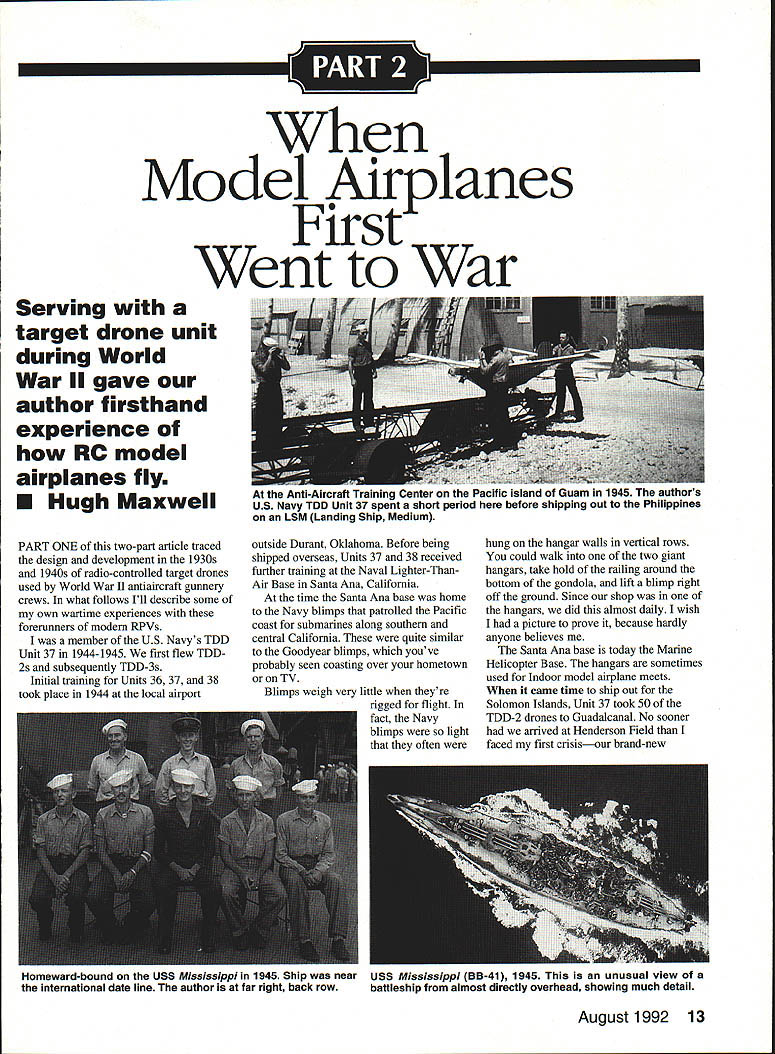
After a short period at the Anti-Aircraft Training Center on Guam, Unit 37 shipped out to the Philippines on an LSM (Landing Ship, Medium). The LSM skipper, obviously a free spirit, invited us to set up our 30-foot catapult on the deck of the recessed cargo hold and launch drones straight ahead for target practice. His plan was to open up the clamshell bow door and drop the landing ramp, giving us an opening 13 feet wide by 13 feet high (because of a bridge across the open hold) through which to fly. The TDD-3 had a wingspan of 11 1/2 feet.
Unfortunately our TDD officer was a man burdened with an excess of common sense, a man who lacked a true spirit of adventure. He said no.
I've always felt a little wistful about this. I still think that with a little careful aiming we could have launched the drones without smashing into the bridge or shearing off a wing. I wish we had tried.
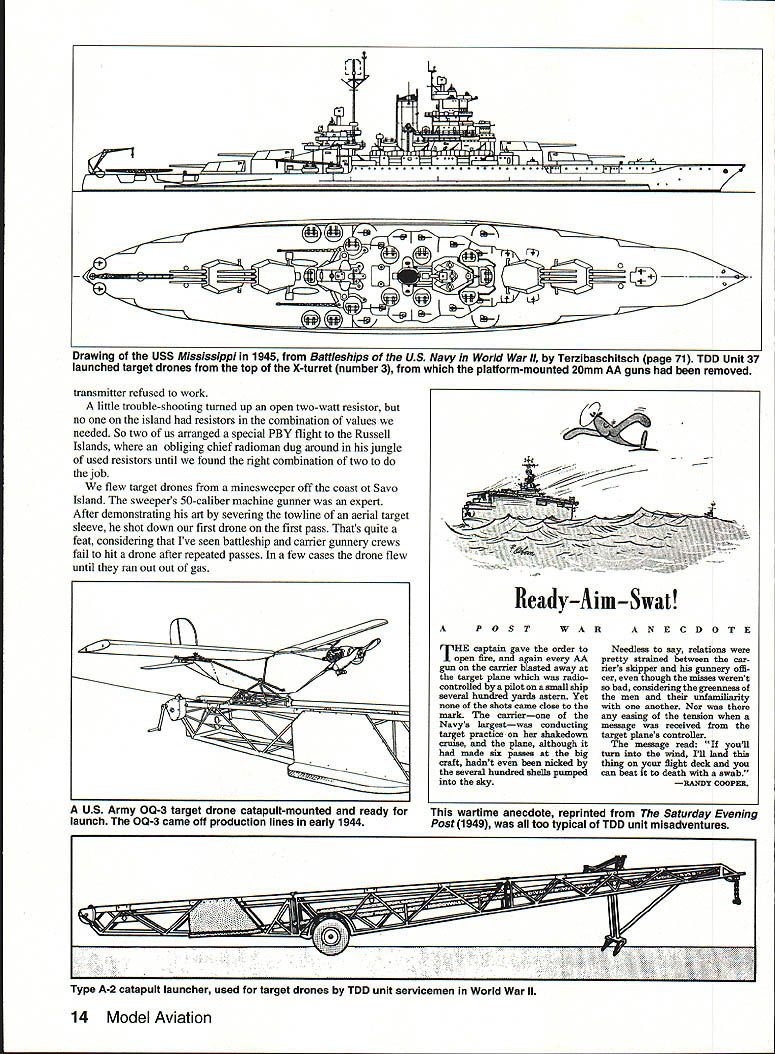
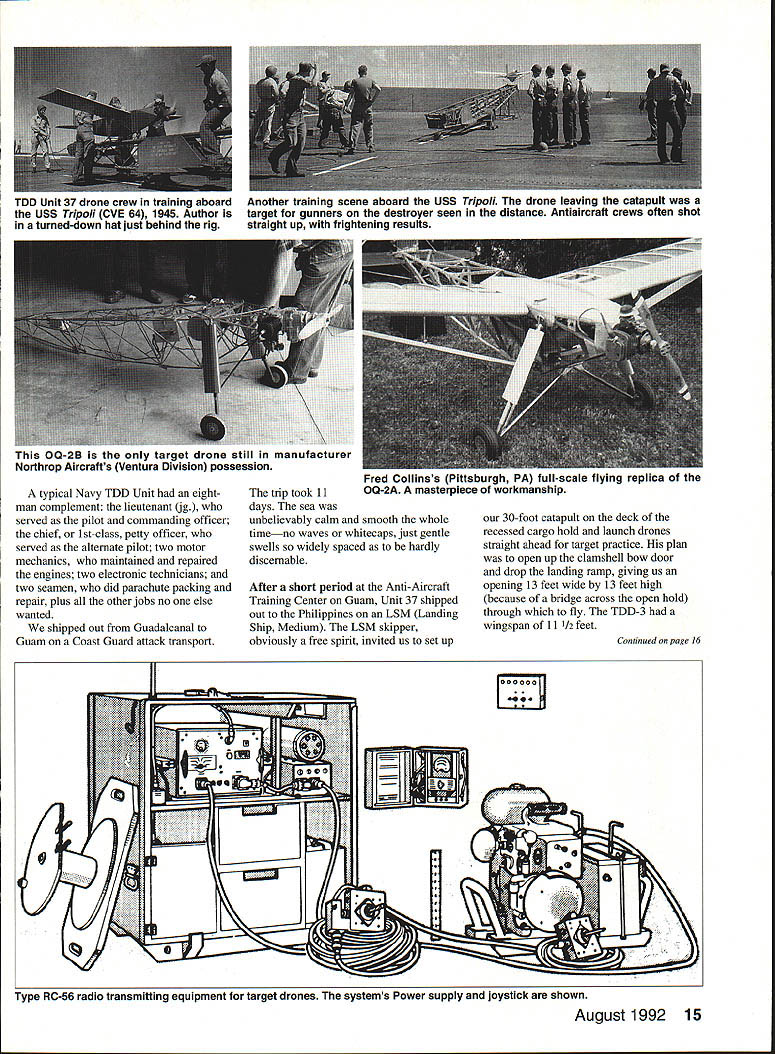
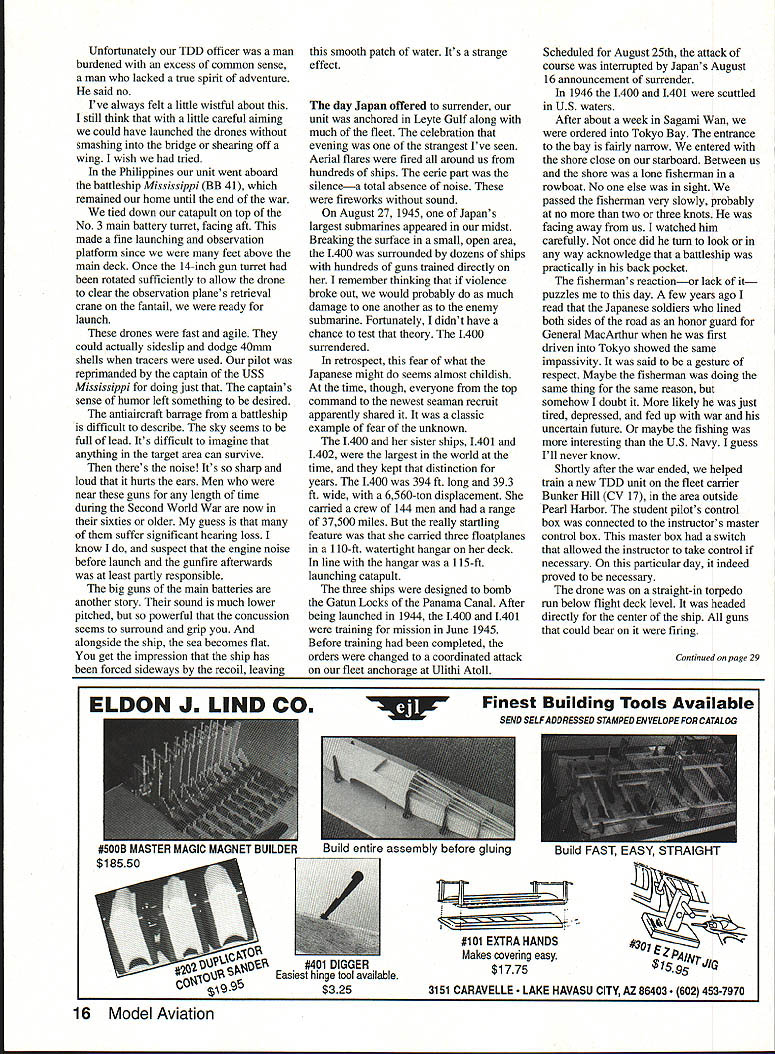
In the Philippines our unit went aboard the battleship Mississippi (BB-41), which remained our home until the end of the war. We tied down our catapult on top of the No. 3 main battery turret, facing aft. This made a fine launching and observation platform since we were many feet above the main deck. Once the 14-inch gun turret had been rotated sufficiently to allow the drone to clear the observation plane's retrieval crane on the fantail, we were ready for launch.
These drones were fast and agile. They could actually sideslip and dodge 40mm shells when tracers were used. Our pilot was reprimanded by the captain of the USS Mississippi for doing just that. The captain's sense of humor left something to be desired.
The antiaircraft barrage from a battleship is difficult to describe. The sky seems to be full of lead. It's difficult to imagine that anything in the target area can survive.
Then there's the noise! It's so sharp and loud that it hurts the ears. Men who were near these guns for any length of time during the Second World War are now in their sixties or older. My guess is that many of them suffer significant hearing loss. I know I do, and suspect that the engine noise before launch and the gunfire afterwards was at least partly responsible.
The big guns of the main batteries are another story. Their sound is much lower pitched, but so powerful that the concussion seems to surround and grip you. And alongside the ship, the sea becomes flat. You get the impression that the ship has been forced sideways by the recoil, leaving this smooth patch of water. It's a strange effect.
The day Japan offered to surrender, our unit was anchored in Leyte Gulf along with much of the fleet. The celebration that evening was one of the strangest I've seen. Aerial flares were fired all around us from hundreds of ships. The eerie part was the silence — a total absence of noise. These were fireworks without sound.
On August 27, 1945, one of Japan's largest submarines appeared in our midst. Breaking the surface in a small, open area, the I-400 was surrounded by dozens of ships with hundreds of guns trained directly on her. I remember thinking that if violence broke out, we would probably do as much damage to one another as to the enemy submarine. Fortunately, I didn't have a chance to test that theory. The I-400 surrendered.
In retrospect, this fear of what the Japanese might do seems almost childish. At the time, though, everyone from the top command to the newest seaman recruit apparently shared it. It was a classic example of fear of the unknown.
The I-400 and her sister ships, I-401 and I-402, were the largest in the world at the time, and they kept that distinction for years. The I-400 was 394 ft. long and 39.3 ft. wide, with a 6,560-ton displacement. She carried a crew of 144 men and had a range of 37,500 miles. But the really startling feature was that she carried three floatplanes in a 110-foot watertight hangar on her deck. In line with the hangar was a 115-foot launching catapult.
The three ships were designed to bomb the Gatun Locks of the Panama Canal. After being launched in 1944, the I-400 and I-401 were training for missions in June 1945. Before training had been completed, the orders were changed to a coordinated attack on our fleet anchorage at Ulithi Atoll.
Scheduled for August 25th, the attack of course was interrupted by Japan's August 15 announcement of surrender.
In 1946 the I-400 and I-401 were scuttled in U.S. waters.
After about a week in Sagami Wan, we were ordered into Tokyo Bay. The entrance to the bay is fairly narrow. We entered with the shore close on our starboard. Between us and the shore was a lone fisherman in a rowboat. No one else was in sight. We passed the fisherman very slowly, probably at no more than two or three knots. He was facing away from us. I watched him carefully. Not once did he turn to look or in any way acknowledge that a battleship was practically in his back pocket.
The fisherman's reaction—or lack of it—puzzles me to this day. A few years ago I read that the Japanese soldiers who lined both sides of the road as an honor guard for General MacArthur when he was first driven into Tokyo showed the same impassivity. It was said to be a gesture of respect. Maybe the fisherman was doing the same thing for the same reason, but somehow I doubt it. More likely he was just tired, depressed, and fed up with war and his uncertain future. Or maybe the fishing was more interesting than the U.S. Navy. I guess I'll never know.
Shortly after the war ended, we helped train a new TDD unit on the fleet carrier Bunker Hill (CV-17) in the area outside Pearl Harbor. The student pilot's control box was connected to the instructor's master control box. This master box had a switch that allowed the instructor to take control if necessary. On this particular day, it indeed proved to be necessary.
The drone was on a straight-in torpedo run below flight deck level. It was headed directly for the center of the ship. All guns that could bear were on it to try to bring it down.
Models to War — Maxwell
Apparently the student pilot became disoriented, because suddenly the drone disappeared from view. We were sure it was going to crash into the hangar deck. But the next instant it reappeared, flying straight out. The instructor had taken over and used a fast combination of rudder and elevator; these planes responded rapidly and decisively. It was a very tense few seconds, but good for a laugh afterwards. A 134-pound object moving at 140 mph can do a lot of damage, especially when loaded with high-octane fuel.
One problem was overexcited gunners who failed to respond to cease-fire orders. At the end of a steep kamikaze-type dive, the drone would pull up and pass directly over the ship. So of course the gunners would fire straight up. This happened more than once. Shells pelting the water everywhere like giant raindrops tended to make us all uneasy.
When destroyers were scheduled for target practice, the drones usually were launched from a larger ship. On one occasion we launched from a carrier and watched as the destroyer shot down the drone. When the ship moved between us and the spot where the drone had gone down, we observed through binoculars a lot of activity on the far side of the ship. In a few minutes, the crew radioed that they had been unable to reach the drone before it sank—while we watched them enthusiastically taking it apart for souvenirs.
On Navy Day, October 27, 1945, we were on the carrier Tripoli (CVE-64) in the harbor at Hilo, Hawaii. That occasion probably ranks as the Navy's most heartfelt celebration ever.
We flew two drones that day, and managed to lose one when the pilot pulled out of a vertical dive about two inches too late. The tip of the propeller hit the water and shattered. The drone coasted into a steep climb, stalled, and parachuted gracefully down into the water in front of the whole town. Embarrassing, but what the heck. It was a great holiday for the Navy after four years of war.
Shortly thereafter, most of us returned to the States for discharge and home. As far as I know, TDD Unit 37 passed into history.
It is interesting to note that many of today's RPVs are about comparable in wingspan and horsepower to our wartime drones. What distinguishes the modern RPV is their new, sophisticated—and costly—surveillance electronics. Some now cost over a million dollars, not including the support equipment.
If you were part of an Army or Navy drone unit before, during, or after World War II, I'd like to hear from you. What were your experiences? I'm sure there are many stories to tell.
I'd especially like to hear from members of Navy TDD units 36, 37, and 38. I seem to remember that Unit 36 was headed for Cuba and 38 was to go aboard the battleship Colorado (BB-45).
Can anyone out there tell us which unit was involved in the "beat it to death with a swab" story? This humorous anecdote and cartoon appeared under the byline of Randy Cooper in a 1949 issue of The Saturday Evening Post and is reprinted here.
Of the over 500 aviation museums in the United States and Canada, only one, the Rubin Fleet Air Museum, has a wartime target drone on display. The museum is in Balboa Park, San Diego, California.
I'm trying to locate any surviving drones with the goal of getting them into museums. If you know of one, please contact me.
The only privately owned target drone that I am aware of is in the possession of my friend, the George Easton family of Riverside, California. An OQ-2B, it's been accepted by the Experimental Aircraft Association Museum in Oshkosh, Wisconsin, and is scheduled to be refurbished and displayed in the near future.
The Ventura Division of Northrop Aircraft, Inc., whose predecessor, the Radioplane Company, produced target drones in the 1930s and 1940s, surprisingly enough owns only a single wartime drone. It's packed away in a warehouse. Although the box is labeled OQ-2A, the drone is actually an OQ-2B, since the wing ribs have tangentially drilled lightening holes. The fuselage is uncovered, revealing the welded steel-tube construction and showing the receiver and servo.
Fred T. Collins, of Pittsburgh, Pennsylvania, has built a full-scale flying replica of an OQ-2A. Judging both from the pictures I've seen and from Fred's descriptions of its flying characteristics, this drone is a masterpiece. Many people have mistaken it for the real thing. Fred's model weighs 48 pounds; the original weighed in at 108 pounds. Fred Collins's address is 29 Stewart Avenue, Pittsburgh, PA 15227.
The enormous interest in recreational RC activities seen today was probably stimulated, at least in part, by our servicemen's wartime exposure to these target drones.
Those of you who served in wartime drone units have a unique distinction. When our grandchildren ask, "What did you do in the war, Grandpa?" we can answer, "I flew model airplanes."
Send your comments and anecdotes to me at 413 East 6th Street, Clare, MI 48617. Or call me at (517) 386-2574.
Transcribed from original scans by AI. Minor OCR errors may remain.

