
Part I: Aircraft of the Gulf War
In the six weeks' conflict following Iraqi President Saddam Hussein's invasion of Kuwait, the world watched stunned as the U.S. and its allies used aircraft and missiles of unprecedented technical sophistication to establish air supremacy in the Persian Gulf. Part One of a three-part article. Don Berliner
On January 16, 1991, the fourth major war of the 20th century began with an aerial assault that was at least as futuristic as Hitler's horrifying blitzkrieg on Poland in 1939. Heralded by radar-invisible Lockheed F-117 stealth fighters that blasted Iraqi communications and command centers with TV-guided "smart" bombs, winged cruise missiles roared from their launch racks on U.S. Navy ships in the Persian Gulf and found their way to within a few feet of their targets.
For several months following Iraq's invasion of its tiny neighbor, arms had poured into Saudi Arabia from the U.S.A., Great Britain, and other members of this most recent allied coalition. Hundreds of thousands of troops had arrived as well. Transported by ship and by huge cargo plane, thousands of tons of vehicles, weapons, ammunition, and supporting materiel turned this formerly quiet desert nation into a vast armed camp.
Some of these aircraft were solid, combat-proven veterans, familiar from the Vietnam War: the F-4 Phantom II, the Lockheed C-130 Hercules, the Douglas A-4 Skyhawk, and of course the UH-1 Huey and the Cobra helicopter. Others, however, were much too new to have been used in the Southeast Asian conflict. These were the highly sophisticated, technically advanced airplanes and helicopters that the Pentagon calls weapons systems.
During the Eighties, hundreds of billions of dollars had been spent on the development of airplanes and helicopters, bombs, rockets, and night-vision devices so sophisticated as to make the rest of the world's weapons obsolete and thus — theoretically, at least — discourage war. As the decade came to a close, drastic political upheavals in the Soviet Union and Eastern Europe had ended the Cold War and canceled the fear that these formidable high-tech weapons might one day be needed in a confrontation with Russia. Nevertheless, the U.S. military proceeded with testing.
The weapons were tested in more or less realistic war games and were demonstrated for congressmen and at air shows. For the most part, however, they languished in warehouses and hangars, awaiting a war that seemed less likely every day. Then Saddam Hussein used his enormous military machine to crush Kuwait, and the world responded.
Network TV news immediately expanded its standard suppertime reports to round-the-clock coverage of this amazing high-technology war. Correspondents who knew their way around the halls of Congress, the courts, and Wall Street found themselves in the role of instant experts on advanced aerospace technology. To fill in the obvious gaps in their own knowledge, they scoured the country for retired generals and think-tank whizzes who proudly strutted their expertise on military computers, stealth technology, and missile guidance systems.
A stunning array of these new, high-tech weapons systems was shown on TV during the six weeks' war. But since TV coverage is usually brief and superficial, Model Aviation presents this three-part series to give our readers a little more depth of information. This first installment covers allied airplanes that either were used in action or were readily available for use. Parts Two and Three will conclude the allied coverage with a survey of helicopters and missiles and continue with a discussion of Iraqi equipment.
Combat airplanes
The airplanes used in past wars were fairly easy to categorize on the basis of speed, maneuverability, size, and payload, as fighters, attack planes, or bombers. But these advanced weapons systems transcend such distinctions. This listing also omits specific weapons loads, since these vary from mission to mission. And of course, you've seen on TV the wide variety of "smart" bombs, traditional bombs, and missiles that can be slung under the wings and fuselages of these aircraft depending on the target of the day: runways, hardened hangars or missile launchers, buildings, tanks, ammunition dumps.
McDonnell-Douglas F-4G Phantom II
"Wild Weasel." This old reliable Mach-2 fighter has seen its working life extended through modification into an antiradar airplane. It uses special bombs that ride the radar beam to its source, knocking out the radar and leaving the enemy with no way to direct its antiaircraft guns and missiles.
Specifications: wingspan, 38 ft. 5 in.; length, 58 ft. 3 in.; wing area, 530 sq. ft. Performance: maximum level flight speed of over Mach 2 with external payload; combat radius of over 1,000 miles in ground-attack configuration. Two GE J79 turbojet engines rated at 17,000 lb. thrust with afterburning.
Northrop F-5 Tiger
The only American fighter that has been developed exclusively for foreign air forces, the F-5 has gone through many versions since it exceeded Mach 1 on its first flight in 1959. The final version of this simple, straight-wing plane was offered to the U.S. but never accepted for production.
Specifications: wingspan, 26 ft. 8 in.; length, 48 ft. 2 in. to 51 ft. 7 in.; wing area, 186 sq. ft. Performance: maximum speed of Mach 1.6 at altitude; combat radius of 540 miles with external payload at sea level. Two GE J85 turbojet engines rated at 5,000 lb. thrust with afterburning.
Grumman F-14 Tomcat
A swing-wing, carrier-based multipurpose fighter that replaced the Phantom II in the U.S. Navy. Used mainly in air defense, the Tomcat quickly established itself as the preeminent aircraft in its category, partly because of its ability to operate efficiently at both ends of the speed range.
Specifications: wingspan—swept, 38 ft. 2 in.; unswept, 64 ft. 2 in.; length, 61 ft. 11 in.; wing area, 565 sq. ft. Performance: maximum design speed of Mach 2.4; service ceiling of over 50,000 ft. Two Pratt & Whitney TF30 turbofan engines rated at 21,000 lb. thrust with afterburning.
McDonnell Douglas F-15 Eagle
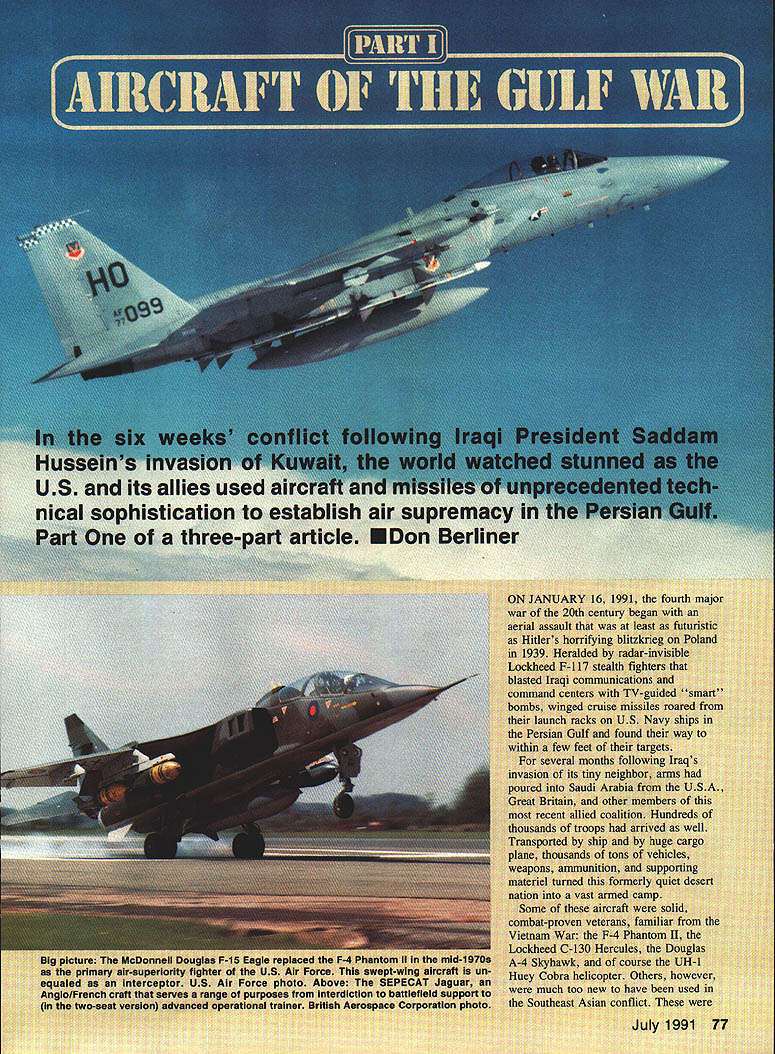
This swept-wing airplane superseded the F-4 Phantom II in the mid-1970s as the primary air-superiority fighter of the U.S. Air Force. Unparalleled as an interceptor, it has set official records for time-to-climb that include a dash to 9,000 meters (almost 30,000 feet) from a standstill in just under 60 seconds. The F-15 is armed chiefly with missiles but also carries a multibarrel cannon.
Specifications: wingspan, 42 ft. 10 in.; length, 63 ft. 9 in.; wing area, 608 sq. ft. Performance: top speed of over Mach 2.5; service ceiling of 60,000 ft. Two Pratt & Whitney F100 turbofan engines rated at 25,000 lb. thrust.
General Dynamics F-16 Fighting Falcon
This cropped-delta-wing design won the U.S. Air Force 1972 competition for a simple, lightweight fighter using variable wing camber, fly-by-wire controls, and advanced-composite construction. The first F-16 went into service in 1978, and the plane soon became active with the Dutch, Belgian, Danish, and Norwegian air forces.
Specifications: wingspan, 31 ft. 0 in.; length, 49 ft. 4 in.; wing area, 300 sq. ft. Performance: top speed of over Mach 2 at 40,000 ft.; service ceiling of over 50,000 ft.; radius of action of over 575 miles. One Pratt & Whitney turbofan engine rated at 25,000 lb. thrust with afterburning.
McDonnell Douglas F/A-18 Hornet
After the Northrop F-17 Cobra lost the lightweight fighter competition to the General Dynamics F-16, the design was reworked into the Navy's F/A-18 attack fighter. Operational with the fleet from 1982 onwards, the F/A-18 is armed with a multibarrel cannon and a selection of Sidewinder and Sparrow missiles that varies with the Navy or Marine mission being flown.
Specifications: wingspan, 37 ft. 6 in.; length, 56 ft. 0 in.; wing area, 400 sq. ft. Performance: top speed of over Mach 1.8, with a combat radius of 660 miles for the attack plane and over 450 miles for the fighter. Two GE F404 turbofan engines rated at 16,000 lb. of thrust.
General Dynamics F-111 Raven
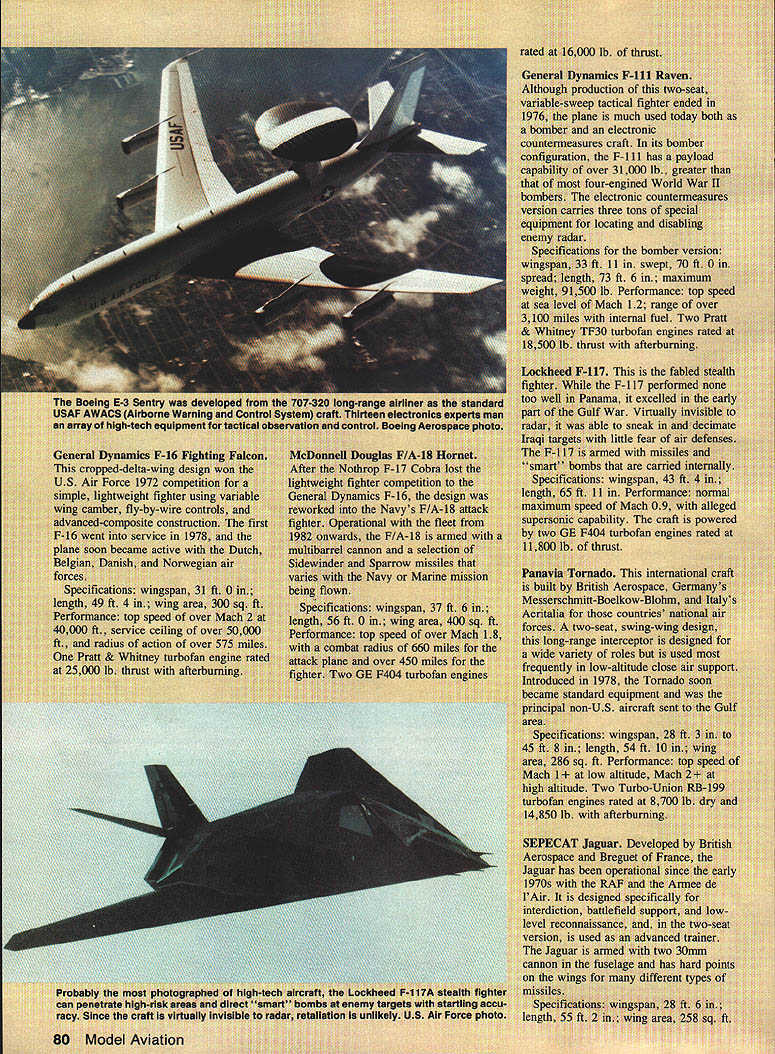
Although production of this two-seat, variable-sweep tactical fighter ended in 1976, the plane is much used today both as a bomber and an electronic countermeasures craft. In its bomber configuration, the F-111 has a payload capability of over 31,000 lb., greater than that of most four-engined World War II bombers. The electronic countermeasures version carries three tons of special equipment for locating and disabling enemy radar.
Specifications for the bomber version: wingspan, 33 ft. 11 in. swept, 70 ft. 0 in. spread; length, 73 ft. 6 in.; maximum weight, 91,500 lb. Performance: top speed at sea level of Mach 1.2; range of over 3,100 miles with internal fuel. Two Pratt & Whitney TF30 turbofan engines rated at 18,500 lb. thrust with afterburning.
Lockheed F-117
This is the fabled stealth fighter. While the F-117 performed none too well in Panama, it excelled in the early part of the Gulf War. Virtually invisible to radar, it was able to sneak in and decimate Iraqi targets with little fear of air defenses. The F-117 is armed with missiles and "smart" bombs that are carried internally.
Specifications: wingspan, 43 ft. 4 in.; length, 65 ft. 11 in. Performance: normal maximum speed of Mach 0.9, with alleged supersonic capability. The craft is powered by two GE F404 turbofan engines rated at 11,800 lb. of thrust.
Panavia Tornado
This international craft is built by British Aerospace, Germany's Messerschmitt-Bölkow-Blohm, and Italy's Aeritalia for those countries' national air forces. A two-seat, swing-wing design, this long-range interceptor is designed for a wide variety of roles but is used most frequently in low-altitude close air support. Introduced in 1978, the Tornado soon became standard equipment and was the principal non-U.S. aircraft sent to the Gulf area.
Specifications: wingspan, 28 ft. 3 in. to 45 ft. 8 in.; length, 54 ft. 10 in.; wing area, 286 sq. ft. Performance: top speed of Mach 1+ at low altitude, Mach 2+ at high altitude. Two Turbo-Union RB-199 turbofan engines rated at 8,700 lb. dry and 14,850 lb. with afterburning.
SEPECAT Jaguar
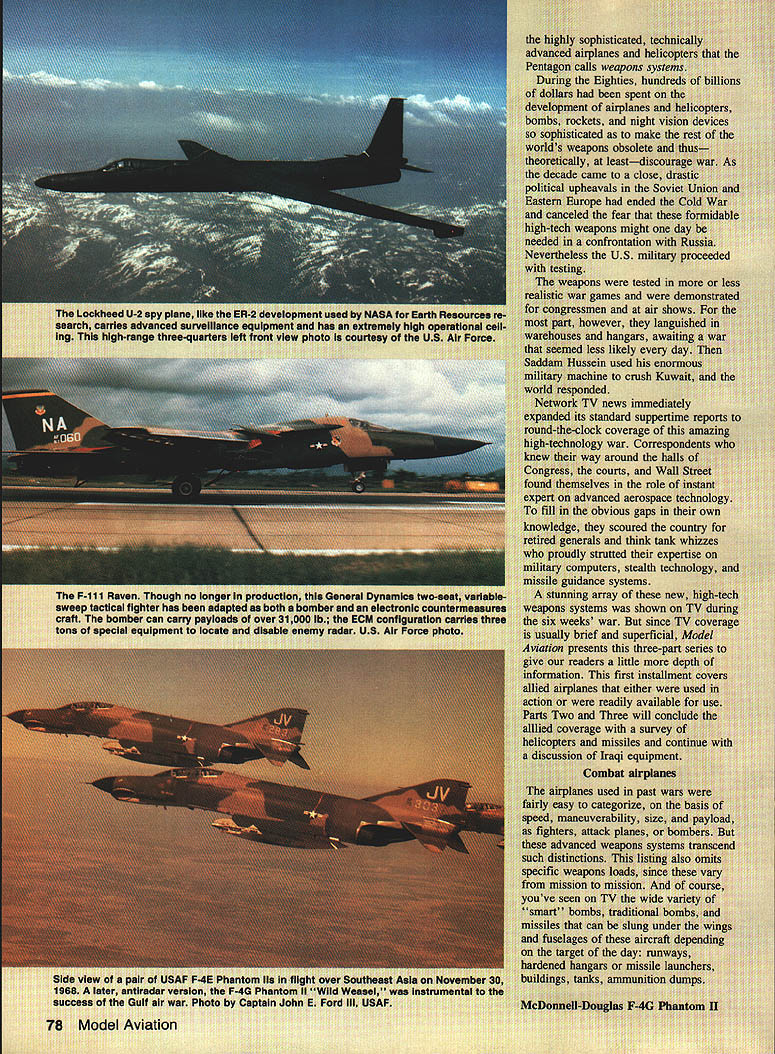
Developed by British Aerospace and Breguet of France, the Jaguar has been operational since the early 1970s with the RAF and the Armée de l'Air. It is designed specifically for interdiction, battlefield support, and low-level reconnaissance, and the two-seat version is used as an advanced trainer. The Jaguar is armed with two 30mm cannon in the fuselage and has hard points on the wings for many different types of missiles.
Specifications: wingspan, 28 ft. 6 in.; length, 55 ft. 2 in.; wing area, 258 sq. ft. Performance: top speed of Mach 1.6 at altitude, Mach 1.1 at sea level; takeoff run with tactical weapons load is 1,900 ft. The craft uses two Rolls-Royce Turbomeca Adour engines rated at 5,500 lb. dry and 8,400 lb. with afterburning.
Dassault Mirage F1
This versatile swept-wing fighter is a departure from an otherwise unbroken line of delta-winged Mirages since the late 1950s. Deliveries of the F1 began in 1973 as a replacement for the Mirage III. The plane typically carries two 30mm cannon and up to 9,000 lb. of bombs and missiles.
Specifications: wingspan, 27 ft. 7 in.; length, 50 ft.; wing area, 269 sq. ft. Performance: top speed of Mach 1.2 at low altitude, Mach 2.2 at high altitude; endurance of 3 3/4 hours. One SNECMA Atar 9K-50 turbojet engine rated at 15,900 lb. thrust with afterburning.
Dassault Mirage 2000
The latest production version of a long line of delta-winged Mirages, the 2000 is an interceptor and air-superiority fighter used mainly by the Armée de l'Air. With minor changes in equipment it can be used for ground support.
Specifications: wingspan, 30 ft. 0 in.; wing area, 441 sq. ft. Performance: maximum speed of over Mach 2.2 at altitude; service ceiling of 59,000 ft. One SNECMA M53 turbofan engine rated at 14,400 lb. dry and 21,400 lb. with afterburning.
Douglas A-4 Skyhawk
One of the most durable of combat airplanes, the Skyhawk stood the test of the Korean War, the first conflict to be fought primarily with jets. From 1954, when the prototype was flown, through the mid-1970s, over 2,000 Skyhawks were built for an international clientele (Kuwait has the TA-4KU version). Originally a carrier-based aircraft, it was later built in land versions, many of which are two-seat trainers that can also be used for ground attack.
Specifications: wingspan, 27 ft. 6 in.; length (two-seater), 42 ft. 7 in.; wing area, 260 sq. ft. Performance: top speed of 630 mph with 4,000 lb. of bombs; ferry range of 2,000 miles. One Pratt & Whitney J52 turbojet engine rated at 11,200 lb. of thrust.
Grumman A-6 Intruder
A carrier-based, all-weather, low-level bomber, the Intruder has been developed in many directions to become one of the most versatile designs of recent years. One variant, the EA-6 Prowler, carries a four-man crew to operate the electronic jammers and computer-directed receivers that make up much of a carrier's offensive apparatus.
Specifications for the A-6E: wingspan, 53 ft. 0 in.; length, 54 ft. 7 in.; wing area, 529 sq. ft. Performance: maximum flight speed of 643 mph at sea level; range of 1,900 miles with maximum payload. Two Pratt & Whitney J52 turbojet engines rated at 9,300 lb. thrust.
Vought A-7 Corsair II
Developed from the F-8 (F8U) Crusader fighter, this shipboard attack plane began replacing the Navy's A-4 Skyhawk in 1966 and soon was in use by the Air Force as well. Many are flown by Air National Guard units today. Up to 15,000 lb. of bombs can be carried under the wings and fuselage.
Specifications: wingspan, 38 ft. 9 in.; length, 46 ft. 2 in.; wing area, 375 sq. ft. Performance: maximum speed, 700 mph at sea level; range of 2,300 miles with internal fuel. Allison TF41 turbofan engine.
Fairchild A-10 Thunderbolt II
With its seven-barrel 30mm cannon firing up to 4,200 rounds per minute, this fighter recalls the Stormovik tank-buster of an earlier day. Better known as the Warthog, the plane can also carry up to 16,000 lb. of bombs and rockets.
Specifications: wingspan, 57 ft. 6 in.; length, 53 ft. 4 in.; wing area, 506 sq. ft. Performance: combat speed of 443 mph with bombs; takeoff distance of 1,200 ft. to the so-called forward airstrip weight. Two GE TF34 turbofan engines rated at 9,000 lb. thrust.
McDonnell Douglas / British Aerospace AV-8 Harrier
Introduced in the mid-1970s as the world's first VTOL combat airplane, the Harrier, which fought in the Falkland Islands war of 1982, remains the only such craft to have seen combat. Using vectored thrust, the plane can outmaneuver any conventional fighter. It can be operated from a platform on any ship, or even from a tennis court.
Specifications: wingspan, 30 ft. 4 in.; length, 46 ft. 4 in.; wing area, 230 sq. ft. Performance: speed range over 200 to 660 mph; capable of lifting 7,000 lb. of bombs vertically. One Rolls-Royce Bristol Pegasus turbofan engine rated at 21,500 lb. of thrust.
British Aerospace Buccaneer
Developed by Blackburn in 1958 for the Royal Navy, the Buccaneer remains an effective weapon in strike and reconnaissance roles with the RAF.
Specifications: wingspan, 44 ft. 0 in.; length, 63 ft. 5 in.; wing area, 515 sq. ft. Performance: maximum level flight speed of 645 mph; typical strike range of 2,300 miles. Two Rolls-Royce RB168 Spey turbofan engines rated at 11,000 lb. of thrust.
Boeing B-52 Stratofortress
Though it is by now older than most of its crew members, the B-52 remains the world's premier heavy bomber. Designed for nuclear weapons payload on long missions, it has been adapted to also carry conventional bombs and missiles, including cruise missiles.
Specifications: wingspan, 185 ft. 0 in.; length, 160 ft. 11 in.; wing area, 4,000 sq. ft. (one-tenth of an acre). Performance: cruising speed of 510 mph at altitude; service ceiling of 55,000 ft.; range of over 7,500 miles. Maximum payload: 35 tons. Eight Pratt & Whitney J57 turbojet engines rated at 13,750 lb. thrust.
Lockheed AC-130 Hercules
If any airplane has earned its place as the latter-day DC-3, it's the AC-130 Hercules. Over 1,600 of these craft have been built for more than 50 nations. They are used to carry cargo and passengers, for satellite retrieval, as an aerial tanker, in search and rescue, and in airborne communications. The AC-130 Spectre gunship is armed with side-firing 105mm howitzers, 40mm cannon, and two 20mm Vulcan guns.
Specifications: wingspan, 132 ft. 7 in.; length, 97 ft. 9 in.; wing area, 1,745 sq. ft. Performance: economy cruise of 345 mph; range of 2,350 miles with maximum payload. Four Allison T56 turboprop engines rated at 4,500 shaft horsepower.
Lockheed C-5 Galaxy
This is the standard wide-body cargo plane. The C-5 can carry over 200,000 lb. of freight such as 16½-ton trucks. Loading and unloading are accomplished via a swinging nose and aft ramp, both of which permit vehicles to be driven onboard.
Specifications: wingspan, 222 ft. 9 in.; length, 230 ft. 7 in.; main deck, 19 ft. wide, 13½ ft. high. Performance: normal cruise of 520 mph; range of 3,750 miles with full load. Four GE TF39 turbofan engines rated at 41,000 lb. thrust.
McDonnell Douglas KC-10 Extender
The air-refueling conversion of the standard DC-10 airliner, this craft can carry 30,000 gallons of fuel and transfer it at 1,500 gallons per minute to a hooked-on airplane.
Specifications: wingspan, 165 ft. 4 in.; length, 181 ft. 7 in.; maximum takeoff weight, 590,000 lb. Performance: maximum range of 4,370 miles with full load; maximum ferry range of 11,000 miles. Three GE CF6 turbofan engines rated at 52,500 lb. thrust.
Beech C-12 Super King Air
The military version of the popular executive transport, this airplane is used as a utility transport for all four branches of the U.S. armed services.
Specifications: wingspan, 54 ft. 6 in.; length, 43 ft. 9 in.; empty weight, 7,500 lb. Performance: economy cruise of 325 mph at 25,000 ft.; range of 2,270 miles at 35,000 ft. Two Pratt & Whitney Canada PT6 turboprop engines rated at 750 to 850 shaft horsepower.
Boeing KC-135 Stratotanker
First delivered to the USAF in 1957, this tanker played a key role in the development of the even more important 707 airliner.
Specifications: wingspan, 130 ft. 10 in.; length, 136 ft. 3 in.; maximum weight, 297,000 lb. Performance: top speed of over 600 mph; service ceiling of over 35,000 ft. Four Pratt & Whitney J57 turbojet engines rated at 13,000 lb. thrust.
North American OV-10 Bronco
Winner of a 1964 U.S. Navy competition for a lightweight armed reconnaissance airplane, the OV-10 Bronco entered service with the Navy, Marines, and Air Force in the late 1960s for such duties as helicopter escort and night forward air control.
Specifications: wingspan, 40 ft. 0 in.; length, 41 ft. 7 in.; cargo compartment, 75 cu. ft. Performance: maximum speed at sea level is 275 mph in "clean" configuration; takeoff run of 740 ft. at normal weight. Two AirResearch T76 turboprop engines rated at 715 shaft horsepower.
Grumman E-2 Hawkeye
This carrier-based, high-tech early warning aircraft has been in Navy service since 1965. Three specialist crew members operate a battery of advanced computers and radar displays to track threats in all weather conditions.
Specifications: wingspan, 80 ft. 7 in.; length, 57 ft. 7 in.; rotating radar dome, 24 ft. diameter. Performance: cruising speed of 310 mph; service ceiling of over 30,000 ft. Two Allison T56 turboprop engines rated at 4,900 shaft horsepower.
Boeing E-3 Sentry
A standard USAF AWACS (Airborne Warning and Control System) airplane, the E-3 Sentry evolved from the 707-320 long-range airliner. Thirteen electronics experts man a vast array of high-tech equipment to observe and control an entire battlefield from above.
Specifications: wingspan, 145 ft. 9 in.; length, 152 ft. 11 in. Performance: maximum cruise of 530 mph; six hours' endurance on station. Four Pratt & Whitney TF33 turbofan engines rated at 21,000 lb. thrust.
Boeing E-8 J-STARS
An even more advanced development of a Sixties-era 707 airliner, in this case the 707-323, the J-STARS carries Joint Surveillance Target Attack Radar equipment to detect stationary surface objects such as individual tanks from a distance of 100 miles. Specifications and performance are approximately the same as for the E-3 Sentry.
Lockheed C-141 Starlifter
The little brother of the immense C-5 Galaxy, the C-141 has long been the standard medium-size troop and cargo transport. It has a payload capability of more than 70,000 lb.
Specifications: wingspan, 160 ft. 1 in.; length, 145 ft. 0 in. Performance: cruising speed of 570 mph; maximum range of 6,400 miles. Four Pratt & Whitney TF33 turbofan engines rated at 21,000 lb. thrust.
Transall C.160
One of the first airplanes built by an international consortium (France and West Germany), the Transall C.160 is a medium-size battlefield transport capable of operating in rough fields. It can carry up to 50 passengers or 35,000 lb. of cargo.
Specifications: wingspan, 131 ft. 3 in.; length, 106 ft. 3 in. Performance: cruising speed of 300 mph; maximum range of 2,800 miles. Two Rolls‑Royce Tyne turboprop engines rated at 6,100 shaft horsepower.
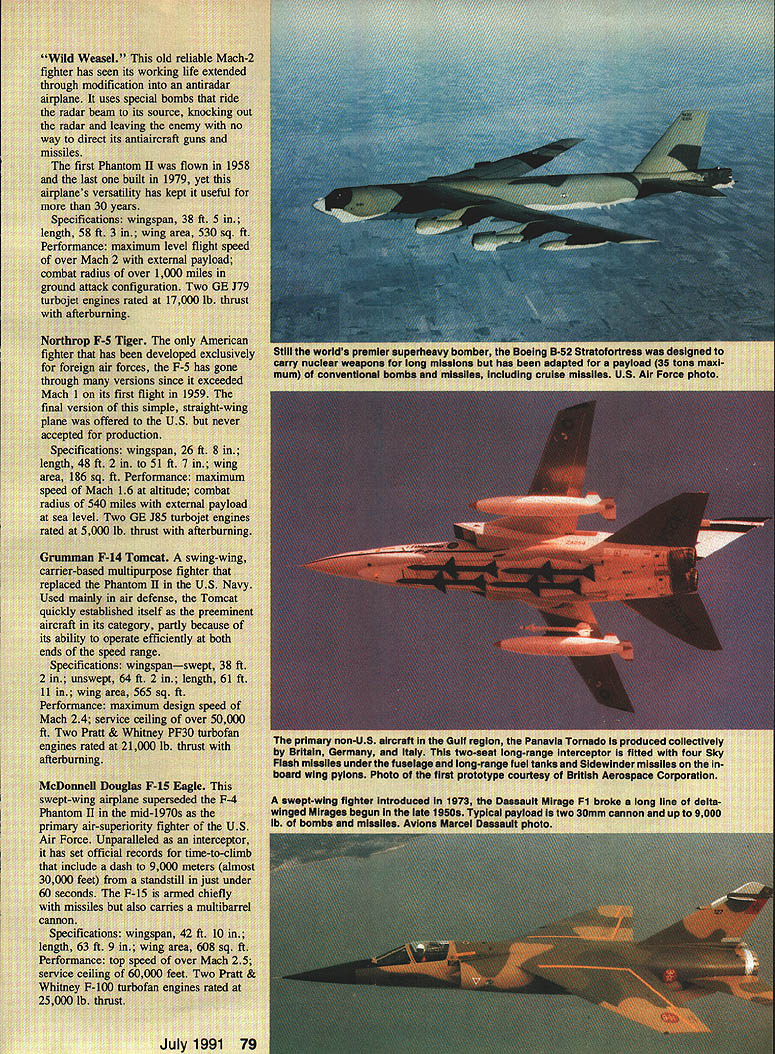
Lockheed ER-2
A single-seater with advanced surveillance equipment, this development of the U-2 spy plane was modified for Earth Resources research by NASA.
Specifications: wingspan, 103 ft.; length, 63 ft.; wing area, 1,000 sq. ft. Performance: approximate cruising speed of over 430 mph above 70,000 ft.; operational ceiling of over 90,000 ft. One Pratt & Whitney turbojet engine rated at 17,000 lb. thrust.
British Aerospace VC-10
This is an aerial tanker modified from long-range airliners that were bought by the RAF from British Overseas Airways (VC-10 Mk.2) and East African Airways (Super VC-10 Mk.3). Built by Vickers, they replace older Handley Page Victor modified bombers.
Specifications: wingspan, 146 ft. 2 in.; length—Mk.2, 158 ft. 8 in., Mk.3, 171 ft. 8 in. Performance: cruising speed of 580 mph; range of 4,700 miles; service ceiling of 38,000 ft. Powered by four rear-mounted Rolls‑Royce Conway turbofan engines rated at 21,800 lb. thrust.
Lockheed S-3 Viking
The standard U.S. shipboard antisubmarine patrol bomber, the Viking has been developed into tanker and antishipping versions.
Specifications: wingspan, 68 ft. 8 in.; length, 53 ft. 4 in. Performance: top speed of 518 mph; range of 2,300 miles with maximum payload. Powered by two GE TF34 turbofan engines rated at 9,300 lb. thrust.
British Aerospace Nimrod Mk.1
A standard Royal Navy maritime reconnaissance airplane, the Mk.1 was developed from the final 4C version of the pioneering de Havilland Comet airliner. Loaded with electronic gear, it can carry torpedoes, depth charges, and missiles.
Specifications: wingspan, 114 ft. 10 in.; length, 126 ft. 9 in.; maximum weight, 178,000 lb. Performance: range of 5,700 miles; cruising speed of 575 mph. Powered by four Rolls‑Royce RB168 Spey turbofan engines rated at 11,500 lb. thrust.
The concluding installments of this three-part article will survey allied helicopters and Iraqi aircraft and missiles.
Transcribed from original scans by AI. Minor OCR errors may remain.

