
Part III: Aircraft of the Gulf War
Those Scuds that arced across the Iraqi night sky on your TV screen, often exploding in a ball of fire when intercepted by a Patriot, were virtually the only missiles that Iraq still was able to launch after the first hours of fighting in the Persian Gulf War. Most of Saddam Hussein's more sophisticated aircraft also never saw battle. Conclusion of a three-part article. — Don Berliner
The first two installments of this three-part series presented in-depth coverage of the aircraft, helicopters, and missiles that were used by or available to the allied coalition in the recent Persian Gulf War. This month's conclusion surveys the aircraft and missiles that were available to the Iraqi side.
The Gulf War probably will be remembered as among the most one-sided conflicts in history. While the allied forces used large numbers of highly developed weapons with great effectiveness, Iraq kept the best of its high-quality equipment in reserve, using few of the airplanes and none of the high-technology missiles in its armory. In the first few hours of fighting, allied forces crippled the control systems for the more sophisticated Iraqi missiles, forcing Saddam Hussein to rely on the much less accurate Scuds for the rest of the war.
Iraqi Airplanes
Mirage F.1
Entering service with the French Air Force in 1973, this all-weather interceptor has been used by at least 10 countries in both fighter and ground-attack versions. The craft carries a standard armament of two 30mm cannon and up to 8,800 lb. of external load (missiles, rockets, reconnaissance pod).
- Specifications: wingspan, 27 ft. 7 in.; length, 49 ft. 3 in.; wing area, 269 sq. ft.
- Performance: top speed at low altitude, Mach 1.2; at high altitude, Mach 2.2. One SNECMA Atar turbojet engine rated at 16,000 lb. thrust with afterburning.
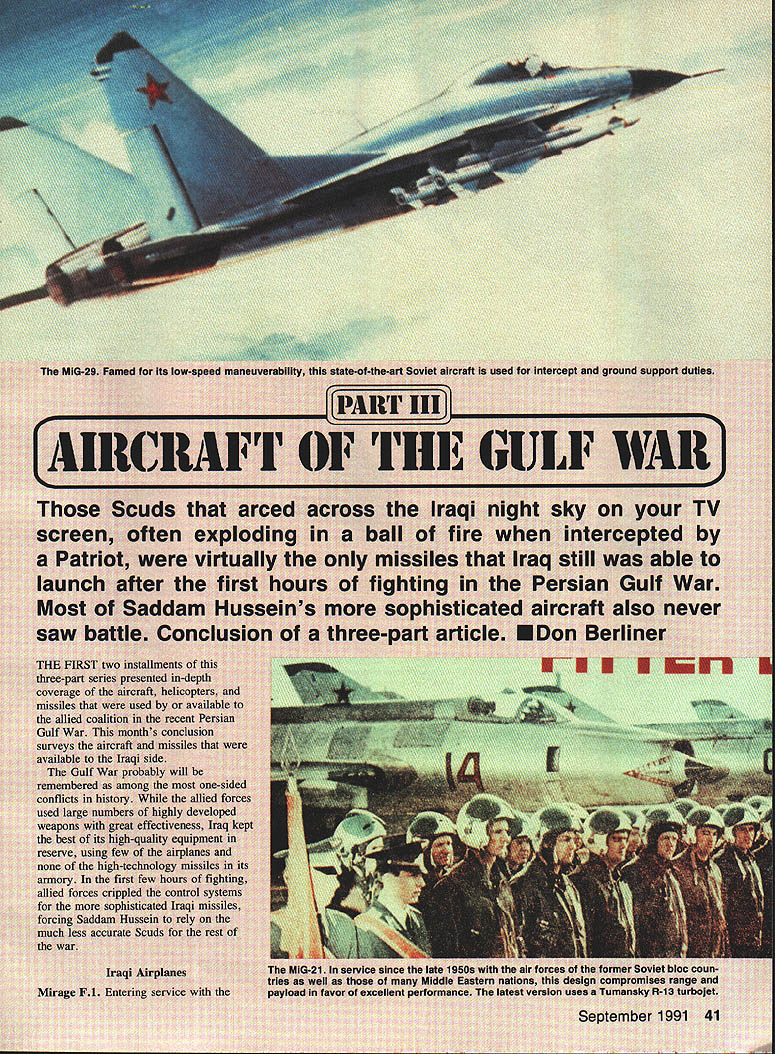
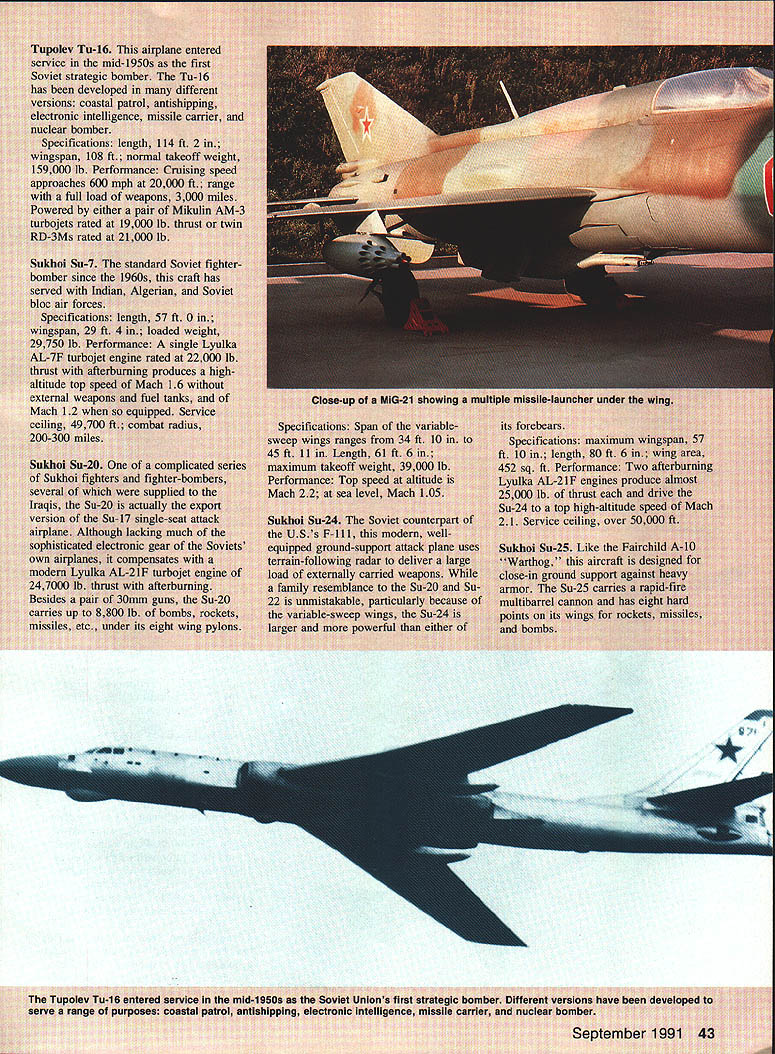
MiG-21
In service since the late 1950s with the air forces of the former Soviet bloc countries as well as with those of many Middle Eastern nations, this design grew directly out of experience with the MiG-15, which featured prominently in the Korean War. The MiG-21 represented a compromise: it delivers excellent performance, but at the cost of range and payload. Armament includes a twin-barrel 23mm gun and four underwing pylons for missiles or fuel tanks.
- Specifications: length, 44 ft. 2 in.; wingspan, 23 ft. 6 in.; maximum takeoff weight, 20,725 lb.
- Performance: The latest version is powered by a Tumansky R-13 turbojet rated at 14,500 lb. thrust with afterburning, giving it a top speed of Mach 2.1 at high altitude and Mach 1.1 at low altitude.
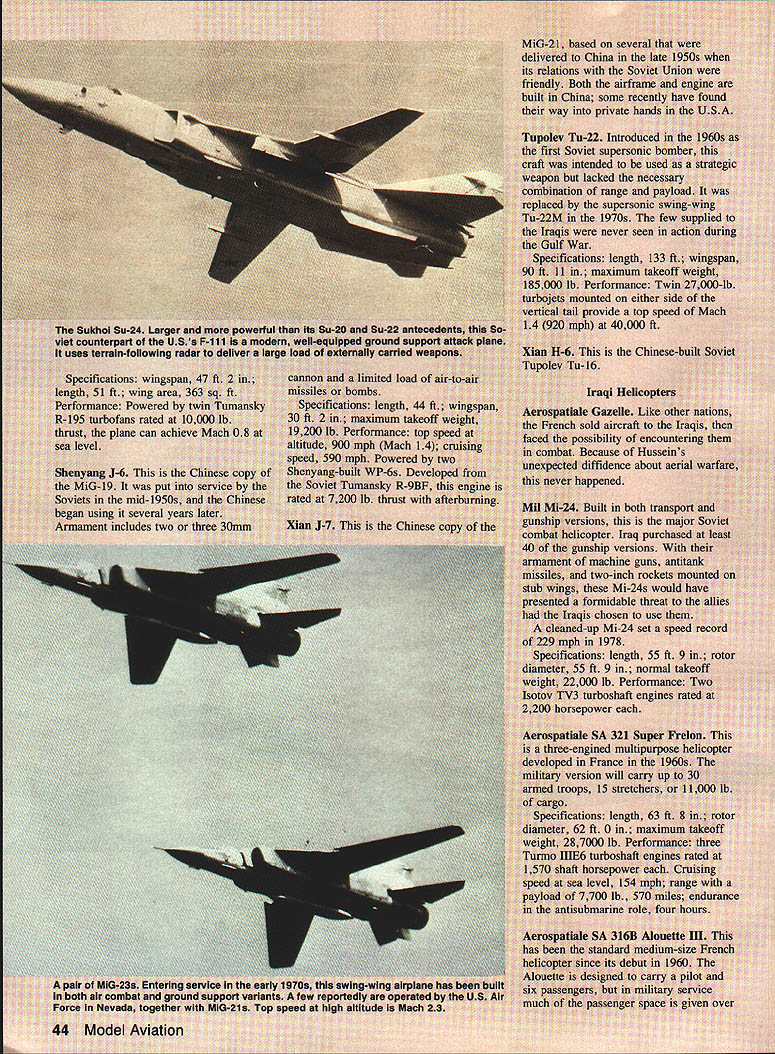
MiG-23
A swing-wing airplane built in both air combat and ground support versions, the MiG-23 first entered service in the early 1970s. Several thousand have been built, with a few reportedly operated by the U.S. Air Force (along with MiG-21s and other types) in Nevada. The craft is standard in the former Warsaw Pact countries as well as in at least a dozen other air forces.
- Specifications: wingspan varies from 26 ft. 10 in. to 46 ft. 9 in.; length, 55 ft. 2 in.; maximum takeoff weight, 33,000 lb.
- Performance: One Tumansky R-29 turbojet rated at 27,500 lb. thrust with afterburning, giving a top speed of Mach 2.3 at high altitude and Mach 1.1 down low.
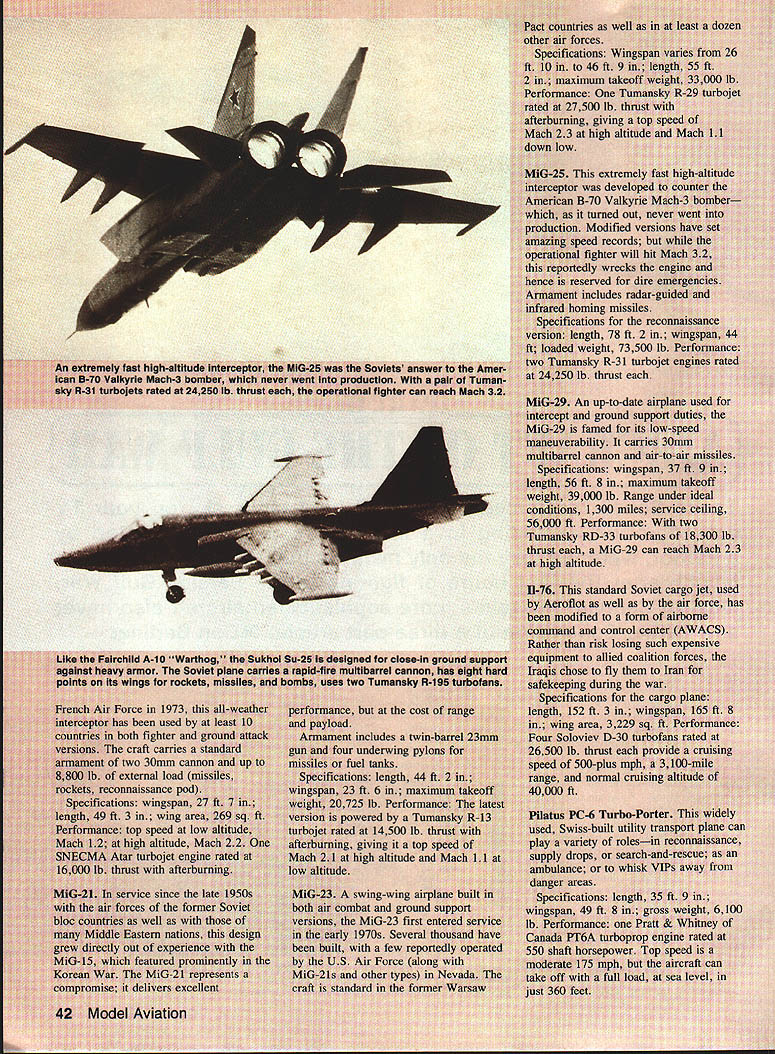
MiG-25
This extremely fast high-altitude interceptor was developed to counter the American B-70 Valkyrie Mach-3 bomber—which never went into production. Modified versions have set amazing speed records; but while the operational fighter will hit Mach 3.2, this reportedly wrecks the engine and hence is reserved for dire emergencies. Armament includes radar-guided and infrared-homing missiles.
- Specifications (reconnaissance version): length, 78 ft. 2 in.; wingspan, 44 ft.; loaded weight, 73,500 lb.
- Performance: two Tumansky R-31 turbojet engines rated at 24,250 lb. thrust each.
MiG-29
An up-to-date airplane used for intercept and ground-support duties, the MiG-29 is famed for its low-speed maneuverability. It carries a 30mm multibarrel cannon and air-to-air missiles.
- Specifications: wingspan, 37 ft. 9 in.; length, 56 ft. 8 in.; maximum takeoff weight, 39,000 lb.; range under ideal conditions, 1,300 miles; service ceiling, 56,000 ft.
- Performance: With two Tumansky RD-33 turbofans of 18,300 lb. thrust each, a MiG-29 can reach Mach 2.3 at high altitude.
Il-76
This standard Soviet cargo jet, used by Aeroflot as well as by the air force, has been modified to a form of airborne command and control center (AWACS). Rather than risk losing such expensive equipment to allied coalition forces, the Iraqis chose to fly them to Iran for safekeeping during the war.
- Specifications (cargo plane): length, 152 ft. 3 in.; wingspan, 165 ft. 8 in.; wing area, 3,229 sq. ft.
- Performance: Four Soloviev D-30 turbofans rated at 26,500 lb. thrust provide cruising speed of 500-plus mph, a 3,100-mile range, normal cruising altitude 40,000 ft.
Pilatus PC-6 Turbo-Porter
This widely used Swiss-built utility transport plane can play a variety of roles—in reconnaissance, supply drops, search-and-rescue, ambulance use, or to whisk VIPs away from danger areas.
- Specifications: length, 35 ft. 9 in.; wingspan, 49 ft. 8 in.; gross weight, 6,100 lb.
- Performance: Pratt & Whitney Canada PT6A turboprop engine rated at 550 shp. Top speed is a moderate 175 mph; the aircraft can take off at full load, at sea level, in just 360 feet.
Tupolev Tu-16
This airplane entered service in the mid-1950s as the first Soviet strategic bomber. The Tu-16 has been developed in many different versions: coastal patrol, antishipping, electronic intelligence, missile carrier, and nuclear bomber.
- Specifications: length, 114 ft. 2 in.; wingspan, 108 ft.; normal takeoff weight, 159,000 lb.
- Performance: Cruising speed approaches 600 mph at 20,000 ft.; range with a full load of weapons, 3,000 miles. Powered by either a pair of Mikulin AM-3 turbojets rated at 19,000 lb. thrust or twin RD-3Ms rated at 21,000 lb.
Sukhoi Su-7
The standard Soviet fighter-bomber since the 1960s, this craft has served with Indian, Algerian, and Soviet bloc air forces.
- Specifications: length, 57 ft. 0 in.; wingspan, 29 ft. 4 in.; loaded weight, 29,750 lb.
- Performance: A single Lyulka AL-7F turbojet engine rated at 22,000 lb. thrust with afterburning produces a high-altitude top speed of Mach 1.6 without external weapons and fuel tanks, and of Mach 1.2 when so equipped. Service ceiling, 49,700 ft.; combat radius, 200–300 miles.
Sukhoi Su-20
One of a complicated series of Sukhoi fighters and fighter-bombers, several of which were supplied to the Iraqis, the Su-20 is actually the export version of the Su-17 single-seat attack airplane. Although lacking much of the sophisticated electronic gear of the Soviets' own airplanes, it compensates with a modern Lyulka AL-21F turbojet engine of 24,700 lb. thrust with afterburning. Besides a pair of 30mm guns, the Su-20 carries up to 8,800 lb. of bombs, rockets, missiles, etc., under its eight wing pylons.
- Specifications: span of the variable-sweep wings ranges from 34 ft. 10 in. to 45 ft. 11 in.; length, 61 ft. 6 in.; maximum takeoff weight, 39,000 lb.
- Performance: Top speed at altitude is Mach 2.2; at sea level, Mach 1.05.
Sukhoi Su-24
The Soviet counterpart of the U.S.'s F-111, this modern, well-equipped ground-support attack plane uses terrain-following radar to deliver a large load of externally carried weapons. While a family resemblance to the Su-20 and Su-22 is unmistakable, particularly because of the variable-sweep wings, the Su-24 is larger and more powerful than either of its forebears.
- Specifications: maximum wingspan, 57 ft. 10 in.; length, 80 ft. 6 in.; wing area, 452 sq. ft.
- Performance: Two afterburning Lyulka AL-21F engines produce almost 25,000 lb. of thrust each and drive the Su-24 to a top high-altitude speed of Mach 2.1. Service ceiling, over 50,000 ft.
Sukhoi Su-25
Like the Fairchild A-10 "Warthog," this aircraft is designed for close-in ground support against heavy armor. The Su-25 carries a rapid-fire multibarrel cannon and has eight hard points on its wings for rockets, missiles, and bombs.
- Specifications: wingspan, 47 ft. 2 in.; length, 51 ft.; wing area, 363 sq. ft.
- Performance: Powered by twin Tumansky R-195 turbofans rated at 10,000 lb. thrust, the plane can achieve Mach 0.8 at sea level.
Shenyang J-6
This is the Chinese copy of the MiG-19. It was put into service by the Soviets in the mid-1950s, and the Chinese began using it several years later. Armament includes two or three 30mm cannon and a limited load of air-to-air missiles or bombs.
- Specifications: length, 44 ft.; wingspan, 30 ft. 2 in.; maximum takeoff weight, 19,200 lb.
- Performance: top speed at altitude, 900 mph (Mach 1.4); cruising speed, 590 mph. Powered by two Shenyang-built WP-6s developed from the Soviet Tumansky R-9BF; this engine is rated at 7,200 lb. thrust with afterburning.
Xian J-7
This is the Chinese copy of the MiG-21, based on several that were delivered to China in the late 1950s when its relations with the Soviet Union were friendly. Both the airframe and engine are built in China; some recently have found their way into private hands in the U.S.A.
Tupolev Tu-22
Introduced in the 1960s as the first Soviet supersonic bomber, this craft was intended to be used as a strategic weapon but lacked the necessary combination of range and payload. It was replaced by the supersonic swing-wing Tu-22M in the 1970s. The few supplied to the Iraqis were never seen in action during the Gulf War.
- Specifications: length, 133 ft.; wingspan, 90 ft. 11 in.; maximum takeoff weight, 185,000 lb.
- Performance: Twin 27,000-lb. turbojets mounted on either side of the vertical tail provide a top speed of Mach 1.4 (920 mph) at 40,000 ft.
Xian H-6
This is the Chinese-built Tupolev Tu-16.
Iraqi Helicopters
Aerospatiale Gazelle
Like other nations, the French sold aircraft to the Iraqis, then faced the possibility of encountering them in combat. Because of Hussein's unexpected diffidence about aerial warfare, this never happened.
Mil Mi-24
Built in both transport and gunship versions, this is the major Soviet combat helicopter. Iraq purchased at least 40 of the gunship versions. With their armament of machine guns, antitank missiles, and two-inch rockets mounted on stub wings, these Mi-24s would have presented a formidable threat to the allies had the Iraqis chosen to use them.
A cleaned-up Mi-24 set a speed record of 229 mph in 1978.
- Specifications: length, 55 ft. 9 in.; rotor diameter, 55 ft. 9 in.; normal takeoff weight, 22,000 lb.
- Performance: Two Isotov TV3 turboshaft engines rated at 2,200 horsepower each.
Aerospatiale SA 321 Super Frelon
This is a three-engined multipurpose helicopter developed in France in the 1960s. The military version will carry up to 30 armed troops, 15 stretchers, or 11,000 lb. of cargo.
- Specifications: length, 63 ft. 8 in.; rotor diameter, 62 ft. 0 in.; maximum takeoff weight, 28,700 lb.
- Performance: Three Turmo IIIE turboshaft engines rated at 1,570 shp each. Cruising speed at sea level, 154 mph; range with a payload of 7,700 lb., 570 miles; endurance in the antisubmarine role, four hours.
Aerospatiale SA 316B Alouette III
This has been the standard medium-size French helicopter since its debut in 1960. The Alouette is designed to carry a pilot and six passengers, but in military service much of the passenger space is given over to guns, rockets, and electronic gear.
- Specifications: length, 33 ft. 4 in.; rotor diameter, 36 ft. 2 in.; maximum takeoff weight, 4,850 lb.
- Performance: A single Turbomeca Artouste IIIB turboshaft engine of 870 shp produces a top speed of 130 mph, cruising speed of 115 mph, and service ceiling of 10,500 ft.
Bolkow Bo 105
In much the same class as the Alouette, this German utility craft has been in production since the mid-1960s. A variety of versions has been produced, including the Bo 105 M (VBH) for liaison and observation and the PAH-1, an antitank variant equipped with outriggers to carry six HOT missiles.
- Specifications: length, 38 ft. 11 in.; rotor diameter, 32 ft. 3 in.; maximum takeoff weight, 5,300 lb.
- Performance: Two Allison C250 turboshaft engines rated at 420 shp each provide a top speed of 167 mph and a cruising speed of 152 mph at sea level.
Iraqi Missiles
Deeply apprehensive that the Iraqis would deploy missiles carrying poison gas or nerve gas at some point during the war, allied coalition forces took precautions against that possibility. For reasons that remain unclear, the dreaded chemical or biological offensive never occurred. Had Saddam Hussein used his presumed capability in this regard, allied forces almost certainly would have retaliated and casualties would have far exceeded the actual figures.
Scud (including Al-Hussein and Al-Abbas variants)
Unguided and similar to German V-2 rockets of World War II in their crudity, the Scud and its variants earned notoriety within the allied coalition because of their lack of strike accuracy — when fired at a major target, they might land almost anywhere — and the difficulty of finding and destroying their flatbed truck-style mobile launchers.
The basic Scud is about 20 ft. long, weighs 6,600 lb. at launch, and can deliver an 1,100-lb. payload 175 miles. The Iraqis modified them by reducing the weight of their warheads and increasing their fuel load. The Al-Hussein could travel 375 miles; the Al-Abbas, 575 miles. But as their range increased, their already poor accuracy declined still further.
The Iraqis used Scuds to terrorize civilian populations during the war, keeping them in a state of confusion and fear because they never knew where one of the erratic missiles might strike. Patriot antimissiles succeeded in intercepting most Scuds before they reached their targets. Some exploded in a ball of fire, but others broke up in the air, scattering pieces that damaged buildings or injured people as they fell to earth.
Silkworm
Developed from the Soviet SS-N-2 Styx, this Chinese infrared/radar-guided battlefield missile can carry a warhead of almost 900 lb. for a distance of 26 miles. There is no evidence that the Iraqis used them against allied coalition forces.
- Specifications: length, 26 ft. 6 in.; takeoff weight, 5,000 lb.
Exocet
This French antishipping missile has been used by the Iraqis in the past, notably in an allegedly accidental attack on an American warship several years ago. When launched from Iraq's Super Frelon helicopters, Exocets have an expected range of over 30 miles.
The helicopter's radar and computer provide the terminal guidance until the missile's own homing gear takes over. The warhead is similar to that of a torpedo.
- Specifications: length, 15 ft. 5 in.; wingspan, 3 ft. 7 in.; top speed, 600 mph.
The diversity of aircraft and missiles used by the allied coalition forces and available to the Iraqis was unprecedented in modern warfare, as was the variety of sources from which they were obtained. While the swiftness and decisiveness of the allied victory was partly a result of superior equipment, it also can be traced to superior planning and a greater willingness on the part of Allied soldiers to fight for a cause in which they believed.
Transcribed from original scans by AI. Minor OCR errors may remain.

