
Partners in Flying
Rolland Mast
Every family has traditions, and mine is no exception. The day after Thanksgiving, my wife Mary Lou and our three daughters go shopping, which leaves my son Ryan and me.
When Ryan was six, we did all of the fun things a father and a young son could do. He often commented, "This is my favorite day of the year." We would go to breakfast, walk through toy shops, and buy Ryan a gift. Later we would have lunch, then browse through sports equipment shops. Watching large airplanes take off and land at the airport was a highlight of the day. We would end the day by picking out a Christmas tree to bring home (my wife was happy to leave that to us).
After four years, Ryan and I started looking for new interests. When we passed the local hobby shop, I thought there must be something inside that a 10‑year‑old boy would enjoy. I didn't know that one stop would turn our lives in a different direction. It was the beginning of a partnership, with many new adventures.
We walked into the shop, and Ryan's eyes lit up—model trains, cars, ships, and airplanes. They hung from the ceiling, small ones, big ones, jets, and so on.
"Dad, can we build an airplane someday?" Ryan asked.
"Being a builder by trade," I said without hesitation, "Maybe someday." He meant, "Yes, we will."
Over the next few months we heard about airplanes—a steady reminder that we were going to build. Mary Lou stalled some time about purchasing Radio Control (RC) magazine, but in July the following year Ryan finally convinced her to order a kit. The kit could arrive for his August birthday. Although Mary Lou was apprehensive, she thought it might be good for Ryan to have a project.
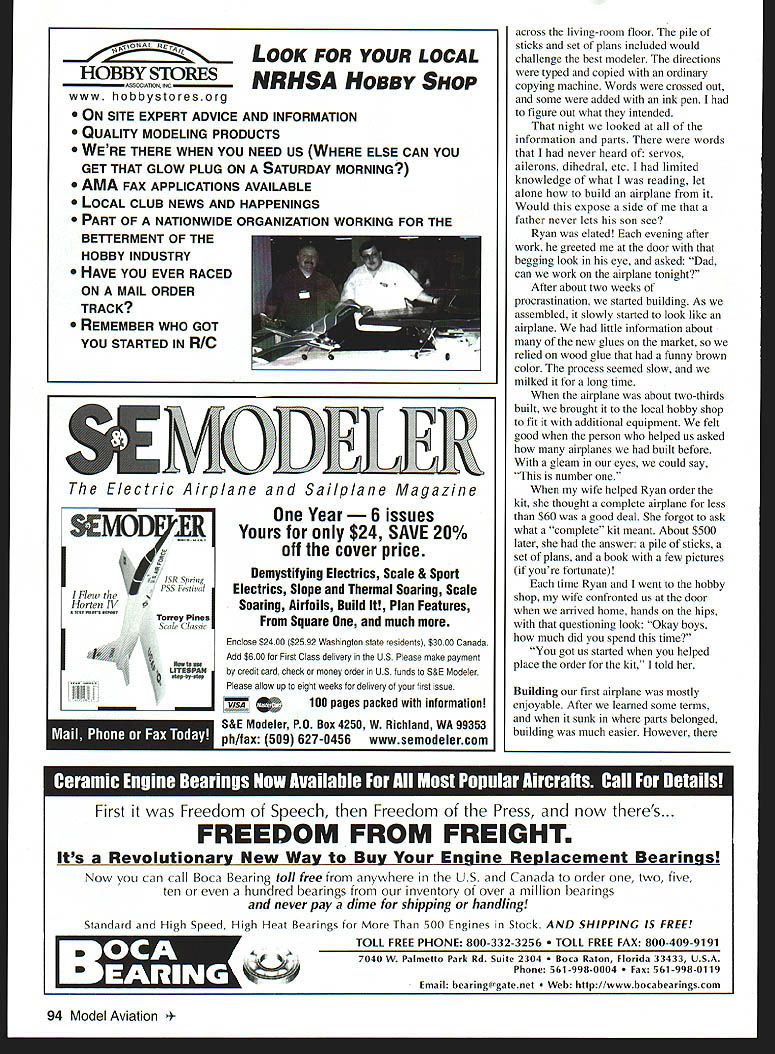
I knew nothing about models. Ryan placed the order and called the clerk, insisting I speak to his mother for approval. Over the next couple of weeks Ryan kept an eye out for the UPS carrier. He had very little experience with airplanes and wasn't sure how to put engine, propeller, tail, and wing together so the plane would fly. Appearance was important to Ryan, so he picked out what he thought would be best for us—a Citabria, a scale model that would fly like a trainer.
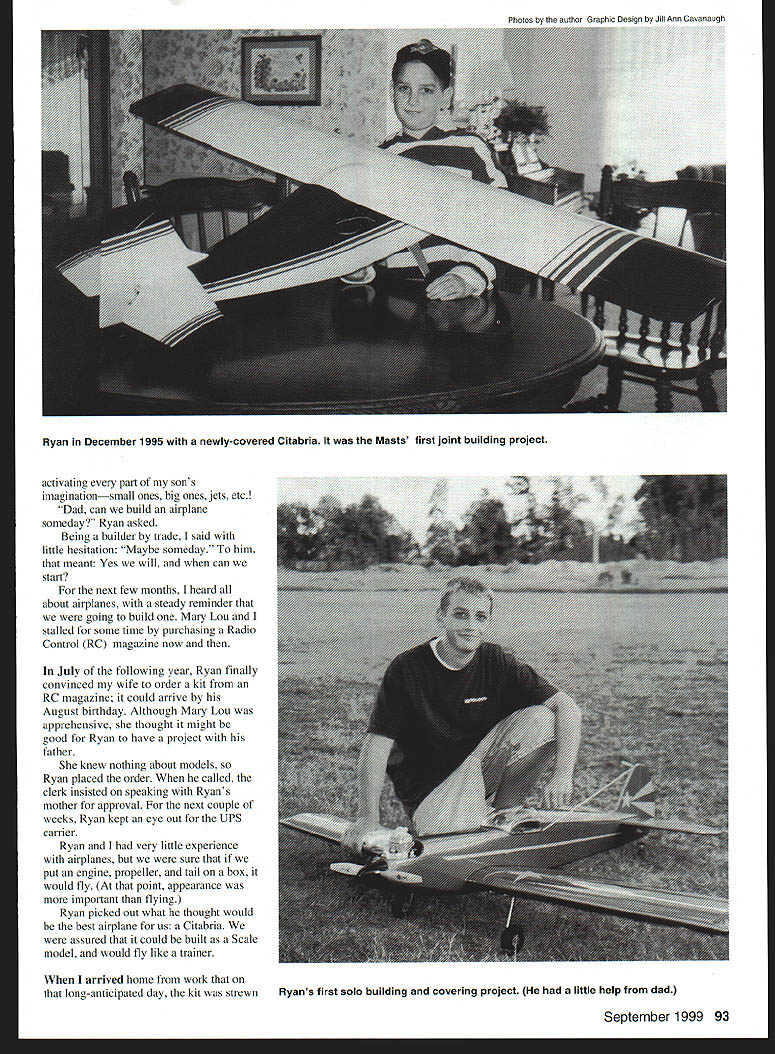
When the kit arrived the long‑anticipated day began. The kit was strewn across the living‑room floor—a pile of sticks and a set of plans that would challenge the best modeler. The directions were typed and copied on an ordinary copying machine. Words were crossed out and some were added in ink; we had to figure out what was intended. At night we looked over the information for parts and words we had never heard—servos, ailerons, dihedral, etc. My limited knowledge of what I was reading, let alone how to build an airplane, would expose a side of a father he never gets to see.
Ryan was elated. In the evening after work he would greet me at the door begging to work on the airplane. "Dad, can we work on the airplane tonight?" he asked. After about two weeks of procrastination, I started building. As we assembled it, it slowly began to look like an airplane. The new glues on the market seemed odd; we relied on wood glue, a funny brown color, and the process seemed slow.
When the airplane was about two‑thirds built, we brought it to the local hobby shop to fit additional equipment. It felt good to be helped by someone who had built airplanes before. Mary Lou helped Ryan order equipment, and we thought we could complete the airplane for less than $60.
When my wife helped place the order she had forgotten to ask what a "complete" kit meant. About $500 later, she had the answer: a pile of sticks, a set of plans, and a book with a few pictures (if you are fortunate!).
Each time Ryan and I went to the hobby shop, Mary Lou confronted us at the door when we arrived home, hands on hips, with that questioning look: "Okay boys, how much did you spend this time?"
Building our first airplane was mostly enjoyable. After we learned some terms, and when it sank in where parts belonged, building was much easier. However, there certainly were times of frustration.
Once I asked Ryan to hand me the dihedral. "Dad, I do not believe that's a part," he said. "I meant the servo," I said. "You're not up to that, either." "Come on, you know what I mean—the aileron."
When my thumb got stuck to the airplane, I learned that debonder has a purpose. I tried lacquer thinner, along with anything else that might work. I used a knife to cut between my skin and the airplane, and there was more skin left on the model than on my thumb. It was sore, but I was free.
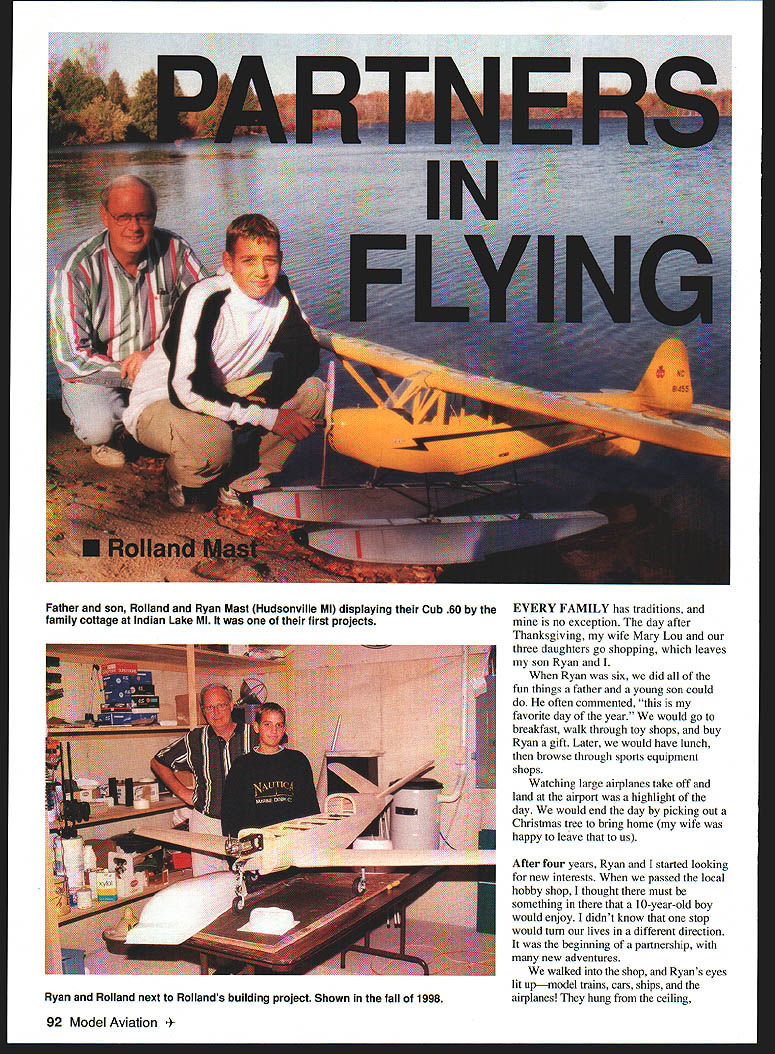
Ryan and I didn't know where to fly our airplane when we completed it. We thought we could find a cow pasture in the country. Joining a club was not an option at the time. Since we owned a cottage, we came up with the bright idea of building a floatplane—a Cub .60 with floats. We could go to the cottage for a relaxing weekend and fly our airplane from a lawn chair.
Between starting the Cub and finishing it, we faced reality: we might not have the skill to fly an airplane without help. It seemed simple: only two controls, and we just had to remember which made the model go up, down, left, or right. Many people who enter this hobby have the same thoughts. After crashing an airplane, very few people are willing to admit that it was because of a lack of skill.
After speaking with several people at the hobby shop, we decided to join the club nearest our residence. We attended our first meeting and filled out an application with the intent of joining. At the second meeting the club would vote to accept or reject us. I am not sure why they have such a rule.
When asked what we were going to fly, we mentioned the Citabria and the Cub .60 with floats. When we told club members that the Citabria was going to be our trainer, they raised their eyebrows. Back to the hobby shop to purchase an ARF (Almost Ready‑to‑Fly) trainer with a .61 engine. After a few more hours of work, Ryan and I were ready to fly—nearly three‑and‑a‑half years after we made that first stop at the hobby shop!
On a warm July night, we loaded our trainer into the van and headed for the field. Ryan and I believed that with a little success we would fly solo in about our second week of flying.
When we unloaded our airplane at the field and started setting up under our instructor's watchful eyes, everything seemed perfect—until instructors advised us to add a little glue here, reinforce the throttle cable a bit, and adjust the throw on the ailerons and rudder. Soon we fueled the airplane and started the engine. Since he was the youngest, my son was first to fly.
One of Ryan's Christmas gifts was an RC flight simulator. We knew that after practicing for several hours, flying would be easy.
Mark, our first instructor, taxied our airplane out to the runway. After he ran it across the field a couple of times, it was ready for liftoff. He slowly eased the throttle up, and the airplane lifted gently into the sky.
With our hearts beating faster and the excitement of seeing our first airplane fly, Ryan and I were on cloud nine. Mark made a few adjustments with the trim settings, and Ryan was ready to fly. I could see the excitement in his eyes. Mary Lou had the video camera, and I was snapping pictures with our 35mm camera.
Ryan was holding the controls. The airplane did not fly as well for him as it did for Mark; it went up, down, and turned left or right when he wanted it to, but on the fifth landing he bounced it and the right main gear folded. The prop struck the ground and the engine quit. I thought we had him too scared to ever try again.
It might take longer than two weeks—maybe several—before we could solo. After about 20 minutes the engine sputtered. Mark took the controls and landed the airplane smoothly.
My 13‑year‑old son flew an airplane! Only a small percentage of young people get to share in this unique experience. The expression on Ryan's face was one only a proud father could read; his first successful flight!
I was next. We refueled the airplane, started the engine, and I began my march out to the pad. Then my disposition began to change. My confidence disappeared; my heart was beating nearly double speed; my knees were shaking, and I wondered if I would be able to stand. My mouth was so dry, it felt as if it was stuffed with cotton.
Mark took the airplane up until I could hardly see it. He did not seem to have much confidence in my flying ability. He should have known that if my son did all right, with my age and ability I would do that much better.
Mark handed me the controls. I made the first turn. The airplane dropped a little. With a couple of corrections, I got it flying straight again.
"I think you're a little inexperienced to try a wave with the wings on your first flight," Mark said. "What do you mean 'a wave with the wings'?" I asked. "That was my thumb shaking on the control."
When I had the controls, the airplane wanted to fly behind me, as it had when Ryan was flying. I managed to keep control, but the airplane went up and down, with turns on the straightaway.
After what seemed a long 20‑minute flight, the airplane began to sputter. As Mark landed it, he asked if I was ready to go again. With the cotton still in my mouth, I told him that Ryan should have another chance. I was ready to collapse from fatigue; my shaking legs did all they could to bring me back to a place of rest.
On the way home, Ryan and I praised each other, but our first flights were much more graceful in our thoughts than the video revealed. We regained our composure and rejuvenated ourselves for the next outing.
"You guys did great," Mary Lou said. I believe that in the back of her mind she knew that it could take us a long time to master flying.
When Ryan and I awoke the next morning, we compared mental notes. During the night we experienced several practice flights. If we went up once, we went up a thousand times, each time looking forward to the real thrill we experienced the night before.
The following Thursday night—trainer night at our field—we met Mike, our second instructor. Some of the feelings from a week before returned.
Mike gave us a few insights on how to fly, and our flights seemed a little smoother. He helped motivate us; he stretched the truth a bit, which made us more confident.
In about our third week, Mike had us doing alignments and low passes. Our knees were shaking less, and the cotton in our mouths was disappearing. I kept hearing that I was doing well, but Ryan was doing better. As much as I love my son, I wondered how that could be. I thought I was his mentor in all of life. Now there was something that he did better than I!
For the following two or three weeks, Dale was our instructor. He is one of our club's better fliers. One rarely sees his serious side; he does his best to keep things light. He keeps flying fun and relaxing, as we thought it would be.
In about our second week with Dale, reality set in for me. He allowed Ryan to land the airplane and take off a few times by himself. I had yet to have a smooth landing, or even line up properly with the runway!
Dale greeted me with news that I was unprepared to hear. "Mr. Mast, I think your son is ready to solo," he said with a serious look. I got a feeling of satisfaction, and a weak smile emerged on my face. As much as it hurt when I realized that Ryan was ahead, I was equally proud to know that he had mastered flying.
Ryan declined to solo that evening. I think he felt that it would hurt me too much, although I know it would have been all right. I needed to concentrate more and exercise some of the patience I had tried to teach him in the building process.
A week later, Ryan soloed; it was a great feeling for both of us. That meant we could go to the field at times other than trainer night. Then I began to understand our roles as members of our flying club. I would not be a competitor in Top Gun or a team fun‑fly. My goal was to learn how to fly fairly well and enjoy it. I would leave the competition up to Ryan.
Late one afternoon, a few weeks after Ryan soloed, we went flying. Ryan took the airplane up first and landed as if he had been doing it for 20 years.
I felt confident; I had taken off and landed with the instructor several times. I took the controls and taxied the airplane down the runway. I increased the throttle slowly, and just before liftoff I clipped a weed. The airplane still went up and made a fairly smooth bank to the left. Suddenly, it parked in front of the sun. There was a blur across the sky. By the time I realized what was happening, the model's wing had clipped a tree.
The worst thing that could happen did, and my wife witnessed everything.
I once read that if a person crashes an RC airplane, don't speak with him or her for at least a half‑hour. Now I know why. It's kind of like falling on ice; the first thing a person does, even before getting up, is look around to see if anyone saw him. A group of young boys witnessed my crash and rushed over.
"Wow, that was quite a crash," they said. Mary Lou and Ryan were understanding. They watched me back the van up to the crashed airplane. In seconds, I loaded up what was left. I did not want to see, hear, or communicate with anyone. I had two goals: to get lost, and to erase what had happened from my mind.
I could think of only one way to correct the situation: make a quick trip to the hobby shop and replace the airplane.
Within a week, I was up and running again—less confident, somewhat shaken, and much more humble. Through it all, my goal remained intact: to master the art of flying an RC airplane.
Nearly two flying seasons have passed. Ryan has his pilot's license, and I soloed in early spring. Flying has become the hobby we wished for when we began. We look forward to going to the field, flying, and socializing with other club members.
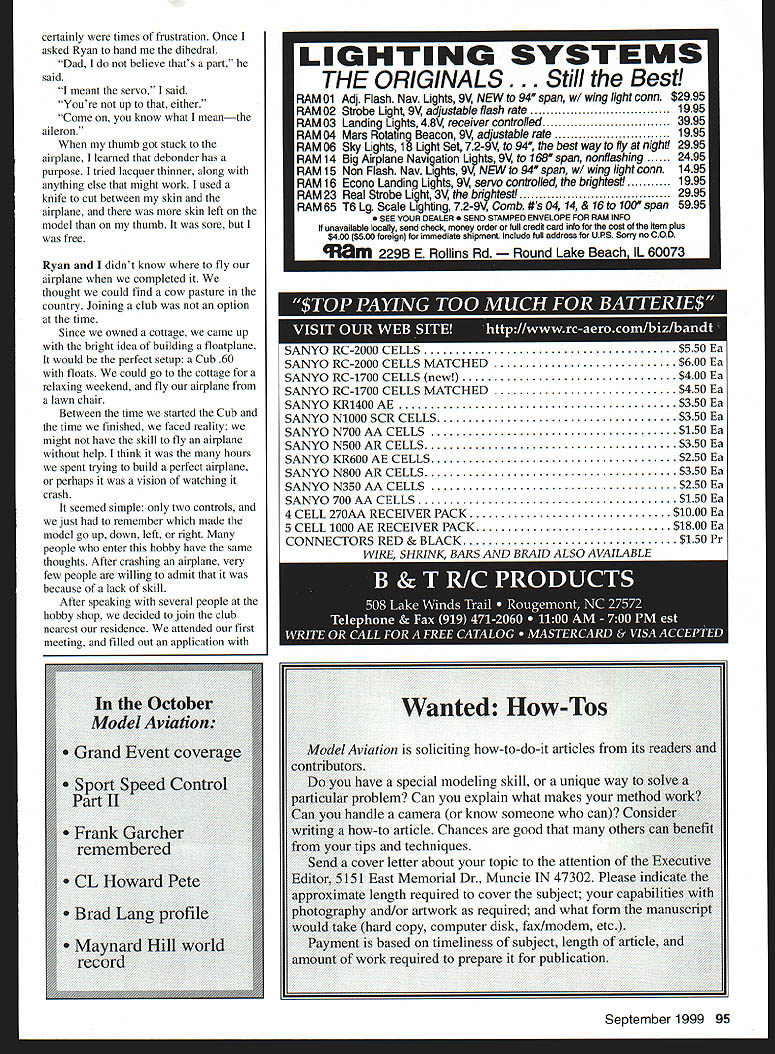
As of this writing, we are building our eighth airplane. I enjoy building about as much as flying, although each aspect is unique. Ryan flew in his first competition last summer with an airplane that he built by himself.
The Cub .60 that we fly at our cottage inspires many comments. Several times we have heard applause when we finished a successful flight. In what other hobby besides RC flying can one enjoy such a wide variety of challenges and satisfactions?
Times that Ryan and I spend flying and traveling to the field, and countless hours spent in our workroom on airplanes, are immeasurable. We share everything, from Ryan's friends to the values my wife and I tried to instill in him as a child.
We even learn to compromise: when selecting a radio station, it is somewhere between what I can tolerate and what is acceptable to a young person.
It is difficult to describe the joy a father experiences when he passes along some of the skills that he has developed through the years. Watching my son develop his ability to construct, read prints, and follow instructions is something that can never be taken away. Truly, this is a partnership that will last a lifetime.
Rolland Mast 4368 Creek View Dr. Hudsonville, MI 49426
Transcribed from original scans by AI. Minor OCR errors may remain.

