
Pass on the Thrill of Flying
By Lynton Younger
Lake County News-Herald photos by Duncan Scott
You and/or your club can provide a community service by organizing and teaching modeling classes in conjunction with schools or recreation departments. It's a rewarding experience.
The class had been taught, and the planes were built. They were all flight-trimmed, and the contest was in progress. Timing one of the planes while it circled overhead, my attention was suddenly drawn to the builder. He was frantically shouting, begging, and pleading with his plane: "Stay up! Stay up! Stay up!" He was running in circles beneath his plane, thoroughly excited, completely caught up in the flight.
I realized, again, what it is like to be a new modeler and to see your creation actually flying. Some of us have largely forgotten that excitement, but it is a joy to stimulate it in others.
We need to enlist new modelers. Young people growing up today do not know the newly created romance of flying as we did. They don't have the love affair with airplanes that we had. They have more to do, more distractions. But they can be captured by the thrill of modeling if we show them how to do it and introduce them to the fun.
After we taught a class at an elementary school, the teacher had the boys write me letters expressing their feelings. One of them wrote:
"Thank you for helping me make the airplane. I liked it very much. I hope we have Winter Wings again next year because I'll join again. I loved to fly my airplane. It was lots of fun. Next time I will go to the store; I'm going to buy an airplane kit . . ."
He got the message.
Most of us belong to model airplane clubs. These clubs need to be operated, at least in part, in the public interest. Our Mentor Area Radio Control Society (MARCS) has discovered that educating and entertaining the public pays off. Two different newspapers have written up the classes we taught.
What kind of classes are we talking about?
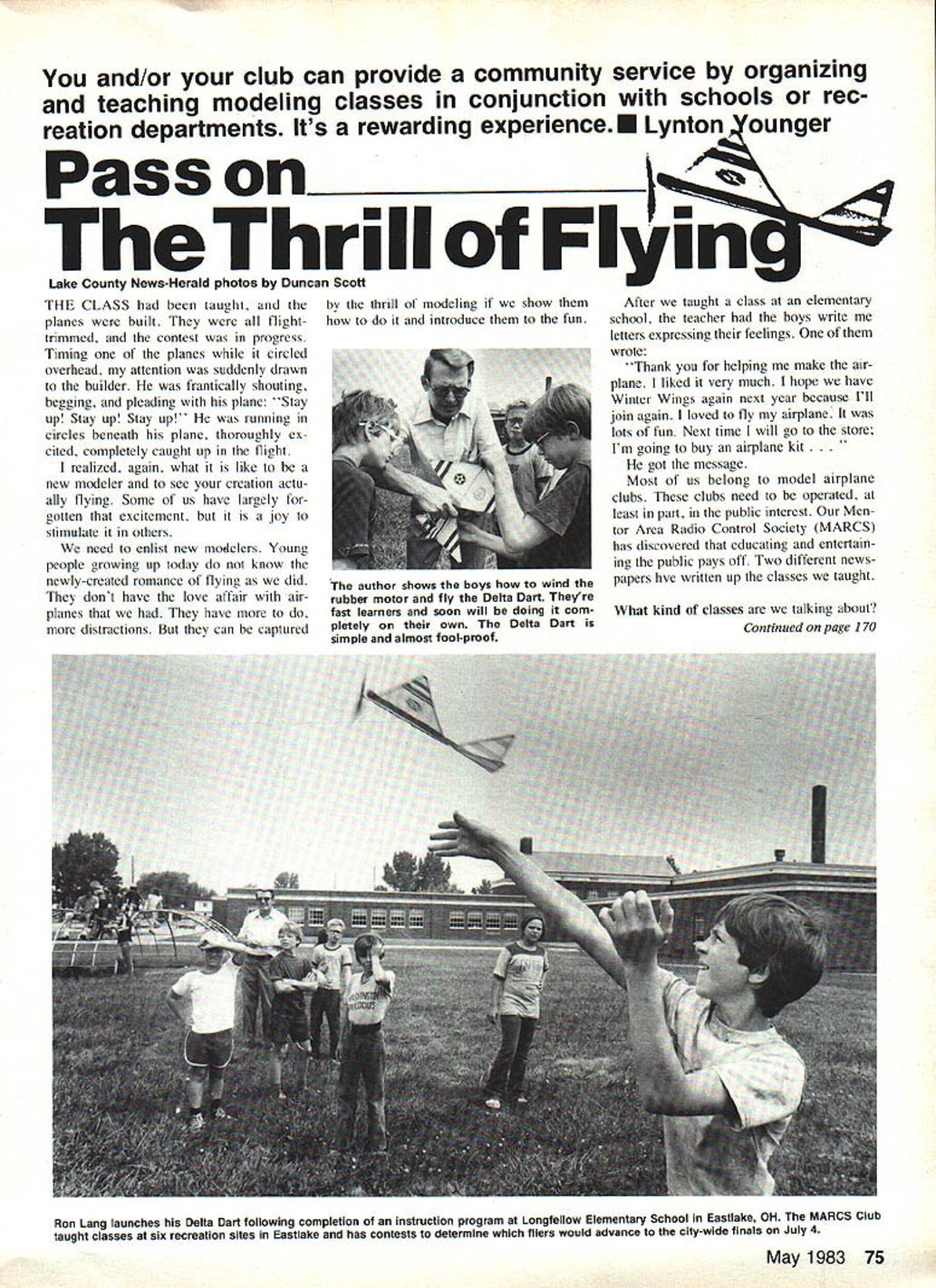
One of the best ways to introduce boys and girls to modeling is to teach a class in how to build and fly the Delta Dart. It is simple and almost fool-proof. A novice builder can build one in an hour. You can buy them inexpensively in large quantities. Complete instructions are included in the kit. I have helped teach about 30 of these classes, and I can assure you it is a piece of cake for a modeler.
Where can these classes be taught?
- Schools
- You can teach them in a school under the sponsorship of the P.T.A. Father‑son or father‑daughter activities are almost always welcomed. The child builds the plane while the father helps. You, the modeler, are there to answer questions and to advise. While the glue on the completed model is drying, you can have model demonstrations or talks to acquaint people with your own modeling activities. Use a fast‑drying white glue if you do it this way.
- When the glue has dried, you and the children can go to where they will be flown—usually outdoors on the playground, but sometimes in the gym when the weather is bad. Then, after the planes are wound, you can have a mass launch. The last one down is the winner. This is a quick and easy way, but it is not my favorite.
- City recreation departments
- Recreation departments are usually delighted to have your free help. Actually, we have found that when the word gets around they will call you asking you to teach these classes. Recreation department classes are taught in the summer during the day, and you don't have the help of the parents. Several modelers need to be there to assist. I like to have one modeler for every eight or ten pupils.
- In Eastlake, OH, for example, there are six recreation sites. We taught classes in each of these and had contests to determine which fliers would advance to the city-wide finals. The community has a huge all-day celebration on July 4th at the high school. We had the city-wide contest at this event. It was good publicity for modeling!
- Special school programs and camps
- An elementary school in Chardon, OH was having five weeks of special crafts. They invited us to teach there one day each of the five weeks. That was ideal. We had plenty of time to build the planes, talk about what makes an airplane do different things, teach them how to flight-trim a model, get their planes trimmed, and have a very fine contest.
- They became rather serious about that contest. One boy wrote, and I quote him exactly: "I think airplanes were fun to build but there even funner to fly. When I didn't win I felt like stomping on it . . ." (Gosh, could I relate to that feeling!)
- I even had the opportunity to teach classes in boys camps for two summers. That was fun—all week long to build and fly! The second year we built 80 planes. I will never forget one evening. We got all those boys together at once, and the sky was filled with airplanes. I don't know who loved it more—the boys, or me.
- Churches
- We have taught classes in churches. In one church we even went beyond the Delta Dart and taught a second class in how to build and fly the Sig Cub.
How do you go about teaching these classes?
First, you gather the materials. You will need:
- Cardboard building boards large enough to hold the plan of the Delta Dart
- Fast-drying white glue
- Straight pins
- Razor blades
- Scissors
- Bottle caps to put the glue in
- Modeling clay for nose weight and to put on the wing tips to make the planes circle
If you want a contest, the quickest way is to let them all fly at once without being trimmed out. This works, but there is a better way if you are willing to go to a little extra trouble.
We like to teach them how to flight-trim their planes so they will get the most performance out of them. Rubber bands are included in the kits, but we furnish contest rubber. We lubricate the rubber, and we teach them how to stretch-wind. With this extra help, these planes are capable of spectacular flights.
One girl launched her plane on the south end of a very large school ground. It caught a thermal, flew completely across the school yard, over several trees, and down a street. It probably went 400 yards. We had some planes which stayed up over a minute. I still remember the look of disbelief on the face of one teenage boy who watched his plane fly on and on and on. Evidently, he had never built a plane which would fly like that before, and he could not get over it. I think it is worth the extra trouble to get the planes to fly this well.
Why should we give our time and energy to do this?
Most of us are captivated by the beauty of flight—this is why we are in this hobby. We need to share this thrill, this joy. I know I have done just about everything in modeling that I can do. I have built and flown all kinds of planes. I have followed the contest trail. Now, I get my kicks from helping others to discover the thrills I have enjoyed over the years. Many of you are in the same situation and should be doing the same thing.
I conclude with this letter that a boy wrote to me:
"Thank you for coming to teach us about airplanes. I learned that building and flying airplanes is a lot of fun. Me and my dad are working on my model airplane. I hope it flies."
He had a good time. He discovered the thrill of flying. This is what we need to pass on.
Editor’s Note
Delta Darts in bulk packs of 40 may be obtained for $17.00 ($15 for the pack, plus $2 shipping) from Midwest Products Co., School Division, P.O. Box 564, Hobart, IN 46343. Each pack includes a Teacher's Guide and Assembly Instruction sheets.
Transcribed from original scans by AI. Minor OCR errors may remain.

