
From the Past: Airplane Toys
By Steve Kanyusik
When Charles Lindbergh crossed the Atlantic, people were enthralled by his achievement. Notables acclaimed him, and crowds swelled the airfields he landed on. Adulation for Lindbergh's heroism wasn't limited to his native country but spread to other parts of the globe, and youngsters were as fascinated as adults. One would have to turn to the rock stars of today to find a cultural idol of comparable stature among the youth of our time.
As one who grew up in the late Twenties, I shared the general obsession with the adventure of flight. Like others of my generation, I started building models just as soon as I was old enough. Kits were scarce and we didn't have the money to buy them anyway. The next best thing was the corner grocery store.
No—old Max Simon didn't carry model airplane kits, but he did have orange and apple crates. My friends and I would arrange to "liberate" some of these wooden boxes for our needs. Of course we lacked skills in the beginning, and our first models were very primitive. The penknife was our primary modeling tool, and sometimes our only one.
In those days carrying a pocketknife was a sign that you were a responsible person. The pocketknife was a rite of passage. We played mumblety-peg with it; we used it to peel our kohlrabi and carrots. A pair of high-top boots from Sears, Roebuck and Co. often came with a jackknife in its pocket—a proud possession indeed for the lucky wearer.
When you wore those boots, the knife always went with you. It was never used in anger, but strictly for fun and craft. We whittled whistles from green branches, made slingshots, or whatever else caught our fancy. We also, of course, used it for building model airplanes. We usually couldn't get sandpaper; when we couldn't get a file from home, we'd use the sidewalk to smooth the rough edges of our projects.
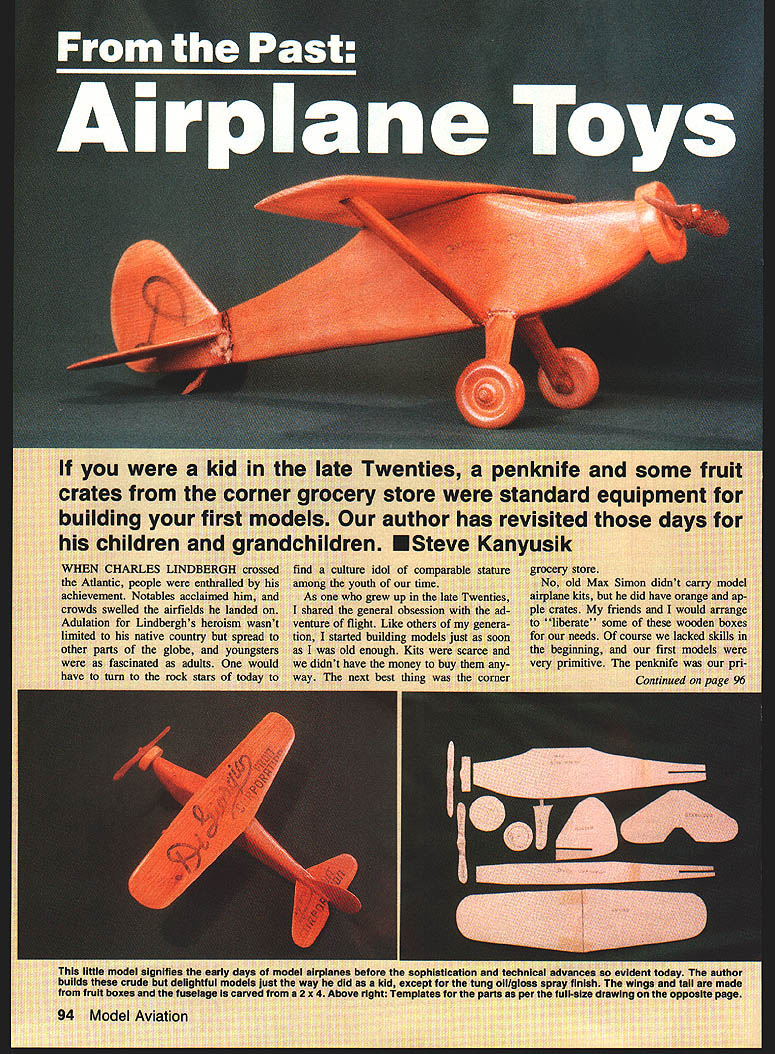
I've recreated some of these simple planes for my children and grandchildren to play with. They make great conversation pieces, and I've even made some for friends who requested them. I keep a supply of printed fruit boxes and use a 2x4 for the fuselage. The wheels are purchased from a hobby shop. I finish the models by rubbing in tung oil and then spraying them with a glossy finish. I've made some low-wingers, but there weren't many of those around in my time.
Building one of these primitive, Lindbergh-era model airplanes for a child today lets them imagine the creative thrill you experienced as a make-believe pilot. It's a great way to revisit those years when you first felt the joy of aviation.
Transcribed from original scans by AI. Minor OCR errors may remain.

