
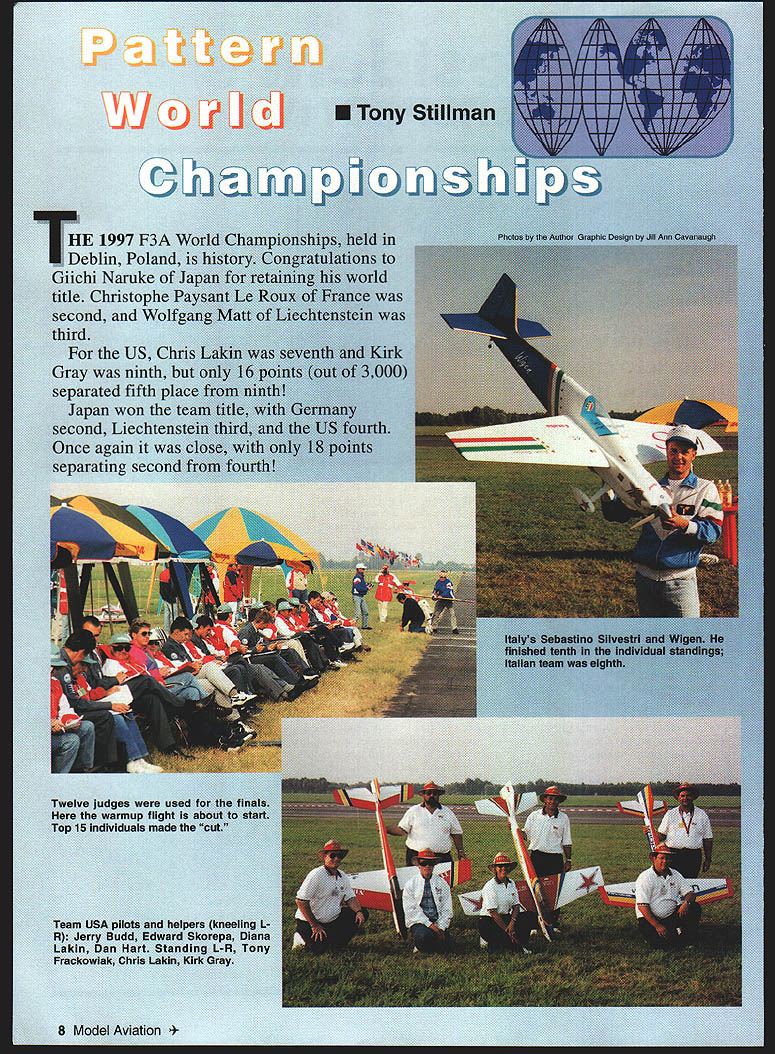
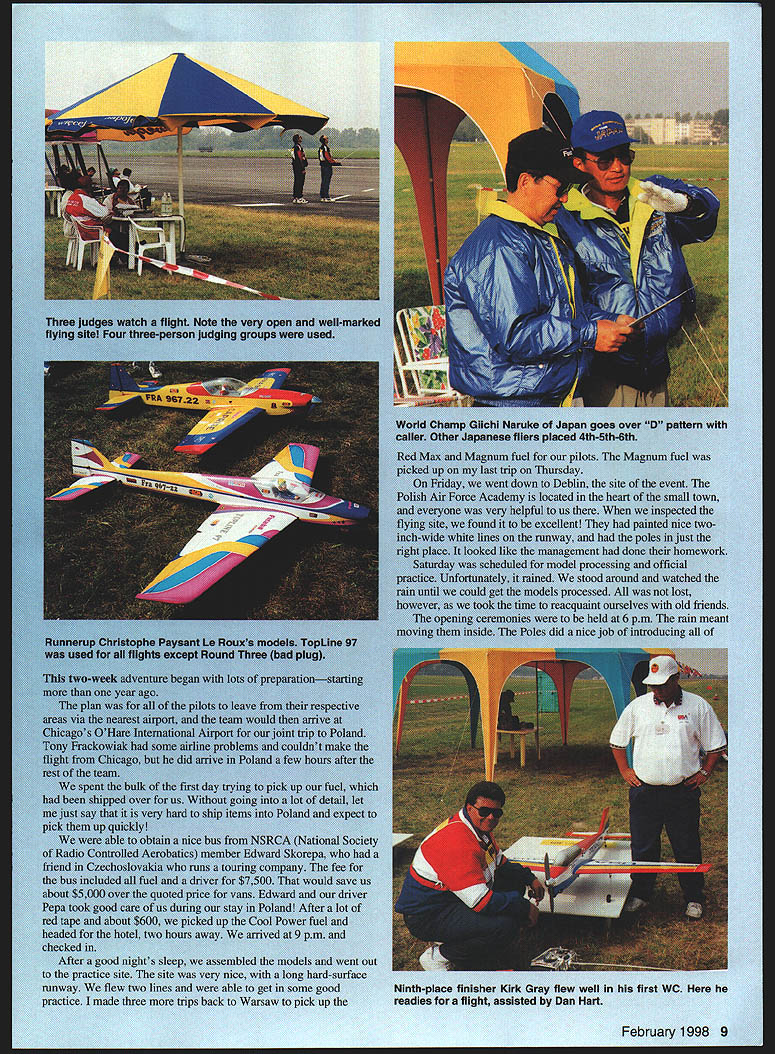
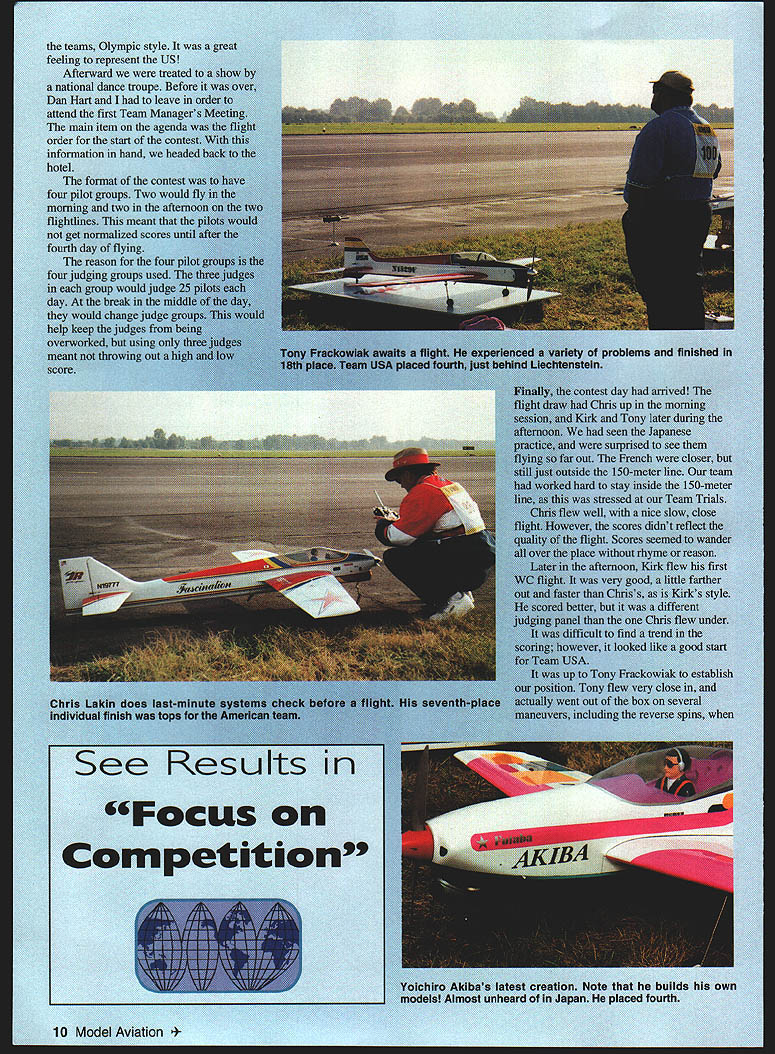
Pattern World Championships
Tony Stillman
Results
- Individual
- 1st: Giichi Naruke (Japan)
- 2nd: Christophe Paysant Le Roux (France)
- 3rd: Wolfgang Matt (Liechtenstein)
- Team
- 1st: Japan
- 2nd: Germany
- 3rd: Liechtenstein
- 4th: United States
Notable U.S. finishes: Chris Lakin 7th, Kirk Gray 9th, Tony Frackowiak 18th. Only 16 points separated 5th through 9th individually, and only 18 points separated 2nd through 4th in the team standings.
Travel and preparation
The two-week trip to the 1997 F3A World Championships in Deblin, Poland, began more than a year earlier with planning and coordination. Our pilots flew from their respective areas to Chicago O'Hare for the joint leg to Poland. Tony Frackowiak had airline problems and missed the Chicago flight, but he arrived in Poland a few hours after the rest of the team.
We had trouble obtaining fuel that had been shipped ahead — it is difficult to ship items into Poland and pick them up quickly. Thanks to NSRCA member Edward Skorep, we obtained a bus (driver Pepa) from a Czech touring company for $7,500; the fee included fuel and driver and saved about $5,000 compared to vans. After dealing with red tape and about $600 in fees, we picked up Cool Power fuel and headed to the hotel, arriving around 9 p.m.
I made three trips back to Warsaw to pick up Red Max and Magnum fuel for our pilots; the Magnum fuel was retrieved on my last trip on Thursday.
Practice and the flying site
After a night's sleep we assembled models and went to the practice site. The practice field had a long hard-surface runway with two flying lines; we got in solid practice. When we inspected the Deblin site (home to the Polish Air Force Academy) we found an excellent facility: two-inch-wide painted white lines on the runway and well-placed poles—management had clearly prepared well.
Saturday was scheduled for model processing and official practice, but rain forced us to move things indoors. The opening ceremonies were moved inside as well; the Poles introduced the countries and put on a national dance troupe.
Contest format and judging
The contest used four pilot groups (two fly in the morning, two in the afternoon) on two flight lines. This arrangement delayed normalized scoring until after the fourth day of flying. There were four judge groups; each group of three judges judged 25 pilots per day and rotated at midday. The rotation helped reduce judge fatigue, but with only three judges per group there was no possibility of discarding a high and a low score.
Preliminaries — weather and judging issues
Day One: Morning warmups went well, but overall scores were inconsistent. Several top pilots were marked down unfairly by some judges while other flights received unusually high marks. Tony Frackowiak had an unexpectedly low score and was discouraged.
Day Two: Fog and light wind delayed the start until about 11 a.m., but flights were completed by staying late. Visibility made it hard to judge conditions until several top pilots flew on the same panel. Kirk flew well in the morning, showing his quiet confidence. Tony, under pressure from his Day One score, put together three strong flights but did not see a big improvement in scores. Chris flew in the afternoon and recorded what we thought was his best preliminary flight; it scored well.
Day Three: Fog delayed the start again. Erratic judging produced some overly high scores on flights many of us deemed less strong. Naruke received a notably high score on a windy-day flight that others could not match in calm conditions. Despite the judging variations, Naruke and the Japanese team were remarkably consistent; four of their pilots were in the top ten. Tony finally flew his best preliminary flight and received a decent score. Going into the last day of prelims it appeared Japan had the top spot secured, but team places behind first were still open.
Overall through prelims the scoring was low compared with typical World Championship events. That reality kept team hopes alive because many teams were having trouble getting high scores.
Finals
Tony's primary Typhoon refused to idle properly entering the finals, forcing him onto his backup model. He started tentative and had a very poor flight, which kept him out of the top 15 (he finished 18th). The top 15 advanced to the finals; Chris drew to fly immediately after Naruke (a favorable position) and Kirk also had a good draw.
Kirk and Chris represented the U.S. admirably in the finals, flying well and conducting themselves professionally. Naruke entered the finals with a perfect 1,000 preliminary points and continued strong performances. Scores in the final rounds were generally low, and the battle for the top spots was tight. In the end Naruke retained the world title, with Christophe Paysant Le Roux close behind.
There was an especially dramatic finish: Naruke's third final flight was only average, and Christophe — in the last position — also did not produce a stellar final flight (one judge even gave a zero on a two-turn spin due to an entry). The end result was unusual and left mixed emotions among observers, but Naruke ultimately prevailed.
Awards and recognition
At the awards ceremony the top teams were:
- Japan
- Germany
- Austria
- United States
Individual champion: Giichi Naruke.
Thanks to the AMA-chartered clubs, members, and companies who contributed to the US F3A Team Fund. I mailed out 2,200 letters and received almost $5,000 in donations. That support was vital to our participation in Poland.
Thanks also to Chris Lakin, Kirk Gray, and Tony Frackowiak for allowing me to serve as the U.S. team manager. It was a great honor and an experience I will never forget.
Looking ahead
The 1999 F3A World Championships are scheduled for Pensacola, Florida — my hometown.
Transcribed from original scans by AI. Minor OCR errors may remain.

