
Pénaud Planophores
Bill Hannan
THE STORY
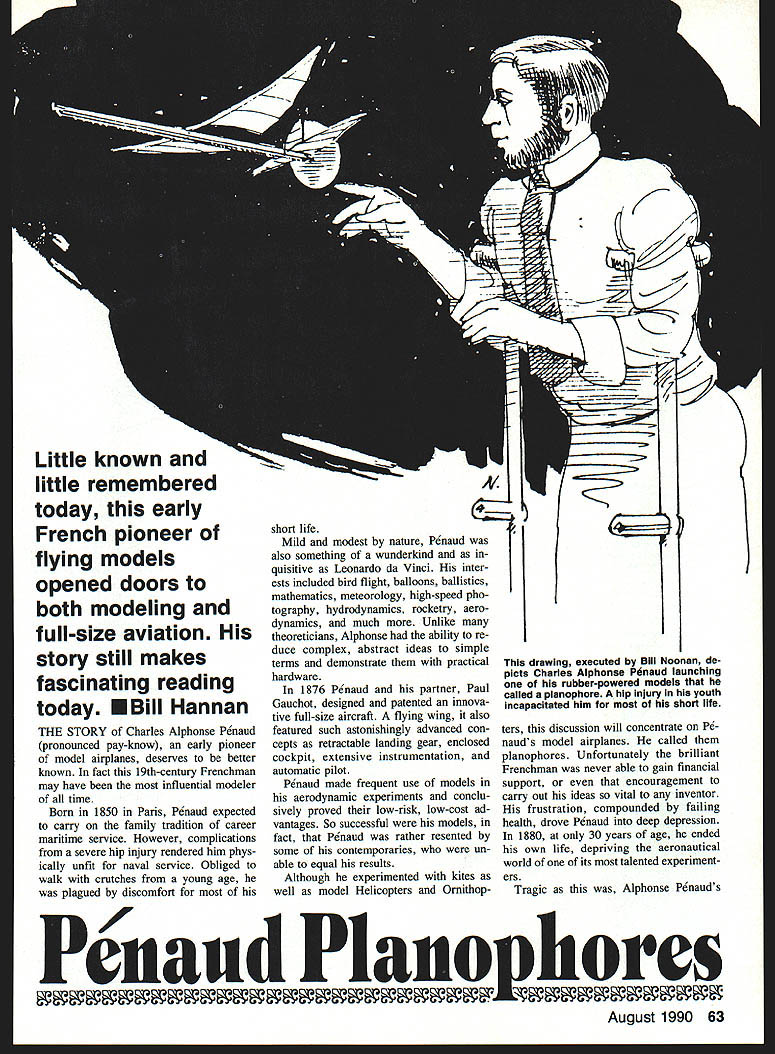
Charles Alphonse Pénaud (pronounced pay-no), an early pioneer of model airplanes, deserves to be better known. In fact, the 19th-century Frenchman may have been the most influential modeler of his time. Born in 1850 in Paris, Pénaud expected to carry on a family tradition of maritime service. However, complications from a severe hip injury rendered him physically unfit for naval service. Obliged to walk with crutches from a young age, he was plagued by discomfort throughout his short life.
Mild and modest in nature, Pénaud was also something of a wunderkind, a curious Leonardo da Vinci. His interests included bird flight, balloons, ballistics, mathematics, meteorology, high-speed photography, hydrodynamics, rocketry, aerodynamics — and much more. Unlike many theoreticians, Alphonse had the ability to reduce complex, abstract ideas to simple terms and demonstrate them with practical hardware.
In 1876 Pénaud, with his partner Paul Gauchot, designed and patented an innovative full-size aircraft — a flying wing — which featured astonishingly advanced concepts for the period: retractable landing gear, an enclosed cockpit, extensive instrumentation, and an automatic pilot. Pénaud made frequent use of models in his aerodynamic experiments and conclusively proved their low-risk, low-cost advantages. So successful were his models that some contemporaries, unable to equal his results, resented him.
Although he experimented with kites as well as model helicopters and ornithopters, this discussion concentrates on Pénaud's model airplanes, which he called planophores. Unfortunately, the brilliant Frenchman was never able to gain financial support or sufficient encouragement to carry out many of his ideas. Frustration, compounded by failing health, drove Pénaud into deep depression. In 1880, at only 30 years of age, he ended his own life, depriving the aeronautical world of one of its most talented experimenters.
Tragic as that was, Pénaud's lifework in aviation was not lost. His concepts and designs influenced later generations and survived in the achievements of other pathbreakers whom they inspired. Among those influenced by Pénaud were two young Americans named Wilbur and Orville Wright.
Pénaud's experiments in model aviation
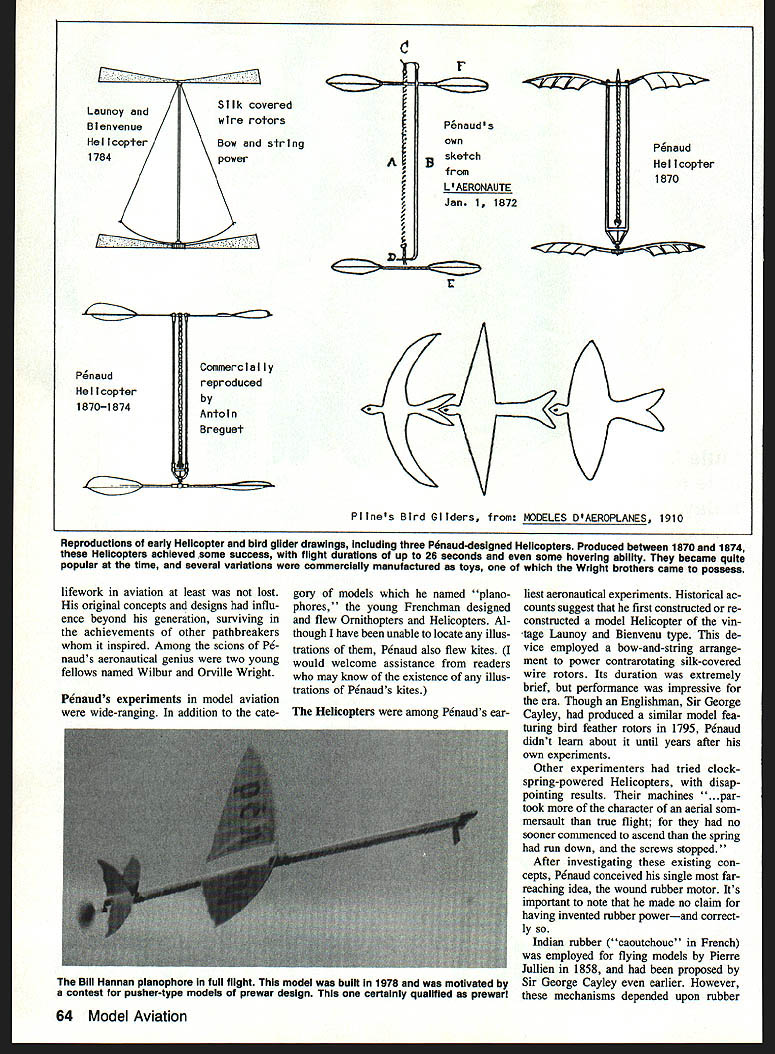
Pénaud's experiments in model aviation were wide-ranging. In addition to the planophores, he designed and flew ornithopters and helicopters. He also flew kites, though illustrations of his kites have not been located; readers with information about such illustrations are invited to contribute.
The helicopters were among Pénaud's earliest aeronautical experiments. Historical accounts suggest he first constructed or reconstructed a model helicopter of the Launoy and Bienvenue type, employing a bow-and-string arrangement to power contra-rotating silk-covered wire rotors. Duration was brief but performance was impressive for the era. Although Sir George Cayley had produced a similar model with bird-feather rotors in 1795, Pénaud did not learn of Cayley's work until years after his own experiments.
Other experimenters tried clock-spring-powered helicopters with disappointing results: their machines "partook more of the character of an aerial somersault than true flight; for they had no sooner commenced to ascend than the spring had run down, and the screws stopped." After investigating these concepts, Pénaud conceived his single most far-reaching idea for models: the wound rubber motor. He did not claim to have invented rubber power — Indian rubber (caoutchouc) had been used earlier by Pierre Jullien (1858) and proposed by Cayley — but his application of rubber strands in torsion (twisted instead of stretched in tension) was an important innovation. Using rubber in torsion allowed simpler, lighter airframes and extended duration compared with lengthwise-stretched strips.
Although moderate by modern standards, Pénaud's small rubber-powered helicopters were sensational in 1870, yielding flight durations of 15 to 26 seconds and even demonstrating some hovering ability. Delighted audiences applauded the clever models, which soon were adapted for commercial manufacture as toys and widely marketed. Among those who eventually received such flying toys were the young Wilbur and Orville Wright.
The planophores
When Pénaud turned his attention to fixed-wing flight he was fortunate to know Joseph M. Pilâtre, who was skilled in designing tiny paper oiseaux (birds) and papillons (butterflies). Pilâtre had painstakingly determined principles of balance, incidence, and dihedral angles to provide the automatic equilibrium essential to free-flight models. By combining improved variations of Pilâtre's self-stabilizing features with his own rubber-in-torsion motors, Pénaud created the series of simple model airplanes he called planophores.
He experimented with contra-rotating propellers to minimize torque, but soon discovered easier methods. Adding a small amount of ballast to a wingtip or setting one wing panel to a slightly greater incidence than the other effectively counteracted torque. Pénaud tried tractor (front-mounted) propellers but favored a single pusher arrangement for propeller protection in collisions.
Although he tested multiple blades, Pénaud preferred two-bladed propellers for simplicity and damage resistance, since two blades could lie flat during landing. He avoided landing gear to keep models light and uncomplicated.
The educational and entertainment value of the planophores was proven during Pénaud's 1871 public demonstrations in Paris' Tuileries Gardens and inside the Horticultural Hall. These demonstrations brought favorable publicity for both the planophores and their creator.
Though planophores were built "in various forms of different styles with diverse results," the most successful fliers had spans from about 18 to 24 inches. One 18-inch example had roughly a 4-inch wing root chord, a 20-inch fuselage stick, and an 8-inch-diameter propeller. Blades were generally paper, sometimes bird feathers; the front and rear motor hooks were steel wire.
The wings were built from bird-feather quills pinned together and covered with goldbeater's skin. Dihedral was either a shallow V or achieved by curving the wing tips upward. The wing assembly could slide along the fuselage stick to adjust balance, and the incidence angles of individual wing panels could be altered. The similarly constructed horizontal tail was also adjustable for incidence, and its tips could be raised for added stability.
Some planophores were equipped with a vertical tailplane, which Pénaud likened to a ship's rudder. Early illustrations rarely show the vertical tail, suggesting it was optional. Charles Dollfus, the French aviation historian, noted that "One could add a vertical rudder..." and Octave Chanute recorded that Pénaud's Garden of Tuileries demonstrator was "guided horizontally by a small vertical rudder ... flew several times in a circle, falling gently to the ground near its starting point when the power of the rubber was exhausted."
An 18-inch-span planophore typically weighed about 16 grams, with the rubber motor supplying roughly 5 grams. Documented flight durations ranged from 11 to 13 seconds, with distances of 130 to 200 feet — impressive results for 1871.
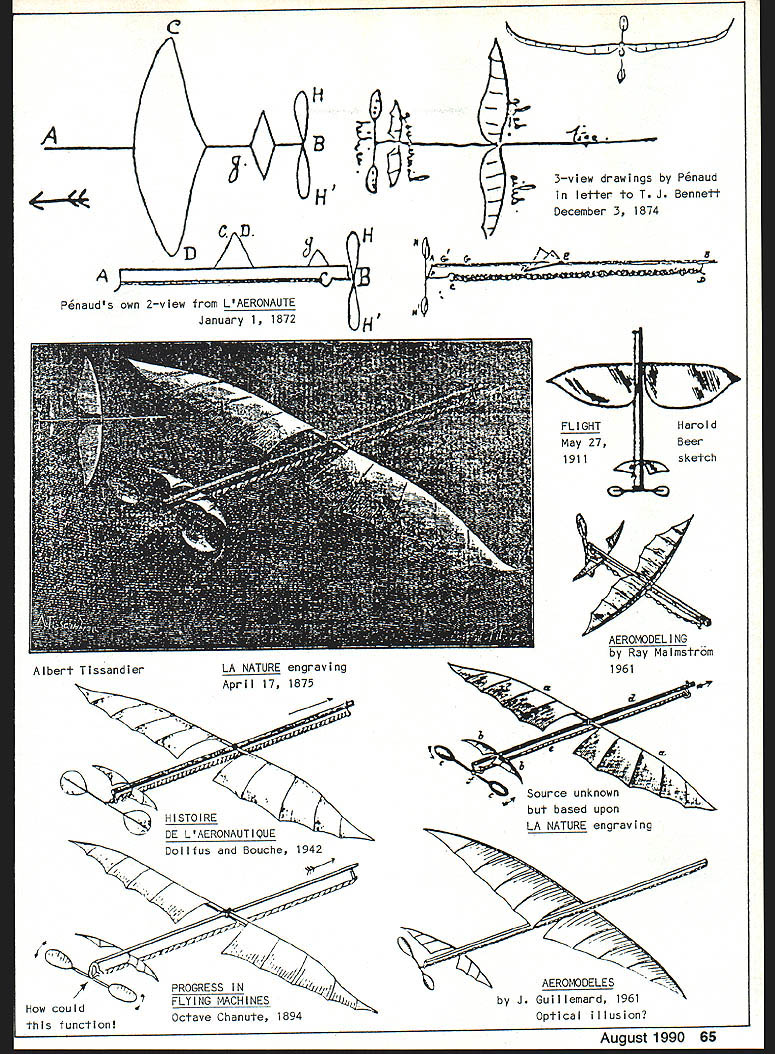
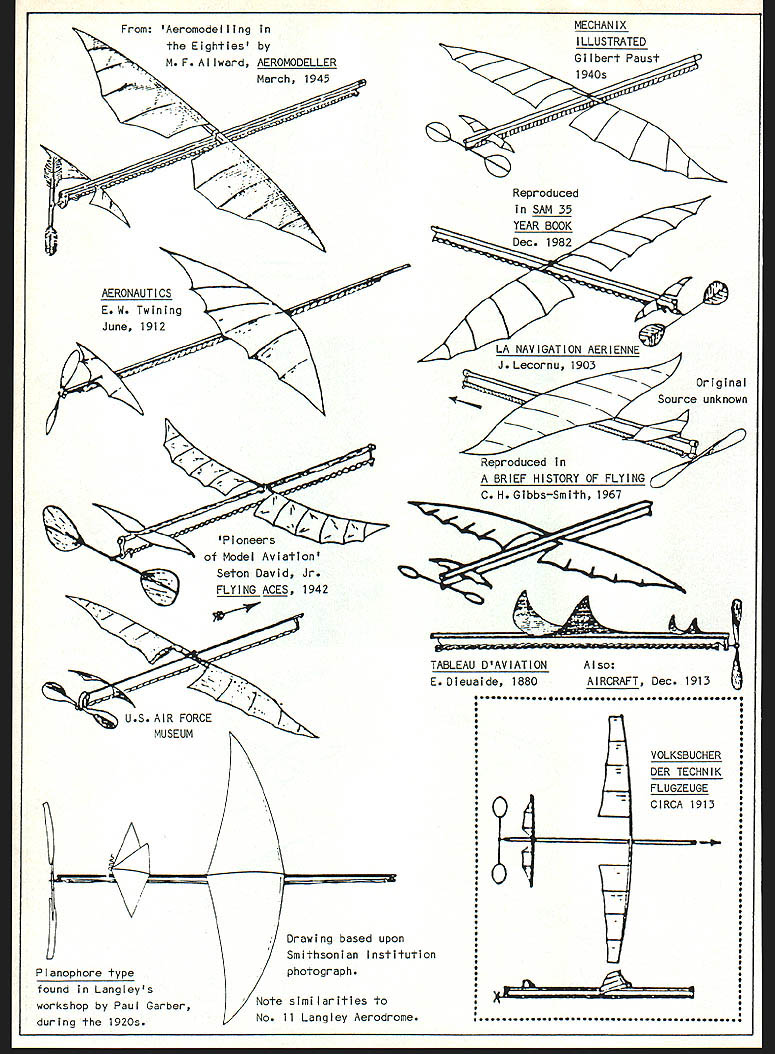
Illustrations of planophores are commonplace in aviation history books, but careful comparison shows considerable variety. The oldest published planophore drawings known appeared in the January 1, 1872 issue of L'Aéronaute, drawn by Pénaud himself; they are freehand sketches intended to convey general ideas rather than technical accuracy. An early engraving in Nature (April 17, 1875) by Albert Tissandier and another artist depicted two different planophores and became a source for many subsequent simplified rehashes.
Latter-day planophores
Interest in Pénaud's flying machines has continued to the present. Many reproductions have been built — some for flying, others for museum display or conversation pieces. A few notable examples:
- Vintage and updated reproductions
- Some vintage-style reproductions, when carefully built and tuned, have exceeded 45 seconds' duration; updated planophore reproductions have achieved indoor flights up to 80 seconds.
- Reg Parham's planophore
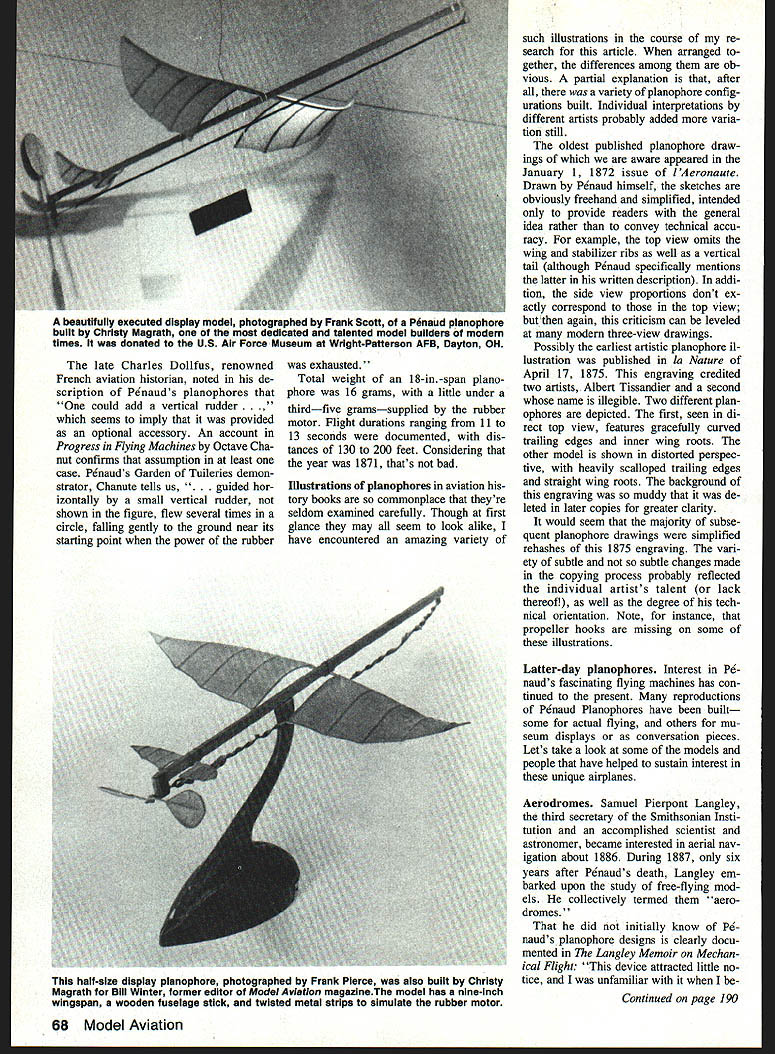
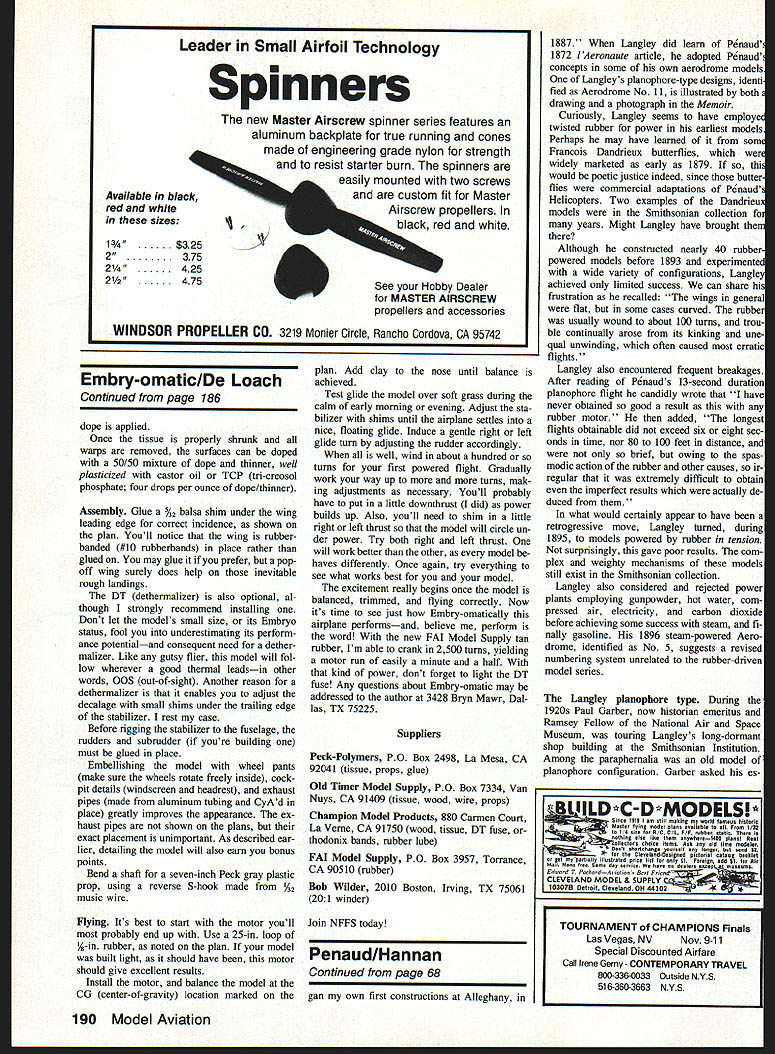
- In 1964 Englishman Reg Parham constructed a planophore for model aviation history demonstrations. It features bamboo flight surfaces with flat-plate airfoils and shellacked silk covering. The motor stick is spruce and the propeller blades are turkey tail feathers. Weighing about the same as Pénaud's original, Parham's model has achieved outdoor flights of 40 seconds.
- Bill Hannan's planophore
- The author built a reproduction in 1978 for a Southern California Antique Model Plane Society (SCAMPS) contest for pusher models of prewar design. Constructed primarily of basswood with Japanese tissue covering, the finished product weighed about 16 grams, similar to Pénaud's originals. It earned a third-place trophy at the contest. The model also flew without its vertical tail, though greater care in launching was required. On one occasion it flew a proxy-timed indoor flight of 58 seconds.
Pénaud's planophores continue to inspire builders and modelers. A street in Paris' 20th arrondissement bears his name, and the FAI committee for international aeromodelling presents a Pénaud diploma to outstanding modelers.
With characteristic modesty, Pénaud once wrote, "My planophore demonstrates the possibilities of stable equilibrium in the heart of the air and promise for great machines of considerable swiftness." If he could see flight today, he would recognize how prophetic that statement was.
Aerodromes
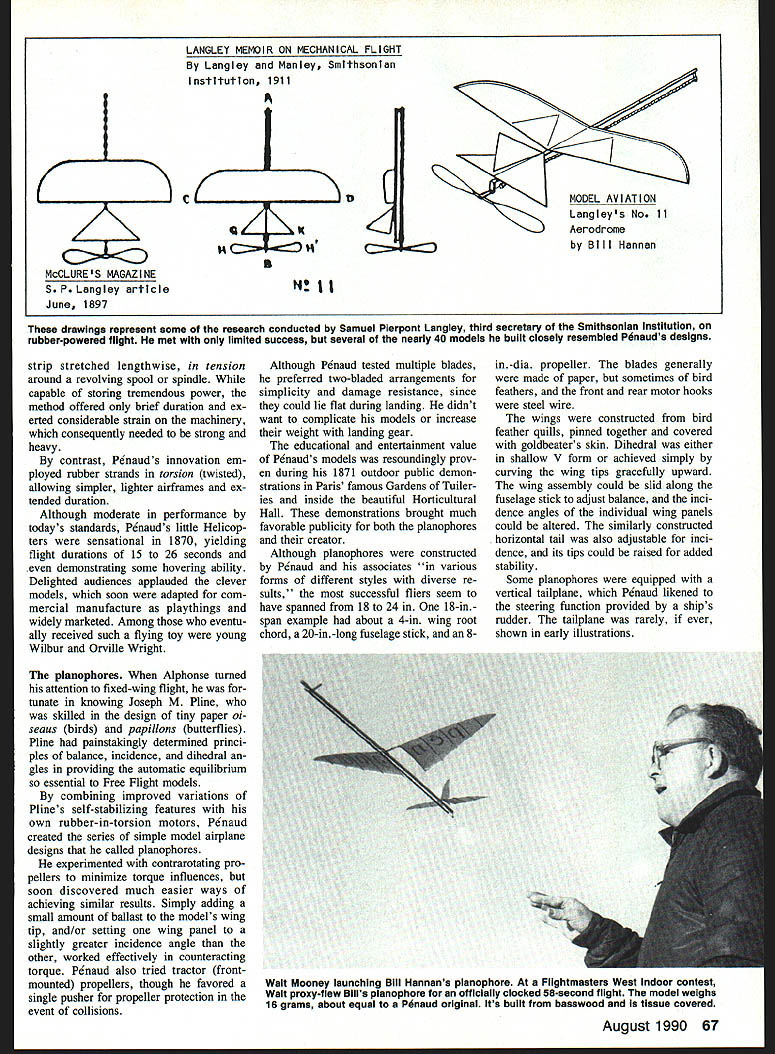
Samuel Pierpont Langley, third secretary of the Smithsonian Institution and an accomplished scientist and astronomer, became interested in aerial navigation about 1886. In 1887 Langley embarked on the study of free-flying models, which he collectively termed "aerodromes." He was initially unfamiliar with Pénaud's planophore designs, but when he did learn of Pénaud's 1872 L'Aéronaute article he adopted Pénaud's concepts in some of his own aerodrome models. One of Langley's planophore-type designs, Aerodrome No. 11, is illustrated by both a drawing and a photograph in The Langley Memoir on Mechanical Flight.
Langley seems to have employed twisted rubber for power in his earliest models — perhaps influenced by commercially marketed butterflies by François Dandrieux (from about 1879), which themselves were adaptations of Pénaud's helicopters. Langley constructed nearly 40 rubber-powered models before 1893 and experimented with many configurations but achieved only limited success. He wrote candidly that he had never obtained results comparable to Pénaud's 13-second planophore flight. Langley's longest rubber-motor flights did not exceed six to eight seconds, and distances were short and irregular.
In 1895 Langley reverted to rubber-in-tension power for some models, which yielded poor results. He also considered and rejected gunpowder, hot water, compressed air, electricity, and carbon dioxide for model power. Langley later moved to heavier powerplants (ultimately steam and then gasoline) for full-size experiments; his 1896 steam-powered Aerodrome No. 5 represented a departure from the rubber-driven model series.
The Langley planophore type
During the 1920s, Paul E. Garber, then curator at the Smithsonian, discovered an old planophore-type model in Langley's shop. Garber had the model cleaned and a skeleton drawing made; artifacts like these helped maintain awareness of Pénaud's influence on later aeronautical research.
References
- Alphonse Pénaud, "Aéromoteur Automoteur," L'Aéronaute, Jan. 1872.
- T. J. Bennett, "Notes from France," Eleventh Annual Report of the Aeronautical Society of Great Britain (1876).
- Octave Chanute, Progress in Flying Machines (1894).
- Paul E. Del Gatto, "Pénaud's Planophore," Model Airplane News, May 1955.
- Charles Dollfus, "Alphonse Pénaud," Revue de l'Aviation Française, No. 38 (1965).
- S. P. Langley, "Experiments With Small Models," The Langley Memoir on Mechanical Flight, Part I (1911).
- S. P. Langley, "The Flying Machine," McClure's Magazine, June 1897. (Reprinted in At Last We Can Fly by George Hardie Jr. [nd].)
- Christy Magrath, "After You Alphonse," Model Airplane News, May 1955.
- Robert B. Meyer Jr., Langley's Model Aero Engine of 1903 (1976). (Volume compiled by Robert B. Meyer Jr.)
- Nigel Mills, "Pénaud," World War I Aero, April 1983.
- Reg Parham, "Indoor Vintage," SAM 35 Yearbook, Dec. 1982.
- Pearl I. Young, Alphonse Pénaud's Letters on Aeronautics (1968).
Acknowledgements
Grateful thanks to numerous historians and enthusiasts who assisted this research:
- C. James Alaback
- John J. Brown
- L. M. Conover
- Paul E. Garber
- Eugene Husting
- Herbert Kelley
- L. S. McCreary
- Richard Miller
- Curtiss and Walt Mooney
- Leonard Odycke
- Richard Padgham
- Hewitt and Viola Phillips
- Bertram Pond
- Dick Seely
- Tom Schmitt
- Bill Warner
- Herbert K. Weiss
- William Winter
Assistance from England was supplied by the late C. H. Gibbs-Smith (via Leonard Odycke), Ken McDonough, J. A. Bagley, and Peter Mann (via Philip Jarrett, who also furnished additional material). From France, special appreciation to George Chaulet, J. F. Frugoli, and Alain Parmentier.
If anyone has been overlooked, my sincere apologies.
Transcribed from original scans by AI. Minor OCR errors may remain.

