
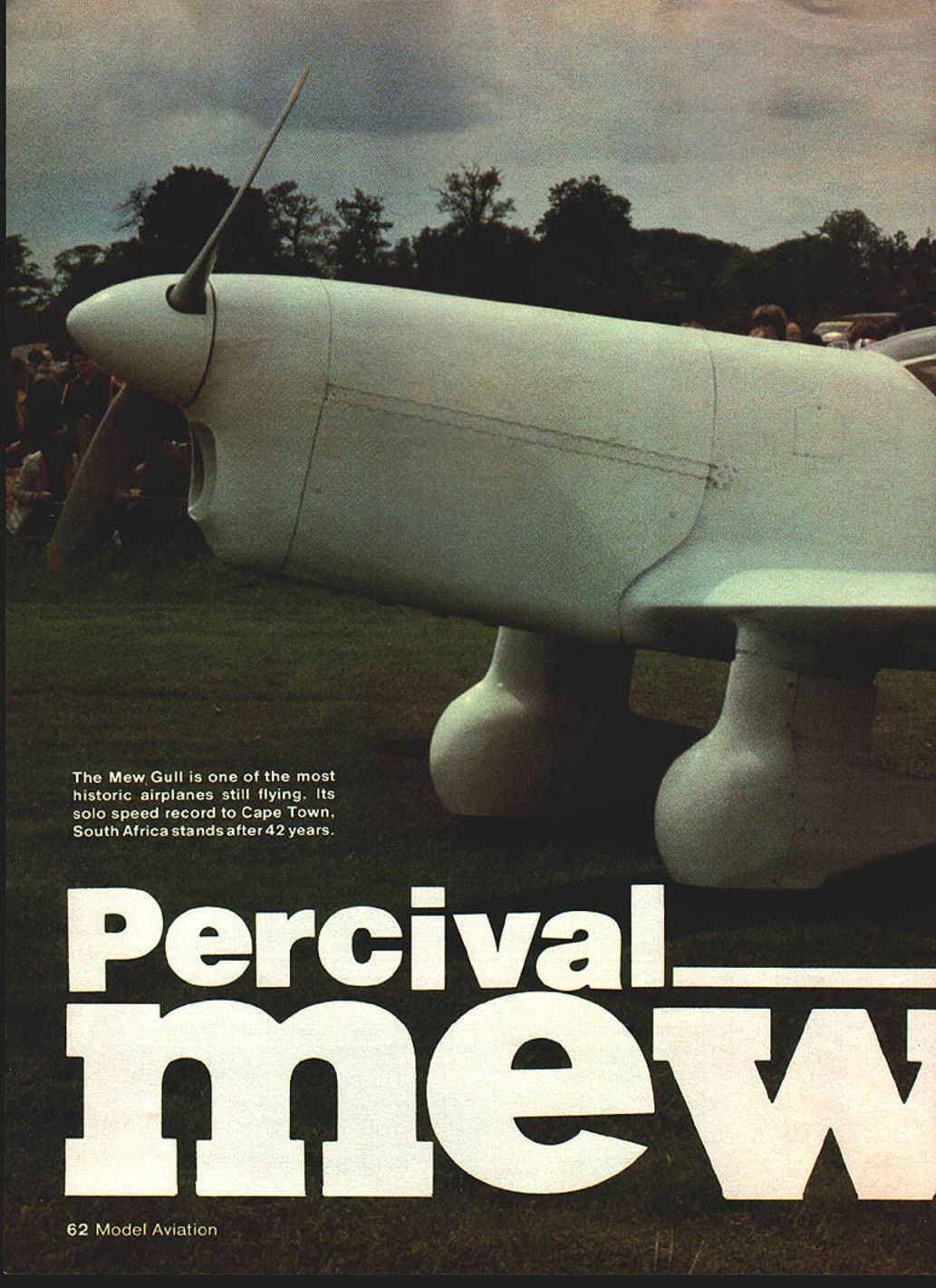
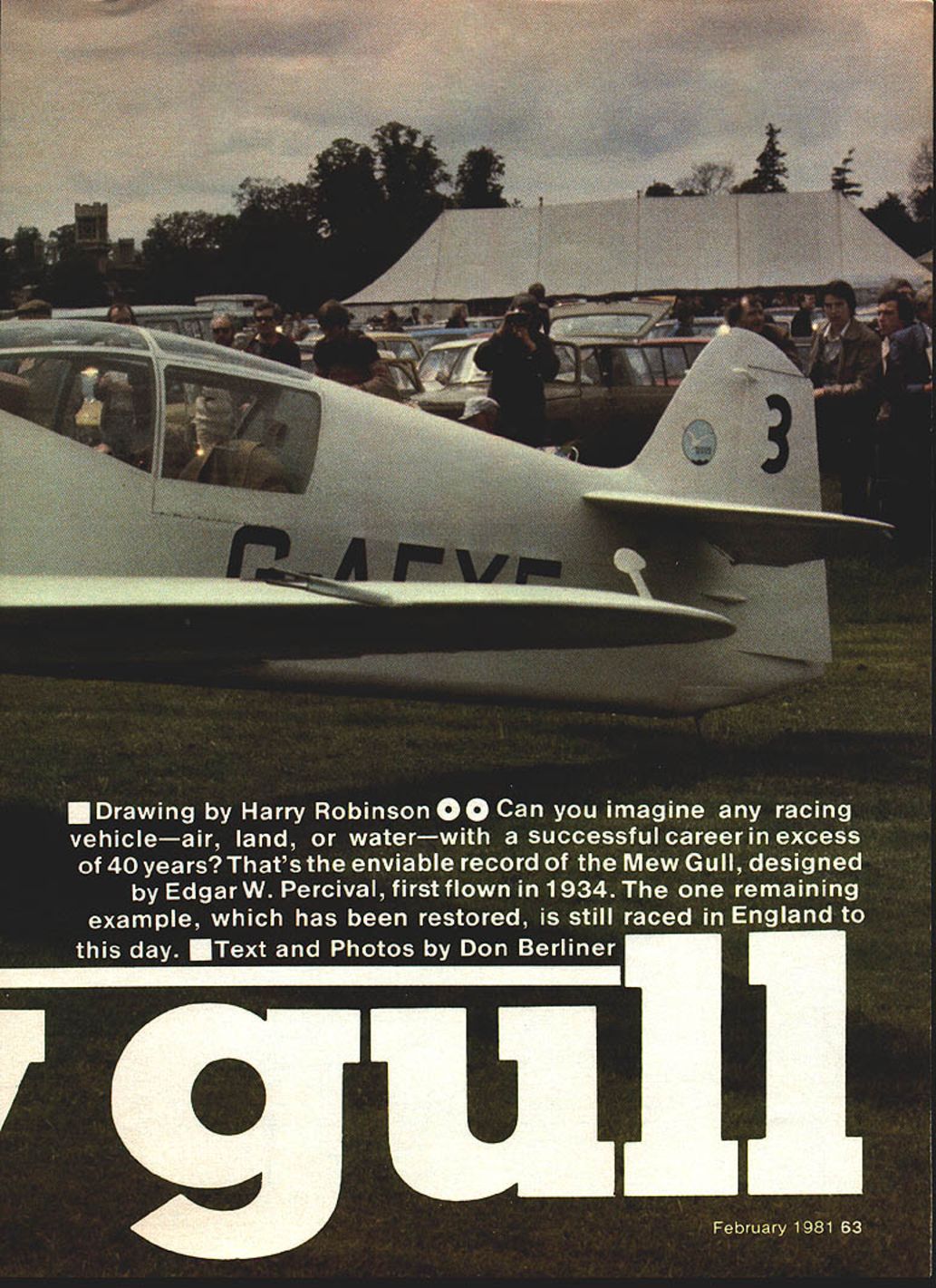
Percival Mew Gull
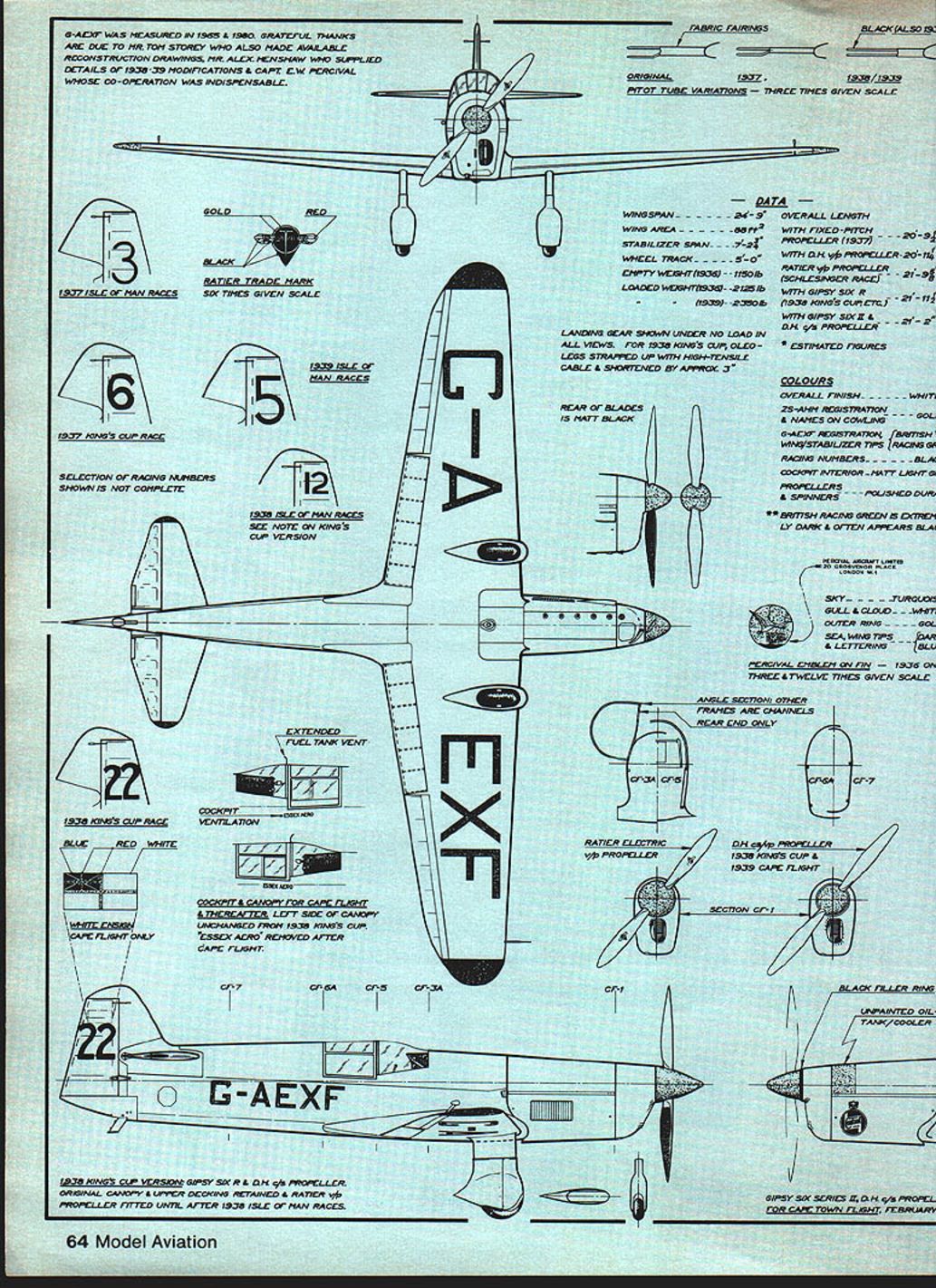
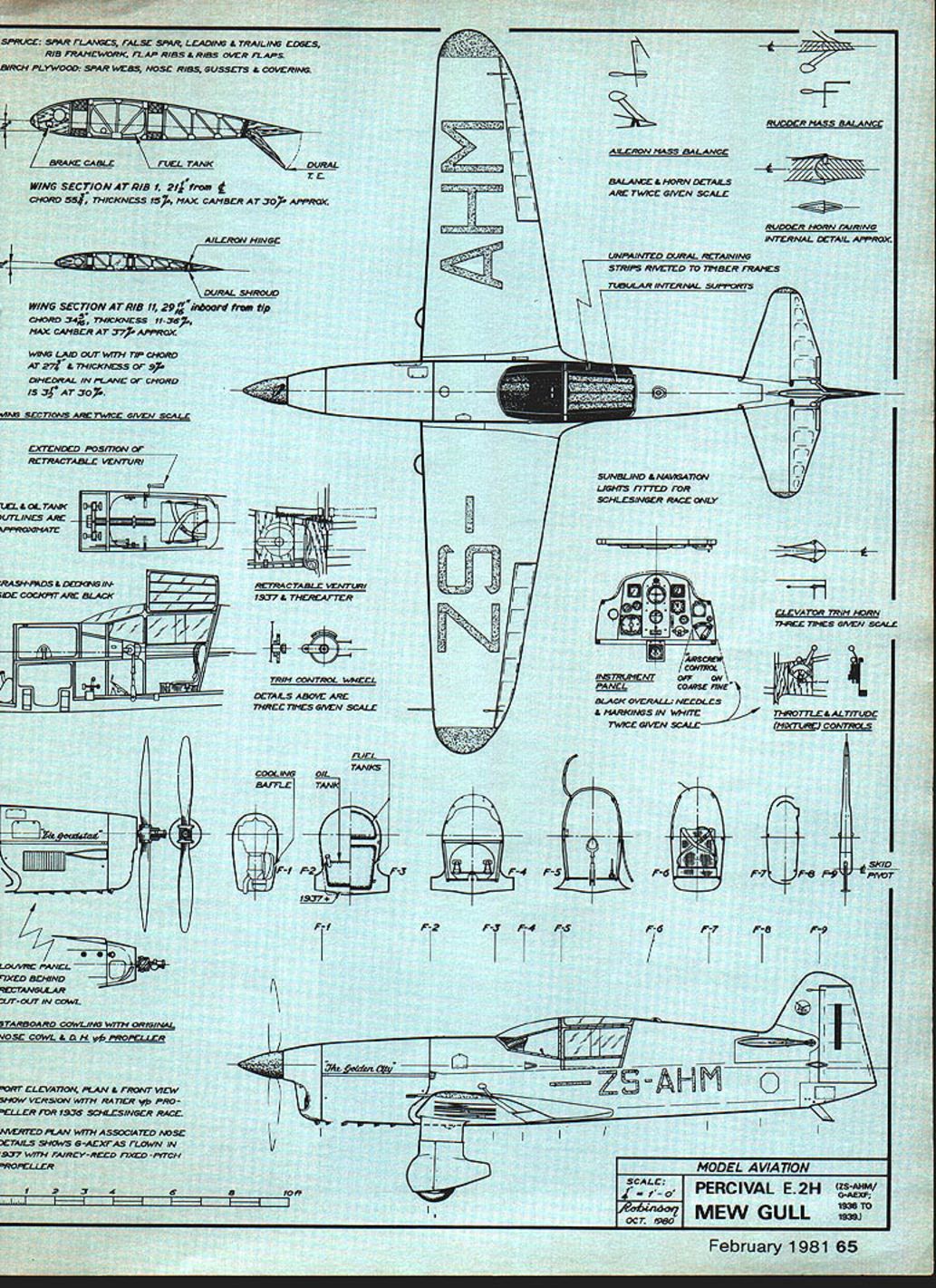
Drawing by Harry Robinson. Text and photos by Don Berliner.
Introduction
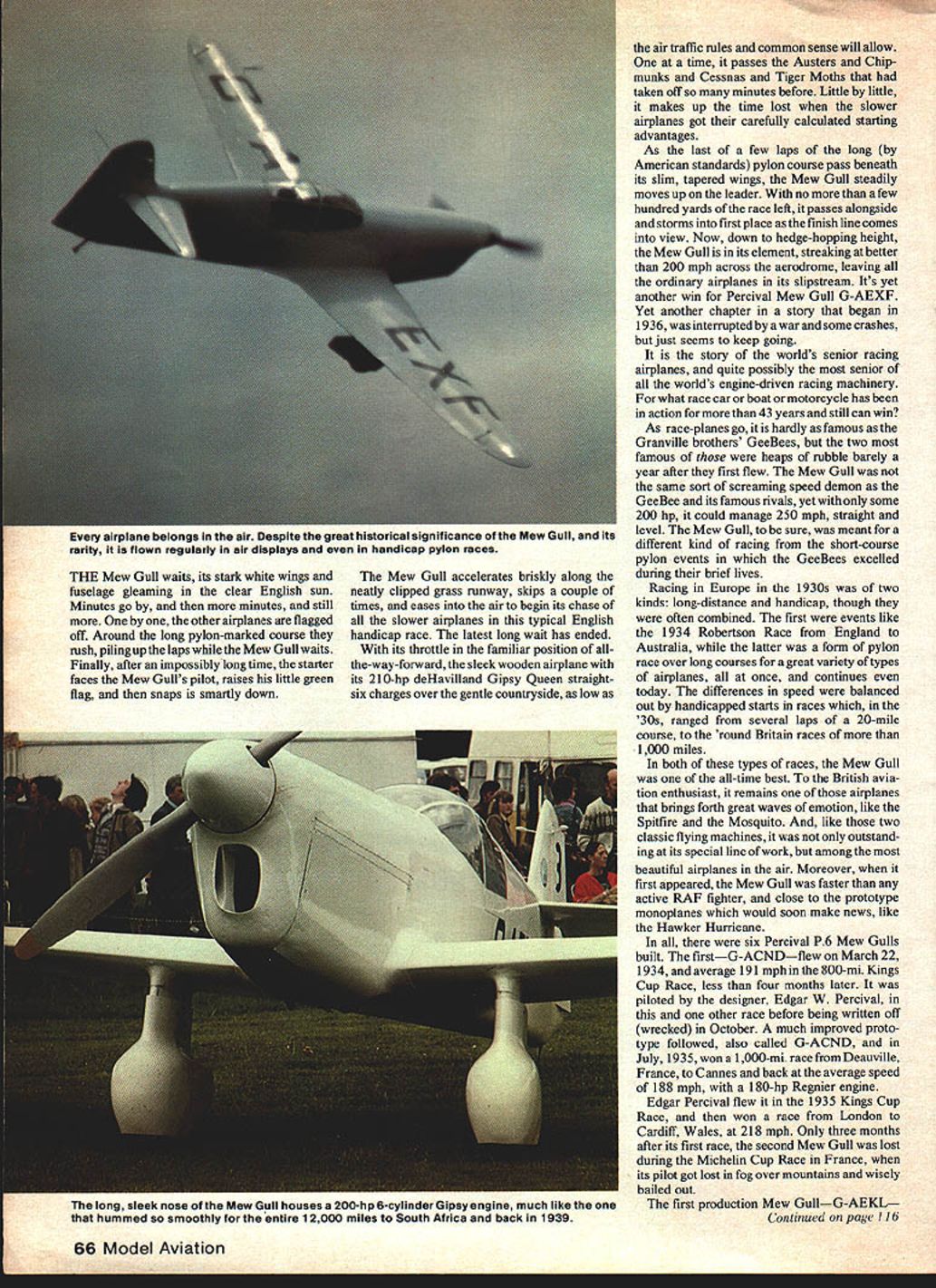
Can you imagine any racing vehicle—air, land, or water—with a successful career in excess of 40 years? That's the enviable record of the Mew Gull, designed by Edgar W. Percival and first flown in 1934. The one remaining example, which has been restored, is still raced in England to this day.
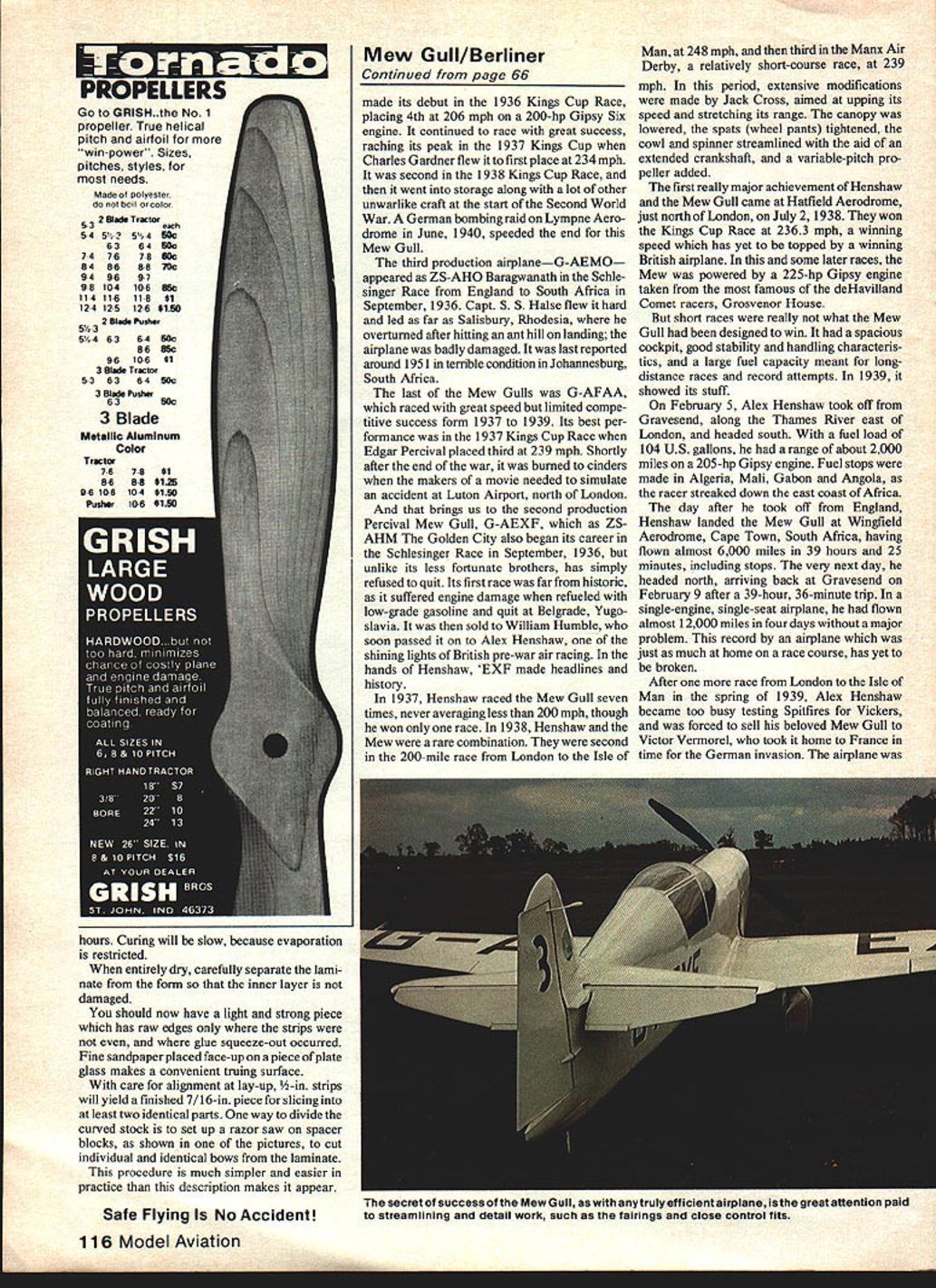
The Mew Gull waits, its stark-white wings and fuselage gleaming in the clear English sun. Minutes go by. Other airplanes are flagged off. Around the long, pylon-marked course they rush, piling up laps. The Mew Gull waits. Finally, after an impossibly long time, the starter faces her. The Mew Gull's pilot raises a little green flag and snaps it smartly down. The Mew Gull accelerates briskly along the neatly clipped grass runway, skips a couple of times, eases into the air to begin its chase of the slower airplanes in the typical English handicap race.
The throttle is in the familiar position—all the way forward. The sleek wooden airplane with its 210-hp de Havilland Gipsy Queen straight-six charges over the gentle countryside, low, as air-traffic rules and common sense will allow. Time passes. Austers, Chipmunks, Cessnas, Tiger Moths—taken off minutes before—fade behind. Little by little it makes up the time lost when the slower airplanes were given carefully calculated starting advantages. As the last few laps of the long, American-style pylon course pass beneath its slim tapered wings, the Mew Gull steadily moves up on the leader. With no more than a few hundred yards of the race left, it passes alongside and storms into first place as the finish line comes into view. Now, down to hedge-hopping height, the Mew Gull is in its element, streaking at better than 200 mph across the aerodrome, leaving all the ordinary airplanes in its slipstream. It's yet another win for Percival Mew Gull G-AEXF—yet another chapter in a story that began in 1936, was interrupted by a war and some crashes, but just seems to keep going.
It is the story of the world's senior racing airplanes, and quite possibly the most senior of all the world's engine-driven racing machinery. For what race car or boat or motorcycle has been in action for more than 43 years and still can win?
As race planes go, it is hardly as famous as the Granville brothers' GeeBees, but the two most famous of those were heaps of rubble barely a year after they first flew. The Mew Gull was not the same sort of screaming speed demon as the GeeBee and its famous rivals, yet with only some 200 hp it could manage 250 mph, straight and level. The Mew Gull, to be sure, was meant for a different kind of racing from the short-course pylon events in which the GeeBees excelled during their brief lives.
Racing types and Mew Gull's role
Racing in Europe in the 1930s was of two kinds: long-distance and handicap, though they were often combined. The first were events like the 1934 MacRobertson (sometimes Robertson) Race from England to Australia, while the latter was a form of pylon race over long courses for a great variety of types of airplanes, all at once, and continues even today. The differences in speed were balanced out by handicapped starts in races which, in the '30s, ranged from several laps of a 20-mile course to the 'round Britain races of more than 1,000 miles.
In both of these types of races, the Mew Gull was one of the all-time best. To the British aviation enthusiast, it remains one of those airplanes that brings forth great waves of emotion, like the Spitfire and the Mosquito. And, like those two classic flying machines, it was not only outstanding at its special line of work, but among the most beautiful airplanes in the air. Moreover, when it first appeared, the Mew Gull was faster than any active RAF fighter, and close to the prototype monoplanes which would soon make news, like the Hawker Hurricane.
Production and individual histories
In all, six Percival P.6 Mew Gulls were built. Brief histories:
- G-ACND (first prototype): Flew on March 22, 1934, and averaged 191 mph in the 800-mile King's Cup Race less than four months later. It was piloted by the designer, Edgar W. Percival, in this and one other race before being written off (wrecked) in October.
- Improved prototype (also recorded as G-ACND): A much improved prototype followed. In July 1935 it won a 1,000-mile race from Deauville, France, to Cannes and back at an average speed of 180 mph, powered by a 180-hp Regnier engine. Edgar Percival flew it in the 1935 King's Cup Race and then won a race from London to Cardiff at 218 mph. Three months after its first race, the second Mew Gull was lost during the Michelin Cup Race in France when its pilot became lost in fog over mountains and bailed out.
- G-AEKL (first production): Made its debut in the 1936 King's Cup Race, placing 4th at 206 mph on a 200-hp Gipsy Six engine. It continued to race successfully, reaching its peak in the 1937 King's Cup when Charles Gardner flew it to first place at 234 mph. It was second in the 1938 King's Cup Race and then went into storage at the start of the Second World War. A German bombing raid on Lympne Aerodrome in June 1940 speeded its end.
- G-AEMO (third production): Appeared as ZS-AHO "Baragwanath" in the Schlesinger Race from England to South Africa in September 1936. Capt. S. S. Halse flew it hard and led as far as Salisbury, Rhodesia, where he overturned after hitting an anthill on landing; the airplane was badly damaged. It was last reported around 1951 in poor condition in Johannesburg, South Africa.
- G-AFAA (last of the series): Raced with great speed but limited competitive success from 1937 to 1939. Its best performance was in the 1937 King's Cup Race when Edgar Percival placed third at 239 mph. Shortly after the end of the war it was burned to cinders when the makers of a movie needed to simulate an accident at Luton Airport, north of London.
- G-AEXF (second production, the survivor): The most famous survivor; see the detailed history below.
G-AEXF — The survivor
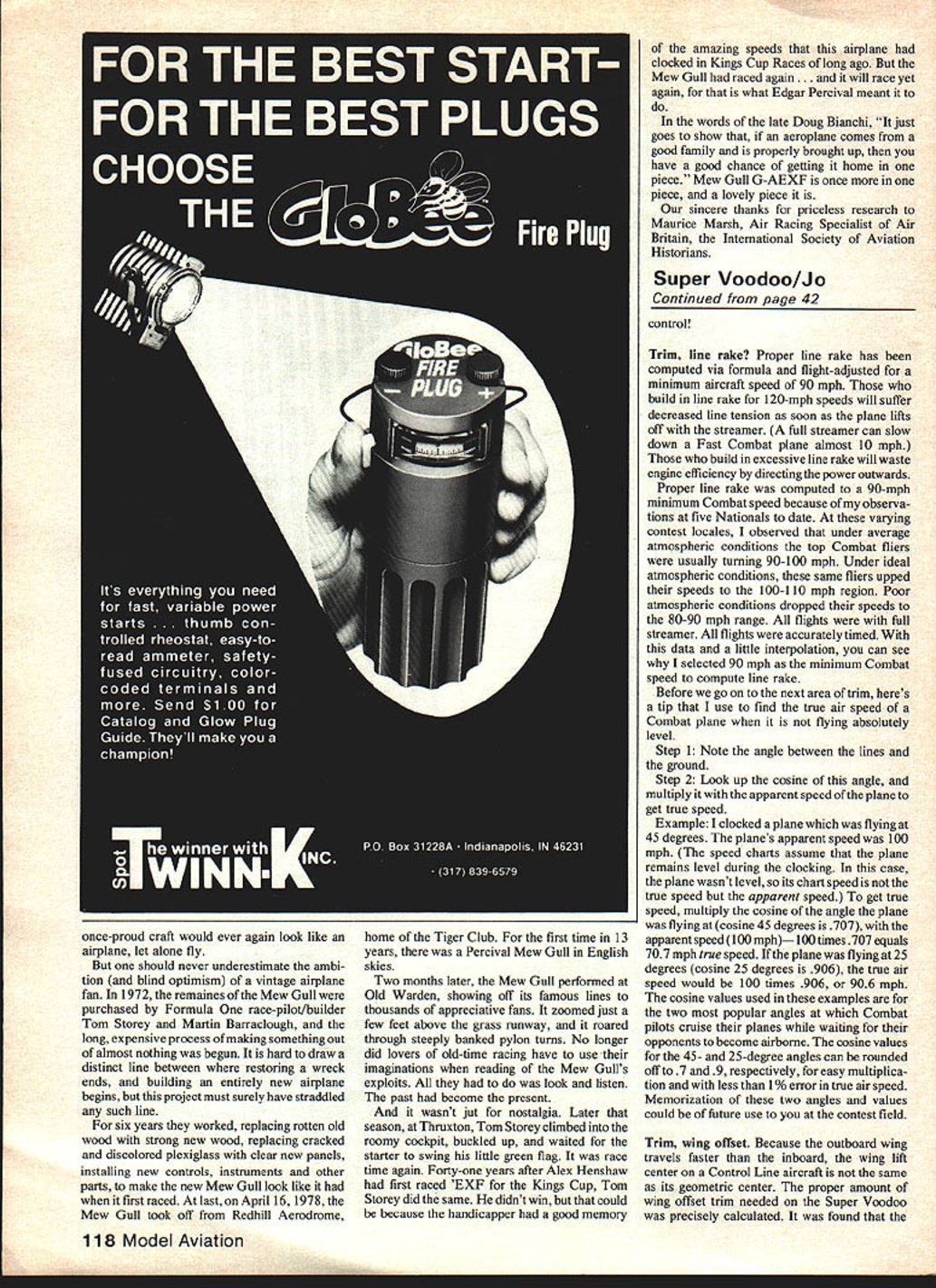
G-AEXF began its career in the Schlesinger Race in September 1936 as ZS-AHM "The Golden City", but suffered engine damage when refueled with low-grade gasoline and quit at Belgrade. It was sold to William Humble, who soon passed it on to Alex Henshaw, one of the shining lights of British pre-war air racing. In Henshaw's hands, "EXF" made headlines and history.
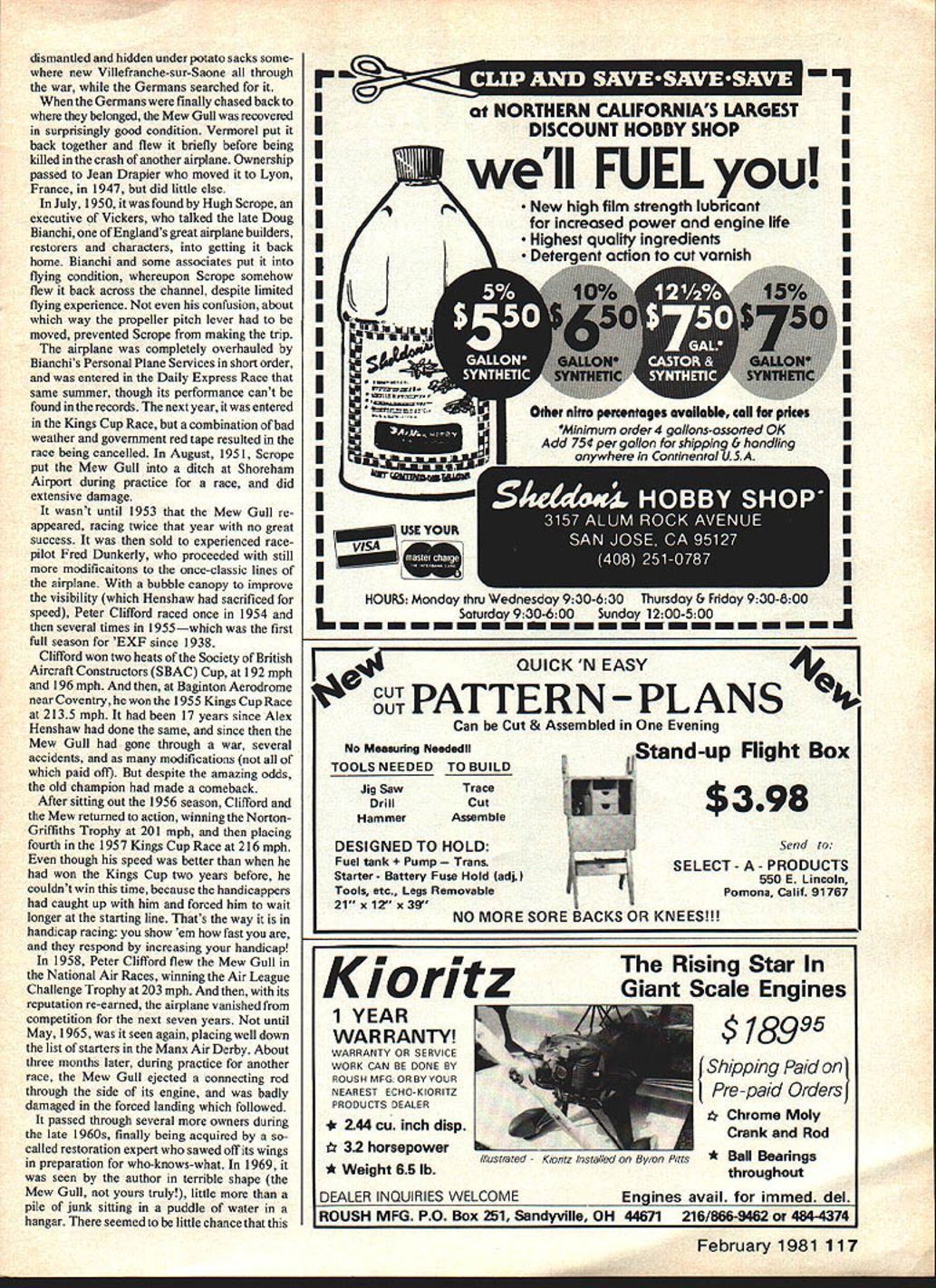
In 1937 Henshaw raced the Mew Gull seven times, never averaging less than 200 mph, though he won only one race. In 1938 Henshaw and the Mew were a rare combination: they were second in the 200-mile race from London to the Isle of Man at 248 mph, then third in the Manx Air Derby at 239 mph. During this period Jack Cross carried out extensive modifications aimed at increasing speed and range: the canopy was lowered, the spats (wheel pants) tightened, the cowl and spinner streamlined with the aid of an extended crankshaft, and a variable-pitch propeller was added.
The first really major achievement of Henshaw and the Mew Gull came at Hatfield Aerodrome on July 2, 1938, when they won the King's Cup Race at 236.3 mph—a winning speed not yet topped by a winning British airplane. In some races the Mew was powered by a 225-hp Gipsy engine taken from the famous de Havilland Comet racer Grosvenor House.
But short races were not what the Mew Gull had been designed to win. It had a spacious cockpit, good stability and handling, and a large fuel capacity meant for long-distance races and record attempts. In 1939 it showed its long-distance ability.
On February 5, 1939, Alex Henshaw took off from Gravesend, along the Thames east of London, and headed south. With a fuel load of 104 U.S. gallons, he had a range of about 2,000 miles on a 205-hp Gipsy engine. Fuel stops were made in Algeria, Mali, Gabon and Angola as the racer streaked down the east coast of Africa.
The day after he took off from England, Henshaw landed the Mew Gull at Wingfield Aerodrome, Cape Town, having flown almost 6,000 miles in 39 hours 25 minutes, including stops. The very next day he headed north, arriving back at Gravesend on February 9 after a 39-hour 36-minute trip. In a single-engine, single-seat airplane, he had flown almost 12,000 miles in four days without a major problem. This record by an airplane equally at home on a race course has yet to be broken.
After one more race from London to the Isle of Man in spring 1939, Henshaw became too busy testing Spitfires for Vickers and sold his beloved Mew Gull to Victor Vermorel, who took it to France in time for the German invasion. The airplane was dismantled and hidden under potato sacks near Villefranche-sur-Saône throughout the war while the Germans searched for it.
When the Germans were finally driven out, the Mew Gull was recovered in surprisingly good condition. Vermorel reassembled and flew it briefly before being killed in the crash of another airplane. Ownership passed to Jean Drapier, who moved it to Lyon in 1947 but did little else with it.
Postwar recovery, racing and decline
In July 1950 Hugh Scrope, an executive of Vickers, found the Mew Gull and persuaded the late Doug Bianchi, one of England's great airplane builders and restorers, to get it back to England. Bianchi and associates put it into flying condition; Scrope then flew it back across the Channel, despite limited experience and some confusion about propeller pitch controls.
The airplane was completely overhauled by Bianchi's Personal Plane Services and entered in the Daily Express Race that summer (performance records are elusive). The following year it was entered in the King's Cup Race, but bad weather and government red tape canceled the race. In August 1951 Scrope put the Mew Gull into a ditch at Shoreham Airport during practice for a race and did extensive damage.
The Mew Gull reappeared in 1953, racing twice with modest success. It was then sold to experienced race pilot Fred Dunkerly, who made more modifications. With a bubble canopy restored for better visibility (which Henshaw had sacrificed for speed), Peter Clifford raced once in 1954 and several times in 1955—the first full season for "EXF" since 1938.
Clifford won two heats of the Society of British Aircraft Constructors (SBAC) Cup at 192 mph and 196 mph. Then, at Baginton Aerodrome near Coventry, he won the 1955 King's Cup Race at 213.5 mph. It had been 17 years since Alex Henshaw had won the King's Cup in G-AEXF, and since then the Mew Gull had survived a war, several accidents, and many modifications. Despite the odds, the old champion had made a comeback.
After sitting out the 1956 season, Clifford and the Mew returned to action, winning the Norton-Griffiths Trophy at 201 mph and then placing fourth in the 1957 King's Cup Race at 216 mph. Even though his speed was better than when he had won the King's Cup two years earlier, he couldn't win because the handicappers had adjusted his starting position accordingly.
In 1958 Peter Clifford flew the Mew Gull in the National Air Races, winning the Air League Challenge Trophy at 203 mph. Then the airplane vanished from competition for several years. It resurfaced in May 1965, placing well down the list of starters in the Manx Air Derby. About three months later, during practice for another race, the Mew Gull ejected a connecting rod through the side of its engine and was badly damaged in the forced landing.
Through the late 1960s it passed through several owners and fell into worse condition. A so-called restoration expert sawed off its wings. By 1969 the author saw the Mew Gull in terrible shape—little more than a pile of junk in a hangar puddle—appearing unlikely ever to fly again.
Restoration and return to flight
In 1972 the remains of the Mew Gull were purchased by Formula One race pilot/builder Tom Storey and Martin Barraclough, and the long, expensive process of making something out of almost nothing began. For six years they worked, replacing rotten wood, fitting new plexiglass, installing new controls and instruments, and restoring the airplane to its original appearance and condition. The project straddled the line between restoration and practically building a new airplane.
On April 16, 1978, the Mew Gull took off from Redhill Aerodrome, home of the Tiger Club. For the first time in 13 years there was a Percival Mew Gull in English skies. Two months later it performed at Old Warden, zooming just a few feet above the grass runway and roaring through steeply banked pylon turns. Later that season, at Thruxton, Tom Storey raced it. Forty-one years after Alex Henshaw had first raced G-AEXF in the King's Cup, Tom Storey did the same. He didn't win—likely because the handicappers remembered the airplane's historical speed—but the Mew Gull had raced again and demonstrated that it was still capable.
Doug Bianchi summed it up: "It just goes to show that, if an aeroplane comes from a good family and is properly brought up, then you have a good chance of getting it home in one piece." Mew Gull G-AEXF is once more in one piece, and a lovely piece it is.
Acknowledgments
Our sincere thanks for priceless research to Maurice Marsh, Air Racing Specialist of Air Britain, the International Society of Aviation Historians.
Transcribed from original scans by AI. Minor OCR errors may remain.

