
Performance by Computer: Warts and All
Computers to choose a configuration? What for? Just pick out the one that makes your blood sing, and take the plunge! Right?
No, not right. Typical, yes, but not right.
From such outbursts of passion emerge turkeys with defective genes or psychotic souls—turkeys that end their days as hangar queens or hobby-room mobiles.
How do you recognize a turkey before you build it? Certainly not by looks alone. To anyone who is smirking, "If it looks right, it will fly right," I would ask: "Have you seen Don Srull's version of the Santos Dumont 14 bis?" (That's a pusher canard biplane with which Don has successfully spanned the application range from Indoor Rubber Scale to full RC.) If anyone thinks that configuration looks right, I suggest a quick return to gamboling with the elves and fairies in your garden—and leave the striving to us.
If it is not appearance, what is to serve as a guide as we seek to separate the turkeys from the eagles? Performance is the answer. Not poetic descriptions of performance, not heroic myths based on chance (45-min. flights), but methods of measuring performance before construction. Such methods have been available for years, but the process proved tedious and would reduce even the iron-willed to tears—until the arrival of friendly computers. The picture has changed drastically.
Once the right program is stored in the innards of your computer, you can check out the flight characteristics of a design in a few seconds. Yes, performance, stability, and such esoteric topics as trim and tail size can be resolved before you reach for the wax paper.
An example of what can happen: a large Rubber Scale project. I'm a sucker for clean lines; I fell to a fatal attraction for the P-39. Ignoring the implications and its curious nickname "Iron Dog," I feverishly built a 1 m-scale version. It turned out to be a turkey. Despite Wakefield-model loading, 40 gm of rubber has never cracked 35 sec in its long, miserable life. The WART program's printout predicted roughly 34 sec for that rubber loading—the prediction was quite accurate. Had I known, I never would have built the foul thing; to be competitive hereabouts you need about 45 sec. You can hope to reach 45 sec by upping the rubber to 60 gm, but there's simply no place to put the stuff. Yes, turkey spotter—the WART program works well.
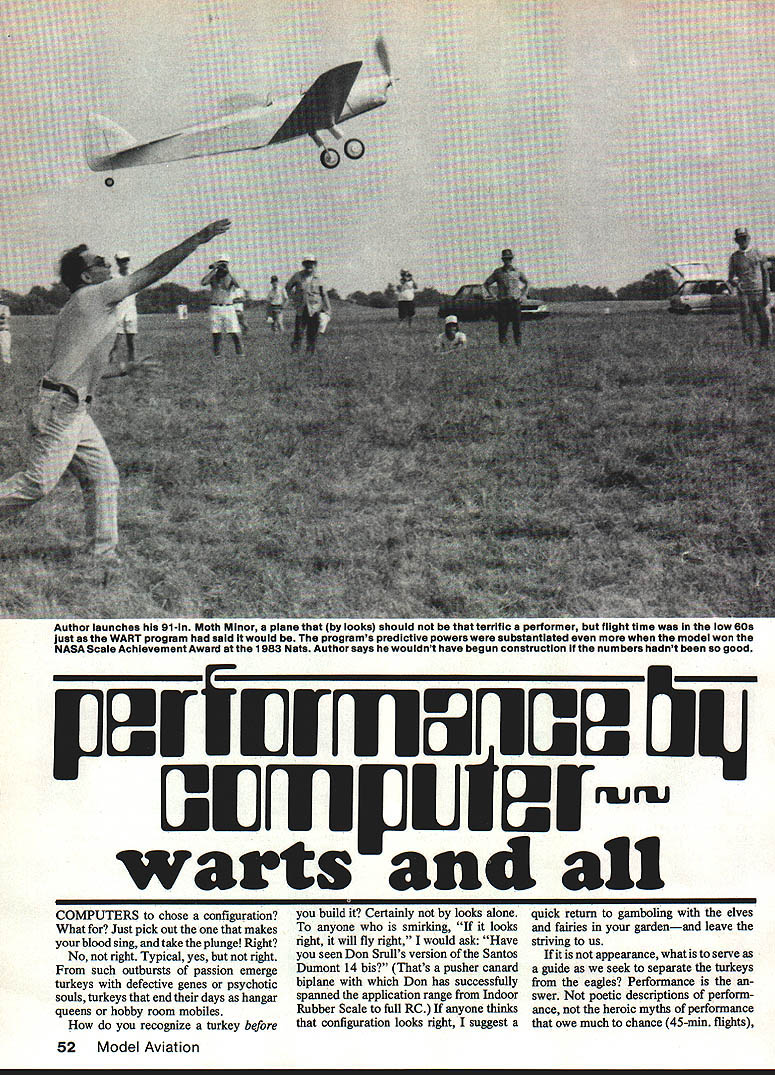
However, eagles are sensed with equal ease. Consider the Moth Minor printout. The computer, used as a design aid, arrived at the right combination of configuration and rubber to assure a 1-min flight despite an all-up flying weight of roughly 22 oz. The resulting model, a 91-in span, is probably the world's biggest Rubber Scale job. Dealing with something far outside ordinary experience cannot serve as a guide; the computer's insistence on 128 gm rubber (16 strands, 1/8-in. FAI, 4 ft long) indicated times in the low 60-sec range. I would have lacked the courage to proceed without that prediction. The model turned out well and won the NASA National Association of Scale Aeromodelers Scale Achievement Award at the 1983 Nats.
Rubber-powered models are one of the oldest types of flying models ever built, but thanks to software written by my wife (the local hacker), they get assistance from one of the newest products on the market. This program can predict flight characteristics and save you the heartbreak of spending hours constructing a model that can't be made to perform up to expectations.
The WART Program for Rubber Scale Performance
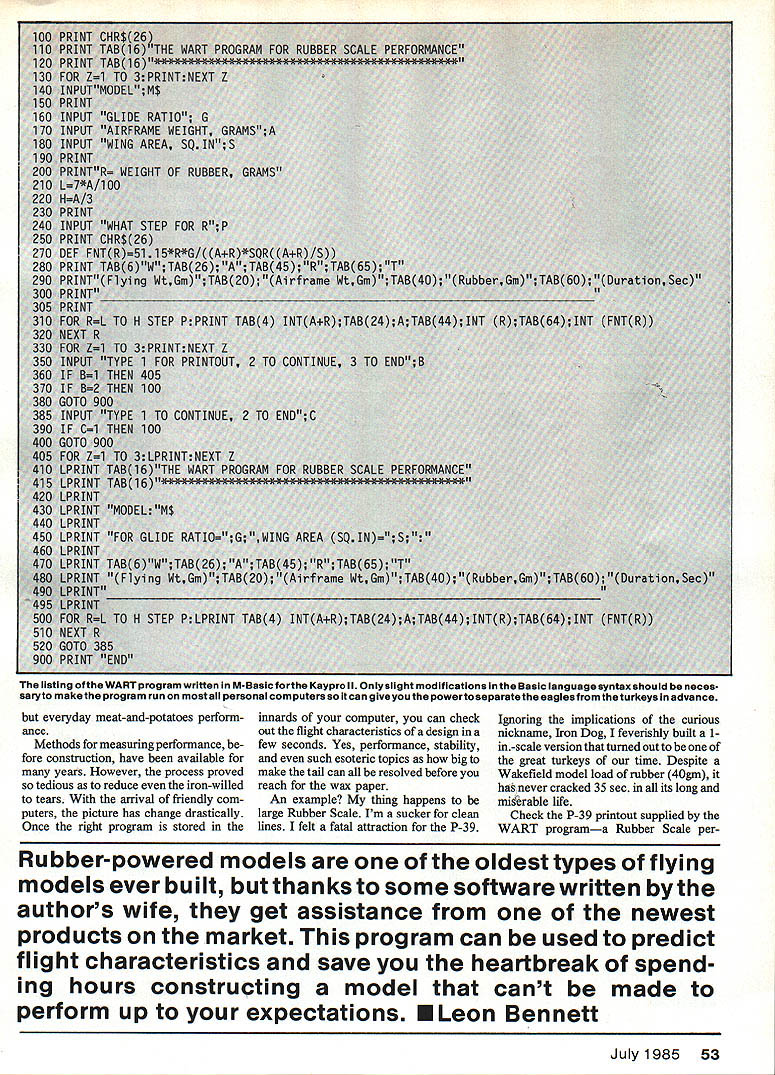
The actual WART program (given in the figure) and Jumbo Scale will handle this kind of rubber-powered flight after a certain amount of tinkering. Written in M-BASIC for the Kaypro II, the program is a development of an earlier version written to run satisfactorily on the VIC-20; with minor syntax modifications it can be adapted to other personal computers. Requiring only an elementary familiarity with programming, it can be adapted to other machines. Printout is useful and can be sent to a printer, although on-screen output is sufficient for most use.
To use the program, you must supply the following data:
- The wing area in square inches (S).
- The airframe weight (everything except rubber) in grams (A).
- The glide ratio in pure number form (G).
The wing area is taken straight from the plans. Do not count that portion of the wing passing through the fuselage or blanketed by the fuselage (as on a high wing). Count only the area sticking out in the breeze. If the area is given in square feet, multiply by 144 to convert to square inches.
The airframe weight includes absolutely everything carried aloft except the rubber. To convert ounces to grams, multiply by 29 (the author uses 29 gm/oz as a rule of thumb). Usually A is given on the plans or in the accompanying article; if not, it can be worked out (see Nitty-Gritty).
The glide ratio is the horizontal distance traveled per unit of vertical drop. Imagine test-gliding the finished, well-trimmed model from a height of 6 ft. If the model travels 18 ft. horizontally before it hits the ground, then G = 18/6 = 3. The G value reflects lift and drag. For typical airfoils, speeds, and trim settings most modelers employ, the lift coefficient is close to 1.0, but drag varies widely depending on cleanliness and size. For Jumbo Scale models, a list of configurations and corresponding G values is given in the G-Table below. Use that table to pick a G that corresponds in "cleanliness" to your model. See Nitty-Gritty for additional advice.
Rubber weight (R) need not be known at the start. One virtue of WART is that it automatically presents a wide range of rubber motors—from light motors for trimming to all-out contest motors. The program assumes possible rubber weight values between 7% and 33% of A. You can choose the increment step for R; when queried "What step for R", entering "5" will use 5 gm steps. Choose progressively finer increments as the design becomes more seriously considered.
The table generated by the program supplies an estimated duration for each motor possibility. You can simply choose from the printout the motor-duration combination you like. The catch is that the program assumes the rubber is used effectively without kinking, poor winding, slippage, or other energy losses. For practical guidance on these factors, see Nitty-Gritty.
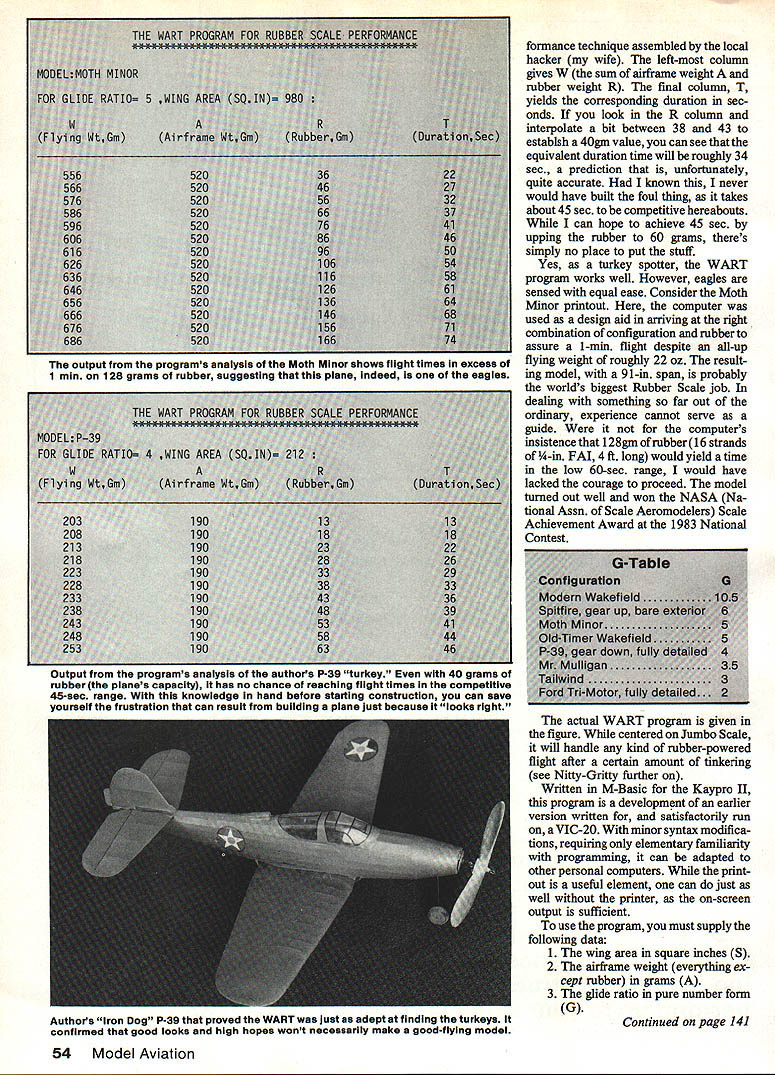
Example Output — MOTH MINOR
FOR GLIDE RATIO = 5, WING AREA (SQ.IN) = 980:
W (Flying Wt, Gm) A (Airframe Wt, Gm) R (Rubber, Gm) T (Duration, Sec) 556 520 36 22 566 520 46 27 576 520 56 32 586 520 66 37 596 520 76 41 606 520 86 46 616 520 96 50 626 520 106 54 636 520 116 58 646 520 126 61 656 520 136 64 666 520 146 68 676 520 156 71 686 520 166 74
The output for the Moth Minor shows flight times in excess of 1 minute on 128 grams of rubber, suggesting that this plane is indeed one of the eagles.
Example Output — P-39
FOR GLIDE RATIO = 4, WING AREA (SQ.IN) = 212:
W (Flying Wt, Gm) A (Airframe Wt, Gm) R (Rubber, Gm) T (Duration, Sec) 203 190 13 13 208 190 18 18 213 190 23 22 218 190 28 26 223 190 33 29 228 190 38 33 233 190 43 36 238 190 48 39 243 190 53 41 248 190 58 44 253 190 63 46
Output from the program's analysis of the author's P-39 "turkey." Even with 40 grams of rubber (the plane's capacity), it has no chance of reaching competitive flight times in the 45-sec range. With this knowledge in hand before starting construction, you can save yourself the frustration of building a plane just because it "looks right."
G-Table (Typical Glide Ratios for Jumbo Scale)
- Configuration — G
- Modern Wakefield ................................... 10.5
- Spitfire, gear up, bare exterior .................... 6
- Moth Minor ......................................... 5
- Old-Timer Wakefield ............................... 5
- P-39, gear down, fully detailed .................... 4.5
- Mr. Mulligan ...................................... 4
- Tailwind .......................................... 3.5
- Ford Tri-Motor, fully detailed ..................... 2
Values in the G-Table are based on Reynolds numbers in the 100,000 range (typical of large Jumbo Scale models). They are computed from drag-coefficient concepts or set by many in-flight observations. For a quick rule-of-thumb in Jumbo Scale: if really clean, use 5; if average drag, use 4; if fairly draggy (outsize fuselage and lots of struts), use 3.
Drawbacks
OK, what's wrong with it? Will future contests consist of fliers hunched over consoles typing in entries? Fear not. The process has merit, but it also has drawbacks. Of these, the greatest is lack of precision.
- The process works well as a turkey spotter and for identifying obvious eagles. However, when it comes to distinguishing good eagles from better eagles, or hopeless turkeys from even more-hopeless turkeys, the system falters.
- The basic difficulty is imprecise input—both from the operator and from assumptions stored within the program. For example, the program assumes prop efficiency is 50%. There is evidence to substantiate this figure (lower and more tested Wakefield prop-efficiency numbers), and it is probable that most good Rubber Scale props are near 50%. However, if you are an excellent prop designer or a novice, your efficiency may be better or worse; as you move away from 50%, the predictive power weakens.
- Many input factors (type of rubber, mode of flight, etc.) are built into the program. The program works best if you adhere to standard modeling practices. As standard practices are departed from, the program becomes increasingly inaccurate.
- The computer makes no comment on practical aspects of a design—rubber placement, nose length, balancing difficulties, prop-to-motor matching, whether the model will stay right-side-up, field worthiness, thermal sensitivity, ROG capability, or tree slitherness. Those practical considerations must be judged separately.
Sometimes the plans will give a practical rubber weight. If not available, you might use R = 20% of A as a reasonable working figure. Check Nitty-Gritty for more advice.
Nitty-Gritty
The following assumptions are built into the program:
- Rubber energy: the model is powered with rubber capable of storing 2,800 ft-lb of energy per unit weight and wound to 75% of maximum turns.
- Hysteresis loss: reduces the energy returned to 60% of max potential.
- Prop efficiency: assumed at 50%.
- Mode of flight: slow cruise. Available energy, deduced from rubber weight and the above efficiency factors, is expended overcoming drag. Once the energy is consumed, the flight is over. This mode does not consider climb or glide effects on duration. There is support (1975 NFFS Symposium) for the view that modest climb rates and subsequent glides typical of Rubber Scale have little effect on overall duration; given "dead air," expending the rubber energy in steady cruising is about as effective.
Wing area (S)
- Use the top or plan-view area. Given mild dihedral, ignoring dihedral effects introduces little error. For exaggerated polyhedral, reduce the wing area to the horizontal projected area.
Airframe weight (A)
- To calculate A, work up the total volume of balsa in cubic inches, and multiply by two to get the weight in grams for average-density (8-lb) balsa. Add 20% for glue. Tissue weighs 1 gm per 90 sq. in. Music wire (1/16") weighs 5 gm per linear foot.
Glide ratio (G)
- Values given are based on a Clark Y section flying at about 20% less than maximum lift coefficient. Most listed drag values use classical expressions (Schlichting, Boundary Layer Theory). Choose a G from the G-Table appropriate to model cleanliness.
Rubber (R)
- The maximum length of rubber motor that can be effectively stored without bunching or balance problems is about three times the distance from the prop hook to the center of gravity (CG).
- Rubber weights: roughly 2 gm per linear foot in 1/4-in. FAI and 1.6 gm per foot in 1/4-in. Sig (approximate).
- If flying in an all-out performance event where turns approach maximum rather than the assumed 75%, you can alter the formula: duration is directly proportional to stored energy. If you store 10% more energy in a given weight of rubber than the program assumes, expect about 10% more duration.
The Future
Where do we go from here? Will computer-assisted design wipe out the turkeys, leaving nothing but eagles in the sky? Or will the computer prove to be a monster, destroying the fun and reducing the game to number crunching?
It's too early to tell. The few programs we have today won't really change the game. But in time you can expect programs for everything from prop design to loop spacing. As the computer assumes an ever-growing role, some whittlers may throw down their razor blades and leave; others will face reality and study computing. Yes, difficult lifestyle decisions will have to be made by each of us concerning the computer. Why do you think I married a hacker?
Address your questions and/or bitter complaints to:
- Leon Bennett (modeler) and/or Rachelle Bennett (hacker), 6 Rivercrest Rd., Bronx, NY 10471. For replies, include a SASE.
Transcribed from original scans by AI. Minor OCR errors may remain.

