
Persistence: Pays Off
By
William R. Allison
Background
The club I belong to, the River City Radio Controllers, had been flying at the northeast corner of E.P. "Tom" Sawyer State Park in Louisville, Kentucky for 22 years. In 1995 a building development that approached the park boundary filed suit asking us to leave. A noise issue was not forcing us to vacate; rather, we were in violation of Academy of Model Aeronautics (AMA) safety guidelines. Some of our landing approaches were outside the park boundaries and over the homes being built by the developer. We had to find a new flying site. Kentucky Lieutenant Governor Stephen L. Henry, a club supporter who was District "A" county commissioner at the time, was adamant about us keeping our site.
E.P. "Tom" Sawyer is a large park, and we knew of an area in the northwest section of the facility that would fulfill our needs. However, the Park Board did not share our view, and the request for the site was denied.
Instead of letting it end there, we decided to fight for our rights as state park users and continue our "pursuit of happiness" by taking steps to obtain the new flying site.
Our strategy
- Use the media and the public.
- Many club members spoke to reporters and gave on-camera interviews. Headlines included: As Grounding of Hobby Planes Nears, Sawyer Options Sought; After 2 Decades in Park, Club Fights to Stay; Airplane Hobbyists May Land New Sawyer Site; Model-plane Club Again Hits Turbulence at Tom Sawyer Park.
- Our plight received attention, though not solely from our point of view—opponents were also heard. Still, public opinion was being shaped.
- Hire public-relations help and prepare a comprehensive presentation.
- We selected club members to present our case, enlisted AMA's Jay Mealy, and targeted the state legislative body that made up the Committee on Economic Development and Tourism. We secured a meeting with the committee and presented our case.
- Present the case to the Committee on Economic Development and Tourism.
- One highlight was Jay Mealy's presentation on AMA history, its model aviation safety record, and the value of model aviation to youth. His presentation was inspiring and instrumental in the committee's favorable reaction.
- Positive responses came from Committee chairman Tom Kerr, Taylor Mills (D), and state senator Julie Rose (R), a staunch supporter of our club. State Representative Steve Riggs (D) of southeast Jefferson County commented, "This case could have statewide ramifications. If our state parks are bending over backwards to pacify business interests who build on the border of our parks, we need to be concerned. The park is for users of the park."
With a favorable recommendation from the committee, we obtained a 60-day trial period to fly at the new site. If there were no problems during the trial, we were promised a five-year contract with one-year options to renew. We were ecstatic — but our excitement was short-lived. Other battles followed.
The opposition and our response
On November 13, 1996, about 20 local homeowners attended a Park Foundation Board meeting and brought a petition signed by 103 residents claiming noise from our airplanes hurt their property values. Because of these concerns, the Parks Commissioner said he would reassess our site.
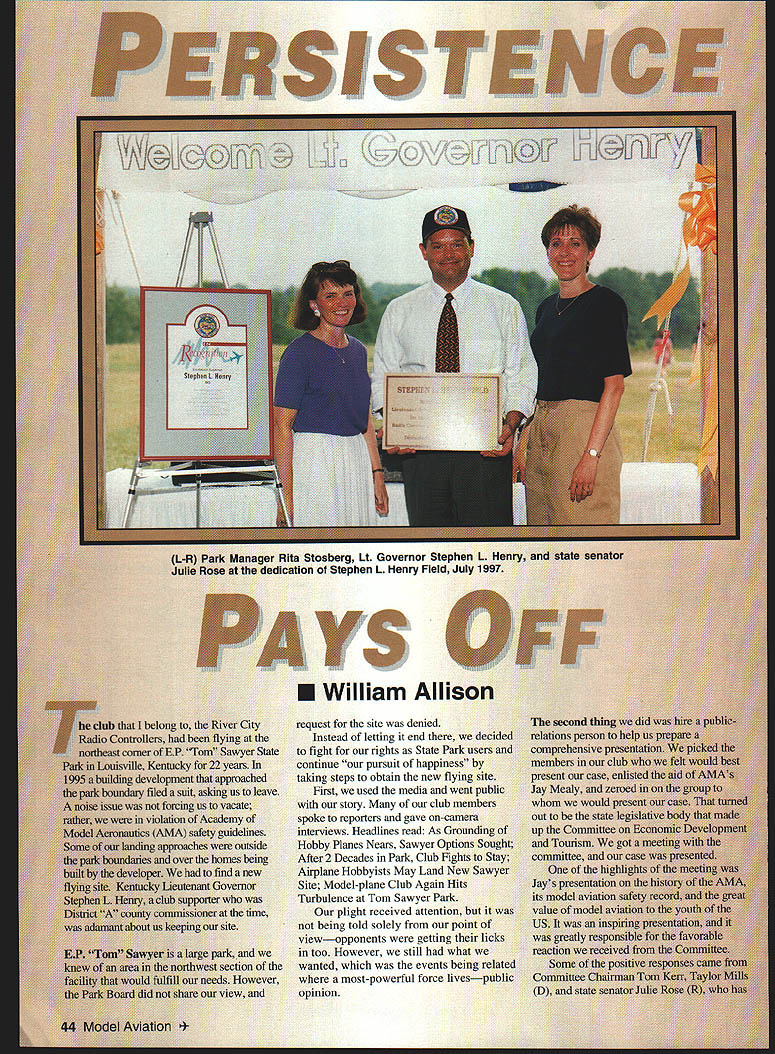
We had two valuable supporters: Park Manager Rita Stosberg, a strong advocate for recreational activities at the park (including noncompetitive activities), and Lt. Governor Stephen L. Henry.
Armed with their support, we got back into the fight. We collected 1,100 names on a petition stating that people liked having us fly at the park. We then drove around and located every home of those who had signed the protesting petition. We found only 17 of the 103 residences could actually hear our airplanes, and 10 of those 17 homes faced a four-lane highway located between the field and their houses. The other seven homes were on the park boundary at the north end of our site.
We took decibel (dB) readings at these 17 locations. Our findings showed traffic noise was louder than our aircraft: highway noise averaged around 75 dB, while noises from our airplanes were 55–58 dB — very close to normal ambient sound readings. We passed this information to Lt. Governor Henry, who reviewed the facts and expressed his complete support for River City Radio Controllers acquiring the new flying site.
Outcome
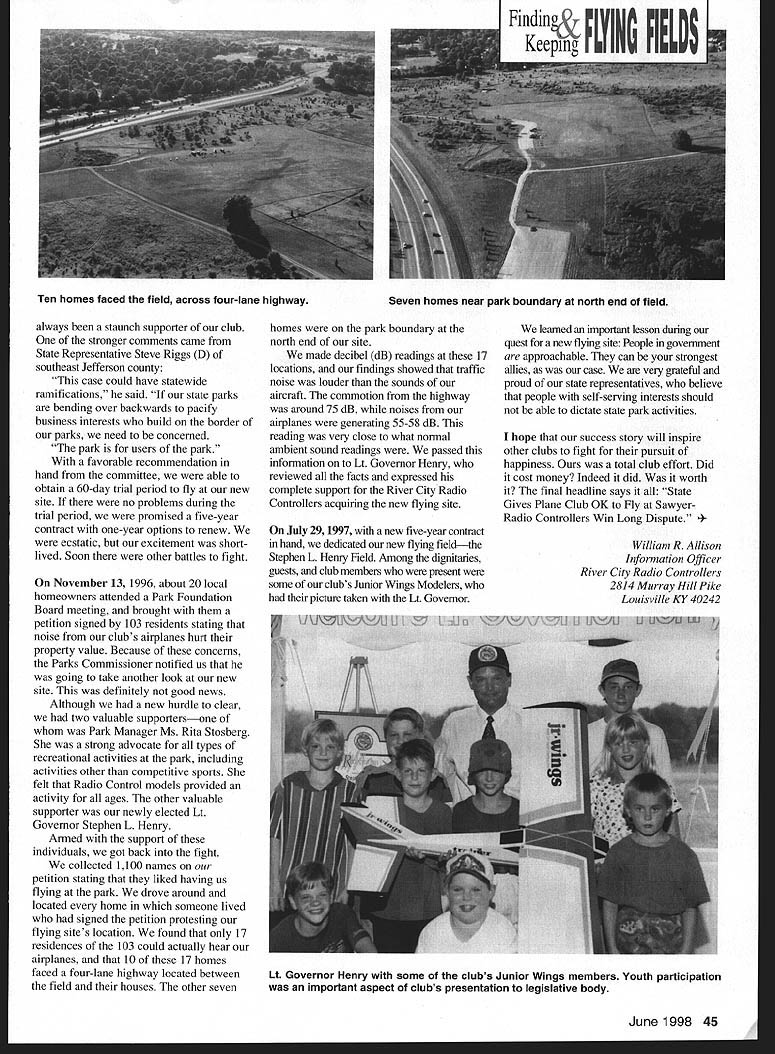
On July 29, 1997, with a new five-year contract in hand, we dedicated our new flying field — the Stephen L. Henry Field. Among the dignitaries, guests, and club members present were some of our club's Junior Wings Modelers, who had their picture taken with the Lt. Governor.
Lessons learned
We learned an important lesson during our quest for a new flying site: people in government are approachable and can be strong allies. We are very grateful and proud of our state representatives, who believe that people with self-serving interests should not be able to dictate state park activities.
I hope our success story will inspire other clubs to fight for their pursuit of happiness. Ours was a total club effort. Did it cost money? Indeed it did. Was it worth it? The final headline said it all: "State Gives Plane Club OK to Fly at Sawyer" — River City Radio Controllers Win Long Dispute.
William R. Allison Information Officer River City Radio Controllers 2814 Murray Hill Pike Louisville, KY 40242
Transcribed from original scans by AI. Minor OCR errors may remain.

